Practice Essentials
Headache is a common reason for pediatric patients to seek medical care. Headaches can result from any of a number of causes, including genetic predisposition, trauma, an intracranial mass, a metabolic or vascular disease, or sinusitis. Recognition that pediatric headaches can result from primary and secondary causes is crucial to their treatment.
Signs and symptoms
In pediatric patients with headache, the history should include the following:
-
Headache onset, duration, and severity
-
Associated symptoms
-
Family history of migraines
-
Medication history
-
Factors that may have precipitated the headache (most often migraine)
Symptoms accompanying migraine headache may vary according to the migraine type present:
-
Migraine with aura: Visual symptoms, sensory symptoms, motor symptoms, speech or language disturbances, and other cognitive effects
-
Complicated migraine: Focal or diffuse neurologic deficits
-
Hemiplegic or hemisensory migraine: Unilateral motor weakness or sensory disturbance that may persist for hours after the headache has subsided
-
Basilar migraine: Vasoconstriction of the basilar and posterior cerebral arteries; diplopia, vertigo, tinnitus, or ataxia
-
Acute confusional states (unusual): Sudden onset of confusion, unresponsiveness, memory disturbances, disorientation, and dysarthria
Distinguishing characteristics of tension headaches include the following:
-
Occurring during times of obvious stress
-
Involving the neck and occiput
-
Continuous pain
-
No nausea, vomiting, or abdominal pain
-
Family history of migraine is less likely
-
In some patients, obvious symptoms of depression; in this subgroup, headaches are relieved when depression is treated
Other types of headache include the following:
-
Cluster headache
-
Sinus headache
-
Head trauma-related headache
-
Intracranial mass-related headache
-
Benign intracranial hypertension
-
Meningeal irritation
-
Medication-overuse headache
Physical examination should include assessment of the following:
-
Vital signs
-
Skin rashes or lesions
-
Signs of neurologic abnormalities
-
Hematomas or other signs of trauma
-
Signs of papilledema or subhyaloid hemorrhage on funduscopy
-
Intracranial hypertension, uncomplicated idiopathic epilepsy, seizures, meningeal irritation
See Clinical Presentation for more detail.
Diagnosis
For migraine or tension headache in pediatric patients, a thorough history and physical examination usually suffice. Laboratory, radiologic, or electroencephalographic (EEG) studies are not useful to confirm the diagnosis of migraine but may help exclude other causes of headache.
For headache associated with head trauma or a significant intracranial hemorrhage, the following laboratory studies may be indicated:
-
Complete blood count
-
Prothrombin time
-
Activated partial thromboplastin time
Lumbar puncture may reveal elevated opening pressure, leukocytosis, elevated protein, and low glucose. It is the most sensitive test in the diagnosis of subarachnoid hemorrhage.
Diagnostic imaging is not routinely indicated unless a structural cause is suspected or, possibly, unless the patient is very young and there is no family history. Modalities include the following:
-
Sinus radiography
-
Computed tomography
-
Magnetic resonance imaging
EEG may be useful to assess the status of an underlying seizure disorder associated with headache or to exclude seizures in children with acute confusional migraines.
See Workup for more detail.
Management
Treatment of pediatric headache is of 3 basic types:
-
Symptomatic
-
Abortive
-
Preventive
Drugs used in symptomatic treatment are chosen according to the following:
-
Headache type and frequency
-
Type of symptoms present
-
Adverse-effect profile
-
Comorbidities present
Nonpharmacologic treatment of migraine and tension-type headaches includes the following:
-
Elimination of identified precipitants
-
Lifestyle changes
-
Stress relief
Abortive therapy for migraine and tension-type headaches may include the following:
-
Triptans (sumatriptan, almotriptan, rizatriptan, and others) (see the image below)
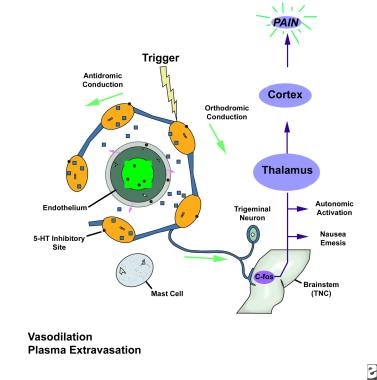 Trigeminovascular system. The trigeminal nerve fibers around basal cerebral and meningeal vessels are triggered (various stimuli are possible), and a vicious cycle starts in which the nerve terminals release calcitonin gene-related peptide (CGRP), substance P, vasoinhibitory peptide (VIP), and other mediators of local neurogenic inflammation and vasodilatation. The latter further stimulates the nerve endings. On the other end of the nerve, painful messages are transmitted toward central centers, including thalamus and cortex, and the sensation of pain arises. Modern drugs, such as the triptans, act at 3 levels, via 5-HT 1 B and D receptors; they vasoconstrict the vessels, reduce the release of the above-mentioned mediators, and decrease the central transmission of pain impulses.
-
Isometheptene and ergotamines
-
Analgesics
Prophylactic therapy for migraine and tension-type headaches may include the following:
-
Beta-blockers
-
Tricyclic antidepressants (TCAs)
-
Anticonvulsants
-
Calcium channel blockers
Treatment of chronic daily headache (CDH) may include the following:
-
Combination of therapies used for tension and migraine headache
-
Discontinuance of over-the-counter analgesics and all narcotics
-
Tricyclic antidepressants
-
Psychological, behavioral, and relaxation interventions (sometimes with TCAs)
-
Abortive therapy, if the CDH pattern includes well-defined migraine attacks
See Treatment and Medication

Background
Headache is a common reason why pediatric patients seek medical care. Headaches can result from any of a number of causes, such as genetic predisposition, trauma, an intracranial mass, a metabolic or vascular disease, or sinusitis, to name a few. Headaches have a significant impact on the lives of children and adolescents, resulting in school absence, decreased extracurricular activities, and poor academic achievement. (See Etiology and Prognosis.) [1]
Recognition that pediatric headaches can result from primary and secondary causes is crucial to their treatment (see the image below). (See Presentation, Workup, Treatment, and Medication.)
 Trigeminovascular system. The trigeminal nerve fibers around basal cerebral and meningeal vessels are triggered (various stimuli are possible), and a vicious cycle starts in which the nerve terminals release calcitonin gene-related peptide (CGRP), substance P, vasoinhibitory peptide (VIP), and other mediators of local neurogenic inflammation and vasodilatation. The latter further stimulates the nerve endings. On the other end of the nerve, painful messages are transmitted toward central centers, including thalamus and cortex, and the sensation of pain arises. Modern drugs, such as the triptans, act at 3 levels, via 5-HT 1 B and D receptors; they vasoconstrict the vessels, reduce the release of the above-mentioned mediators, and decrease the central transmission of pain impulses.
The most common primary headaches in pediatrics are migraine and tension-type headaches, representing the ends of a spectrum of manifestations of similar pain mechanisms. These 2 types of headache can be episodic, or they can exist in a chronic, daily form (present 15 or more days per month for 3 or more months).
Migraine headaches
Migraine headaches account for most primary childhood headaches. More than 90% of patients who present to a neurologist complaining of headache are estimated to have a migraine (Rothrock, personal communication, 2006). Migraine can be divided into 2 groups: migraine with aura, and migraine without aura. (See Presentation.) [2]
Pediatric migraines are often bilateral, and clear localization of the pain can be difficult to obtain from children. Migraines in children are often of shorter duration than they are in adults. Migraine with aura is seen in 14-30% of children with migraine.
Migraine variants are headaches that are accompanied or manifested by transient neurologic symptoms. These symptoms may occur immediately before, during, or after the headache. In some situations, the headache may be mild or nonexistent.
Tension-type headaches
Tension-type headaches are benign. They manifest as a bandlike sensation around the head, and they may be associated with neck and/or shoulder pain. These headaches often become worse as the day progresses and can last for days. They may be associated with stressful events at home or school, and they may be temporarily and relieved by sleep.
International Headache Society classification
The International Headache Society (IHS) has provided diagnostic criteria and a classification scheme for headaches in general. [2, 3, 4, 5, 6, 7] (Pediatric migraine is now distinctly recognized among the primary headache disorders.) Headaches are grouped on the basis of etiology, facilitating proper evaluation and treatment. The 3 main classifications are as follows (see Etiology, Presentation, Workup, and Treatment):
-
Primary headaches - Eg, migraine, tension-type, and cluster
-
Secondary headaches - Eg, related to head/neck trauma, vascular and nonvascular disorders, infection, or psychiatric disorders (except in young children, the frequency of secondary headaches is lower in children than in adults)
-
Cranial neuralgias, central and primary facial pain, and other headaches
Migraine without aura
Migraine without aura is identified by at least 5 attacks fulfilling the following criteria:
-
Duration between 1 and 48 hours
-
At least 2 of the following: (1) unilateral or bilateral, (2) pulsating, (3) moderate to severe in intensity, (4) aggravation by, or causing avoidance of, routine physical activity
-
During the headache, at least 1 of the following must be present: (1) nausea or vomiting, (2) photophobia or phonophobia
In addition, the headache should not be attributed to any other cause.
Migraine with aura
Migraine with aura includes the following types of headache [7] :
-
Typical aura with migraine
-
Typical aura with nonmigraine headache
-
Typical aura without headache
-
Familial hemiplegic migraine (FHM)
-
Sporadic hemiplegic migraine
-
Basilar-type migraine
Typical aura with migraine consists of the presence of the IHS criteria for migraine without aura, along with visual, sensory, or speech symptoms or any combination of the 3. In addition, development is gradual and the aura lasts no more than 60 minutes. Positive and negative features are experienced, and there is complete reversibility of symptoms. (See Presentation.)
Migraine variants
Migraine variants are headaches that are accompanied by or manifested by transient neurologic symptoms. These symptoms may occur immediately before, during, or after the headache. In some situations, the headache may be mild or nonexistent.
Hemiplegic migraine and basilar artery migraine are typical examples of migraine with aura. Hemiplegic migraine, while unusual, is seen more commonly in children than in adults. This type of headache is characterized by abrupt onset of hemiparesis, which usually is followed by a headache. Hemianesthesia may also precede the headache.
Basilar artery migraines are more common in girls. They are characterized by dizziness, weakness, ataxia, and severe occipital headache (with vomiting).
Less common migraine presentations have been described in which head pain is not a prominent feature. The "Alice in Wonderland" syndrome is characterized by distortions of vision, space, and/or time. Patients may note micropsia and/or metamorphopsia, as well as other sensory hallucinations.
Confusional migraine seen in juvenile patients is characterized by impairment of sensorium, agitation, and lethargy; these impairments sometimes progress to stupor. Focal neurologic deficits, such as aphasia, anisocoria, and memory deficits, may also be seen.
Benign paroxysmal torticollis of infancy is characterized by episodes of a head tilt, and benign paroxysmal vertigo of childhood is characterized by recurrent episodes of vertigo and ataxia. The torticollis typically occurs during the first year, whereas the vertigo occurs in young children (usually aged 2-3 years).
Cyclic vomiting and recurrent abdominal pain frequently are considered migraine variants. Before diagnosing either of these entities, primary gastrointestinal (GI) diseases must be excluded.
Classification by temporal pattern
Besides being classified on the basis of associated symptoms, headaches can also be classified by their temporal pattern, as follows:
-
Acute
-
Acute recurrent (episodic)
-
Chronic nonprogressive
-
Chronic progressive
Impact of headache on daily activities and productivity
Headache can lead to psychological impairment and decreased quality of life, especially for persons who experience chronic migraine. Children who suffer from migraine are more impaired than children who do not suffer from headaches or even children who suffer from tension-type headache, in terms of medication use, school nurse visits, and school absences.
Three million bedridden days per month in the US are attributed to headache, and more than 50% of absentees from headache average at least 2 days of absence per month. For almost 1 million children who have migraine, over 150,000 school days are missed.
Etiology
Because the brain is insensate, headache is due to the stimulation of pain-sensitive nerve fibers in large cerebral arteries and veins, the periosteum of the skull, the muscle and skin of the scalp, the sinus mucosa, the temporomandibular joint, the teeth, or the gingiva.
Migraine
Trigeminovascular system activation
Although much remains to be discovered, the pain in migraine attacks is multifactorial. One mechanism suggests activation of the trigeminovascular system. Synaptic boutons of the perivascular branches of the trigeminal nerve at the level of meningeal and basal cerebral vessels release the following proinflammatory mediators when the nerve is stimulated:
-
Substance P
-
Calcitonin gene-related peptide (CGRP)
-
Vasoactive intestinal peptide (VIP)
The initial triggers are still poorly understood. The mediators create neurogenic inflammation, including local rupture of the blood-brain barrier, and trigger vasodilatation, further stimulating the trigeminal nerve terminals. (See the image below.)
Trigeminovascular system. The trigeminal nerve fibers around basal cerebral and meningeal vessels are triggered (various stimuli are possible), and a vicious cycle starts in which the nerve terminals release calcitonin gene-related peptide (CGRP), substance P, vasoinhibitory peptide (VIP), and other mediators of local neurogenic inflammation and vasodilatation. The latter further stimulates the nerve endings. On the other end of the nerve, painful messages are transmitted toward central centers, including thalamus and cortex, and the sensation of pain arises. Modern drugs, such as the triptans, act at 3 levels, via 5-HT 1 B and D receptors; they vasoconstrict the vessels, reduce the release of the above-mentioned mediators, and decrease the central transmission of pain impulses.
On the other end, pain afferent messages are transmitted centrally. Whether this system is abnormal in migraineurs versus healthy people, and whether it is genetically determined, is not known. Evidence exists of cortical hyperexcitability in migraineurs, which may be linked to a defect in the central catecholaminergic systems. Low magnesium levels also may play a role.
White-matter T2 MRI hyperintensities are observed in higher frequency in migraineurs with aura, especially in the posterior circulation territories. The pathophysiologic implication of this remains unclear.
Chronic transformation of migraine is believed to be due to spatial and temporal, central and peripheral sensitization, which correlates clinically with cutaneous allodynia.
Cortical spreading depression
Another mechanism thought to result in migraine headache has its origin in the brain stem. The onset of the aura in migraine headache is thought to be mediated by cortical spreading depression (CSD)—caused by neuronal activation followed by suppression—which spreads over the cortical surface. A simultaneous change occurs in cerebral blood flow, characterized by hyperperfusion, followed by hypoperfusion.
CSD is thought to be caused by either trauma or changes in the local concentrations of hydrogen ions, potassium, and glutamate. CSD activates central nervous system (CNS) nociceptors, possibly through the release of nitric oxide, atrionatriuretic factor, activation of noradrenergic pathways, and/or changes in cerebral blood flow. CSD also causes neurogenic inflammation, which stimulates the release of several different neurotransmitters that lead to cerebral vasodilatation and activation of CNS nociceptors.
Genetic predisposition
Migraine headaches may also have a genetic predisposition; nearly 70% of pediatric patients with migraine have a family history of migraine headache. Some individuals with familial hemiplegic migraine (FHM), a rare migraine subtype, have been found to have several genetic mutations in ion channels responsible for neurotransmitter release within the CNS, which may ultimately affect cortical excitability. [8]
In 1993, a gene mutation was found on chromosome 19, locus p13, in a pedigree experiencing FHM. Later, hemiplegic migraine in other families was mapped to chromosomes 1 and 2. At this time, 3 genes have been discovered, leading to following categories of FHM:
-
FHM I (locus 19, q 13) - Codes for the calcium channel CACNA1A gene
-
FHM II (locus 1, q 21) - Codes for the Na-K ATPase ATP1A2 gene [9]
-
FHM III (locus 2, q 24) - Codes for the sodium channel SCN1A gene [10]
Defects in ion channels resulting in excessive glutamate activity explain the effect of the mutations, which play a role in the aura. Cases of migraine due to a single mutation remain the exception. [11, 12]
Migrainelike headache
It should be clarified that although true migraine is a primary headache disorder, sometimes a migrainelike headache can be secondary to a metabolic or vascular disease. This is the case, for instance, with MELAS (mitochondrial encephalomyopathy, lactic acidosis, stroke), a mitochondrial cytopathy, and with CADASIL (cerebral autosomal dominant angiopathy with subcortical infarcts and leukoencephalopathy), a genetically determined disease of small vessels in the brain. The headache attacks in these disorders are indistinguishable from those of primary, true migraine, but other symptoms and disease features are also present.
Tension-type headache
The causes of tension-type headache are still poorly understood. A combination of muscular factors, abnormal pain-perception mechanisms, and central emotional abnormalities exist, all possibly linked to brain-stem serotonergic interneurons. Furthermore, central and peripheral sensitization is involved. Contrary to common belief, the relevance of muscle contraction itself is marginal, especially in the chronic form.
Posttraumatic headache
Because of their frequency, posttraumatic headaches should be mentioned. The acute phase usually is not a significant concern, because it does not change the initial assessment or management; this headache phase usually is considered nociceptive. Later, however, it can become a chronic, lingering head pain.
This syndrome is variably associated with autonomic symptoms and is often akin to a primary headache syndrome, such as migraine and tension-type headache. It is believed that the trauma has acted as a trigger or exacerbating factor in the genesis of that primary headache. Frequently, psychological disturbances are present and need to be specifically addressed for therapeutic success.
Sinus headache
Often suspected but rarely implied, sinusitis should be excluded as the cause of headache, although acute sinusitis typically presents with systemic and otorhinolaryngologic (ORL) symptoms and signs. Chronic and allergic sinusitis are almost never responsible for headaches.
Benign intracranial hypertension
Benign intracranial hypertension (pseudotumor cerebri) is caused by the expansion of one or more of the intracranial fluid spaces, such as the vasculature, the extracellular fluid compartment, or the cerebrospinal fluid (CSF) space. Several drugs, such as tetracycline, minocycline, penicillin, gentamicin, oral contraceptives, steroids, indomethacin, thyroid hormone, and lithium carbonate, may be inciting agents.
Other causes
Headache related to meningeal irritation may be caused by infection (meningitis), inflammation (eg, from a tumor), or hemorrhage (eg, from vascular malformation or malignant hypertension).
Epidemiology
Occurrence in the United States
Nearly 40% of all Americans have a significant headache at some time in their lives. Headaches are very common during childhood and become increasingly frequent during adolescence. The prevalence of headache, in general, ranges from 37-51% during the elementary-school years and gradually rises to 57-82% by the high-school years. Frequent or severe headaches, including migraines, were reported over a 12-month period in 17% of a national sample of children and adolescents. [13]
The most frequent type of recurrent headache in childhood is migraine; in adolescents, tension headaches are the most common cause of frequent headache. [14]
Age-related demographics
Throughout the medical literature, estimates of overall frequency of headache in children vary among authors.
Secondary headaches are the ones that are most frequently encountered before age 5 years. Migraine headache can occur as early as a few months of age. (A higher prevalence of migraine seems to exist in city dwellers.) Chronic tension-type headache occurs in 0.9% of 15 year-olds.
In a widely cited study, Bille analyzed a questionnaire of 8993 children aged 7-15 years in the city of Uppsala in Sweden and found that 59% had suffered headache at some time in their life. [15, 16] In a systematic questionnaire of 2941 children, Sillanpaa found the prevalence of headache to be 37% at age 7 years, increasing to 69% by 14 years; migraine accounted for 2.7% and 10.6% of these headaches, respectively.
A meta-analysis found that the prevalence of headache in general was approximately 60% by age 7. Other studies have shown that up to 51% of children aged 7 years and 57-82% of adolescents aged 15 years report recurrent headaches. [17, 18]
A study performed in Taiwan indicated that approximately 85% of children aged 13-15 years have had headache. [19] According to a large survey by Split et al, 75% of children have suffered headaches in general by age 15 years. [20]
Migraine
Starfield screened 2500 children and found that 11% experienced chronic morbidity; among those children, about 20% had headache, with roughly one half of these children having migraine.
According to Sillanpaa, migraine prevalence is around 11% at puberty (age 13 y) but increases over time. [21, 22] Lewis et al, in a meta-analysis of over 25,000 persons, found the incidence of migraine to be 2% by ages 3-7 years; 7% by ages 7-11 years; and 20% by ages 11-15 years. The aforementioned survey by Split et al indicated that 4% of children have migraine by the ages of 7 through 15; by age 15 years, 28% have migraine. [17, 20, 23, 24, 25, 26]
Race- and sex-related demographics
No specific report exists regarding differential incidence of headache by race in children, but migraine frequency in adults in the US declines from whites to African-Americans to Asians.
Approximately 60% of all children with migraines before puberty are male. Thereafter, the relationship is inversed, with 3 times more female than male migraineurs in adulthood. Other headache types are distributed more evenly.
Prognosis
Long-term prognostic studies of pediatric headache are scarce, but Brna et al reported that at 20-year follow-up, 73% of pediatric headache patients in their study continued to suffer from headache. [27] In a follow-up study of 200 patients from a headache clinic over 6 years, 48% of initial migraineurs remained migraine sufferers; 26% became tension-type headache sufferers; and 26% became headache-free.
Similar numbers were observed for initial tension-type headache sufferers but with a slightly higher headache-free rate (41% remained with tension-type headache; 21% developed migraine; and 38% became headache-free).
Headache can cause significant disruption in a child's daily activities, and children with migraine headache are often not appropriately diagnosed and thus go untreated. In a large study looking at the prevalence of migraine headache, 31% of patients reported that they had missed at least 1 day of school or work in the previous 3 months. In this same study, more than half of patients reported that their productivity was reduced by 50%. Some authors believe that children and adolescents with recurrent migraines experience a reduction in their quality of life similar to that of children with cancer. [28]
Primary headache conditions are notorious for their waxing/waning course, and long-term follow-up care is usually necessary. Short-term remissions are not uncommon, but long-term ones are rare. The natural history and prognosis of migraine may follow one of the following 4 clinical patterns [29] :
-
Clinical remission - Some migraine sufferers may become symptom-free over prolonged periods.
-
Partial clinical remission - In others, migraines get less severe over time, resembling common migraine or tension-type headaches.
-
Clinical persistence - The frequency and severity of migraine headache does not improve but does not get worse either.
-
Progression - The frequency and severity of migraine headache gets worse
Early diagnosis and prompt initiation of optimal treatments (abortive and preventative) may lead to better treatment outcomes and prognosis and less disability for children and adolescents with migraine. [30]
Morbidity and mortality
No mortality is associated with primary headaches, and that associated with secondary headaches depends purely on the underlying cause.
However, frequent headaches, as with other chronic pain syndromes, can be psychologically distressing and may have major implications on the life of the growing individual. According to Battistutta et al, chronic tension-type headache is comorbid with psychiatric illnesses such as depression and anxiety disorders, internalization syndrome, and attention deficit and anger-control deficit in adolescents. However the relationship between the psychological condition and the headache syndrome is far from simple and has not yet been resolved. The clinical implication is to attend to the entire symptomatology of the child. [31]
Migraine in general, but especially migraine with aura (any type [typical aura, hemiplegic migraine, basilar migraine]), seems to be associated with a slightly increased risk of ischemic stroke, but overall, the risk remains very low. The stroke risk is further magnified, however, in women, patients younger than 45 years, smokers, and persons using oral contraceptives. [32]
Other conditions comorbid with migraine have been observed, including irritable bowel syndrome, sleep disorders, bruxism, systemic lupus erythematosus, and obesity. [33]
Reports have indicated a higher incidence of ataxia associated with migraine, whether clinical or subclinical during provocation tests. These reports could correlate with white matter lesions on magnetic resonance imaging (MRI), especially in the cerebellum.
Patient Education
Reassure the parents and the patient that the headache process is benign and not progressive. Review with them the headache pattern; associated symptoms such as nausea, dizziness, and photophobia; and the benign nature of the physical examination (including funduscopy).
An imaging study can be reassuring to the family. This simple, but crucial, review will help to alleviate stress and worry, which may contribute to the patient's symptoms and the anxiety of the parents. Realizing that the pain, although unpleasant, is not life-threatening often allows the patient and parents to apply healthier coping strategies.
Parents and patients need to be aware that migraine headaches may be a lifelong condition and that they should expect that the headaches will reappear at some time during the patient’s lifetime, especially during situations of increased stress such as puberty, marriage, or change of job.
Reinforcing good health hygiene is another important educational step; sleep hygiene is particularly required.
For patient education information, see the Headache and Migraine Center, as well as Causes and Treatments of Migraine and Related Headaches; Migraine Headache in Children; Migraine Headaches, Vision Effects; and Migraine and Cluster Headache Medications.
-
Trigeminovascular system. The trigeminal nerve fibers around basal cerebral and meningeal vessels are triggered (various stimuli are possible), and a vicious cycle starts in which the nerve terminals release calcitonin gene-related peptide (CGRP), substance P, vasoinhibitory peptide (VIP), and other mediators of local neurogenic inflammation and vasodilatation. The latter further stimulates the nerve endings. On the other end of the nerve, painful messages are transmitted toward central centers, including thalamus and cortex, and the sensation of pain arises. Modern drugs, such as the triptans, act at 3 levels, via 5-HT 1 B and D receptors; they vasoconstrict the vessels, reduce the release of the above-mentioned mediators, and decrease the central transmission of pain impulses.