Background
A red eye is a cardinal sign of ocular inflammation, which can result from many conditions. Subconjunctival hemorrhage (see the image below), defined as blood between the conjunctiva and the sclera, is usually not secondary to inflammation. [1, 2] Most cases of subconjunctival hemorrhage are benign and can be effectively managed by the primary care provider. [3] The key to management is recognizing cases with underlying disease that require ophthalmologic consultation.
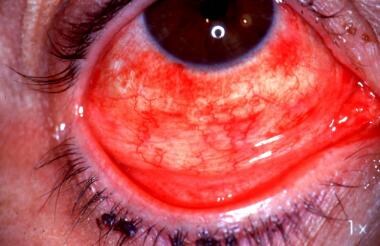
For patient education resources, see the Eye and Vision Center and the Glaucoma Center, as well as Anatomy of the Eye, Pinkeye, Iritis, Subconjunctival Hemorrhage (Bleeding in Eye), Black Eye, and Glaucoma Overview.

Pathophysiology and Etiology
A red eye most often results from dilation of blood vessels in the anterior portion of the eye. Diagnosis may be aided by the differentiation between ciliary and conjunctival injection. Ciliary injection involves branches of the anterior ciliary arteries and indicates inflammation of the cornea, iris, or ciliary body. Conjunctival injection mainly affects the posterior conjunctival blood vessels. Because these vessels are more superficial than the ciliary arteries, they produce more redness, move with the conjunctiva, and constrict with the application of topical vasoconstrictors. [4]
Numerous conditions may be associated with red eye, including conjunctivitis, blepharitis, canaliculitis, corneal injury, dacryocystitis, episcleritis, scleritis, iritis, keratitis, dry eye syndrome (DES; also referred to as keratoconjunctivitis sicca [KCS]), glaucoma, subconjunctival hemorrhage, bacterial or viral infection, or trauma.
Conjunctivitis, the most common cause of red eye, is characterized by vascular dilation of the superficial conjunctival blood vessels, cellular infiltration, and exudation; it must be differentiated on the basis of etiology (viral, bacterial, or allergic).
Blepharitis is an inflammation of the eyelids, usually involving the lid margins. It may be seborrheic or may be caused by staphylococcal infection.
Canaliculitis often is caused by Actinomyces israelii, but Candida or Aspergillus species also may be involved.
Numerous causes or corneal injury exist, which can be grouped into infective, toxic, degenerative, traumatic, and allergic conditions.
Dacryocystitis is inflammation of the lacrimal sac caused by obstruction of the nasolacrimal duct. In infants, this results from failure of the canalization that normally occurs by the end of the first month. In adults, acute forms are due to Staphylococcus aureus or beta-hemolytic Streptococcus. Acute cases in children are due to Haemophilus influenzae.
The episclera is the layer between the conjunctiva and the sclera. Episcleritis is an inflammation of the episcleral vessels, usually of autoimmune origin; it can be caused by virtually any inflammatory systemic condition affecting the body, such as rheumatoid arthritis, Sjögren syndrome, coccidioidomycosis, syphilis, zoster, or tuberculosis. Most often, no specific cause can be determined even after these inflammatory conditions have been tested for.
Iritis is an inflammation of the anterior uveal tract. In most cases, the cause cannot be determined. Like episcleritis, however, iritis can be caused by any systemic inflammatory disease. More than 50% of patients have human leukocyte antigen (HLA) B27 (HLA-B27) or HLA-B8 and the many diseases associated with them. Trauma is a common cause.
Keratitis is an inflammation of the cornea and can be of bacterial, viral, fungal, or parasitic origin.
DES may result from any disease that is associated with deficiency of tear film components and lid surface or epithelial abnormalities. In particular, KCS may be associated with rheumatoid arthritis and other autoimmune diseases (Sjögren syndrome).
Narrow-angle glaucoma occurs in patients with preexisting narrowing of the anterior chamber angle. Far-sighted patients and older patients are at increased risk when there has been enlargement of the lens.
Associated systemic disease (eg, rheumatoid arthritis, herpes zoster ophthalmicus, or gout) is found in 40% of all patients with scleritis (anterior).
Subconjunctival hemorrhage results from bleeding of the conjunctival or episcleral blood vessels into the subconjunctival space. It may be spontaneous, traumatic, or related to systemic illness. [5, 6, 7, 8] The classic presentation involves a patient without eye pain or visual disturbance who discovers the red eye in the mirror or from a concerned friend or family member. Occasionally, the subconjunctival hematoma may be more extensive, thereby elevating the overlying conjunctival tissue and leading to excessive discomfort and surface irritation due to exposure or blinking. In rare cases, the elevated redundant conjunctiva becomes trapped and compressed between the lids, creating even more discomfort and superficial punctate conjunctival staining or frank conjunctival abrasions. Persistent elevated limbal conjunctiva may cause a dellen, which may cause other clinical complications. Causes of a subconjunctival hematoma include the following [9, 10] :
-
Idiopathic
-
Valsalva (eg, coughing, straining, weightlifting, working under a sink)
-
Traumatic (mild isolated lesion due to eye rubbing or sports injuries or a more serious lesion associated with retrobulbar hemorrhage or ruptured globe)
-
Hypertension or arteriosclerosis
-
Bleeding disorders (if recurrent or in young patients without a history of trauma or infection), including hematologic or hepatic disease, diabetes, systemic lupus erythematosus, parasites, and vitamin C deficiency [11]
-
Certain viral infections of the conjunctiva, especially in children
-
Normal sequelae of ocular surgery, even if there was no conjunctival incision
-
Suction ring due to femtosecond laser-assisted cataract surgery (FLACS) or Lasik surgery
-
Febrile systemic infections, such as meningococcal septicemia, scarlet fever, typhoid fever, cholera, rickettsia, malaria, and viral infections (eg, influenza, smallpox, measles, yellow fever, and sandfly fever).
-
Emboli from long bone fractures, chest compression, cardiac angiography, open-heart surgery, and other remote operations [14]
Bacterial pathogens in keratitis and corneal ulcers include Pseudomonas aeruginosa, S aureus, Streptococcus pneumoniae, and coagulase-negative Staphylococcus. Viral pathogens include herpes simplex and adenovirus.
Epidemiology and Prognosis
Red eye is very common, and conjunctivitis is the most frequent cause. Subconjunctival hemorrhage also occurs frequently, but, because it is a self-limited disorder, exact figures are not available since many asymptomatic individuals do not seek medical care. Subconjunctival hemorrhage can occur at all ages, but it is more common with increasing age; no sex-based or racial predilection has been noted.
The prognosis depends on the cause of the red eye. For example, subconjunctival hemorrhage is a self-limited condition when not associated with systemic illness or significant trauma; thus, the prognosis is excellent. Complications also depend on the cause of the red eye.
-
Follicular conjunctivitis and subconjunctival hemorrhage.
-
Symblepharon secondary to epidemic keratoconjunctivitis.
-
Blepharitis. Courtesy of Wikipedia Commons.
-
Scleritis. Courtesy of Wikipedia Commons.
-
Acute dacryocystitis.
-
Canaliculitis of the left lower lid. Courtesy of Peter Rubin, MD, Director, Eye Plastics Service, Massachusetts Eye and Ear Infirmary, Harvard Medical School.
-
Corneal abrasion.
-
This photograph depicts a child with a bilateral eye condition known as interstitial keratitis (IK), a stigma related to congenital syphilis.
-
Conjunctivitis. Courtesy of Wikipedia Commons.