Practice Essentials
In patients who present with blephparoptosis and extraocular movement disorders, the clinican must be attentive in there assessment to include in the differential diagnsis a mitochondrial disorder such as Chronic Progressive External Ophthalmoplegia (CPEO). Such patients have an increased risk of cardiac abnormalities and if not recognized, can result in significant morbidity and even mortality. More recently AAV9 gene therapy is being tired for patients with SURF1 Leigh Syndrome. [1]

Background
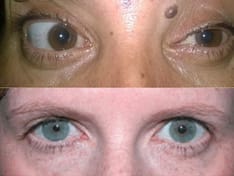
Chronic progressive external ophthalmoplegia (CPEO), also known as progressive external ophthalmoplegia (PEO), is a disorder characterized by slowly progressive paralysis of the extraocular muscles. Patients usually experience bilateral, symmetrical, progressive ptosis, followed by ophthalmoparesis months to years later. Ciliary and iris muscles are not involved so accomodating (focussing) and pupillary function is not affected. [2]
Mitochondrial disorders result in an array of clinical manifestations. These disorders can affect unique anatomic structures such as the eye (Leber hereditary optic neuropathy) or multiple systems, resulting in a variegated presentation (ataxia neuropathy syndrome [ANS], of which sensory, ataxia, neuropathy, dysarthria, and ophthalmoplegia [SANDO] is one). [3] Kearns-Sayre syndrome (KSS) affects the heart and eyes. [4] Pearson syndrome can manifest as pancytopenia, pancreatic problems, and renal tubular maladies. [3, 5]
CPEO is the most frequent manifestation of mitochondrial myopathies. [6, 7] CPEO in association with mutations in mitochondrial DNA (mtDNA) may occur in the absence of any other clinical sign, but it is usually associated with skeletal muscle weakness. However, individuals with a similar clinical presentation may have various mitochondrial defects. [3] There can also be causations due to dletions or defect in nuclear DNA (nDNA), which regulate mtDNA, for exapmle, POLG1. [2]
Kearns-Sayre syndrome (KSS) is a related mitochondrial myopathy that demonstrates the following: CPEO, onset before age 20 years, and pigmentary retinopathy. KSS also has at least one of the following: cardiac conduction defects, cerebrospinal fluid (CSF), protein level greater than 100 mg/dL, and a cerebellar syndrome. Other abnormalities in KSS can include intellectual disability, Babinski sign, hearing loss, seizures, short stature, delayed puberty, and various endocrine disorders, [8] such as diabetes mellitus, hypoparathyroidism, and hearing loss. [3, 4]
CPEO can also be a sign in the following disorders: oculopharyngeal dystrophy, myasthenia gravis, and Graves disease.
Pathophysiology
Mitochondrial DNA (mtDNA) encodes for essential components of the respiratory chain. Deletions of various lengths of mtDNA, nuclear DNA (nDNA), [9, 10] mt-tRNA mutations, [11] and mutations in 12S rRNA and 16S rRNA [12] result in defective mitochondrial function. This dysfunction is particularly problematic in highly oxidative tissues (eg, muscle, brain, heart). Extraocular muscles are affected preferentially because their fraction of mitochondrial volume is several times greater than that of other skeletal muscle. [13, 14] The most common deletion is in the mtDNA. [2]
Impaired protein synthesis in these mitochondria accounts for the histological hallmark of the mitochondrial myopathies. When muscle fibers are stained with Gomori trichrome stain, an abnormal accumulation of enlarged mitochondria is seen beneath the sarcolemma. These fibers are called ragged red fibers due to their unusual appearance and dark red color. With large-scale deletion of mitochondrial DNA, progressive replacement of muscle by fat cells has been reported. [15]
A variable proportion of deleted mtDNA has been found to be present in different tissues from the same patient. The balance of oxidative demands of a given tissue and the proportion of deleted mtDNA it contains will ultimately determine whether the tissue is affected clinically. [16]
Epidemiology
Frequency
Worldwide
Worldwide, the prevalence of mitochondrial disease is 11.5 cases per 100,000 population. [3]
United States
CPEO is rare. Approximately 1000-4000 children are born with mitochondrial disease annually in the United States. [17]
Sex
In KSS, boys and girls are affected equally.
Age
In KSS, onset of CPEO is before age 20 years.
Inheritance
CPEO can be inherited in an autosomal-recessive pattern, autosomal-dominant pattern, or mitochondrial pattern or can occur sporadically. The genes TWNK and SLC25A4 are involved in the autosomal-dominant pattern of inheritance, whereas the genes POLG and RRM2B are involved in both the autosomal-dominant and autosomal-recessive patterns of inheritance. The MTTL1 gene is most often associated with the mitochondrial inheritance pattern, along with other mtRNA and mtDNA genes. [18]
Prognosis
The prognosis in Chronic Progressive External Ophthalmoplegia is guarded. Patients often will present with ptosis and then progress to the abnormal plegia. Additional problems, such as cardiac dysfunction, can result in severe morbidity and mortality. Concurrent management of other affected organ systems is of the most importance to offset symptoms and in proved quality of life. There is no current cure for this condition.
Patient Education
The following support group is available to patients [19] :
United Mitochondrial Disease Foundation
8085 Saltsburg Road Suite 201
Pittsburgh, PA 15239
USA
412-793-8077
MitoAction
P.O. Box 310
Novi, MI 48376
USA
888-648-6228
CureMito
McKinney, TX
USA
646-483-7073
with special emphasis on SURF1 Leigh syndrome for which gene therapy is being tried. (TSHA-104 is an investigational AAV9-based gene therapy administered intrathecally for the treatment of SURF1-associated Leigh syndrome) [1]
-
This table outlines the differential diagnoses of chronic progressive external ophthalmoplegia.