Continually Updated Clinical Reference
 
 
  All Sources     eMedicine     Medscape     Drug Reference     MEDLINE
 
You are in: eMedicine Specialties > Neurology > Pediatric Neurology

Craniosynostosis

Last Updated: January 9, 2007
Email to a Colleague
Synonyms and related keywords: anterior plagiocephaly, Apert syndrome, brachycephaly, Carpenter syndrome, Chotzen syndrome, Crouzon syndrome, kleeblattschädel, cloverleaf skull, oxycephaly, Pfeiffer syndrome, plagiocephaly, scaphocephaly, trigonocephaly

  AUTHOR INFORMATION Section 1 of 9    Click here to go to the next section in this topic
Author Information Introduction Clinical Differentials Workup Treatment Follow-up Pictures Bibliography

Author: Raj D Sheth, MD, Professor, Departments of Neurology and Pediatrics, Director of Comprehensive Epilepsy Program, Department of Neurology, University of Wisconsin at Madison

Coauthor(s): Bermans J Iskandar, MD, Director, Associate Professor, Departments of Neurological Surgery, Pediatrics, Children's Hospital, University of Wisconsin Hospital and Clinics

Raj D Sheth, MD, is a member of the following medical societies: American Academy of Neurology, American Academy of Pediatrics, American Epilepsy Society, American Neurological Association, and Child Neurology Society

Editor(s): James J Riviello, Jr, MD, Professor, Department of Neurology, Director of Epilepsy Program, Division of Epilepsy and Clinical Neurophysiology, Children's Hospital, Harvard University Medical School; Francisco Talavera, PharmD, PhD, Senior Pharmacy Editor, eMedicine; Kenneth J Mack, MD, PhD, Visiting Associate Professor, Department of Neurology, University of Wisconsin at Madison; Associate Professor and Consultant, Department of Neurology, Division of Child and Adolescent Neurology, Mayo Medical School; Selim R Benbadis, MD, Professor of Neurology, Director of Comprehensive Epilepsy Program, Departments of Neurology and Neurosurgery, University of South Florida College of Medicine, Tampa General Hospital; and Nicholas Lorenzo, MD, Chief Editor, eMedicine Neurology; Consulting Staff, Neurology Specialists and Consultants

Disclosure


  INTRODUCTION Section 2 of 9   Click here to go to the previous section in this topic Click here to go to the top of this page Click here to go to the next section in this topic
Author Information Introduction Clinical Differentials Workup Treatment Follow-up Pictures Bibliography

Background: Craniosynostosis consists of premature fusion of 1 or more cranial sutures, often resulting in an abnormal head shape. It may result from a primary defect of ossification (primary craniosynostosis) or, more commonly, from a failure of brain growth (secondary craniosynostosis). Simple craniosynostosis is a term used when only 1 suture fuses prematurely. Complex or compound craniosynostosis is used to describe premature fusion of multiple sutures. When children with craniosynostosis, usually complex, also display other body deformities, this is termed syndromic craniosynostosis.

Pathophysiology:

Normal skull development

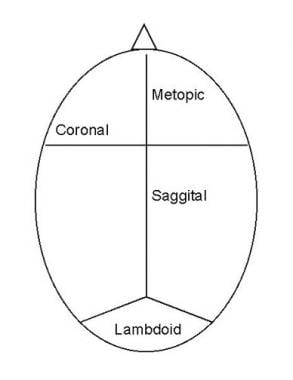
Ossification of the cranial vault starts in the central region of each cranial bone and extends outward toward the cranial sutures (see Image 1).

The coronal suture separates the 2 frontal bones from the parietal bones.

The metopic suture separates the frontal bones.

The sagittal suture separates the 2 parietal bones.

The lambdoid suture separates the occipital bone from the 2 parietal bones.

The primary factor that keeps sutures open is ongoing brain growth.

Normal skull growth occurs perpendicular to each suture.

Primary craniosynostosis

When 1 or more sutures fuse prematurely, skull growth can be restricted perpendicular to the suture. If multiple sutures fuse while the brain is still increasing in size, intracranial pressure can increase.

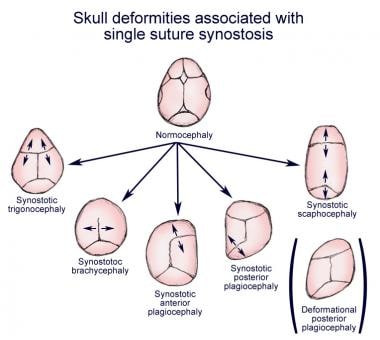
Scaphocephaly - Early fusion of the sagittal suture

Anterior plagiocephaly - Early fusion of 1 coronal suture

Brachycephaly - Early bilateral coronal suture fusion

Posterior plagiocephaly - Early closure of 1 lambdoid suture

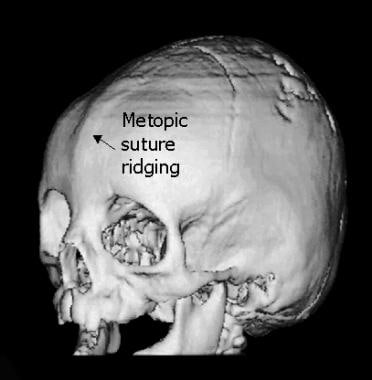
Trigonocephaly - Early fusion of the metopic suture (see Image 2).
Secondary craniosynostosis

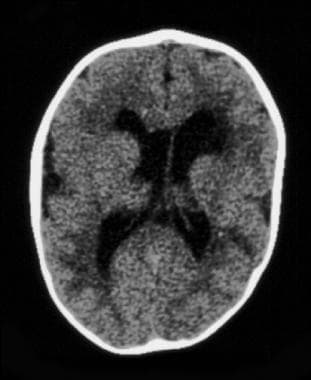
More frequent than the primary type, secondary craniosynostosis results from early fusion of sutures due to primary failure of brain growth. Since brain growth drives the bony plates apart at the sutures, a primary lack of brain growth allows premature fusion of all the sutures (see Image 3). Intracranial pressure usually is normal, and surgery seldom is needed. Typically, failure of brain growth results in microcephaly. Premature suture closure does not compromise brain growth and does not require surgery to open sutures. Intrauterine space constraints may play a role in the premature fusion of sutures in the fetal skull (see Bibliography). This has been demonstrated in coronal craniosynostosis.

Frequency:

  • In the US: Incidence of craniosynostosis is 0.04-0.1%. Of affected individuals, 2-8% have primary craniosynostosis. The remaining cases are secondary craniosynostosis, which frequently is accompanied by microcephaly. The frequencies of the various types of craniosynostosis are as follows: sagittal 50-58%, coronal 20-29%, metopic 4-10%, and lambdoid 2-4%.

Mortality/Morbidity: Raised intracranial pressure is rare with fusion of a single suture. It can occur in primary craniosynostosis when multiple sutures fuse.

  • Primary craniosynostosis: Although the major morbidity is cosmetic, intracranial pressure can be elevated. This occurs with a high frequency in multiple suture synostosis and rarely with single suture synostosis.
  • Secondary craniosynostosis: Typically no morbidity is noted, except that related to the underlying disorder. The lack of brain growth often is associated with neurodevelopmental delay.
  • Craniosynostosis of 1-2 sutures: Cosmetic defect is the primary morbidity.

Sex: Craniosynostosis is equally distributed in both boys and girls.

Age:

  • Neonatal period: Craniosynostosis is evident at birth when associated with other craniofacial abnormalities.
  • Infancy (0-18 mo): Secondary or primary craniosynostosis becomes evident as the child grows.


  CLINICAL Section 3 of 9   Click here to go to the previous section in this topic Click here to go to the top of this page Click here to go to the next section in this topic
Author Information Introduction Clinical Differentials Workup Treatment Follow-up Pictures Bibliography

History:

  • Craniosynostosis may be evident at birth or in infancy from craniofacial abnormalities.
  • It may become evident later when the child exhibits neurodevelopmental delays.

Physical: Typically, careful examination alone can make the diagnosis.

  • Microcephaly usually suggests a secondary craniosynostosis.
  • Scaphocephaly
    • Premature fusion of the sagittal suture is the most common craniosynostosis, constituting more than half of all cases. It occurs frequently in premature infants.
    • The head typically is elongated in the anterior-posterior diameter and shortened in the biparietal diameter. Ridging of the sagittal suture is palpable.
  • Anterior plagiocephaly - Premature fusion of 1 coronal suture.
  • Brachycephaly
    • Premature fusion of both coronal sutures results in increased biparietal diameter. This anomaly is often syndromic. The skull is shorter in the anterior-posterior diameter.

    • Because the coronal suture develops in conjunction with the sutures at the base of the skull, unilateral or bilateral mid and upper face hypoplasia may occur. Orbits may be elliptical (ie, Harlequin features), and the supraorbital ridge may not be formed well.

    • Consider these features when planning surgery for brachycephaly.
  • Posterior plagiocephaly
    • The 2 predominant causes of posterior plagiocephaly are craniosynostosis of the lambdoid suture (<2%) or positional molding (vast majority).
    • Since the American Academy of Pediatrics recommended that infants sleep on their backs to reduce sudden infant death syndrome (SIDS) incidence, positional molding has been seen with increased frequency.
    • Torticollis frequently is associated with positional molding.
    • In positional molding, ear position is more anterior on the side of flattening; in synostosis, ear position is more posterior.
    • Frontal bossing is observed ipsilateral to the flattening in positional molding and contralateral in synostosis.
  • Trigonocephaly
    • Premature fusion of the metopic suture frequently results in pointed forehead (ie, triangular shaped head) (see Images 6-7). The abnormality is usually mild and requires no surgical intervention. Surgery is performed if the abnormality is persistent and severe.
    • Oxycephaly (ie, turricephaly) is fusion of all skull sutures and the sutures at the base of the skull.
  • Craniosynostosis sometimes is associated with sporadic craniofacial syndromes such as Crouzon, Apert, Chotzen, Pfeiffer, or Carpenter syndromes. In this context, facial features, typically craniofacial abnormalities, suture ridging, and early closure of fontanelles, suggest the diagnosis.
  • Kleeblattschädel (ie, cloverleaf skull) results from fusion of all sutures except the metopic and squamosal sutures, giving the head a cloverleaf appearance (see Image 8).
  • Intracranial pressure may be elevated in primary multiple suture craniosynostosis, such as cloverleaf skull and the syndromic synostoses. Signs include sun-setting eyes, papilledema, vomiting, and lethargy.

Causes:

  • Multiple theories have been proposed for the etiology of primary craniosynostosis, but the most widely accepted is a primary defect in the mesenchymal layer ossification in the cranial bones.
  • Secondary craniosynostosis typically results from systemic disorders such as the following:
    • Endocrine - Hyperthyroidism, hypophosphatemia, vitamin D deficiency, renal osteodystrophy, hypercalcemia, and rickets
    • Hematologic disorders that cause bone marrow hyperplasia (eg, sickle cell disease, thalassemia)
    • Inadequate brain growth, including microcephaly and its causes and shunted hydrocephalus
  • The syndromic causes appear to result from genetic mutations responsible for fibroblast growth factor receptors 2 and 3. A gene locus for single suture craniosynostosis has not been identified.
  • Other important factors to consider
    • Differentiating plagiocephaly that results from positional molding (which does not require surgery and is seen frequently) from lambdoid suture fusion is extremely important.
    • The presence of multiple suture fusions strongly suggests a craniofacial syndrome, which frequently requires the diagnostic expertise of a pediatric geneticist.
  DIFFERENTIALS Section 4 of 9   Click here to go to the previous section in this topic Click here to go to the top of this page Click here to go to the next section in this topic
Author Information Introduction Clinical Differentials Workup Treatment Follow-up Pictures Bibliography

Benign Skull Tumors
Hydrocephalus
Mental Retardation
Neural Tube Defects
Syringomyelia
Thyroid Disease
Torticollis


Other Problems to be Considered:

Apert syndrome
Carpenter syndrome
Chotzen syndrome
Crouzon syndrome
Hypercalcemia
Hyperthyroidism
Hypophosphatemia
Kleeblattschädel (cloverleaf skull)
Pfeiffer syndrome
Renal osteodystrophy
Rickets
Vitamin D deficiency

Quick Find
Author Information
Introduction
Clinical
Differentials
Workup
Treatment
Follow-up
Pictures
Bibliography

Click for related images.

Related Articles
Benign Skull Tumors

Hydrocephalus

Mental Retardation

Neural Tube Defects

Syringomyelia

Thyroid Disease

Torticollis


Patient Education
Click here for patient education.


  WORKUP Section 5 of 9   Click here to go to the previous section in this topic Click here to go to the top of this page Click here to go to the next section in this topic
Author Information Introduction Clinical Differentials Workup Treatment Follow-up Pictures Bibliography

Imaging Studies:

  • Perform skull radiography with anterior-posterior, lateral, and Water views. Prematurely fused sutures are easily identified by the absence of sutures and associated ridging of the suture line. Sutures either are not visible or have evidence of sclerosis.
  • Cranial CT scan with 3-dimensional reconstruction is not required in most infants. It is sometimes performed when surgery is being considered.
  • Nuclear medicine isotope studies are of limited value.

Other Tests:

  • Endocrine evaluation: Order thyroid and parathyroid studies when associated features suggest these diagnoses.
  TREATMENT Section 6 of 9   Click here to go to the previous section in this topic Click here to go to the top of this page Click here to go to the next section in this topic
Author Information Introduction Clinical Differentials Workup Treatment Follow-up Pictures Bibliography

Medical Care: In the past 30 years, a better understanding of the pathophysiology and management of craniosynostosis has developed. Currently, surgery is usually cosmetic for infants with fusion of 1-2 sutures that result in a misshapen head. For infants with microcephaly (ie, secondary craniosynostosis), surgery usually is not required.

  • In patients with microcephaly, investigate the cause of microcephaly.
  • Measure head circumference longitudinally and monitor development. Ensure normal brain growth in patients with primary craniosynostosis.
  • Carefully monitor signs and symptoms of elevated intracranial pressure.
    • Examine the fundi and alert parents to report persistent vomiting or lethargy promptly.

    • Should elevated intracranial pressure be suspected, an emergent neurosurgical consult would be appropriate.
  • To preserve visual function in patients with elevated intracranial pressure, an emergent ophthalmological consult would be appropriate.
  • Address the cosmetic appearance of the skull abnormality.

Surgical Care: Surgery typically is indicated for increased intracranial pressure or for cosmetic reasons.

  • Do not operate in patients without raised intracranial pressure until considering the following:
    • If the shape of the head does not improve by age 2-4 months, then the abnormality is unlikely to resolve with age. Infants have a large head relative to body size. Deformity appears more prominent in the young infant and may be less obvious with age.

    • Handle minor deformities conservatively. As the child grows and more hair appears, the visible abnormality may decrease.
  • Consideration for cosmetic surgery is dependent on the age of presentation and on which sutures have fused prematurely.
    • Cosmetic surgery is performed in infants aged 3-6 months in the author's practice, although a variety of approaches exist among different surgeons.

    • Surgery in younger infants may result in a relatively large loss of blood volume.

    • Surgery in infants older than 8 months may be associated with a slowing of skull growth. Thus, the surgical defect may not be covered adequately by bone growth.
  • Infants with a defined syndrome causing craniosynostosis should be evaluated early for surgery.
    • Results are best when surgery is performed in infants younger than 6 months.

    • Patients with associated facial deformities may need a staged surgical approach (performed by a team of multidisciplinary specialists).
  • Positional molding
    • No surgery is indicated for posterior plagiocephaly secondary to positional molding.
    • The vast majority of infants improve with repositioning maneuvers and physical therapy for torticollis.
    • Some clinicians elect to use molding helmets for severe cases.

Consultations:

  • A pediatric neurologist should evaluate the cause of the craniosynostosis and differentiate secondary from primary craniosynostosis. The head circumference should be plotted carefully and monitored from birth onward.
  • A geneticist/dysmorphologist should evaluate for associated syndromes.
  • A plastic surgeon should evaluate the infant when synostosis is associated with facial deformities.
  • A neurosurgeon should evaluate a patient with primary craniosynostosis or elevated intracranial pressure.
  • An endocrinologist should evaluate the patient when appropriate.

Activity: Following surgery, patients may require some restriction in activity under the direction of the treating neurosurgeon to avoid head injury.

  • In the immediate postoperative period, complications include hemorrhage.
  FOLLOW-UP Section 7 of 9   Click here to go to the previous section in this topic Click here to go to the top of this page Click here to go to the next section in this topic
Author Information Introduction Clinical Differentials Workup Treatment Follow-up Pictures Bibliography

Further Outpatient Care:

  • Following surgery, carefully monitor patients to ensure that the suture does not re-fuse.
    • Continue head circumference measurements.
    • Watch for signs of raised intracranial pressure in infants at risk.

Prognosis:

  • Patients with primary craniosynostosis must be monitored after surgery.
  • In secondary craniosynostosis, prognosis is dependent upon underlying etiology.

Patient Education:

  • If a patient has a mild head shape deformity, inform parents that the deformity will become less prominent with the appearance of abundant hair and physiological molding.
  PICTURES Section 8 of 9   Click here to go to the previous section in this topic Click here to go to the top of this page Click here to go to the next section in this topic
Author Information Introduction Clinical Differentials Workup Treatment Follow-up Pictures Bibliography

Caption: Picture 1. Diagram of a neonate's skull demonstrating the location of the sutures.
Click to see larger pictureClick to see detailView Full Size Image
Picture Type: Image
Caption: Picture 2. Frontal view showing a fused and ridged metopic suture on 3-dimensional CT.
Click to see larger pictureClick to see detailView Full Size Image
Picture Type: CT
Caption: Picture 3. CT image demonstrating features of secondary craniosynostosis with cerebral atrophy. Cerebral atrophy is not present in primary craniosynostosis.
Click to see larger pictureClick to see detailView Full Size Image
Picture Type: CT
Caption: Picture 4. Positional molding. Note the anterior displacement of the right occiput and of the right frontal region on the same side, which differentiate positional molding from posterior plagiocephaly craniosynostosis.
Click to see larger pictureClick to see detailView Full Size Image
Picture Type: Photo
Caption: Picture 5. Posterior view of 3-dimensional cranial CT demonstrating early fusion of the lambdoid suture.
Click to see larger pictureClick to see detailView Full Size Image
Picture Type: CT
Caption: Picture 6. Isolated fusion of the metopic suture. Note that the remaining sutures are open.
Click to see larger pictureClick to see detailView Full Size Image
Picture Type: CT
Caption: Picture 7. Trigonocephaly. Note the triangular shape of the head.
Click to see larger pictureClick to see detailView Full Size Image
Picture Type: Photo
Caption: Picture 8. Infant with primary craniosynostosis. The specific deformity of the skull is Kleeblattschädel or cloverleaf skull.
Click to see larger pictureClick to see detailView Full Size Image
Picture Type: Photo
  BIBLIOGRAPHY Section 9 of 9   Click here to go to the previous section in this topic Click here to go to the top of this page
Author Information Introduction Clinical Differentials Workup Treatment Follow-up Pictures Bibliography

  • Anderson PJ, Netherway DJ, Abbott A, David DJ: Intracranial Volume Measurement of Metopic Craniosynostosis. J Craniofac Surg 2004 11; 15(6): 1014-1016[Medline].
  • Dundulis JA, Becker DB, Govier DP, et al: Coronal ring involvement in patients treated for unilateral coronal craniosynostosis. Plast Reconstr Surg 2004 Dec; 114(7): 1695-703[Medline].
  • Elmslie FV, Reardon W: Craniofacial developmental abnormalities. Curr Opin Neurol 1998 Apr; 11(2): 103-8[Medline].
  • Fernbach SK: Craniosynostosis 1998: concepts and controversies. Pediatr Radiol 1998 Sep; 28(9): 722-8[Medline].
  • Higginbottom MC, Jones KL, James HE: Intrauterine constraint and craniosynostosis. Neurosurgery 1980 Jan; 6(1): 39-44[Medline].
  • Jabs EW: Toward understanding the pathogenesis of craniosynostosis through clinical and molecular correlates. Clin Genet 1998 Feb; 53(2): 79-86[Medline].
  • Liptak GS, Serletti JM: Pediatric approach to craniosynostosis. Pediatr Rev 1998 Oct; 19(10): 352; quiz 359[Medline].
  • Losee JE, Corde Mason A: Deformational plagiocephaly: diagnosis, prevention, and treatment. Clin Plast Surg 2005 Jan; 32(1): 53-64[Medline].
  • Robin NH: Molecular genetic advances in understanding craniosynostosis. Plast Reconstr Surg 1999 Mar; 103(3): 1060-70[Medline].
  • Schaefer GB, Sheth RD, Bodensteiner JB: Cerebral dysgenesis. An overview. Neurol Clin 1994 Nov; 12(4): 773-88[Medline].
  • Sheth RD, Mullett MD, Bodensteiner JB, Hobbs GR: Longitudinal head growth in developmentally normal preterm infants. Arch Pediatr Adolesc Med 1995 Dec; 149(12): 1358-61[Medline].
  • Sheth RD, Schaefer GB, Keller GM, et al: Size of the corpus callosum in cerebral palsy. J Neuroimaging 1996 Jul; 6(3): 180-3[Medline].

Craniosynostosis excerpt