| Patient Education |
|
Click here for patient education.
|
|
You are in: eMedicine Specialties >
Neurology > Movement and Neurodegenerative Diseases
Pelizaeus-Merzbacher Disease
Article Last Updated: Jan 5, 2007
AUTHOR AND EDITOR INFORMATION
Section 1 of 11
Author: James Y Garbern, MD, PhD, Clinical Director of Neurogenetics Clinic, Associate Professor, Department of Neurology and Center for Molecular Medicine and Genetics, Detroit Medical Center, Wayne State University School of Medicine
James Y Garbern is a member of the following medical societies: American Academy of Neurology, American Association for the Advancement of Science, American Society of Human Genetics, and Society for Neuroscience
Editors: Stephen T Gancher, MD, Adjunct Associate Professor, Department of Neurology, Oregon Health Sciences University; Francisco Talavera, PharmD, PhD, Senior Pharmacy Editor, eMedicine; Nestor Galvez-Jimenez, MD, Program Director of Movement Disorders, Department of Neurology, Division of Medicine, Director of Neurology Residency Training Program, Cleveland Clinic Florida; Selim R Benbadis, MD, Professor, Director of Comprehensive Epilepsy Program, Departments of Neurology and Neurosurgery, University of South Florida School of Medicine, Tampa General Hospital; Nicholas Y Lorenzo, MD, Chief Editor, eMedicine Neurology; Consulting Staff, Neurology Specialists and Consultants
Author and Editor Disclosure
Synonyms and related keywords:
spastic paraplegia type 2, SPG2, sudanophilic leukodystrophy, connatal form, proteolipid protein 1
Background
Though distinguished nosologically, Pelizaeus-Merzbacher disease (PMD) and X-linked spastic paraplegia type 2 (SPG2) are at opposite ends of a clinical spectrum of X-linked diseases caused by mutations of the same gene, the proteolipid protein 1 (PLP1) gene, and resulting in defective central nervous system (CNS) myelination. Clinical signs usually include some combination of nystagmus, stridor, spastic quadriparesis, hypotonia, cognitive impairment, ataxia, tremor, and diffuse leukoencephalopathy on MRI scans. Seizures and perinatal stridor are rare signs, typically seen only in the most severe cases.
Severe clinical syndromes (sometimes referred to as the connatal form) are typically caused by missense and other small mutations that affect critical positions in PLP1, whereas the milder spastic paraplegia syndrome is caused by mutations that affect presumably less critical regions of the protein. The most common mutations causing PMD are duplications of a region of the X chromosome that includes the entire PLP1 gene.
Pathophysiology
PMD is caused, in most cases, by mutations of PLP on the X chromosome. PLP1 encodes 2 major products, PLP (Note: The gene is now designated as PLP1, whereas the protein is still PLP.) itself and a smaller protein, DM20, that results from alternative splicing. These proteins constitute about 50% of the mass of CNS white matter and are believed to serve an important structural function in compact myelin.
Approximately 60-70% of cases of PMD result from duplications of the region of the X chromosome that contains PLP1. Extent and breakpoints of duplications vary among different families. Inclusion of other genes in the duplicated region, or of aberrations of genes at the duplication endpoints, may potentially affect the phenotype. Most individuals with PLP1 duplications present with the classic PMD syndrome, typified by nystagmus beginning in the first year of life, delayed motor and cognitive milestones, and ataxia. Most of these patients acquire some language function, which can be quite good although slow. Recently, it has been established that some patients with PMD have 3 or more copies of the PLP1 gene. These individuals have a more severe phenotype than most of those with duplications.
Transgenic mice that have extra copies of Plp1 develop a syndrome that effectively models the PLP1 duplication form of PMD; this provides strong experimental support for the hypothesis that overexpression of PLP itself is deleterious to oligodendrocytes. Approximately 15-20% of mutations in PMD are point or other small mutations that result in base substitutions, insertions, or deletions. Base substitutions usually result in missense mutations, but nonsense mutations (ie, substitution of an amino acid codon by a stop codon) and splicing mutations also occur. Splicing mutations are now recognized as quite common and may account for almost 20% of point mutations in the PLP1 gene.
The most severe form of PMD, the so-called connatal form, usually results from missense substitutions. These severe mutations are believed to result in misfolding of the newly synthesized protein, which then accumulates in the endoplasmic reticulum and triggers apoptosis, or programmed cell death. Thus, oligodendrocyte numbers are severely reduced, and little (if any) myelin is made.
Mutations that prevent any PLP1 from being made result in a syndrome (PLP null syndrome) that is usually milder than classic PMD; however, these mutations appear to cause a demyelinating peripheral neuropathy. Moreover, these null mutations do not result in oligodendrocyte cell death. Interestingly, mice that have been genetically engineered to prevent PLP1 expression develop a similar pathologic syndrome characterized by severe late-onset axonal degeneration. Mutations that result in SPG2 generally are missense mutations that do not prevent processing of DM20, although they may interfere with the processing of PLP itself. These mutations do not appear to cause oligodendrocyte cell death.
Because females are mosaic with respect to X chromosome gene expression due to X inactivation, heterozygous females begin life with roughly equal proportions of oligodendrocytes that utilize the normal or the mutated X chromosome. Females heterozygous for severe mutations are neurologically normal as adults, probably because the defective oligodendrocytes die, as already described, and are replaced by healthy ones. These females may have transient neurologic abnormalities during childhood. However, females heterozygous for mutations that do not result in oligodendrocyte apoptosis (programmed cell death) continue to have oligodendrocytes that use the defective PLP1 and therefore are more likely to have detectable neurologic signs.
Frequency
United States
Frequency is not known with certainty, but the estimated prevalence is at least 1 case per 500,000 population.
International
Frequency is estimated to be 1 case per 100,000-1,000,000 population.
Mortality/Morbidity
- Severe PMD is often fatal during the first decade of life, typically from respiratory complications.
- Patients with classic PMD (such as that caused by PLP1 gene duplications) may survive into the sixth decade of life.
- Patients with SPG2 generally have a normal life span.
Race
PMD and SPG2 are global syndromes and affect all major ethnic groups.
- So far, no case reports of patients of African descent have been published; however, the author is aware of African Americans with PMD.
- PMD has been reported in people of Asian, Middle Eastern, and European descent.
Sex
- PMD typically affects males, but female heterozygotes can be clinically affected, especially those who carry alleles that are relatively mild. As the defective oligodendrocytes die and are replaced by healthy oligodendrocytes in heterozygous females, neurologic function improves. Females heterozygous for the less severe alleles of PLP1 that are not believed to cause oligodendrocyte cell death or apoptosis may develop a more progressive and nonremitting syndrome that usually begins during adulthood.
- Some females with PMD (such as the original PMD family) probably have a clinical course much like that of affected males, in which the symptoms do not remit and may be the result of skewed X inactivation, ie, the majority of oligodendrocytes have inactivated the normal X chromosome and insufficient healthy oligodendrocytes are available to myelinate the CNS effectively.
Age
- PMD typically begins during infancy, but milder syndromes may not be recognized until early childhood. While most heterozygous (ie, carrier) females are asymptomatic, examples are known of young girls in families with severe to classic PMD who develop a classic PMD syndrome that regresses as the child matures, followed by completely normal neurologic health. This transient phase most likely reflects the defective myelination brought about by those oligodendrocytes that have inactivated the normal X chromosome. As these defective oligodendrocytes die and are replaced by healthy oligodendrocytes, neurologic function improves.
- Females heterozygous for the less severe alleles of PLP1 that are not believed to cause oligodendrocyte cell death or apoptosis may develop a more progressive and nonremitting syndrome that usually begins during adulthood. See Sex.
History
The clinical severity of PMD varies widely, primarily depending upon the precise nature of the causative mutation and probably, to a certain extent, upon other genetic and environmental influences.
- The presentation of classic PMD is of infantile-onset (typically within the first 2 months of life) nystagmus, titubation, and weakness, followed by development of ataxia, cognitive delay, and spasticity. Most patients never ambulate. Most do acquire some degree of language skills, which may approach normal levels, but the speed of language output is usually slow and may suggest a more severe degree of mental retardation than is present. These patients may survive to the sixth decade of life or longer.
- More severely affected patients, those with so-called connatal PMD, have nystagmus present beginning within the first week or two of life, often have stridor and respiratory difficulty and hypotonia, and may even have seizures. These patients typically have limited language skills, never ambulate, and develop severe spasticity with little voluntary movement. These individuals usually die before the third decade of life.
- Individuals with the least severe form of PMD, which overlaps with SPG2, present with childhood-onset spastic paraplegia, mild cognitive impairment, ataxia, and athetosis. Survival to the sixth decade of life or later is characteristic. Typically, neurologic signs progress but at a gradual rate with reported periods of relative stability. Generally, those who learn to walk begin to lose ambulatory abilities during adolescence, but in some cases this can be delayed until adulthood.
Physical
Physical signs depend on the age of the patient, severity of mutation, and probably on modifier genes and perhaps environmental factors.
- Infants with connatal PMD invariably have nystagmus within the first week or two of life and typically have stridor and hypotonia. The latter may be severe enough to suggest spinal muscular atrophy. As these children age, limb spasticity usually replaces the hypotonia, but the child has poor head control and does not learn to sit unsupported, much less walk. Seizures can occur in this severe form. Growth is poor; developmental milestones are significantly delayed or never achieved. Patients may comprehend spoken words, but verbal output is typically limited or absent. Motor function is severely limited.
- Children with the classic form of PMD generally have nystagmus present in the first few weeks of life or at least in the first year of life. Early hypotonia is succeeded by limb spasticity, which is worse in the legs than arms. Ataxia of truncal and limb movements is prominent; dystonic posturing and movements can occur as well. Occasionally, a child can walk, although movement is impaired by weakness and spasticity. Walking ability is usually lost by adolescence or earlier. Language ability can be mildly to moderately impaired, and some cognitive delay is usual. Diffuse hyperreflexia and Babinski signs are seen.
- Those with milder mutations may not ever have nystagmus; they have delayed sitting and walking, but they usually learn to walk. They have limb spasticity, which is worse in the legs, and ataxia that affects speech as well as limb movements. Patients are hyperreflexic and have Babinski signs.
- Patients with PLP1 null mutations can have mild distal sensory loss and relative hyporeflexia in addition to spastic paraparesis, but they have Babinski signs. These individuals have mild to moderate cognitive impairment.
- Clinical signs and symptoms include the following:
- Usually nystagmus is of a pendular nature; it can often have horizontal and rotatory components. Over 95% patients have nystagmus. This sign may disappear later during childhood. The patient's age at onset of nystagmus alone does not predict clinical severity.
- Ataxia is evident once voluntary movements are acquired and occurs in virtually all patients.
- Spasticity develops in the majority (>90%) of patients, but it may not be apparent until the second year of life or even later. Hyperreflexia and Babinski signs are present. A majority of severely affected patients have neonatal hypotonia that may mimic spinal muscular atrophy.
- Titubation is an early characteristic sign. Frequency of head bobbing is typically synchronous with or follows eye movements.
- Seizures and stridor are reported only in the most severely affected patients, who tend to have missense or frameshift mutations of the PLP1 gene.
Causes
- PMD is caused by mutations of the PLP1 gene located on the long arm of the X chromosome (Xq22). See the discussion in Pathophysiology of mutation types and molecular mechanisms believed to be important in the disease.
- Other gene defects can also cause a PMD-like syndrome, in particular mutations that affect the GJA12 gene on chromosome 1. SOX10 mutations cause both severe peripheral and central dysmyelination and dysmorphic facial abnormalities. Salla disease, caused by defects in a lysosomal transporter protein for sialic acid (N-acetyl neuraminic acid), may manifest with nystagmus in the first months of life as well as hypotonia and cognitive impairment. The most severely impaired children do not ambulate or acquire language, but they do typically learn to walk and speak and can have a normal life expectancy. The MRI shows arrested or delayed myelination.
- Other diagnostic considerations include the following:
- Lazzarini has described a PMD-like disease; unfortunately, MRI data have not been obtained on members of this single family whose disorder is linked to Xq28.
- Other leukodystrophies, such as metachromatic leukodystrophy, adrenoleukodystrophy, Krabbe disease, Cockayne disease, and Canavan disease, do not typically cause nystagmus, and MRI scans in these diseases usually show a regional predilection of abnormality, eg, occipital white matter in adrenoleukodystrophy and frontal white matter in metachromatic leukodystrophy. Results of peripheral nerve conduction testing as well as evoked potentials testing are usually abnormal.
- Infants with merosin deficiency have dramatically increased T2 signal in the cerebral white matter, but the presence of severe weakness and hypotonia and the absence of nystagmus should direct the clinician toward consideration of myopathy. A fatal X-linked syndrome of ataxia, blindness, deafness, and mental retardation has been described and is linked to Xq21-24, but the MRI does not show a pattern of leukodystrophy. Mutations in the PLP1 coding regions have been excluded for this disorder.
- Mutations in the cell adhesion molecule gene L1CAM at Xq28 cause X-linked spastic paraplegia type 1 (SPG1). This disorder is associated with mental retardation and adducted thumbs and is allelic to the MASA syndrome (mental retardation, aphasia, shuffling gait, adducted thumbs) and X-linked hydrocephalus. MRI scans of these disorders may show enlarged ventricles or agenesis of the corpus callosum, but they do not reveal leukodystrophy.
Ataxia with Identified Genetic and Biochemical Defects
Cerebral Palsy
Chorea in Adults
Chorea in Children
Complex Partial Seizures
Cortical Basal Ganglionic Degeneration
Dopamine-Responsive Dystonia
Hallervorden-Spatz Disease
Inherited Metabolic Disorders
Lysosomal Storage Disease
Multiple Sclerosis
Parkinson Disease
Parkinson Disease in Young Adults
Parkinson-Plus Syndromes
Peroxisomal Disorders
Progressive Supranuclear Palsy
Striatonigral Degeneration
Temporal Lobe Epilepsy
Tonic-Clonic Seizures
Wilson Disease
Other Problems to be Considered
Alexander disease
Adrenoleukodystrophy
Ataxias with identified biochemical defects
CADASIL (cerebral autosomal dominant arteriopathy with subcortical infarcts and leukoencephalopathy)
Canavan disease
Cockayne disease
Congenital muscular dystrophy due to merosin deficiency
Congenital nystagmus
Familial spastic paraplegia
Krabbe disease (globoid cell leukodystrophy)
Metachromatic leukodystrophy
Pelizaeus-Merzbacher–like disease
Salla disease (sialic aciduria)
Sjögren-Larsson syndrome
SOX10 mutation syndrome
Spastic paraplegia type 1
X-linked ataxia, deafness, blindness, and mental retardation
Imaging Studies
- MRI is the most useful imaging study and demonstrates symmetric and widespread abnormality of the white matter of cerebrum, brain stem, and cerebellum.
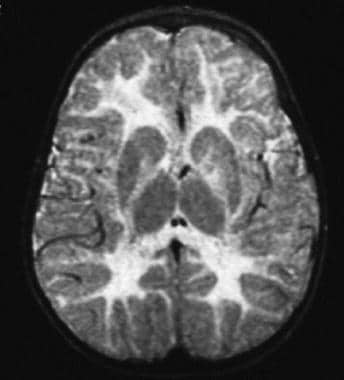
- White matter has increased signal intensity on T2-weighted and inversion recovery images (see Images 1-2) and is hypointense on T1 images. These changes may not be readily evident or as confidently detected until after age 1 year because the newborn brain is not well myelinated at birth. The normal differentiation of white from gray matter is most easily observed after age 1 year, by which time myelination normally is proceeding actively. However, the brainstem and cerebellum are partially myelinated at birth, and the posterior limbs of the internal capsule, splenium, and genu are normally myelinated at 3 months of age; therefore, absence of the normal myelin MRI signals in these areas should raise suspicion of PMD in an appropriate clinical setting.
- In addition to the diffuse increased T2 signal intensity, the absolute volume of white matter is often reduced, most severely in patients with connatal PMD (see Image 3). Patients with SPG2 may have only patchy areas of increased T2 signal. Patients with the null mutation may have a more subtle increase in signal intensity relative to that seen in other patients with PMD, and the volume of white matter may be normal (see Image 4).
Other Tests
- Auditory evoked potential testing shows normal latency of wave 1, and possibly of wave 2 as well, but with prolongation or abolition of central waves 3-5.
- Visual evoked potential testing shows increased latency of P100.
- Somatosensory evoked potential testing reveals normal peripheral latencies with prolonged or absent central latencies.
- Evoked potentials of other leukodystrophies typically have delayed peripheral as well as central components.
- Nerve conduction testing results usually are normal, but patients with null mutations (ie, those that prevent any PLP1 expression) have a mild, multifocal, demyelinating peripheral neuropathy. In contrast, other leukodystrophies, such as Krabbe disease, Cockayne disease, metachromatic leukodystrophy, and adrenoleukodystrophy, have diffusely slow nerve conduction velocities.
- Molecular diagnostic testing is the definitive method to diagnose PMD, by detecting mutations of the PLP1 gene. Most patients (about 70%) have duplications (or rarely triplication or quintuplication) of the gene, which can usually be identified by fluorescent in situ hybridization (FISH) testing on interphase leukocytes. Other cells, such as buccal epithelia, chorionic villus cells, and amniocytes, can be tested as well. Duplications can also be identified by Southern blot and quantitative polymerase chain reaction (Q-PCR) testing. Chromosomal microarray analysis (CMA) or comparative genomic hybridization (CGH) testing also can identify duplications or other changes in dosage of the PLP1 gene. FISH testing of metaphase chromosomes can be helpful in identifying rare cases when the duplicated PLP1 gene is inserted in anomalous sites, such as distant loci of the X chromosome or the Y chromosome or autosomes.
- About 15-20% of patients have small, typically single, nucleotide mutations that result in missense substitutions. Since FISH testing, CMA, and CGH testing do not identify these mutations, patients suspected of having PMD who do not have PLP1 duplications should have PLP1 sequence analysis performed.
- Mutations have been described that cause nonsense, frameshift, and splicing changes, in addition to complete gene duplications and deletions.
- The remaining 5-10% of patients without duplication or other mutations may have mutations in PLP1 remote from those regions that are examined routinely in testing laboratories.
- Locus heterogeneity, ie, additional genes that can also cause a PMD-like syndrome, occurs. Mutations affecting a gap junction protein, GJA12 (also known as connexin 46.6), cause a syndrome virtually identical to PMD. Patients with this autosomal recessive syndrome have nystagmus, motor and cognitive impairment, and diffuse leukodystrophy on MRI scans. Peripheral neuropathy and seizures are more prevalent in this PMD-like syndrome.
- Testing for lysosomal storage diseases (particularly for arylsulfatase A, galactosylceramide beta-galactosidase, and hexosaminidase), Salla disease (urine sialic acid), and adrenoleukodystrophy (very long chain fatty acids) should be done to exclude these diseases. Children with Canavan disease have elevated cerebral, serum, and urine N-acetyl aspartate (NAA) levels. If prominent peripheral as well as central dysmyelination is present along with facial features of Waardenburg-Hirschsprung syndrome, then screening for mutations of the SOX10 gene should be considered. Individuals with typical clinical history and signs of PMD, but for whom results of routine mutation testing for PLP1 mutations is negative, should be referred to a research laboratory for possible research testing and additional mutation screening.
- Alexander disease has recently been reported to be caused by mutations of the glial fibrillary acidic protein (GFAP). Canavan disease is caused by mutations in the aspartoacylase gene and is characterized by elevations in the levels of NAA in the brain, urine, and blood. Magnetic resonance spectroscopy reveals elevation in the N-acetylaspartate resonance in patients with Salla disease or Canavan disease.
Histologic Findings
White matter areas classically show a tigroid or patchy pattern of staining with myelin stains, but more severely affected individuals may have uniform and total loss of myelin staining. Oligodendrocyte numbers are reduced in most patients, but patients with null or other relatively mild mutations have normal to near-normal oligodendrocyte numbers and are able to make normal amounts of myelin, although it stains poorly with conventional histochemical myelin stains, such as Luxol fast blue. Some patients have loss of axons, especially of the longer tracts. Patients with null mutations of PLP1 develop patchy demyelination of the peripheral nerves, typically at sites prone to compression, such as the elbow and wrist.
Medical Care
No specific treatment exists for PMD. Medical care is currently limited to supportive care, such as physical therapy, orthotics, and antispasticity agents, including intrathecal baclofen. Regular physical medicine or orthopedic evaluations, physical therapy, and careful attention to posture and seating can help minimize the development of joint contractures, dislocations, and kyphoscoliosis. Severely affected patients with connatal PMD need special attention directed to airway protection and may need anticonvulsant therapy. Developmental assessment is important to maximize cognitive achievement and to assist in proper educational program assignment.
Surgical Care
Some patients with severe spasticity, especially children, may benefit from intrathecal baclofen, surgical release of contractures, and other orthopedic procedures.
Consultations
- Consultation with a geneticist and genetic counselor is essential for parents of an affected child to educate them about the disorder and the risks to future offspring; consultation may also be critical for establishing and confirming the diagnosis. Confirmation of the disease is likely to have implications for more distant relatives as well as the immediate family. Identification of a causative mutation would be essential before prenatal testing could be performed. Preimplantation genetic diagnosis is possible when a mutation is known.
- Neonates with the connatal form of PMD should be evaluated by a pulmonologist and perhaps by a neonatal swallowing specialist to evaluate airway safety and swallowing safety, respectively. Feeding tube placement may be necessary.
- As the child grows, regular consultations with physiatrists should be arranged to optimize mobility and strengthening and to maximize capabilities. Orthotics, custom seating and cushions, and other aids are important to minimize development of joint dislocations and kyphoscoliosis. Communication therapy, including training in use of communication devices, is often valuable.
- For severe contractures or scoliosis, orthopedic consultation may be beneficial.
Diet
No special diets have been found to be beneficial.
Activity
Within their capabilities, patients should be encouraged to be active for both physical and emotional well-being. A physiatrist or physical therapist can be helpful in providing guidelines for a specific child. Aquatic therapy can be a helpful exercise to maintain leg strength as well as an enjoyable form of recreation.
No specific medications are available for treatment of PMD. However, some patients may benefit from antispasticity medications such as baclofen (including intrathecally administered), tizanidine (Zanaflex), and benzodiazepines. Botulinum toxin injections in spastic muscles or salivary glands can be very helpful in managing spasticity or sialorrhea/drooling, respectively. Children with seizures need to be treated appropriately.
Drug Category: Benzodiazepines
These agents may potentiate the effects of GABA and facilitate inhibitory GABA neurotransmission.
| Drug Name | Clonazepam (Klonopin) |
| Description | Useful in suppressing muscle contractions by facilitating inhibitory GABA neurotransmission and other inhibitory transmitters. |
| Adult Dose | Initial: 1.5 mg PO divided tid Maintenance: Increase initial dose by 0.5-1 mg q3d to range of 0.05-0.2 mg/kg Alternative maintenance dosing: 7-12 mg/d PO; not to exceed 20 mg/d |
| Pediatric Dose | <10 years ( <30 kg body weight): 0.01-0.03 mg/kg/d PO bid/tid initially; increase by 0.5 mg q3d to range of 0.1-0.2 mg/kg/d PO divided tid for maintenance; not to exceed 0.2 mg/kg/d >10 years: Administer as in adults |
| Contraindications | Documented hypersensitivity; severe liver disease; acute narrow-angle glaucoma |
| Interactions | Phenytoin and barbiturates may reduce effects; CNS depressants increase toxicity |
| Pregnancy | C - Safety for use during pregnancy has not been established.
|
| Precautions | Caution in chronic respiratory disease or impaired renal function; withdrawal symptoms can result from abrupt discontinuation of medication |
Drug Category: Muscle relaxants
These agents may inhibit the transmission of monosynaptic and polysynaptic reflexes at the spinal cord level.
| Drug Name | Baclofen (Lioresal) |
| Description | May induce hyperpolarization of afferent terminals and inhibit both monosynaptic and polysynaptic reflexes at spinal level. |
| Adult Dose | 5 mg PO tid for 3 d; 10 mg tid for 3 d; 15 mg tid for 3 d; 20 mg tid for 3 d; thereafter, additional increases may be necessary; not to exceed 80 mg/d divided qid |
| Pediatric Dose | <2 years: Not established 2-7 years: 10-15 mg/d PO tid, titrate dose q3d in increments of 5-15 mg/d; not to exceed 40 mg/d >8 years: Titrate dose as above to maximum of 60 mg/d; intrathecal baclofen is titrated to effect and as tolerated |
| Contraindications | Documented hypersensitivity |
| Interactions | Opiate analgesics, benzodiazepines, alcohol, tricyclic antidepressants, guanabenz, MAOIs, clindamycin, and hypertensive agents may increase effects |
| Pregnancy | D - Unsafe in pregnancy
|
| Precautions | Caution in patients with history of autonomic dysreflexia and when spasticity is utilized to obtain increased function; autonomic dysreflexia can result from withdrawal of this medication |
| Drug Name | Botulinum toxin (BOTOX®) |
| Description | May provide relief of spasticity without the systemic adverse effects of other antispasticity agents. |
| Adult Dose | BTX-A: Usually used for treatment of spasticity; 200-400 U IM; usually repeated at 3- to 4-mo intervals BTX-B: Has more systemic autonomic activity; 1.4 U/kg and 0.6U/kg; divided between parotid and submandibular glands, respectively, for control of sialorrhea |
| Pediatric Dose | <12 years: Not established >12 years: Administer as in adults |
| Contraindications | Documented hypersensitivity |
| Interactions | Aminoglycosides or drugs that interfere with neuromuscular transmission may potentiate effects of botulinum toxin |
| Pregnancy | C - Safety for use during pregnancy has not been established.
|
| Precautions | Do not exceed recommended dosages and frequencies of administration; presence of antibodies to botulinum toxin type A may reduce effects of therapy |
Further Outpatient Care
- Regular consultation with a physiatrist or orthopedist and therapy team should be arranged.
- Referral to a geneticist or genetic counselor and/or reproductive geneticist should be arranged when a family wants additional children.
In/Out Patient Meds
- When indicated, antiepileptic medications should be used. Antispasticity medications such as baclofen, tizanidine, or benzodiazepines may be beneficial. Constipation is a common complication and may require use of mild laxatives, such as senna, fiber supplements, or osmotic agents such as polyethylene glycol 3350 (MiraLax, Enemeez).
Deterrence/Prevention
- Families who plan to have additional children should be referred to a geneticist and reproductive geneticist.
Prognosis
- Individuals with connatal PMD typically die of respiratory complications during childhood, but with attentive care, they can live into the third decade of life.
- Those with classic PMD can live into the fifth to sixth decades of life.
- Patients with a predominantly spastic paraplegia phenotype have a normal life span and may even reproduce.
- Each form of the disease may have real or apparent intervals of stability, but overall the trend is of gradual progression.
- Heterozygous females who carry a severe mutation are usually healthy, but those who carry a relatively mild mutation may develop neurologic signs, including spastic paraparesis and dementia, that typically manifest during adulthood.
Patient Education
- Families with confirmed PMD must be referred to a geneticist or neurogeneticist for education about the disease and, especially, for genetic counseling.
Medical/Legal Pitfalls
- Failure to recognize the disease in a child who has no family history of PMD or failure to refer the parents of a child with PMD to an appropriate genetics specialist may result in the parents having an avoidable pregnancy with another affected child ("wrongful birth").
- Neglect of proper physical therapy, seating, and exercise needs predisposes to orthopedic complications that may lead to severe discomfort and respiratory compromise.
Special Concerns
- As a hereditary disorder, PMD affects the lives not only of the affected individuals but also their relatives. Competent genetic counseling must be provided to the family of an affected individual to provide the most accurate prognosis for the individual and to educate the family about implications for future pregnancies. Prenatal testing and preimplantation genetic testing are both possible and should be offered when appropriate.
| Media file 1:
T2-weighted MRI of a 10-month-old child with duplication of the proteolipid protein (PLP) gene; note the high-intensity signal throughout the cerebral white matter. |
 | View Full Size Image | |
Media type: MRI
|
| Media file 2:
T2-weighted MRI of a 41-year-old man with duplication of the proteolipid protein (PLP) gene; note the increased white matter signal as well as diffuse atrophy. |
 | View Full Size Image | |
Media type: MRI
|
| Media file 3:
T2-weighted MRI of a 20-year-old man with connatal Pelizaeus-Merzbacher disease due to a Pro14Leu mutation; note the severe reduction in white matter volume as well as increased white matter signal. |
 | View Full Size Image | |
Media type: MRI
|
| Media file 4:
T2-weighted MRI of a 17-year-old boy with null mutation of the proteolipid protein (PLP) gene; note the more subtle increase in signal intensity relative to that seen in Images 1-3, and the volume of white matter is normal. |

 | View Full Size Image | |
Media type: MRI
|
- Aicardi J. The inherited leukodystrophies: a clinical overview. J Inherit Metab Dis. 1993;16(4):733-43. [Medline].
- Barkovich AJ, Ferriero DM, Bass N, Boyer R. Involvement of the pontomedullary corticospinal tracts: a useful findingin the diagnosis of X-linked adrenoleukodystrophy. AJNR Am J Neuroradiol. Jan 1997;18(1):95-100. [Medline].
- Barkovich AJ. Magnetic resonance techniques in the assessment of myelin and myelination. J Inherit Metab Dis. 2005;28(3):311-43. [Medline].
- Boulloche J, Aicardi J. Pelizaeus-Merzbacher disease: clinical and nosological study. J Child Neurol. Jul 1986;1(3):233-9. [Medline].
- Garbern J, Cambi F, Shy M, Kamholz J. The molecular pathogenesis of Pelizaeus-Merzbacher disease. Arch Neurol. Oct 1999;56(10):1210-4. [Medline].
- Garbern J, Krajewski KM, Hobson GM. PLP1-related disorders. Geneclinics. 2006;Available at: http://www.geneclinics.org/profiles/pmd. [Full Text].
- Garbern JY, Yool DA, Moore GJ, et al. Patients lacking the major CNS myelin protein, proteolipid protein 1, develop length-dependent axonal degeneration in the absence of demyelination and inflammation. Brain. Mar 2002;125(Pt 3):551-61. [Medline].
- Gow A, Lazzarini RA. A cellular mechanism governing the severity of Pelizaeus-Merzbacher disease. Nat Genet. Aug 1996;13(4):422-8. [Medline].
- Griffiths I, Klugmann M, Anderson T, et al. Current concepts of PLP and its role in the nervous system. Microsc Res Tech. Jun 1 1998;41(5):344-58. [Medline].
- Griffiths I, Klugmann M, Anderson T, et al. Axonal swellings and degeneration in mice lacking the major proteolipid of myelin. Science. Jun 5 1998;280(5369):1610-3. [Medline].
- Hodes ME, DeMyer WE, Pratt VM, et al. Girl with signs of Pelizaeus-Merzbacher disease heterozygous for a mutation in exon 2 of the proteolipid protein gene. Am J Med Genet. Feb 13 1995;55(4):397-401. [Medline].
- Hodes ME, Woodward K, Spinner NB, et al. Additional copies of the proteolipid protein gene causing Pelizaeus-Merzbacher disease arise by separate integration into the X chromosome. Am J Hum Genet. Jul 2000;67(1):14-22. [Medline].
- Hurst S, Garbern J, Trepanier A, Gow A. Quantifying the carrier female phenotype in Pelizaeus-Merzbacher disease. Genet Med. Jun 2006;8(6):371-8. [Medline].
- Inoue K, Osaka H, Imaizumi K, et al. Proteolipid protein gene duplications causing Pelizaeus-Merzbacher disease: molecular mechanism and phenotypic manifestations. Ann Neurol. May 1999;45(5):624-32. [Medline].
- Inoue K, Tanabe Y, Lupski JR. Myelin deficiencies in both the central and the peripheral nervous systems associated with a SOX10 mutation. Ann Neurol. Sep 1999;46(3):313-8. [Medline].
- Jouet M, Rosenthal A, Armstrong G, et al. X-linked spastic paraplegia (SPG1), MASA syndrome and X-linked hydrocephalus result from mutations in the L1 gene. Nat Genet. Jul 1994;7(3):402-7. [Medline].
- Kim TS, Kim IO, Kim WS, et al. MR of childhood metachromatic leukodystrophy. AJNR Am J Neuroradiol. Apr 1997;18(4):733-8. [Medline].
- Kremer H, Hamel BC, van den Helm B, et al. Localization of the gene (or genes) for a syndrome with X-linked mental retardation, ataxia, weakness, hearing impairment, loss of vision and a fatal course in early childhood. Hum Genet. Nov 1996;98(5):513-7. [Medline].
- Lazzarini A, Schwarz KO, Jiang S, et al. Pelizaeus-Merzbacher-like disease: exclusion of the proteolipid protein locus and documentation of a new locus on Xq. Neurology. Sep 1997;49(3):824-32. [Medline].
- Lewis RA, Sumner AJ. The electrodiagnostic distinctions between chronic familial and acquireddemyelinative neuropathies. Neurology. Jun 1982;32(6):592-6. [Medline].
- McKusick V. Pelizaeus-Merzbacher disease. Online Mendelian Inheritance in Man. 2004;Available at: http://www.ncbi.nlm.nih.gov/entrez/dispomim.cgi?id=312080. [Full Text].
- Mimault C, Giraud G, Courtois V, et al. Proteolipoprotein gene analysis in 82 patients with sporadicPelizaeus-Merzbacher Disease: duplications, the major cause of thedisease, originate more frequently in male germ cells, but point mutationsdo not. The Clinical European Network on B. Am J Hum Genet. Aug 1999;65(2):360-9. [Medline].
- Nance MA, Boyadjiev S, Pratt VM, et al. Adult-onset neurodegenerative disorder due to proteolipid protein genemutation in the mother of a man with Pelizaeus-Merzbacher disease. Neurology. Nov 1996;47(5):1333-5. [Medline].
- Uhlenberg B, Schuelke M, Rüschendorf F, et al. Mutations in the gene encoding gap junction protein alpha 12 (connexin 46.6) cause Pelizaeus-Merzbacher-like disease. Am J Hum Genet. Aug 2004;75(2):251-60. [Medline].
- Wolf NI, Sistermans EA, Cundall M, et al. Three or more copies of the proteolipid protein gene PLP1 cause severe Pelizaeus-Merzbacher disease. Brain. Apr 2005;128(Pt 4):743-51. [Medline].
- Woodward K, Malcolm S. Proteolipid protein gene: Pelizaeus-Merzbacher disease in humans and neurodegeneration in mice. Trends Genet. Apr 1999;15(4):125-8. [Medline].
- van der Knaap MS, Smit LM, Barth PG, et al. Magnetic resonance imaging in classification of congenital muscular dystrophies with brain abnormalities. Ann Neurol. Jul 1997;42(1):50-9. [Medline].
Pelizaeus-Merzbacher Disease excerpt Article Last Updated: Jan 5, 2007
|