Practice Essentials
Ramsay Hunt syndrome is defined as an acute peripheral facial neuropathy associated with erythematous vesicular rash of the skin of the ear canal, auricle (also termed herpes zoster oticus), and/or mucous membrane of the oropharynx.
This syndrome is also known as geniculate neuralgia or nervus intermedius neuralgia. Ramsay Hunt syndrome can also occur in the absence of a skin rash, a condition known as zoster sine herpete. [1]
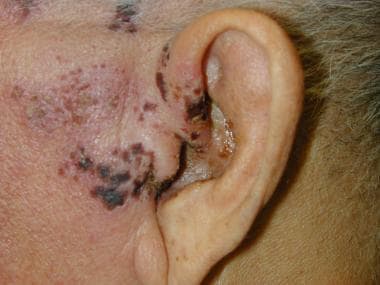 Herpes zoster oticus, day 6. Image courtesy of Manolette Roque, MD, ROQUE Eye Clinic.
Signs and symptoms
Patients usually present with paroxysmal pain deep within the ear. The pain often radiates outward into the pinna of the ear and may be associated with a more constant, diffuse, and dull background pain. The onset of pain usually precedes the rash by several hours and even days.
Classic Ramsay Hunt syndrome can be associated with the following:
-
Vesicular rash of the ear or mouth (as many as 80% of cases)
-
The rash might precede the onset of facial paresis/palsy (involvement of the seventh cranial nerve [CN VII])
-
Ipsilateral lower motor neuron facial paresis/palsy (CN VII)
-
Vertigo and ipsilateral hearing loss (CN VIII)
-
Tinnitus
-
Otalgia
-
Headaches
-
Dysarthria
-
Gait ataxia
-
Fever
-
Cervical adenopathy
Diagnosis
The diagnosis of Ramsay Hunt syndrome is usually made without difficulty when the clinical characteristics are present. If necessary, varicella zoster virus (VZV) may be isolated from vesicle fluid and inoculated into susceptible human or monkey cells for identification by serologic means.
WBC count, erythrocyte sedimentation rate (ESR), and serum electrolytes are helpful in distinguishing the infectious and inflammatory nature of this syndrome.
Management
Treatment goals of Ramsay Hunt syndrome are to minimize disability and relieve symptoms. Clinical evidence shows that earlier start of treatment is correlated with better outcomes. [10]
Oral corticosteroids and oral acyclovir are commonly used in the treatment of Ramsay Hunt syndrome.
After initiation of medical therapy, the patient with Ramsay Hunt syndrome should be seen in follow-up at 2 weeks, 6 weeks, and 3 months.

Background
Ramsay Hunt syndrome is defined as an acute peripheral facial neuropathy associated with erythematous vesicular rash of the skin of the ear canal, auricle (also termed herpes zoster oticus), and/or mucous membrane of the oropharynx.
Herpes zoster oticus, day 6. Image courtesy of Manolette Roque, MD, ROQUE Eye Clinic.
This syndrome is also known as geniculate neuralgia or nervus intermedius neuralgia. Ramsay Hunt syndrome can also occur in the absence of a skin rash, a condition known as zoster sine herpete. [1]
Ramsay Hunt syndrome was first described in 1907 by James Ramsay Hunt in a patient who had otalgia associated with cutaneous and mucosal rashes, which he ascribed to infection of the geniculate ganglion by human herpesvirus 3 (ie, varicella-zoster virus [VZV]). [2]
The following may be observed:
-
VZV auricularis
-
VZV in any of the zoster zones of the head and neck (herpes auricularis, herpes facialis, and herpes occipito-collairs) with facial palsy
-
VZV in any of the zoster zones with facial palsy and auditory symptoms (eg, tinnitus, deafness, vertigo, nystagmus, ataxia)
Pathophysiology
Ramsay Hunt syndrome is defined as VZV infection of the head and neck that involves the facial nerve, often the seventh cranial nerve (CN VII). Other cranial nerves (CN) might be also involved, including CN VIII, IX, V, and VI (in order of frequency). This infection gives rise to vesiculation and ulceration of the external ear and ipsilateral anterior two thirds of the tongue and soft palate, as well as ipsilateral facial neuropathy (in CN VII), radiculoneuropathy, or geniculate ganglionopathy.
VZV infection causes 2 distinct clinical syndromes. Primary infection, also known as varicella or chickenpox, is a common pediatric erythematous disease characterized by a highly contagious generalized vesicular rash. The annual incidence of varicella infection has significantly declined after the introduction of mass vaccination programs in most countries of the world. [3]
After chickenpox, VZV remain latent in neurons of cranial nerve and dorsal root ganglia. Subsequent reactivation of latent VZV can result in localized vesicular rash, known as herpes zoster. VZV infection or reactivation involving the geniculate ganglion of CN VII within the temporal bone is the main pathophysiological mechanism of Ramsay Hunt syndrome. Diminished level of VZV-specific cell-mediated immunity may lead to reactivation of this virus. [4]
Epidemiology
Frequency
Ramsay Hunt syndrome is a rare complication of latent VZV infection. [5] As previously stated, Ramsay Hunt syndrome might occur in the absence of cutaneous rash (zoster sine herpete). Interestingly, VZV has been detected by polymerase chain reaction (PCR) in the tear fluid of patients diagnosed with Bell palsy. [6] Ramsay Hunt syndrome is estimated to account for 16% of all causes of unilateral facial palsies in children, and 18% of facial palsies in adults. Ramsay Hunt syndrome is rare in children younger than 6 years. [5]
Ramsay Hunt syndrome is thought to be the cause of as many as 20% of clinically diagnosed cases of Bell palsy. [6]
The incidence of Ramsay Hunt syndrome among patients with HIV infection is unknown. However, it may occur at a higher rate than in the general population because individuals with HIV infection have a higher risk of VZV infection. [2]
Mortality/morbidity
Ramsay Hunt syndrome is not usually associated with mortality. It is a self-limiting disease; the primary morbidity results from facial weakness. Unlike Bell palsy, this syndrome has a complete recovery rate of less than 50%.
Prognosis
In general, prognosis is good for the resolution of Ramsay Hunt syndrome symptoms. [39] However, fewer than 50% of patients have complete recovery of facial function.
Patient Education
The patient with Ramsay Hunt syndrome should be educated about eye care to prevent corneal irritation or injury.
-
Herpes zoster oticus, day 6. Image courtesy of Manolette Roque, MD, ROQUE Eye Clinic.