Practice Essentials
Herpes zoster is viral infection that occurs with reactivation of the varicella-zoster virus. It is usually a painful but self-limited dermatomal rash. Symptoms typically start with pain along the affected dermatome, which is followed in 2-3 days by a vesicular eruption. Classic physical findings include painful grouped herpetiform vesicles on an erythematous base. Treatment includes antiviral medications such as acyclovir, famciclovir, and valacyclovir given within 72 hours of symptom onset.
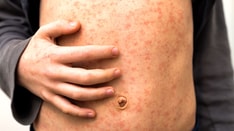
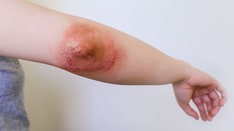
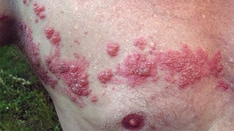
Reactivation of varicella-zoster virus (VZV) that has remained dormant within dorsal root ganglia, often for decades after the patient’s initial exposure to the virus in the form of varicella (chickenpox), results in herpes zoster (shingles). [1] While usually a self-limited rash with pain, it can be far more serious; in addition, acute cases often lead to postherpetic neuralgia (PHN) and is responsible for a significant economic burden. [2] See the image below.
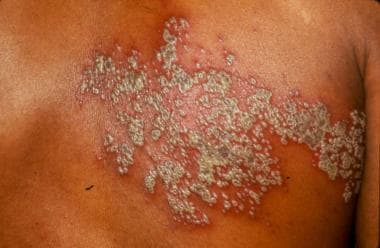
See 14 Rashes You Need to Know: Common Dermatologic Diagnoses, a Critical Images slideshow, for help identifying and treating various rashes.
Signs and symptoms of herpes zoster
The clinical manifestations can be divided into the following three phases:
-
Preeruptive phase (preherpetic neuralgia)
-
Acute eruptive phase
-
Chronic phase (PHN)
The preeruptive phase is characterized by the following:
-
Sensory phenomena along 1 or more skin dermatomes, lasting 1-10 days (average, 48 hours)
-
Phenomena usually are noted as pain or, less commonly, itching or paresthesias [3]
-
Pain may simulate headache, iritis, pleurisy, brachial neuritis, cardiac pain, appendicitis or other intra-abdominal disease, or sciatica
-
Other symptoms, such as malaise, myalgia, headache, photophobia, and, uncommonly, fever
The acute eruptive phase is marked by the following:
-
Patchy erythema, occasionally accompanied by induration, in the dermatomal area of involvement
-
Regional lymphadenopathy, either at this stage or subsequently
-
Grouped herpetiform vesicles developing on the erythematous base (the classic finding)
-
Cutaneous findings that typically appear unilaterally, stopping abruptly at the midline of the limit of sensory coverage of the involved dermatome
-
Vesicular involution: Vesicles initially are clear but eventually cloud, rupture, crust, and involute
-
After vesicular involution, slow resolution of the remaining erythematous plaques, typically without visible sequelae
-
Scarring can occur if deeper epidermal and dermal layers have been compromised by excoriation, secondary infection, or other complications
-
Almost all adults experience pain, typically severe
-
A few experience severe pain without a vesicular eruption (ie, zoster sine herpete)
-
Symptoms tend to resolve over 10-15 days
-
Complete healing of lesions may require up to a month
PHN is characterized by the following:
-
Persistent or recurring pain lasting 30 or more days after the acute infection or after all lesions have crusted (9-45% of all cases) [4]
-
Pain usually is confined to the area of original dermatomal involvement
-
The pain can be severe and incapacitating
-
Pain can persist for weeks, months, or years
-
Slow resolution of pain is especially common in the elderly [5]
-
PHN is observed more frequently after cases of herpes zoster ophthalmicus (HZO) and in instances of upper-body dermatomal involvement
-
Less common postherpetic sequelae include hyperesthesia or, more rarely, hypoesthesia or anesthesia in the area of involvement
Common features of herpes zoster ophthalmicus are as follows:
-
Classic symptoms and lesions of herpes zoster
-
Ophthalmic manifestations including conjunctivitis, scleritis, episcleritis, keratitis iridocyclitis, Argyll-Robertson pupil, glaucoma, retinitis, choroiditis, optic neuritis, optic atrophy, retrobulbar neuritis, exophthalmos, lid retraction, ptosis, and extraocular muscle palsies
Other forms include the following:
-
Herpes zoster of maxillary branch of cranial nerve (CN) V
-
Herpes zoster of mandibular branch of CN V
-
Herpes zoster oticus (Ramsay Hunt syndrome)
-
Glossopharyngeal and vagal herpes zoster
-
Herpes occipitocollaris (vertebral nerves C2 and C3 involvement)
-
Herpes zoster encephalomyelitis
-
Disseminated herpes zoster
-
Unilateral herpes zoster involving multiple dermatomes
-
Recurrent herpes zoster
-
Herpes zoster involving urinary bladder, bronchi, pleural spaces, or gastrointestinal tract
-
Herpes zoster with motor complications
See Clinical Presentation for more detail.
Diagnosis
Diagnosis is based primarily on the history and physical findings. In most cases, confirming the diagnosis via laboratory testing has no utility. In select patient populations, however—particularly immunocompromised patients—the presentation can be atypical and may require additional testing.
Laboratory studies for VZV include the following:
-
Direct fluorescent antibody (DFA) testing of vesicular fluid or a corneal lesion
-
Polymerase chain reaction (PCR) testing of vesicular fluid, a corneal lesion, or blood
-
Tzanck smear of vesicular fluid (lower sensitivity and specificity than DFA or PCR)
See Workup for more detail.
Management
Episodes of herpes zoster are generally self-limited and resolve without intervention; they tend to be more benign and mild in children than in adults.
Conservative therapy includes the following:
-
Nonsteroidal anti-inflammatory drugs (NSAIDs)
-
Wet dressings with 5% aluminum acetate (Burrow solution), applied for 30-60 minutes 4-6 times daily
-
Lotions (eg, calamine)
Primary medications for acute zoster–associated pain include the following:
-
Narcotic and nonnarcotic analgesics (both systemic and topical)
-
Neuroactive agents (eg, tricyclic antidepressants [TCAs])
-
Anticonvulsant agents
Steroid treatment is traditional but controversial. Typically, a substantial dose (eg, 40-60 mg of oral prednisone every morning) typically is administered as early as possible in the course of the disease and is continued for 1 week, followed by a rapid taper over 1-2 weeks.
Antiviral therapy may decrease the length of time for new vesicle formation, the number of days to attain complete crusting, and the days of acute discomfort. Usually, the earlier antiviral medications are started, the more effective they are in shortening the duration of zoster and in preventing or decreasing the severity of PHN. Ideally, therapy should be initiated within 72 hours of symptom onset.
Oral treatment with the following has been found beneficial:
-
Acyclovir
-
Famciclovir
-
Valacyclovir
Hospital admission should be considered for patients with any of the following:
-
Severe symptoms
-
Immunosuppression
-
Atypical presentations (eg, myelitis)
-
Involvement of more than 2 dermatomes
-
Significant facial bacterial superinfection
-
Disseminated herpes zoster
-
Ophthalmic involvement
-
Meningoencephalopathic involvement
Prevention
The routine use of the live attenuated varicella vaccine has led to a remarkable reduction in the incidence of primary varicella infection. Prevention or attenuation is particularly desirable in older patients because zoster is more frequent and is associated with more complications in older populations and because declining cell-mediated immunity in older age groups is associated with an increased risk of zoster.
Vaccines available in the United States include the following:
-
Varivax for children
-
Shingrix for older adults
The CDC recommends administration of varicella-zoster immune globulin to prevent or modify clinical illness in persons with exposure to varicella or herpes zoster who are susceptible or immunocompromised.
Prompt treatment of acute zoster and its associated pain (eg, with antiviral therapy) can prevent the development of PHN. Once PHN has developed, various treatments are available, including the following:
-
Neuroactive agents (eg, TCAs) [6]
-
Anticonvulsant agents (eg, gabapentin, [7] pregabalin)
-
Narcotic and nonnarcotic analgesics, both systemic (eg, opioids) and topical
See Treatment and Medication for more detail.

Background
Herpes zoster (shingles) is an acute, cutaneous viral infection caused by the reactivation of varicella-zoster virus (VZV), a herpesvirus that is the cause of varicella (chickenpox). Differences in clinical manifestations between varicella and herpes zoster apparently depend on an individual's immune status; those with no previous exposure to VZV, most commonly children, develop the clinical syndrome of varicella, whereas those with circulating varicella antibodies develop a localized recrudescence, zoster.
Zoster probably results most often from a failure of the immune system to contain latent VZV replication. Whether other factors, such as radiation, physical trauma, certain medications, other infections, and stress, also can trigger zoster has not been determined with certainty. Nor is it entirely clear why circulating varicella antibodies and cell-mediated immune mechanisms do not prevent recurrent overt disease, as is common with most other viral illnesses.
The incidence of zoster appears to be inversely correlated with the host’s capacity to mount a cellular immune response. However, many patients with zoster apparently have normal immunity. In these patients, zoster is postulated to occur when VZV antibody titers and cellular immunity drop to levels that no longer are completely effective in preventing viral invasion. Evidence for this hypothesis includes the observation that pediatricians, who presumably are routinely reexposed to VZV and thus maintain high levels of immunity, seldom develop zoster.
Herpes zoster manifests in many ways. It should not be considered simply a self-limited dermatomal rash with pain. VZV infection is an acute neurologic disease that warrants immediate evaluation. That VZV is always a benign disorder is a common misperception. Once VZV infection resolves, many individuals continue to suffer pain—a condition known as postherpetic neuralgia (PHN).
Pathophysiology
VZV infection gives rise to two distinct syndromes. The primary infection, chickenpox, is a contagious and usually benign febrile illness. After this infection resolves, viral particles remain in the dorsal root or other sensory ganglia, where they may lay dormant for years to decades.
In this latent period, host immunologic mechanisms suppress replication of the virus, but VZV reactivates when the host mechanisms fail to contain the virus. Such failure may result from a wide spectrum of conditions, ranging from stress to severe immunosuppression; occasionally, it follows direct trauma. VZV viremia occurs frequently with chickenpox but also may arise with herpes zoster, albeit with a lower viral load.
Once VZV is activated at the spinal root or cranial nerve neurons, an inflammatory response occurs that also encompasses the leptomeninges; both plasma cells and lymphocytes are noted. This inflammation in the dorsal root ganglion can be accompanied by hemorrhagic necrosis of nerve cells. The result is neuronal loss and fibrosis.
The frequency of dermatologic involvement is correlated with the centripetal distribution of the initial varicella lesions. This pattern suggests that the latency may arise from contiguous spread of the virus during varicella from infected skin cells to sensory nerve endings, with subsequent ascent to the ganglia. Alternatively, the ganglia may become infected hematogenously during the viremic phase of varicella, and the frequency of the dermatome involvement in herpes zoster may reflect the ganglia most often exposed to reactivating stimuli.
The appearance of the cutaneous rash due to herpes zoster coincides with a profound VZV-specific T-cell proliferation. Production of interferon alfa appears with the resolution of herpes zoster. In immunocompetent patients, specific antibodies (immunoglobulins G, M, and A [IgG, IgM, and IgA]) appear more rapidly and reach higher titers during reactivation (herpes zoster) than during the primary infection. The patient has a long-lasting, enhanced, cell-mediated immunity response to VZV. [8, 9, 10]
The anatomic location of the involved dermatome often determines the specific manifestations. When cervical and lumbar roots are involved, motor involvement, which is often overlooked, may be evident, depending on the virulence or extent of migration. In at least 1 case of motor neuron involvement, lymphocytic infiltration and myelin breakdown were observed with preservation of axons.
This infection is contagious to persons with no previous immunity to VZV. However, it is estimated to be only one third as contagious as primary varicella. It is transmitted either via direct contact with the lesions or via the respiratory route.
Herpes virus infections may occur together in the same host. Of more than 100 types of Herpesviridae viruses, eight are of particular interest in humans: herpes simplex viruses (HSVs)–1 and 2, VZV, cytomegalovirus (CMV), Epstein-Barr virus (EBV), and human herpesviruses 6, 7, and 8 (HHV-6, HHV-7, HHV-8). [11] Postmortem examination of trigeminal and/or facial ganglia detected these viruses in 30 (63.8%) of 47 subjects, with HHV-6 being the most prevalent, identified in 46.8% of them, followed by HSV-1 in 14.9%, VZV in 8.5%, EBV in 8.5%, HSV-2 in 4.3%, and CMV in 2.1%.
Organ system involvement
Central nervous system
Whereas herpes zoster is classically described in sensory (dorsal root) ganglia, it can spread to affect any portion of the central nervous system (CNS). Involvement of the anterior horn cells can produce muscular weakness, cranial nerve palsies, diaphragmatic paralysis, neurogenic bladder, and colonic pseudo-obstruction. Wider involvement of the spinal cord can produce Guillain-Barré syndrome, transverse myelitis, and myositis.
In severely ill or immunocompromised patients, general CNS involvement can be observed in the form of meningoencephalitis or encephalitis. Such presentations may be indistinguishable from those of other forms of meningoencephalitis, though other evidence of acute zoster usually is present. [12] Cerebrospinal fluid (CSF) studies frequently reveal pleocytosis without elevated protein. These infections can be life-threatening.
Optical system
Herpes zoster ophthalmicus (HZO), a potentially devastating form of acute herpes zoster, results from the reactivation of VZV in the trigeminal (fifth cranial) nerve. Any branch of the nerve may be affected, though the frontal branch within the first division of the trigeminal nerve is most commonly involved. This branch innervates nearly all of the ocular and periocular structures.
Polymerase chain reaction (PCR) nerve studies have detected latent trigeminal VZV in as many as 87% of patients. [13] Clinical disease has been reported in as few as 8% and as many as 56% of patients in studies focused on ophthalmic involvement. [14]
Auditory system
Herpes zoster oticus (also known as Ramsay Hunt syndrome, geniculate neuralgia, or herpes zoster auricularis) is caused by VZV reactivation involving the facial and auditory nerves. This syndrome may go unnoticed and be difficult to diagnose, especially in elderly patients.
Vesicular eruptions may manifest on the pinna, tragus, or tympanic membrane or in the auditory canal, as well as anywhere in the facial nerve distribution. The patient may experience hearing impairment, nystagmus, vertigo, or a facial nerve palsy mimicking Bell palsy. [15] Patients may lose taste sensation in the anterior two thirds of the tongue. [15]
Clinical phases of disease
The clinical manifestations can be divided into the following three phases:
-
Preeruptive phase (preherpetic neuralgia)
-
Acute eruptive phase
-
Chronic phase (PHN)
The preeruptive phase is characterized by unusual skin sensations or pain within the affected dermatome that heralds the onset of lesions by 48-72 hours. During this time, patients may also experience other symptoms, such as malaise, myalgia, headache, photophobia, and, uncommonly, fever. Trigeminal herpes zoster and Ramsay Hunt syndrome were described in an elderly man with a prodromal toothache. [16]
The acute eruptive phase is marked by the emergence of vesicular eruptions. Patients may also experience some of the other symptoms seen in the preeruptive phase. Lesions begin as erythematous macules and papules that quickly develop into vesicles. New lesions tend to form over a period of 3-5 days, sometimes coalescing to form bullae. After they form vesicles, lesions progress through stages in which they rupture, release their contents, ulcerate, and finally crust over and become dry. Patients remain infectious until the lesions have dried.
During this phase, almost all adult patients experience pain (ie, acute neuritis). A few experience severe pain without any evidence of a vesicular eruption (ie, zoster sine herpete), and a small number have a characteristic eruption but do not experience pain. Symptoms and lesions in the acute eruptive phase tend to resolve over 10-15 days. However, lesions may require up to a month to completely heal, and the associated pain may become chronic.
PHN, the chronic phase, is characterized by persistent or recurring pain lasting 30 or more days after the acute infection or after all lesions have crusted. It is the most frequent complication, observed in 9-45% of all cases. [4] Most people report a deep burning or aching pain, paresthesia, dysesthesia, hyperesthesia, or electric shock–like pains. The pain can be severe and incapacitating, and may take a long time to resolve, especially in the elderly; it lasts longer than 12 months in nearly 50% of patients older than 70 years. [5]
Etiology of Herpes Zoster
Herpes zoster (shingles) is caused by VZV infection. VZV is an enveloped, double-stranded DNA virus belonging to the Herpesviridae family; its genome encodes approximately 70 proteins. In humans, primary infection with VZV occurs when the virus comes into contact with the mucosa of the respiratory tract or conjunctiva. From these sites, it is distributed throughout the body. After primary infection, the virus migrates along sensory nerve fibers to the satellite cells of dorsal root ganglia where it becomes dormant.
Reactivation of VZV that has remained dormant within dorsal root ganglia, often for decades after the patient’s initial exposure to the virus in the form of varicella (chickenpox), results in herpes zoster. [1] Exactly what triggers this reactivation has not yet been determined precisely, but likely candidates (alone, or in combination) include the following:
-
External reexposure to the virus
-
Acute or chronic disease processes (particularly malignancies and infections)
-
Medications of various types
-
Emotional stress
The reason why one dorsal root ganglion experiences reactivation of its stored viral load preferentially over another ganglia is unclear. Diminished cellular immunity seems to increase the risk of reactivation, in that the incidence increases with age and in immunocompromised persons. [17]
Zoster can be a presenting symptom of hyperparathyroidism, and it occurs twice as often (frequency, 3.7%) among patients with hypercalcemia as it does among age-matched cohorts of patients older than 40 years who have normal calcium levels. [18]
The cause of PHN also remains a mystery. Rapid initiation of treatment decreases the incidence of PHN substantially, an effect that can be explained by the theory that incessant pain of active zoster sets up a positive feedback loop within the thalamus and the cortex, creating a central pain syndrome similar to phantom leg pain. According to this theory, prompt treatment breaks the loop by providing pain-free periods early in the disease course.
Risk factors
Known risk factors for developing herpes zoster relate to the status of cell-mediated immunity to VZV. Risk factors in children and adults include the following:
-
VZV-specific immunity and cell-mediated immunity, which generally declines with age
-
Primary VZV infection in utero or in early infancy, when the normal immune response is decreased
-
Anti-tumor necrosis factor (TNF)-a agents (may pose an increased risk) [34]
-
Immune reconstitution inflammatory syndrome (IRIS)
-
Acute lymphocytic leukemia and other malignancies
IRIS is a paradoxical deterioration in clinical status that develops in a patient receiving antiretroviral treatment despite satisfactory control of viral replication and improvement of the patient’s CD4 count. Such patients may have signs and symptoms of a previously subclinical and unrecognized herpes zoster infection, as a paradoxical worsening of treatment response several weeks into therapy in the context of immune recovery on antiretroviral therapy (ART).
The appearance of herpes zoster within an 8- to 12-week period after initiation of ART should prompt consideration of IRIS. Early recognition and prompt treatment, along with continuation of highly active ART, are especially important in such cases. [35]
Research indicates that patients with inflammatory bowel disease (IBD) are at significantly increased risk for herpes zoster. [8] In an analysis of more than 108,000 IBD patients and 430,000 matched controls, the overall annual incidence per 100,000 person-years was 734 among IBD patients, compared with 437 in non-IBD patients. The elevated risk in IBD patients remained after adjustment for comorbidities and other factors. Treatment with thiopurines, corticosteroids, and biologic antitumor necrosis factor–alpha (anti-TNF) agents was independently associated with an increased risk of herpes zoster. [36, 37]
Patients with multiple myeloma and colon cancer treated with arsenic trioxide may have a propensity to develop herpes zoster (shingles). Arsenic compounds have been suggested as a possible predisposing factor for herpes viral reactivation in these patients. [38]
Ambilateral reactivation of herpes zoster after cataract operations on both eyes has been described. [39]
In a population-based case-control study from the United Kingdom aimed at quantifying the effects risk factors at various ages, 144,959 adults diagnosed with herpes zoster between 2000 and 2011 were compared with 549,336 age-, sex-, and practice-matched control subjects (median age, 62 years). [40] The following factors were associated with increased risk of zoster:
-
Rheumatoid arthritis (2.1% vs 1.5%)
-
Inflammatory bowel disease (1.3% vs 0.9%)
-
Chronic obstructive pulmonary disease (4.7% vs 3.7%)
-
Asthma (7.1% vs 5.8%)
-
Chronic kidney disease (6.0% vs 5.4%)
-
Depression (4.7% vs 4.0%)
For many of the risk factors evaluated, the relative effects were greater in younger individuals. [40] The greatest risk of zoster was observed in patients with severely immunosuppressive conditions (eg, lymphoma and myeloma), but current vaccines are contraindicated in these individuals.
Epidemiology
United States statistics
In the United States, approximately 95% of adults—and 99.5% of adults aged 40 years or older—have antibodies to VZV and thus are vulnerable to reactivation of infection. [41] A person of any age with a previous varicella infection may develop zoster, but the incidence increases with advancing age as a consequence of declining immunity.
Approximately 4% of patients develop a recurrent episode later in life. [42] Recurrent zoster occurs almost exclusively in people who are immunosuppressed. Approximately 25% of patients with HIV and 7-9% of those receiving renal transplantation or cardiac transplantation experience a bout of zoster.
HZO represents 10-15% of all cases of HZ. Approximately half of these patients develop complications of HZO. The risk of ophthalmic complications in patients with herpes zoster does not seem to correlate with age, sex, or severity of the rash.
Before the advent of widespread vaccination, an estimated 4 million cases of primary VZV infection occurred annually in the United States alone. [41] Infection was nearly universal by the end of the teenage years, with studies showing only 10% of persons older than age 15 years as remaining susceptible to infection. [42]
Over the period of a lifetime, 10-20% of those with primary infections went on to experience episodes of herpes zoster. [43] High-risk groups, such as elderly populations and immunocompromised people, might experience cumulative incidences as high as 50%. [44] The estimated annual number of cases in the United States is approximately 1 million. [18]
Since the introduction of widespread vaccination for varicella in 1995, the incidence of primary VZV infection in the United States has been reduced by up to 90%. [41] However, the effect of this vaccination, as well as that of the subsequently approved vaccination for herpes zoster, on the current and future incidence of herpes zoster remains to be determined.
International statistics
Internationally, the incidence of zoster has not been well studied, but it is probably in the same range as that reported in the United States. [45] A German study of data on patients in the country’s statutory health system (SHI) for the year 2010 estimated that the mean annual incidence was 5.79 cases per 1000 person-years, equivalent to 403,625 cases annually in the SHI population (which comprised about 85% of the total German population). [46]
Age-related demographics
It is rare in children and young adults, except in younger patients with AIDS, lymphoma, other malignancies, and other immune deficiencies and in patients who have received bone marrow or kidney transplants. Fewer than 10% of zoster patients are younger than 20 years, and only 5% are younger than 15 years. Even though zoster is primarily a disease of adults, it has been noted as early as the first week of life, occurring in infants born to mothers who had primary VZV infection (chickenpox) during pregnancy.
The incidence increases with age. [47] In the general population, the lifetime incidence rate is 10-20%, which rises to 50% in those individuals surviving to age 85 years. [17] More than 66% of patients are older than 50 years. The incidence of PHN also rises with advancing age. [48]
Sex-related demographics
It generally has not been considered to have a sex predilection. However, one study reported a higher prevalence in women than in men. [49] Ertunc et al suggested both that zoster frequency is higher in right-handed patients and that the rash appears more frequently on the left side in females. [50] The pathophysiology for these differences is uncertain.
Race-related demographics
Blacks are reported to have a significantly lower risk of developing zoster than whites do; however, zoster has been reported as an early manifestation of HIV infection in young Africans. Research has shown that elderly blacks are up to 75% less likely to develop herpes zoster than elderly whites. [44] Similar findings have been demonstrated in children. [51] In a meta-analysis of controlled herpes zoster clinical trials, a nonwhite racial group was found to be associated with a younger age at zoster onset. [47]
Prognosis
The rash usually resolves within 10-15 days. The prognosis for younger and otherwise healthy patients is excellent. Elderly people have a significantly increased risk of complications.
It rarely causes fatalities in patients who are immunocompetent, but it can be life-threatening in severely debilitated or immunocompromised patients. Disseminated zoster in immunocompromised patients can lead to death from encephalitis, hepatitis, or pneumonitis. Patients with active lymphoproliferative malignancies are at particular risk. Mortality rate from disseminated herpes zoster is between 5% and 15%. [43]
Morbidity usually is confined to pain within the affected dermatome, which can range in intensity from uncomfortable to debilitating. PHN can persist well beyond the duration of active disease, though most cases eventually resolve.
Variant presentations of zoster (eg, keratitis and myelitis) may carry additional morbidity. Eye involvement (HZO) can cause temporarily or permanently decreased visual acuity or blindness. Complications such as secondary infection and meningeal or visceral involvement can produce further morbidity in the form of infections and scarring.
A 2017 propensity score–matched analysis indicates that newly diagnosed herpes zoster significantly raises the risk of myocardial infarction and stroke. [52, 53] Results showed a 41% increased risk of composite cardiovascular events. Antiviral treatment and vaccination may decrease risks, but further research is needed. Rationing of health care so that there is an 80-year upper age limit on vaccinations enhances the burden of disease. [54]
Patient Education
Patients should be informed about the natural progression of herpes zoster, its potential complications, and the value of vaccinations. Motivational interviewing has been successful in increasing adult vaccinations using supermarket chain pharmacies. [55]
During the acute phase, patients are infective and contagious to others and should be instructed to avoid contact with elderly people, people who are immunocompromised, pregnant women, people with no history of chickenpox infection. It is especially contagious to infants and babies.
In regard to treatment, patients should be instructed that treatment should be started within 72 hours of onset if at all possible, not only to speed resolution of the shingles itself but also to prevent PHN. Once PHN begins, treatment is much more difficult and often unsuccessful. Patients should also be told not to scratch the lesions; doing so may predispose them to secondary bacterial infections.
For patient education resources, see the Infections Center, as well as Shingles and Chickenpox. Additionally, an informational video is provided below.
-
Typical zoster in the vicinity of right popliteal fossa in a vertebral nerve L4 distribution.
-
Suspected zoster of the hand.
-
Herpes zoster, unilateral, on trunk.
-
Herpes zoster on lateral part of abdomen.
-
Maculopapular rash due to herpes zoster in child with history of leukemia. Image courtesy of Centers for Disease Control and Prevention (CDC).
-
Herpes zoster in ophthalmic (V1) distribution of trigeminal nerve. Note unilateral distribution of rash and how V1 distribution may extend to tip of nose. Though at risk for keratitis with zoster in this distribution, patient had normal ocular examination. Patient consented to picture distribution for educational use; written permission on file. Image courtesy of JS Huff.
-
Herpes zoster on neck.
-
What is herpes? Herpes is a virus causing sores most commonly around the mouth (oral herpes) and genitals (genital herpes).