You are in: eMedicine Specialties >
Neurology > Pediatric Neurology
Neonatal Injuries in Child Abuse
Article Last Updated: Jan 10, 2007
AUTHOR AND EDITOR INFORMATION
Section 1 of 10
Author: Nitin Patel, MD, MPH, Associate Professor of Clinical Neurology and Child Health, Department of Child Health, Interim Division Chief for Developmental Pediatrics and Child Neurology, Specialist in Pediatrics/Neurology, University of Missouri Hospital and Clinic at Columbia
Nitin Patel is a member of the following medical societies: American Academy of Neurology, American Epilepsy Society, American Headache Society, and Child Neurology Society
Coauthor(s):
Bhagwan I Moorjani, MD, FAAP, FAAN, Consulting Staff, Department of Neuroscience, Director, Department of Neuroscience, Division of Evoked Response Laboratory, Children's National Medical Center
Editors: Robert Rust Jr, MD, Thomas E Worrell Jr Professor of Epileptology and Neurology, Co-Director of FE Dreifuss Child Neurology and Epilepsy Clinics, University of Virginia School; Clinical and Residency Training, Child Neurology, University of Virginia Hospital and Clinics; Francisco Talavera, PharmD, PhD, Senior Pharmacy Editor, eMedicine; Kenneth J Mack, MD, PhD, Senior Associate Consultant, Department of Child and Adolescent Neurology, Mayo Clinic; Matthew J Baker, MD, Consulting Staff, Collier Neurologic Specialists, Naples Community Hospital; Nicholas Y Lorenzo, MD, Chief Editor, eMedicine Neurology; Consulting Staff, Neurology Specialists and Consultants
Author and Editor Disclosure
Synonyms and related keywords:
shaken baby syndrome, shaken-baby syndrome, SBS, shaking, neurologic injury in child abuse, battered child syndrome, battered-child syndrome, child abuse, shaken infant, shaking impact syndrome, shaking-impact syndrome, retinal hemorrhage
Background
Child abuse is often misdiagnosed and underrecognized by physicians and caregivers.
Child abuse occurs in many forms and is best defined as purposeful infliction of physical or emotional harm, sexual exploitation, and/or neglect of basic needs (eg, nutrition, education, medical care).
Shaken baby syndrome (SBS) is of particular interest to the neurologist, as it affects the nervous system. SBS may cause long-term sequelae in the developing nervous system, and the effects may even be lethal.
In 1946, Caffey reported a series of patients with multiple fractures and chronic subdural hematoma, which fit the profile of what is now defined as SBS. Kempe et al coined the term battered child syndrome. In 1967, Gilkes and Mann first reported the funduscopic findings of battered babies. In 1972, Caffey wrote about the syndrome of shaken infants. This report brought attention to this form of child abuse.
Pathophysiology
Anatomic features make infants especially prone to neurologic injury from excessive shaking or trauma. Infants have a large head compared with their body size, and the cervical paraspinal muscles are weak. (This accounts for head lag observed during the first month of life.) The infant brain has a higher water content than that of the adult brain, and it is incompletely myelinated. The subarachnoid spaces are also larger in infants than in adults, given the small size of their brains.
When the infant is shaken, movement of the immature brain in relation to the skull and the poor muscle tone in the neck cause the bridging vessels to tear, resulting in the classic finding of a subdural hematoma. Retinal hemorrhages are produced when venous congestion causes rupture of the retinal vasculature. Therefore, SBS is defined by subdural hemorrhage and retinal hemorrhage.
The mechanism by which brain damage occurs is controversial. Traditionally, shearing forces were believed to cause axonal damage. Geddes et al suggested that hypoxia-ischemia, rather than axonal injury, as the mechanism, as seen in older children and adults with lethal head trauma. They also thought that acceleration and deceleration forces may damage the neuraxis to cause apnea, with consequent ischemia and cerebral edema.
Biomechanical studies of infant trauma injuries have shown that the magnitude of angular deceleration is 50 times greater when the infant's head strikes a surface than when he or she is only shaken. This force is distinct from those of other accidental traumas that occur in infants. This evidence suggests that the term shaking-impact syndrome is more accurate than SBS.
Frequency
United States
Approximately 12 of every 1000 American children are mistreated. In 2004, 3.5 million cases of child abuse and neglect were reported. Of these, 872,000 cases were substantiated. In the first year of life, accidental injury occurs more often than intentional injury. The incidence of trauma in children younger than 12 months is approximately 86 cases per 1000 children per year.
International
Good statistical data are not available.
Mortality/Morbidity
Abuse and neglect account for 5-14% of all deaths of children. In the United States, 1490 fatalities from child abuse were reported, and 45% involved infants younger than 12 months. In 2005 in Missouri, 32 children died as a result of child abuse or neglect. SBS is reported to be the leading cause of death in children younger than 4 years.
- In children younger than 1 year, homicide is the leading cause of death. This is the only cause of death in children that is increasing in frequency.
- In a series of 80 patients younger than 2 years who had head trauma and died because of the injury, 43% had evidence of child abuse.
Sex
- Boys are affected more often than girls.
- The perpetrator is usually alone with the victim.
- Men are the abusers in 90% of cases. The abuser is usually the biologic father or, in some cases, the mother's boyfriend.
- The most common female attacker is a babysitter.
Age
- In 2004, 3.5 million cases of child abuse and neglect were reported. Of these, 872,000 cases were substantiated. About 16.1% of the affected children were younger than 3 years, and 10.3% were younger than 1 year.
- The typical abused child is younger than 6 months.
History
- More than half of the patients who present to the emergency department (ED) or a physician's office with suspected above have no history of previous abuse.
- One fourth have a history of minor trauma.
- A small percentage present with a seizure, with varying levels of consciousness (eg, coma, apnea, respiratory arrest).
- Other symptoms failure to thrive, poor feeding, and other vague symptoms.
- The typical patient is a frequent visitor to the ED because of various symptoms.
- Common historical accounts that suggest abuse include injury inflicted by sibling, a fall down the steps, suddenly turning blue and stopping breathing, being left alone for a few minutes, and falling from a low height.
- Patients occasionally present with minor symptoms, such as earache, ear pulling, cough, or colds.
- The true nature of the problem is often discovered only after CT is preformed and evidence of intracranial pathology is found.
- The most common intracranial lesion is subdural hemorrhage.
- The symptoms are related to signs of increased intracranial pressure (ICP), but some patients have no evidence of increased ICP.
- Other findings are cerebral edema, subarachnoid hemorrhage, and even intraparenchymal hemorrhage.
- Skull fractures are seen in as many as 95% of patients with serious intracranial injury.
- The fracture is usually in the occipital or parietal bones.
- Abuse should be considered if the patient has bilateral depressed fractures or multiple fractures, especially if they cross the suture lines.
- Retinal hemorrhage is a characteristic and diagnostic feature of SBS. It can be detected even before intracranial hemorrhages are seen. Several types of retinal hemorrhages have been described.
- Whether cardiopulmonary resuscitation (CPR) can cause retinal hemorrhage is controversial.
- Kanter evaluated 54 patients for retinal hemorrhage after CPR. Among the patients, 45 had no trauma, and only 1 patient (2%) had evidence of retinal hemorrhage.
- Of the 9 patients who had evidence of trauma, 5 had retinal hemorrhage, and 4 of had evidence of child abuse.
- In 1998, Jayawant identified 9 characteristics of supposed and proven nonaccidental injury in children with subdural hematoma.
- These characteristics suggest a set of criteria that may be used to increase the precision of diagnosis.
- Boys account for two thirds of the children studied.
- Four fifths of the perpetrators are men.
- In about one eighth of all cases, the child and/or his or her siblings were previously abused by the same perpetrator.
- More than half of the caregivers change their stories several times.
- About half of all perpetrators eventually admit to shaking the child.
- About half of all patients have a hemoglobin level of less than 10 g/L at presentation.
- The skeletal survey is positive in 60% of cases involving nonaccidental injury.
- About 60% of patients have evidence of present or past trauma.
- Retinal hemorrhages are present in 80% of patients.
Physical
- Ludwig and Warman in 1984 characterized the presenting physical findings of SBS.
- An enlarged head circumference was seen in slightly more than half of all patients, as was a bulging fontanelle.
- Nonspecific bruising was noted in one third of the patients.
- Neurologic involvement was seen in fewer than 50% of patients.
- The key to diagnosis is the presence of retinal hemorrhages, which are seen in 80% of patients.
- Retinal hemorrhage is considered the hallmark of SBS.
- Retinal hemorrhages can be seen as early as 48 hours before any intracranial lesions can be detected on brain CT or MRI.
- After vaginal delivery, retinal hemorrhages are occasionally seen without intracranial lesions.
Causes
- Certain risk factors increase the probability of child abuse.
- Characteristics of the child abuser include increased stress, social difficulties, and low educational achievement.
- Crying of the infant or child also may play a role.
Blood Dyscrasias and Stroke
Cerebellar Hemorrhage
Epidural Hematoma
Head Injury
Intracranial Hemorrhage
Subdural Empyema
Subdural Hematoma
Other Problems to be Considered
Accidental trauma
Arteriovenous malformation
Bleeding disorders
Infectious subdural effusion
Metabolic disorders, especially glutaric aciduria type 1 (can cause retinal hemorrhages and intracranial lesions)
Lab Studies
- Laboratory studies for SBS are nonspecific and are not diagnostic.
- Leukocytosis is seen in approximately 50% of patients.
- Serum chemistry findings are usually normal, but they may reveal evidence of acidosis.
- The cerebrospinal fluid may be bloody, possibly indicating subarachnoid hemorrhage.
Imaging Studies
- The true nature of the problem is often discovered only after CT is preformed and evidence of intracranial pathology is found.
- The key to diagnosing SBS is neuroimaging.
- CT scanning of the brain is sufficient to diagnose subdural hemorrhage (see Image 1), cerebral edema (see Image 2), and/or subarachnoid hemorrhage. CT is usually the first neuroimaging study obtained in the ED.
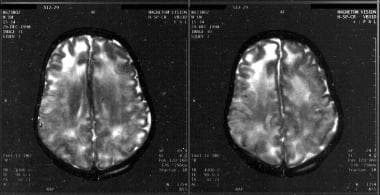
- As a follow-up study, MRI can be used to determine the extent of the neurologic injury (see Images 3-6). MRI may be helpful for continued management and prognosis.
- Retinal hemorrhages can be seen as early as 48 hours before any intracranial lesions can be detected on brain CT or MRI.
- As long as the fontanelle is still open, ultrasonography can be performed identify an intracranial hemorrhage. However, a negative head sonogram does not rule out intracranial pathology.
Other Tests
- An ophthalmologic evaluation is extremely important and helpful in diagnosis.
- A dilated eye examination is preferred. However, in the ED, all patients (regardless of the presenting complaint) should receive retinal examination with a direct ophthalmoscope.
- Papilledema indicates increased ICP, and retinal hemorrhage strongly suggests SBS (see Image 7).
- All patients in whom abuse is suspected must be given a long-bone skeletal survey to check for new or healing fractures, which help in the diagnosis.
Medical Care
- Supportive care is the mainstay of treatment in child abuse.
- Blood pressure and vital signs should be supported and maintained.
- Provide mechanical ventilation as needed.
- Treat increased ICP, if present.
Surgical Care
- Intracranial monitoring may be necessary, especially when ICP is a problem.
- In the presence of subdural hematoma, surgical evacuation may be necessary.
Consultations
- Consult an ophthalmologist who is well versed in identifying eye findings in abused children. The ophthalmologist is required for the initial ophthalmic evaluation and possibly for follow-up as well.
- Appropriate referral to the state or county protective (abuse) center is necessary to identify siblings who may be at risk of abuse.
- Referral to a physician who specializes in abuse can be helpful but not mandatory.
Activity
- Physical therapy and occupational therapy can be helpful after neurologic injury.
- Speech therapy might be beneficial for patients in whom speech and/or language may be affected.
Further Inpatient Care
- Further inpatient rehabilitation therapy may be indicated to manage the acute intracranial pathology, depending on the severity of injury.
- If long-term inpatient care is required, the patient should be transferred to a pediatric rehabilitation unit for maximal multidisciplinary care.
Further Outpatient Care
- The patient may require continued physical and occupational therapy after discharge.
- Continued follow-up with a neurologist is recommended.
- Closely watch the patient for spasticity, and control this with medication as needed.
In/Out Patient Meds
- Antiepileptic medication may be indicated if evidence of seizures is noted.
- Neurosurgeons tend to prescribe prophylactic therapy for all patients. However, this practice is not a universal recommendation.
Complications
- The main complications after SBS affect the neurologic and visual systems.
- After retinal hemorrhages resolved, the following visual complications may occur: macular thinning, retinal pigment epithelial atrophy, and visual loss.
- Wilkinson et al showed that the degree of retinal hemorrhage reflects the degree of neurologic injury.
- Patients with bilateral retinal hemorrhages tend to have acute, severe neurologic injury.
- Large subhyaloid hemorrhage, vitreous hemorrhage, or diffuse involvement of the fundus is likely to be associated with severe neurologic injury.
- Neurologic complications include varying degrees of learning disabilities, spasticity and weakness, hydrocephalus, developmental delay, acquired microcephalus, seizures, hearing loss, and cortical blindness.
Prognosis
- The prognosis depends on the severity of the neurologic injury and the involvement of other organ systems.
Patient Education
Medical/Legal Pitfalls
- In most states, reporting suspected child abuse to the authorities is mandatory.
- Advocates recommend medical tests that support nonaccidental injury, especially in cases of SBS.
- Five controversies have been identified in the field of nonaccidental trauma to children. They pertain to the 5 major assumptions reflected in the sworn testimony of state medical experts.
- The first assumption is that shaking alone of a healthy child causes retinal hemorrhages and subdural hematomas. Biomechanical research and human case data suggest that shaking alone cannot cause these symptoms, but experts can state that short falls cannot.
- The second assumption is that falls over a short distance do not kill infants or children. However, findings from medical research and case studies do suggest that infants and children can and do die from such falls.
- The third controversy states that chronic subdural hematomas do not spontaneously rebleed. The literature about adult patients suggests that rebleeding can also occur in children with a subdural hematoma, with or without abuse.
- The fourth controversy is that a lucid interval is not a feature of pediatric head injury. However, the medical literature suggests the occurrence of a lucid interval in head injuries affecting children, as well as adults.
- The fifth controversy is that retinal hemorrhage occurs only in SBS. However, this hemorrhage is found in different situations, such as injuries related to childbirth, coagulation disorders, and CPR.
| Media file 2:
CT scan shows cerebral edema, with loss of gray matterwhite matter distinction. |
 | View Full Size Image | |
Media type: CT
|
| Media file 3:
T1-weighted MRIs reveal bilateral chronic subdural hematomas, as well as severe encephalomalacia involving the parietal, occipital, and temporal lobes. |
 | View Full Size Image | |
Media type: MRI
|
| Media file 4:
T1-weighted MRIs show chronic bilateral subdural hematomas. |
 | View Full Size Image | |
Media type: MRI
|
| Media file 5:
T2-weighted MRIs show encephalomalacia after shaken baby syndrome. |
 | View Full Size Image | |
Media type: MRI
|
| Media file 7:
Funduscopic image shows intraretinal hemorrhages, subhyaloid hemorrhages, localized hemorrhagic choroid detachments, and thin retinal folds. |
 | View Full Size Image | |
Media type: Photo
|
- Alexander R, Sato Y, Smith W, Bennett T. Incidence of impact trauma with cranial injuries ascribed to shaking. Am J Dis Child. Jun 1990;144(6):724-6. [Medline].
- Andreadou E, Yapijakis C, Paraskevas GP, et al. Hereditary neuropathy with liability to pressure palsies: the same molecular defect can result in diverse clinical presentation. J Neurol. Mar 1996;243(3):225-30. [Medline].
- Bruce DA, Zimmerman RA. Shaken impact syndrome. Pediatr Ann. Aug 1989;18(8):482-4, 486-9, 492-4. [Medline].
- Caffey J. Multiple fractures in long bones of infants suffering from chronic subdural hematoma. AJR Am J Roentgenol. 1946;36:163-73.
- Caffey J. On the theory and practice of shaking infants. Its potential residual effects of permanent brain damage and mental retardation. Am J Dis Child. Aug 1972;124(2):161-9.
- Coody D, Brown M, Montgomery D, et al. Shaken baby syndrome: identification and prevention for nurse practitioners. J Pediatr Health Care. Mar-Apr 1994;8(2):50-6. [Medline].
- Donohoe M. Shaken baby syndrome (SBS) and non-accidental injuries (NAI). Available at: http://www.whale.to/v/sbs.html;. 1999;[Full Text].
- Duhaime AC, Alario AJ, Lewander WJ, et al. Head injury in very young children: mechanisms, injury types, and ophthalmologic findings in 100 hospitalized patients younger than 2 years of age. Pediatrics. Aug 1992;90(2 Pt 1):179-85. [Medline].
- Duhaime AC, Gennarelli TA, Thibault LE, et al. The shaken baby syndrome. A clinical, pathological, and biomechanical study. J Neurosurg. Mar 1987;66(3):409-15. [Medline].
- Ewigman B, Kivlahan C. Child maltreatment fatalities. Pediatr Ann. Aug 1989;18(8):476-8, 480-1. [Medline].
- Geddes JF, Plunkett J. The evidence base for shaken baby syndrome. BMJ. Mar 27 2004;328(7442):719-20. [Medline].
- Geddes JF, Hackshaw AK, Vowles GH. Neuropathology of inflicted head injury in children. I. Patterns of brain damage. Brain. Jul 2001;124(Pt 7):1290-8. [Medline].
- Geddes JF, Vowles GH, Hackshaw AK, et al. Neuropathology of inflicted head injury in children. II. Microscopic brain injury in infants. Brain. Jul 2001;124(Pt 7):1299-306. [Medline].
- Giardino AP, Christian CW, Giardino ER. A practical guide to the evaluation of child physical abuse and neglect. Thousand Oaks, Calif: Sage;. 1997.
- Gilkes MJ, Mann TP. Fundi of battered babies. Lancet. 1967;2:468-9.
- HHS. US Department of Health an Human Services. Administration for Children and Families. Factsheets/Publications. Child Maltreatment Reports. Child Maltreatment 2004: Reports from the States to the National Child Abuse and Neglect Data Systems. Washington, DC: Administration for Children and Families;. 2005;[Full Text].
- Hahn YS, Raimondi AJ, McLone DG, Yamanouchi Y. Traumatic mechanisms of head injury in child abuse. Childs Brain. 1983;10(4):229-41. [Medline].
- Ingrahan FD, Matson DD. Subdural hematoma in infancy. J Pediatr. 1944;24:1-37.
- Kanter RK. Retinal hemorrhage after cardiopulmonary resuscitation or child abuse. J Pediatr. Mar 1986;108(3):430-2. [Medline].
- Kempe CH, Silverman FN, Steele BF, et al. The battered-child syndrome. JAMA. Jul 7 1962;181:17-24. [Medline].
- Lancon JA, Haines DE, Parent AD. Anatomy of the shaken baby syndrome. Anat Rec. Feb 1998;253(1):13-8. [Medline].
- Ludwig S, Warman M. Shaken baby syndrome: a review of 20 cases. Ann Emerg Med. Feb 1984;13(2):104-7. [Medline].
- Manning SC, Casselbrant M, Lammers D. Otolaryngologic manifestations of child abuse. Int J Pediatr Otorhinolaryngol. Sep 1990;20(1):7-16. [Medline].
- Missouri Department of Social Services Children's Division. Child Abuse and Neglect in Missouri: Report for Calendar Year 2005: Research and Evaluation. June 2006;[Full Text].
- Spaide RF, Swengel RM, Scharre DW, Mein CE. Shaken baby syndrome. Am Fam Physician. Apr 1990;41(4):1145-52. [Medline].
- Truth Foundation. Shaken Baby Syndrome: Questions and Controversies [Shaken Baby Syndrome Web site]. Available at: http://www.sbstruth.com/Questions%20and%20controversies.htm. Lakeside, MT: Truth Foundation;. 2002;[Full Text].
- Wilkinson WS, Han DP, Rappley MD, Owings CL. Retinal hemorrhage predicts neurologic injury in the shaken baby syndrome. Arch Ophthalmol. Oct 1989;107(10):1472-4. [Medline].
Neonatal Injuries in Child Abuse excerpt Article Last Updated: Jan 10, 2007
|