Practice Essentials
Olivopontocerebellar atrophy (OPCA) is a neurodegenerative syndrome characterized by prominent cerebellar and extrapyramidal signs, dysarthria, and dysphagia. It describes the degeneration of neurons in specific areas of the brain: the cerebellum, pons, and inferior olives. [1]
Signs and symptoms
Generally, cerebellar signs and extrapyramidal signs are the predominant signs of OPCA. In addition, peripheral neuropathy is common. Ophthalmoplegia, retinopathy, and parkinsonism may be present.
Diagnosis
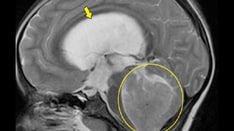
MRI is the imaging study of choice in patients with olivopontocerebellar atrophy (OPCA) because CT scanning does not provide adequate resolution of the pons and cerebellum. MRI typically shows (1) pancerebellar and brainstem atrophy, with flattening of the pons; (2) an enlarged fourth ventricle and cerebellopontine angle; and (3) demyelination of the transverse pontine fibers.
Management
There is no specific treatment for OPCA. Physicians may try different medications to treat the ataxia, tremor, and rigidity that are associated with the disorder. Other treatments are directed at specific symptoms and may include medications, exercise, or assistive devices.

Background
Olivopontocerebellar atrophy (OPCA) is a neurodegenerative syndrome characterized by prominent cerebellar and extrapyramidal signs, dysarthria, and dysphagia. Those who study OPCA quickly learn that it is not a single entity, and that its nosology can be confusing. The umbrella term of OPCA includes common sporadic forms and uncommon genetic forms. In the genetic subgroup, all 3 major inheritance patterns (autosomal dominant, autosomal recessive, and X-linked) have been described. The classification scheme for autosomal dominant OPCA overlaps with that of autosomal dominant spinocerebellar atrophies (SCAs) and autosomal dominant cerebellar atrophies (ADCAs). In the sporadic type of OPCA, at least some of the cases are a subset of multiple system atrophy (MSA).
While the classification is seemingly convoluted, there is good reasoning behind the complexity. The study of neurodegenerative ataxias draws from the interplay between clinical observations, neuropathological analysis, and biochemistry and molecular genetics. Historically, however, one had to rely solely on the combination of clinical observation and neuropathology to describe the disorders. Because of this, the recognition of the OPCA as its own entity has evolved over time.
The first named ataxia to emerge as a clinical entity was not an OPCA, but Friedreich ataxia, which Nicolaus Friedreich (1825-1882) managed to separate from numerous other conditions, the most prominent being multiple sclerosis (then called disseminated sclerosis) and neurosyphilis. [2, 3] Thirty years later, Pierre Marie described another grouping of hereditary cerebellar ataxias. [4] Essentially, he proposed a classification to include all the non-Friedreich ataxia cases and suggested the name heredoataxia cerebelleuse. Some of these cases would now be termed OPCAs.
In 1907, Holmes described a family with a purely cerebellar form of ataxia, and the terms Holmes ataxia and ataxia of Holmes stuck to this category for decades. In 1922, Marie, Foix, and Alajouanine reported a similar family that probably had the same disease. [5] Thus, both Holmes ataxia and the ataxia of Marie, Foix, and Alajouanine (sometimes called Marie ataxia) are purely cerebellar ataxias. Neither would be considered a type of OPCA.
In 1900, Dejerine and Thomas identified cases that combined purely cerebellar problems with evidence of brainstem pathology. [6] They coined the term olivopontocerebellar atrophy. The neurologic community accepted this name and collected many cases under this rubric. Gradually, researchers realized that both sporadic and hereditary (mostly autosomal dominant) cases comprised this group, and that, broadly speaking, these cases all had similar neuropathologic features that are described later in this article. Menzel (1890) also had described a similar case. Throughout the years, both Dejerine-Thomas ataxia and Menzel ataxia have been used as terms for certain cases of either hereditary or sporadic OPCA.
Disputes in the clinic, on paper, and in conferences have occurred about the usage of these terms, such as fine distinctions between Menzel ataxia and ataxia of Dejerine-Thomas, but they are mainly now of historical interest only. OPCA type 1 (OPCA-I) is synonymous with SCA type 1 (SCA-1) and is sometimes referred to as Menzel-type ataxia. Dejerine-Thomas ataxia might be used for any of the 6 major phenotypic OPCAs, which are better defined below. However, the authors recommend against applying either of these terms to any new case of ataxia. These terms are mentioned here only so the reader may understand where they came from if they are encountered in other literature.
In 1954, Greenfield proposed a new clinicopathological classification of OPCA. [7] This was revised by Harding in 1982, based on anatomical, pathological, and biochemical features. [8] As applied to the purely autosomal dominant ataxias, the classification is as follows:
-
Type 1 ADCA (ADCA-1) - Ataxia and noncerebellar findings (eg, pyramidal or extrapyramidal dysfunction and ophthalmoplegia)
-
Type 2 ADCA (ADCA-2) - Similar to ADCA-1 but includes retinal degeneration
-
Type 3 ADCA (ADCA-3) - Includes relatively pure cerebellar dysfunction
In the ADCA grouping, the OPCAs are found in ADCA-1 and ADCA-2.
Harding was well aware that this was essentially a phenotypic grouping that lumped a number of different genetic diseases into 3 classes. However, the system was valuable for further genetic and other scientific work, in which Harding herself has been a significant contributor.
Working on a somewhat separate but related track, in 1970, Konigsmark and Weiner attempted to bring some order to the heterogeneity found among the OPCAs. [9] The proposed classification was based on clinical, genetic, and anatomic factors, as follows:
-
OPCA-I (Menzel-type OPCA) - Autosomal dominant
-
OPCA type 2 (OPCA-II or Fickler-Winkler type OPCA) - Autosomal dominant
-
OPCA type 3 (OPCA-III or OPCA with retinal degeneration) - Autosomal recessive
-
OPCA type 4 (OPCA-IV or Schut-Haymaker type OPCA) - Autosomal dominant
-
OPCA type 5 (OPCA-V or OPCA with dementia and extrapyramidal signs - Likely autosomal dominant
-
OPCA type X (OPCA-X) - X-linked OPCAs (added to classification at later date)
These are detailed in Table 1 in Causes.
In 1974, Skre studied the hereditary ataxia diseases in western Norway and chose to consider all these disorders as members of a comprehensive group of diseases termed spinocerebellar ataxias. [10] This classification then evolved in the classification of SCAs. According to Paulson and Ammache in 2001, SCAs include all well-understood types of dominant OPCA and many other dominant ataxias. [11] Geneticists sometimes state that the OPCA classification has been replaced by the SCA classification. This does not mean that every currently defined SCA is also an OPCA. The SCAs that could typically be considered to be an OPCA are SCA types 1, 2, 3, 7, and possibly 17.
In addition to these major forms, which might be called the traditional or classic OPCAs, some extremely rare diseases also involve degeneration of the same, or very similar, anatomical regions. These are mainly infantile or childhood diseases. They are not what neurologists (even pediatric neurologists) usually call OPCAs. However, occasionally in the literature they are called infantile OPCAs and thus they are included in Table 2 in Causes.
Table 3 in Causes lists a large number of the known SCAs (no table of such diseases is ever totally up-to-date for long), and those that can be reasonably identified as OPCAs are noted.
Finally, the sporadic OPCAs are considered. According to current knowledge, sporadic cases can be classified into the 3 following categories, which may be modified later based on further research findings:
-
Type 1 - A subtype; essentially the presentation of MSA
-
Type 2 - Sporadic cases that are not part of an MSA, as presently understood
-
Type 3 - De novo mutations that are actually genetic cases (but authorities do not realize they are genetic)
A separate but related question is whether the sporadic diseases are simply multigenetic, with the genetics being presently too complex to recognize as such.
A large percentage of the sporadic OPCAs are a subset of MSA, known as cerebellar subtype (MSA-C). Some authorities have claimed that all sporadic OPCAs will progress to include significant autonomic and parkinsonian features and thus evolve into full-blown MSA if the patient lives long enough. According to this view, MSA typically starts as an ataxic OPCA form, an autonomic form (Shy-Drager syndrome), or a parkinsonian form (striatonigral degeneration). Motor neuron degeneration with spasticity and pyramidal weakness, and dementia also eventually occur. [12]
However, a large and careful study by Gilman et al published in 2000 showed that of the cases they selected for analysis, only 25% of the sporadic OPCAs converted to full-blown MSA within 5 years. [13] Nevertheless, all the sporadic OPCAs, Shy-Drager syndrome, striatonigral degeneration, and full-blown MSAs appear on the molecular level to be alpha-synucleinopathies; that is, they involve abnormalities of the protein alpha-synuclein. In addition, Jellinger reports in 2003 that the molecular pathology involves alpha-synuclein–positive glial (and less abundant neuronal) cytoplasmic inclusions in MSA and in all the purported subtypes. [14] These inclusions are also different from the alpha-synucleinopathic inclusions (eg, Lewey bodies), which are seen in other diseases.
The genetic OPCAs are all more pure in the sense that they do not evolve to an MSA picture. Many of the genetic forms are considered SCAs. Some genetic forms have additional characteristics such as retinal involvement, extrapyramidal degeneration, spinal cord degeneration, dystonia, dementia, and other neurological abnormalities dependent mainly on the genetic subtype but even showing variability within the same subtype. The genetic OPCAs are generally not alpha-synucleinopathies.
Clinical distinction of these entities is based on the dominant feature, which may be cerebellar ataxia (observed in OPCAs, SCAs, and MSA), parkinsonism (observed in MSA, striatonigral degeneration, and Shy-Drager syndrome), or autonomic failure (observed in MSA and Shy-Drager syndrome). Whatever the subtype, the term OPCA indicates a form of progressive ataxia distinguished by pontine flattening and cerebellar atrophy on brain imaging studies and at autopsy.
When faced with an adult having progressive ataxia suggestive of OPCA, the role of the clinician includes (1) excluding readily treatable alternative diagnoses, (2) discussing the value of genetic testing with patients in whom such testing is informative, (3) managing symptoms, and (4) advising the patient and family regarding the natural history and the need to plan for the future. No definitive therapy exists for OPCA. [15]
Pathophysiology
The OPCAs are progressive neurodegenerative conditions. Genetic and pathological evidence suggest that abnormalities of alpha-synuclein (αSYN) are important in the pathogenesis of these disorders. Many specific genes have been identified for the genetic forms, although how the genetic abnormalities lead to the specific αSYN abnormalities or to the specific clinical findings remains uncertain. Recently developed models using transgenic mice possessing the genes for human αSYN suggest that MSA involves dysfunction of the ubiquitin-proteasome system causing proteolytic stress that disrupts the oligodendroglial/myelintrophic support. Oligodendroglia in such models, as well as in pathological specimens of the human disease, have cytoplasmic inclusions of fibrillar αSYN. [16] There is also evidence for involvement of the ubiquitin-binding protein p62/sequestosome-1 in some cases of OPCA. [17]
On the gross level, brains show some common characteristics in all cases of OPCA. The pons is diminutive, especially in the area of the basis pontis. Degeneration of the cerebellum occurs, especially in the white matter. This white matter loss is probably due to the dying back of axons from degenerating neurons rather than a primary attack on the myelinated tracts. Loss of Purkinje cells is common. Major neuronal loss occurs in the inferior olivary, arcuate, and pontine nuclei. Dentate nuclei are well preserved. The middle cerebellar peduncles are also atrophic, possibly secondary to degeneration of the basal pontine gray matter. The substantia nigra of the midbrain shows evidence of tissue loss. Cellularly, one sees neuronal degeneration in the arcuate, pontine, inferior olivary, pontobulbar nuclei, and the cerebellar cortex.
Additional areas of degeneration probably account for the difference in subtypes. In sporadic OPCA, oligodendroglial and neuronal intracytoplasmic and intranuclear inclusions characteristic of MSA are frequently seen. Many of these are accumulations of alpha-synuclein. In autosomal dominant OPCA, spinal cord lesions, especially in the posterior columns, spinocerebellar tracts, and anterior gray horn cells, are more common. The cerebellar features may be less prominent. However, so many variations of both the sporadic and genetic forms are described that one can find cases that appear to be exceptions to these generalizations.
Epidemiology
Frequency
The prevalence of olivopontocerebellar atrophy (OPCA) is 3–5 cases per 100,000 individuals; this may represent approximately 5–6% of patients diagnosed with atypical Parkinson disease.
Mortality/Morbidity
The OPCAs are progressive neurodegenerative disorders that have no definitive treatment. Eventually, many patients become wheelchair bound. Severe dysarthria, anarthria, and dysphagia are not uncommon as the disease progresses.
-
Morbidity increases significantly, including falls and aspiration pneumonia.
-
Enteral feeding becomes necessary for many patients.
-
Death commonly results from aspiration pneumonia.
-
The duration of familial OPCA is approximately 15 years. The duration of sporadic OPCA is approximately 6 years.
Race-, sex-, and age-related demographics
No apparent racial preference is observed in OPCA. This is unlike Machado-Joseph disease, which has a predominance in certain Azorean, Indian, and Italian families.
A male preponderance is observed in familial cases of OPCA, with a male-to-female ratio of 2:1. However, no such distinction is seen in sporadic cases.
The mean age of onset of sporadic OPCA is 53 years. The mean age of onset of familial OPCA is 28 years (excluding the infantile forms in Table 2 in Causes).
Prognosis
Currently, no effective therapy is available for the neurodegenerative processes that constitute OPCA. Clinically, only supportive care can be given to patients with this progressive disease.
-
Axial T2 brain shows hyperintensity signals within pons ("hot cross bun" sign).
-
Axial T2 weighed shows putaminal hyposignal intensity with hypersinal intensity rim.
Tables
OMIM # |
OPCA Names |
Other Names |
Genetic Pattern |
Description |
OPCA-1, OPCA-I, Menzel type OPCA |
SCA-1, SCA-I, ADCA-1, ADCA-I |
Gene map locus 6p23 expanded (CAG)n trinucleotide repeat in the ataxin-1 gene (ATXN1; 601556); autosomal dominant; genetic test available |
Onset 30-40 years; ataxia, spasticity, dysarthria, ophthalmoplegia, slow saccades, nystagmus, optic atrophy, pyramidal tract signs; rare extrapyramidal signs; some have dementia; neuropathy occurs late [20] |
|
OPCA-2 |
SCA-2, ADCA-I |
Gene map locus 12q24 expanded (CAG)n trinucleotide repeat in the gene encoding ataxin-2 (ATXN2; 601517); autosomal dominant; genetic test available |
Onset in 30s; ataxia, dysarthria, muscle cramps; slow saccades; ophthalmoplegia; peripheral neuropathy; dementia (some); no pyramidal or extrapyramidal features [21] |
|
OPCA-II, Fickler-Winkler type OPCA |
Fickler-Winkler Syndrome |
Gene/biochemistry not known; autosomal recessive |
Adult-onset; cerebellar ataxia, albinism, impaired intellect; neurological impairments similar to OPCA-I but no involuntary movements or sensory loss [10, 22, 23] |
|
OPCA-III, OPCA-3, OPCA with retinal degeneration |
ADCA-II, SCA-7, OPCA with macular degeneration and external ophthalmoplegia |
Gene locus 3p21.1-p12; expanded trinucleotide repeat in the gene encoding ataxin-7 (ATXN7; 607640); autosomal dominant; genetic test available |
Onset in mid 20s; initially pigmentary retinal degeneration then ataxia, dysarthria, ophthalmoplegia, slow saccades, pyramidal tract signs [21] |
|
^ 164600 Number now obsolete; considered the same as # 164400 (see first row above) |
OPCA-IV, Schut-Haymaker type OPCA |
|
Genetics unclear; glutamate dehydrogenase deficiency suspected in some; some cases may be linked to OPCA locus at chromosome 6p; may not be a pure genetic type; now thought to be same as OPCA-I (SCA-1) |
Adult-onset ataxia with involvement of cranial nerves IX, X, and XII [24] |
OPCA-V, OPCA-5, OPCA with dementia and extrapyramidal signs |
This may be the same as SCA-17 |
Autosomal dominant; genetic test available for SCA-17, but unclear if this is the same |
Cerebellar ataxia, rigidity, dementia; neuronal loss in cerebellum, basal ganglia, substantia nigra, olivary nuclei, cerebral cortex [25, 9] |
|
OPCA-X, OPCA X-linked-1 |
SCA-X1 (do not confuse this with SAX-1, the locus for hereditary (autosomal dominant) spastic ataxia [%108600]) |
X-linked, some cases linked to Xp11.21-q21.3; not homogenous; gene(s) not known |
Onset in first or second decade and often bedbound by 20s; loss of cerebellar Purkinje cells, inferior olivary cells, myelin loss in spinocerebellar tracts, posterior columns, and corticospinal tracts; gait and limb ataxia, intention tremor, dysmetria, dysdiadochokinesia, dysarthria, and nystagmus; some have peripheral neuropathy [26, 27] |
OMIM # |
OPCA Names |
Other Names |
Genetic Pattern |
Description |
Pontocerebellar hypoplasia type 1, PCH-1 |
Pontocerebellar hypoplasia with infantile spinal muscular atrophy, pontocerebellar hypoplasia with anterior horn cell disease |
Autosomal recessive |
Cerebellar hypoplasia plus motor neuron loss; sometimes called a combination of olivopontocerebellar degeneration plus spinal muscular atrophy; present from birth; patients usually die in infancy [28, 29] |
|
Pontocerebellar hypoplasia type 2, PCH-2 |
Pontocerebellar hypoplasia with progressive cerebral atrophy, Volendam neurodegenerative disease |
Autosomal recessive |
Congenital microcephaly, extrapyramidal findings, epilepsy; autopsy in one case showed that the olivopontocerebellar system was the most heavily involved in degeneration |
|
Pontocerebellar hypoplasia type, PCH-3, Pontocerebellar hypoplasia with optic atrophy |
Cerebellar atrophy with progressive microcephaly, CLAM |
Autosomal recessive; gene map locus 7q11-q21Gene map locus 7q11-q21 |
Onset in infancy or childhood, cerebellar atrophy with progressive microcephaly; on MRI of small brainstem, small cerebellar vermis and atrophy of the cerebellum and cerebrum; ataxia, truncal hypotonia, and exaggerated deep tendon reflexes; one patient had optic atrophy; seizures common [30] |
|
Pontocerebellar hypoplasia type 4, PCH-4 |
Fatal infantile encephalopathy with olivopontocerebellar hypoplasia |
Probably autosomal recessive, possibly autosomal dominant or maternal transmission; biochemical defect and gene locus not known |
Patients die in infancy; severe olivopontocerebellar hypoplasia on autopsy [31, 32] |
|
Pontocerebellar hypoplasia type 5, PCH-5 |
Olivopontocerebellar hypoplasia, fetal onset |
Genetics not clear |
Pontocerebellar hypoplasia is a heterogeneous group of disorders characterized by an abnormally small cerebellum and brainstem with significant hypoplasia of the olivae, the pons, and the cerebellum; patients typically die in infancy [32] |
|
De Sanctis-Cacchione syndrome |
|
Gene map locus 10q11; an excision repair gene named variously ERCC6, CKN2, COFS, and CSB causing Cockayne syndrome type B (CSB; 133540) or genes of xeroderma pigmentosum, usually XPA (ie, complementation group A); 278700 9q22.3 or more rarely, other genes associated with xeroderma pigmentosum; autosomal recessive |
Xeroderma pigmentosum (severe sun sensitivity), intellectual disability, dwarfism, and progressive neurological deterioration; overlaps with known types of xeroderma pigmentosum and Cockayne syndrome, especially XPA and CSB, apparently as allelic variants but other unknown factors may bring out the olivopontocerebellar (and cerebral) atrophy [33, 34, 35] |
|
Congenital disorder of glycosylation, type Ia |
|
Phosphomannomutase-2 (PMM2; 601785); autosomal recessive |
Severe congenital psychomotor retardation, generalized hypotonia, hyporeflexia, and trunk ataxia, neonatal-onset OPCA, peripheral neuropathy, retinitis pigmentosa; defects in other systems include heart and musculoskeletal systems; severe neonatal neurodegenerative disease; some patients have olivopontocerebellar phenotype; usually death in infancy or childhood [36, 37] |
Disease OMIM # |
Disease Names |
Locus |
GeneProduct (OMIM #) |
Description |
References |
SCA-1, OPCA-I, OPCA-IV (OPCA-IV same as OPCA-I), ADCA-1 |
ATXN1, 6p23 |
CAG expansion repeat in N-terminal coding region of Ataxin-1 (*601556); |
Onset 30-40 years; ataxia, spasticity, dysarthria, ophthalmoplegia, slow saccades, nystagmus, optic atrophy, pyramidal tract signs; rare extrapyramidal; signs; some have dementia; neuropathy occurs late. Expansion repeat causes toxic gain of function via abnormally long ataxin-1. This worsens in subsequent generations. |
Menzel, 1891 [38] ; Waggoner et al, 1938 [39] ; Schut, 1950 [40] ; Schut and Haymaker, 1951 [24] ; Orr et al, 1993 [41] Donato et al. 2012 [42] |
|
SCA-2, OPCA-2, ADCA-1 |
ATXN2, 12q24 |
Ataxin-2 (601517); genetic test available |
Onset in 30s; ataxia, dysarthria, muscle cramps; slow saccades/ophthalmoplegia; peripheral neuropathy, hyporeflexia, dementia in some; no pyramidal or extrapyramidal features |
Boller and Segarra, 1969 [43] ; Wadia and Swami, 1971 [44] ; Ueyama et al, 1998 [45] |
|
#109150 |
SCA-3 or Machado-Joseph disease, ADCA-1 |
ATXN3, 14q24.3-q31 |
Machado-Joseph disease protein 1(ATXN3). (607047); genetic test available |
All have ataxia, dysarthria, ophthalmoplegia; type I onset in mid 20s with facial-lingual myokymia, pyramidal and extrapyramidal features; type II onset in 40s; type III onset in mid 40s with peripheral neuropathy (weakness and atrophy) |
|
SCA-4, ADCA-1 |
Gene unknown, 16q22.1 (same region as #117210 below) |
|
Onset average approximately 40 years (range, 19-72 y); pure ataxia in some cases, most have sensory axonal neuropathy; deafness in some |
||
SCA, 16q22-linked ADCA-3 |
PLEKHG4, 16q22.1 |
Puratrophin-1 (609526) |
Typically pure cerebellar ataxia with gait ataxia, cerebellar dysarthria, limb ataxia, decreased muscle tone, horizontal-gaze nystagmus; lacks other feature seen in SCA-4, ADCA-1 (but sometimes called SCA-4) |
Ishikawa et al, 2005 [50] |
|
SCA-5, ADCA-3 |
SPTBN2, 11p13 |
Spectrin beta chain, brain 2 (604985) |
Onset mid 30s; downbeat nystagmus; ataxia, dysarthria, impaired smooth pursuit, and gaze-evoked nystagmus; slow progression; both vermal and hemispheric cerebellar atrophy, normal life expectancy |
Ikeda et al, 2006 [51] |
|
SCA-6, ADCA-1 ADCA-3 |
CACNA1A, 19p13 |
Voltage-dependent P/Q-type Ca+2 channel alpha-1a subunit (601011); genetic test available |
Onset 20-40 years; ataxia, dysarthria, nystagmus, distal sensory loss, normal life expectancy |
||
SCA-7, OPCA-3 ADCA-2 |
ATXN7, 3p21.1-p12 |
Ataxin-7 (607640); genetic test available |
Onset mid 20s; pigmentary retinal degeneration, ataxia, dysarthria, ophthalmoplegia, slow saccades, pyramidal tract signs |
||
SCA-8, ADCA-2 |
KLHL1AS, 13q21 |
Genetic test available |
Onset 20s to 70s; ataxia, dysarthria, nystagmus, impaired smooth pursuit |
Koob et al, 1999 [55] ; Ikeda et al, 2000 [56] ; Factor et al, 2005 [57] (Factor et al case was actually consistent with MSA) |
|
|
SCA-9 |
Unassigned category |
|
Unassigned category |
Unassigned category |
SCA-10 ADCA-3 |
ATXN10, 22q13 |
Ataxin-10; genetic test available |
Onset in 20s; ataxia, dysarthria, nystagmus, epileptic seizures; to date only found in Mexican families |
Grewal et al, 1998 [58] ; Zu et al, 1999 [59] ; Grewal et al, 2002 [60] |
|
SCA-11 |
SCA11, 15q14-q21.3 |
Tau-tubulin kinase 2 |
Onset at 20-40 years; ataxia, dysarthria, nystagmus |
Worth et al, 1999 [61] |
|
SCA-12 |
PPP2R2B, 5q31-q33 |
Serine/threonine protein phosphatase 2A, 55-kd regulatory subunit B, beta isoform; genetic test available |
Onset at 8-55 years, commonly 30s; upper extremity and head tremor, gait ataxia, ophthalmoplegia, hyperreflexia, bradykinesia, dementia |
||
SCA-13 |
KCNC3, 19q13.3-q13.4 |
Voltage-gated K+ channel, subfamily C member 3 |
Onset in childhood; ataxia, dysarthria, intellectual disability; slow progression |
Waters et al, 2006 [64] |
|
SCA-14 |
PRKCG, 19q13.4 |
Kinase C, gamma type; genetic test available |
Onset mostly in most those older than 39 years; ataxia, dysarthria, nystagmus; younger patients (< 27 y) also had intermittent axial myoclonus prior to ataxia |
Yamashita et al 2000 [65] ; Brkanac, Bylenok et al 2002 [66] ; Chen, Brkanac et al 2003 [67] ; Yabe et al 2003 [68] |
|
SCA-15 |
Gene unknown, 3p26.1-p25.3 |
Inositol 1,4,5-triphosphate receptor type 1 |
Similar to SCA-6 and SCA-8; MRI-proven cerebellar atrophy; onset at 10-50 years; slowly progressive pure cerebellar ataxia, ataxic dysarthria, tremor; may have head titubation, nystagmus, oculovestibular reflex abnormalities, mild hyperreflexia (no spasticity or Babinski signs) |
Storey et al, 2001 [69] ; Knight et al, 2003 [70] ; Hara et al, 2004 [71] |
|
SCA-16 |
SCA16, 8q22.1-q24.1 |
Contactin-4 |
MRI-proven cerebellar atrophy without brainstem involvement; onset at 20-66 years; pure cerebellar ataxia, some with head tremor, slow progression |
Miyoshi et al, 2001 [72] |
|
SCA-17, may be OPCA-5 |
TBP, 6q27 |
TATA-box–binding protein; genetic test available |
Onset at 3-55 years; ataxia and involvement of pyramidal, extrapyramidal, and, possibly autonomic system; intellectual impairment, dementia, psychosis, chorea; presentation similar to Huntington disease; degeneration of caudate, putamen, thalamus, frontal cortex, temporal cortex, and cerebellum |
Nakamura et al, 2001 [73] ; Rolfs et al, 2003 [74] ; Maltecca et al, 2003 [75] |
|
SCA-18 |
SCA18 7q22-q32 |
|
Onset in teens, 20s, and 30s; sensorimotor neuropathy with ataxia; gait abnormality, dysmetria, hyporeflexia, muscle weakness and atrophy, axonal neuropathy, decreased vibratory and proprioceptive sense |
Brkanac et al, 2002 [76] |
|
SCA-19 |
1p21-q21 |
|
Onset at 12-40 years; gait and limb ataxia, hyporeflexia, dysphagia, dysarthria, and gaze-evoked horizontal nystagmus; cerebellar atrophy on MRIs |
Schelhaas et al, 2001 [77] ; Verbeek et al, 2002 [78] ; Chung et al, 2003 [79] ; Schelhaas et al, 2004 [80] |
|
SCA-20 |
SCA20, 11p13-q11 |
|
Onset at 19-64 years; dysarthria, gait ataxia, upper limb, slow progression; more variable features are mild pyramidal signs, hypermetric saccades, nystagmus, palatal tremor, slow cognitive decline; CT scan shows dentate calcification |
Knight et al, 2004 [81] |
|
SCA-21 |
SCA21, 7p21-15 |
|
Onset at 6-30 years; cerebellar ataxia, limb ataxia and akinesia, dysarthria, dysgraphia, hyporeflexia, postural tremor, resting tremor, rigidity, cognitive impairment, cerebellar atrophy |
||
SCA-22 |
1p21-q21 |
|
Now believed to be identical to SCA-19 (Schelhaas et al, 2004 [80] ) though Chung et al (2004) [79] dispute this |
Schelhaas et al, 2001 [77] ; Verbeek et al, 2002 [78] ; Chung et al, 2004 [79] ; Schelhaas et al, 2004 [80] |
|
SCA-23 |
20p13-12.3 |
|
Onset at 40s and 50s; slow progression; gait and limb ataxia, dysarthria (varies), slow saccades and ocular dysmetria, decreased vibratory sense; severe cerebellar atrophy |
Verbeek, et al, 2004 [84] |
|
SCA-25 |
SCA25, 2p21-p13 |
|
Onset in childhood; invariable features are cerebellar ataxia; variable features are lower limb areflexia, peripheral sensory neuropathy, nystagmus, decreased visual acuity, facial tics, extensor plantar responses, urinary urgency, and gastrointestinal symptoms |
Stevanin et al, 2004 [85] |
|
SCA-26 |
19p13.3 |
|
Onset t 25-60 years; pure cerebellar signs, including ataxia of the trunk and limbs, dysarthria, and irregular visual pursuit movements; intelligence normal; MRI shows atrophy of cerebellum, sparing pons and medulla |
Yu et al, 2005 [86] |
|
SCA-27 |
FGF14, 13q34 |
Fibroblast growth factor 14 (601515) |
Onset in childhood; cerebellar ataxia, tremor, low IQ, aggressive behavior, eye movement abnormalities are nystagmus, cerebellar dysarthria, head tremor, orofacial dyskinesias, cerebellar atrophy, pes cavus, axonal sensory neuropathy, neuronal loss in cerebral cortex, amygdala, and basal ganglia |
van Swieten et al, 2003 [87] |
|
SCA-28 |
18p11.22-q11.2 |
AFG3-like protein 2 |
Onset at 19.5 years (range, 12-36 y); imbalance and mild gait incoordination; gaze-evoked nystagmus, slow saccades, ophthalmoparesis, and, often, ptosis; frequently lower limb hyporeflexia |
Cagnoli et al, 2006 [88] |
|
Dentatorubral-pallidoluysian atrophy (DRPLA) |
DRPLA, 12p13.31 |
Atropin-1–related protein (607462); genetic test available |
Onset in 20s to 30s; myoclonic epilepsy, dementia, ataxia, choreoathetosis, degeneration of dentatorubral and pallidoluysian systems |
||
Episodic ataxia type 1, EA-1 |
KCNA1, 12p13 |
K+1 voltage-gated channel (A1) (600111); genetic test available on research basis |
Onset usually in childhood; continuous muscle movement (myokymia) and periodic ataxia |
Van Dyke et al, 1975 [91] ; Hanson et al, 1977 [92] ; Gancher and Nutt, 1986 [93] ; Browne et al, 1994 [94] ; Brandt and Strupp, 1997 [95] ; Eunson et al, 2000 [96] |
|
Episodic ataxia type 2, EA-2 |
CACNA 1A, 19p13 |
Voltage-dependent P/Q-type Ca+2 channel alpha-1A subunit (601011); genetic test available on research basis |
Onset in childhood; ataxia, downbeating nystagmus dizziness treated with acetazolamide; no progression after childhood; cerebellar atrophy |
Parker, 1946 [97] ; White, 1969 [98] ; Subramony et al, 2003 [99] ; Spacey et al, 2005 [100] ; Imbrici et al, 2005 [101] |
|
Episodic ataxia type 3, EA-3 |
1q42 |
Unknown |
Onset at 1-42 years; vestibular ataxia, vertigo, tinnitus, interictal myokymia |
||
Episodic ataxia type 4, EA-4 |
Unknown |
Unknown |
Onset in third to sixth decade; recurrent attacks of vertigo, diplopia, and ataxia; slowly progressive cerebellar ataxia in some; periodic vestibulocerebellar ataxia in an autosomal dominant pedigree pattern, defective smooth pursuit, gaze-evoked nystagmus, ataxia, vertigo |
Farmer and Mustian, 1963 [104] ; Vance et al, 1984 [105] ; Damji et al, 1996 [106] |
|
Episodic ataxia type 5, EA-5 |
CACNB 4, 2q22-q23 |
Voltage-dependent L-type calcium beta-4 subunit (+601949) |
Onset in third or fourth decade; mutation at C104F in French-Canadian family; ataxia similar to EA-2; severe episodic lasting hours to weeks; treatment with acetazolamide; interictal ataxia includes gait and truncal, mild dysarthria; nystagmus (downbeat, spontaneous, gaze evoked); seizures |
Escayg et al, 1998 [107] ; Escayg et al, 2000 [108] ; Herrmann et al, 2005 [109] |
|
Choreoathetosis spasticity, episodic, CSE |
12p13 (close to potassium channel gene KCNA1 but not the same) |
Unknown |
Onset at 2-15 years; paroxysmal choreoathetosis with episodic ataxia and spasticity |
||
Hereditary (autosomal dominant) spastic ataxia |
SAX1, 12p13 |
Unknown |
Onset at 10-20 years; lower limb spasticity, generalized ataxia with dysarthria, dysphagia, impaired ocular movements, gait abnormalities; brain and cord MRIs normal; neuropathology shows midbrain neuronal loss |
Ferguson and Critchley, 1929 [112] ; Gayle and Williams, 1933 [113] ; Mahloudji, 1963 [114] ; Meijer et al, 2002 [115] ; Grewal et al, 2004 [116] |
SCAs |
SCA-1 |
SCA-2 |
SCA-3 |
SCA types 8, 12, 17, 25, 27, 28, (13) |
SCA-7 |
SCAs 4, 5, 6, 10, 11, 14, 15, 22, 26, (13) |
OPCAs |
OPCA-1†, OPCA-IV† |
OPCA-2 |
No OPCA matching SCA-3 |
No OPCA matching above SCAs |
OPCA-III |
No OPCA matching above SCAs |
ADCAs |
ADCA-1 |
ADCA-1 |
ADCA-1 |
ADCA-1 |
ADCA-2 |
ADCA-3 |
Eponyms |
Menzel type OPCA (or Menzel ataxia)‡, Schut- Haymaker type OPCA†, Dejerine-Thomas ataxia |
Holguin type ataxia, Wadia-Swami syndrome, Dejerine-Thomas ataxia |
Machado-Joseph disease, Dejerine-Thomas ataxia |
Dejerine-Thomas ataxia |
Sanger-Brown ataxia§, Dejerine-Thomas ataxia |
Holmes ataxiall, ataxia of Marie, Foix, and Alajouanine¶, Marie ataxia¶, Nonne syndrome# |
*SCA-13 is often said to not be part of ADCA classification. It is mainly a childhood intellectual disability/ataxia syndrome. The ataxia is not accompanied by significant brainstem pathology, similar to ADCA-3. The intellectual disability can be interpreted as a dementia, putting it in ADCA-1. † OPCA-IV (Schut-Haymaker OPCA) is now thought to be an SCA-1, which makes it OPCA-I (ie, strictly speaking, OPCA-IV no longer exists). ‡ Menzel OPCA is sometimes taken much more broadly as virtually any OPCA except perhaps OPCA-III. Alternatively, it is taken as essentially the same as ADCA-1. In addition, it is sometimes applied to sporadic OPCAs that have similar presentations to any of the syndromes under ADCA-1. § Sanger-Brown ataxia is sometimes taken more broadly. As expansively defined, the term could be used for virtually any of these. ll Holmes ataxia is sometimes applied to pure sporadic cerebellar ataxia of late onset. ¶ This is sometimes used for most any of these syndromes, which seems to be the sense in which it was used in the original 1893 paper by Marie. # This is a very obscure term. It is most commonly used for conditions fitting ADCA-3. **The authors found no papers calling SCA-3 Dejerine-Thomas ataxia, but Dejerine-Thomas ataxia is so broadly defined, the term could possibly be applied to SCA-3. |
||||||