eMedicine Specialties > Neurology > Neuromuscular Diseases

Chronic Inflammatory Demyelinating Polyradiculoneuropathy

Richard A Lewis, MD, Associate Chairman, Program Director, Professor, Department of Neurology, Wayne State University School of Medicine
Marina Zvartau-Hind, MD, Ph, Director of Clinical Neurology, GlaxoSmithKline, UK
Contributor Information and Disclosures

Updated: Jan 8, 2007

Introduction

Background

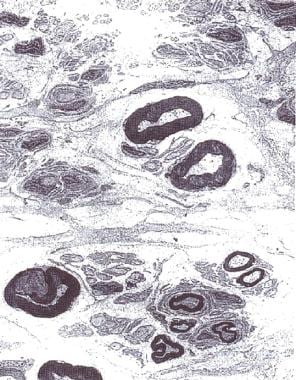
The term chronic inflammatory demyelinating polyradiculoneuropathy (CIDP) has been used to identify patients with a chronically progressive or relapsing symmetric sensorimotor disorder with cytoalbuminologic dissociation and interstitial and perivascular endoneurial infiltration by lymphocytes and macrophages. In many ways, CIDP can be considered the chronic equivalent of acute inflammatory demyelinating polyradiculoneuropathy (AIDP), the most common form of Guillain-Barré syndrome (GBS).

A number of variants of CIDP have been described that have immune or inflammatory aspects and electrophysiologic and/or pathologic evidence of demyelination in common. No consensus exists on the best approach to the nomenclature of these disorders. CIDP is a major subset of chronic acquired demyelinating polyneuropathies (CADP). In this context, CIDP is considered when patients have a symmetric proximal and distal motor predominant disorder.

CIDP variants include patients with predominantly sensory symptoms, those with a distal symmetric disorder (DADS), those with multifocal sensorimotor neuropathy or sensorimotor mononeuropathy multiplex with prominent conduction block (also known as Lewis-Sumner neuropathy), and those with CIDP with associated CNS demyelination or with other systemic disorders.

The following disorders are considered distinct from CIDP because they have specific pathophysiologic features and respond to treatments differently than do patients with CIDP: Demyelinating neuropathies associated with immunoglobulin M (IgM) paraproteins, including those with anti–myelin-associated glycoprotein (MAG) antibodies; polyneuropathy, organomegaly, endocrinopathy, monoclonal gammopathy, and skin changes (POEMS) syndrome; and multifocal motor neuropathy.

Pathophysiology

CIDP is presumed to occur because of immunologic antibody-mediated reaction along with interstitial and perivascular infiltration of the endoneurium with inflammatory T cells and macrophages. The consequence is a segmental demyelination of peripheral nerves.

Human leukocyte antigens Dw3, DRw3, A1, and B8 occur more frequently in patients with CIDP than in the healthy population.

Cytoalbuminologic dissociation is a characteristic finding in cerebrospinal fluid (CSF) pointing to nerve root involvement. Occasionally, CSF studies reveal mild lymphocytic pleocytosis and elevation of gamma globulin level, but this is observed most frequently in HIV-positive patients.

Frequency

International

CIDP is uncommon. The prevalence of CIDP is difficult to ascertain but estimates have ranged from 0.8-1.9 cases per 100,000 population.

Mortality/Morbidity

CIDP most commonly has an insidious onset and either chronic progressive or relapsing course. Occasionally, complete remissions occur. Quadriplegia, respiratory failure, and death have been described but are rare.

Race

No racial predilection has been identified.

Sex

Both sexes are affected. Of CADP variants, multifocal motor neuropathy has a male predominance of at least 2:1 based on a survey of the largest case series.

Age

CIDP may occur at any age, but it is more common in the fifth and sixth decades. Relapsing course is associated with younger age of patients (third and fourth decades). CIDP has been described in childhood.

Clinical

History

CIDP most frequently starts insidiously and evolves slowly, either in a slowly progressive (more than 60% of patients) or relapsing manner (approximately one third of patients), with partial or complete recovery between recurrences.

  • Periods of worsening and improvement usually last weeks or months. Patients with a younger age of onset are said to have a higher frequency of relapsing course.
  • Because of the insidious onset of CIDP, documenting precipitating illnesses or events is very difficult. However, preceding infection has been reported infrequently. Both respiratory and gastrointestinal infections have been cited, but no causative organism has been identified.
  • Initial symptoms include weakness of the limbs, both proximal and distal, with proximal muscles affected at least as severely as distal.
  • Sensory symptoms are common, such as tingling and numbness of hands and feet, but usually motor symptoms predominate.
  • Only a small proportion of patients (approximately 16%) have a relatively acute or subacute onset of symptoms, with subsequent steadily progressive or fluctuating course.
  • Children usually have a more precipitous onset of symptoms.
  • Most experts consider the necessary duration of symptoms to be greater than 8 weeks for the diagnosis of CIDP to be made.
  • Autonomic system dysfunction can occur; in such a case, the patient would complain of orthostatic dizziness, problems with bowel and bladder functions, and cardiac problems.

Physical

Pertinent findings are limited to the nervous system, except for cases of CADP associated with other diseases, as already mentioned. Depending on the associated systemic disorder, abnormalities on physical examination may be found in multiple organ systems. Patients should be examined in detail for signs of autoimmune, inflammatory, and neoplastic conditions.

  • Cranial nerves
    • Cranial nerves may be involved, particularly CN VII, with paralysis of both upper and lower facial muscles. Diplopia can occur with the involvement of CN III, IV, or VI. Rarely, bulbar muscles (eg, palate, tongue) can be affected.
    • Papilledema with pseudotumor cerebri syndrome (eg, headaches, transient visual obscurations, pulsatile tinnitus, visual field defects) are observed rarely in patients with CIDP and are due to a very high CSF protein level (usually >1000 mg/mL).
  • Gait frequently is abnormal.
  • Type of gait depends on location of weakness and degree of proprioceptive loss. With significant weakness in the lower extremities, patients may walk with steppage (ie, high elevation of both feet to compensate for weakness of foot dorsiflexors) or a slapping gait (ie, due to deficit of proprioception in the feet).
  • Children are said to have more profound gait abnormalities than adults.
  • Motor system
    • Usually relatively symmetric weakness of both proximal and distal muscles is present in upper and lower extremities.
    • Muscle tone can be normal or decreased. Hypotonia, atrophy, and fasciculations may be present.
  • Deep tendon reflexes: Reflexes characteristically are diminished or absent even in regions with only mild weakness.
  • Sensory system
    • Large-diameter, heavily myelinated fibers are affected most severely, leading to proprioceptive and vibratory deficits.
    • Loss or decrease of pain (ie, pinprick) and temperature sensations is less common.
    • Stocking-glove distribution of sensory deficits is typical.
    • Neuropathic pain in affected extremities may occur.
  • Coordination: Patients may have sensory ataxia with positive Romberg sign due to damage to the large nerve fibers that convey proprioception.
  • Pathological reflexes: Pathological reflexes (eg, Babinski, Chaddock, Oppenheim) usually are not observed in patients with CIDP.

Causes

CIDP is most frequently an idiopathic illness, but it has been known to occur with several conditions. In those cases, the associated condition is included in the main diagnosis (eg, CIDP with systemic lupus erythematosus, CIDP with HIV infection) to separate those cases from the idiopathic variety. Most reported conditions associated with CIDP are listed below.

  • CIDP associated with other disorders cannot be distinguished clinically from isolated CIDP except where mentioned in this section. The disease mechanisms for all these disorders are not known. They appear to be immunologic; in some instances, antibody-mediated mechanisms have been shown to play a role.
  • Vasculitis does not seem to be involved; physiologic and pathologic differences can distinguish the multifocal variants of CADP from vasculitic mononeuritis multiplex. Vasculitic neuropathies cause wallerian degeneration with minimal signs, if any, of segmental demyelination on biopsy and electromyographic studies (EMG). The multifocal variants of CADP have prominent conduction block and slowing—hallmarks of segmental demyelination.
  • HIV infection: In these patients, mild lymphocytic pleocytosis and increased gamma globulin level in the CSF are seen frequently. CIDP has been observed with early disease and later on in the course of AIDS.
  • Hodgkin lymphoma: Neuropathy associated with Hodgkin lymphoma is not caused by direct infiltration of the peripheral nerves but is a consequence of the autoimmune cascade that occurs with this disease; the mechanism is not completely clear.
  • Paraproteinemias and/or plasma cell dyscrasias
    • CADP is seen with monoclonal gammopathies (eg, monoclonal gammopathy of unknown significance [MGUS]), most frequently gammopathy of IgM. Evidence exists to suggest that CADP with IgM MGUS has specific clinical and electrophysiologic characteristics. Patients usually have predominance of distal sensory symptoms that are greater than motor symptoms. Conduction slowing on nerve conduction testing is accentuated in distal nerve segments. Fifty percent of patients with IgM-associated neuropathies have antibodies directed against MAG, a protein found in noncompact myelin of peripheral nerves. Whether any clinical difference exists between patients with IgM gammopathy without anti-MAG antibodies and those with anti-MAG antibodies is not clear. In both cases, the response to immunosuppressive and/or immunomodulatory treatment is poor. However, encouraging reports describe a response to rituximab, a monoclonal antibody directed against B cells.
    • Some paraproteinemias occur as isolated phenomena and some are by-products of malignant cells, as in the cases of Waldenström macroglobulinemia and myeloma. In myeloma-associated neuropathy, the abnormal paraprotein usually consists mostly of lambda light chain component. Combination of osteosclerotic myeloma, organomegaly, endocrinopathy, M protein, sensorimotor neuropathy, and pigmentary skin changes is referred to as POEMS syndrome. In POEMS syndrome, the M protein is typically immunoglobulin G (IgG).
    • The association of CIDP with IgG or immunoglobulin A (IgA) gammopathy is less clear. IgG paraproteins can occur in 5% of the population and it is unclear that the incidence of IgG paraproteins is excessive in patients with demyelinating neuropathy. Patients with CIDP and IgG or IgA paraproteins have identical clinical and electrophysiologic features to patients with CIDP and no paraprotein. Response to treatment is also the same.
  • Multiple sclerosis: Reports describe CNS white matter changes in patients with CIDP. Whether a true association exists between CIDP and multiple sclerosis remains unclear.
  • Systemic lupus erythematosus
  • Chronic active hepatitis (B or C): CIDP associated with hepatitis should be differentiated from cryoglobulinemic vasculitis. The latter causes either symmetric distal sensorimotor polyneuropathy or mononeuropathy multiplex but on pathologic examination shows wallerian degeneration and not the segmental demyelination seen in CIDP.
  • Inflammatory bowel disease: CIDP has been described in association with Crohn disease and other inflammatory bowel conditions, although no direct correlation between the 2 afflictions is known. The mechanism of development of CIDP is presumed to be an autoimmune abnormality that is also causing the primary problem in inflammatory bowel disease, although the details are not known.
  • Diabetes mellitus: Whether an increased incidence of CIDP occurs in patients with diabetes mellitus remains unclear. The most recent literature has not corroborated earlier reports of an association.
  • Pregnancy: Pregnancy is known to exacerbate CIDP. Worsening usually occurs in the third trimester or in the postpartum period.

Contents

Overview: Chronic Inflammatory Demyelinating Polyradiculoneuropathy
Differential Diagnoses & Workup: Chronic Inflammatory Demyelinating Polyradiculoneuropathy
Treatment & Medication: Chronic Inflammatory Demyelinating Polyradiculoneuropathy
Follow-up: Chronic Inflammatory Demyelinating Polyradiculoneuropathy
Multimedia: Chronic Inflammatory Demyelinating Polyradiculoneuropathy

References

  1. Barnett MH, Pollard JD, Davies L, McLeod JG. Cyclosporin A in resistant chronic inflammatory demyelinating polyradiculoneuropathy. Muscle Nerve. Apr 1998;21(4):454-60. [Medline].

  2. Barohn RJ, Saperstein DS. Guillain-Barre syndrome and chronic inflammatory demyelinating polyneuropathy. Semin Neurol. 1998;18(1):49-61. [Medline].

  3. Barohn RJ, Kissel JT, Warmolts JR, Mendell JR. Chronic inflammatory demyelinating polyradiculoneuropathy. Clinical characteristics, course, and recommendations for diagnostic criteria. Arch Neurol. Aug 1989;46(8):878-84. [Medline].

  4. Bouchard C, Lacroix C, Plante V, et al. Clinicopathologic findings and prognosis of chronic inflammatory demyelinating polyneuropathy. Neurology. Feb 1999;52(3):498-503. [Medline].

  5. Bromberg MB. Comparison of electrodiagnostic criteria for primary demyelination in chronic polyneuropathy. Muscle Nerve. Oct 1991;14(10):968-76. [Medline].

  6. Chassande B, Leger JM, Younes-Chennoufi AB, et al. Peripheral neuropathy associated with IgM monoclonal gammopathy: correlations between M-protein antibody activity and clinical/electrophysiological features in 40 cases. Muscle Nerve. Jan 1998;21(1):55-62. [Medline].

  7. Chaudhry V. Multifocal motor neuropathy. Semin Neurol. 1998;18(1):73-81. [Medline].

  8. Dalakas MC, Quarles RH, Farrer RG, et al. A controlled study of intravenous immunoglobulin in demyelinating neuropathy with IgM gammopathy. Ann Neurol. Nov 1996;40(5):792-5. [Medline].

  9. Donofrio PD. Chronic inflammatory demyelinating polyradiculoneuropathy: new views and guidelines. J Peripher Nerv Syst. Sep 2005;10(3):217-9. [Medline].

  10. Dyck PJ, Daube J, O'Brien P, et al. Plasma exchange in chronic inflammatory demyelinating polyradiculoneuropathy. N Engl J Med. Feb 20 1986;314(8):461-5. [Medline].

  11. Dyck PJ, Lais AC, Ohta M, et al. Chronic inflammatory polyradiculoneuropathy. Mayo Clin Proc. Nov 1975;50(11):621-37. [Medline].

  12. Dyck PJ, Litchy WJ, Kratz KM, et al. A plasma exchange versus immune globulin infusion trial in chronic inflammatory demyelinating polyradiculoneuropathy. Ann Neurol. Dec 1994;36(6):838-45. [Medline].

  13. Erdmann PG, van Meeteren NL, Kalmijn S, et al. Functional health status of patients with chronic inflammatory neuropathies. J Peripher Nerv Syst. Jun 2005;10(2):181-9. [Medline].

  14. European Federation of Neurological Societies/Peripheral Nerve Society. European Federation of Neurological Societies/Peripheral Nerve Society Guideline* on management of chronic inflammatory demyelinating polyradiculoneuropathy. Report of a joint task force of the European Federation of Neurological Societies and the Periph. J Peripher Nerv Syst. Sep 2005;10(3):220-228. [Medline].

  15. Good JL, Chehrenama M, Mayer RF, Koski CL. Pulse cyclophosphamide therapy in chronic inflammatory demyelinating polyneuropathy. Neurology. Dec 1998;51(6):1735-8. [Medline].

  16. Gorson KC, Allam G, Ropper AH. Chronic inflammatory demyelinating polyneuropathy: clinical features and response to treatment in 67 consecutive patients with and without a monoclonal gammopathy. Neurology. Feb 1997;48(2):321-8. [Medline].

  17. Hadden RD, Hughes RA. Treatment of immune-mediated inflammatory neuropathies. Curr Opin Neurol. Oct 1999;12(5):573-9. [Medline].

  18. Hobson-Webb LD, Donofrio PD. Inflammatory neuropathies: an update on evaluation and treatment. Curr Rheumatol Rep. Oct 2005;7(5):348-55. [Medline].

  19. Jann S, Beretta S, Bramerio MA. Different types of chronic inflammatory demyelinating polyneuropathy have a different clinical course and response to treatment. Muscle Nerve. Sep 2005;32(3):351-6. [Medline].

  20. Korinthenberg R. Chronic inflammatory demyelinating polyradiculoneuropathy in children and their response to treatment. Neuropediatrics. Aug 1999;30(4):190-6. [Medline].

  21. Leger JM, Behin A. Multifocal motor neuropathy. Curr Opin Neurol. Oct 2005;18(5):567-73. [Medline].

  22. Mahattanakul W, Crawford TO, Griffin JW, et al. Treatment of chronic inflammatory demyelinating polyneuropathy with cyclosporin-A. J Neurol Neurosurg Psychiatry. Feb 1996;60(2):185-7. [Medline].

  23. Mendell JR, Barohn RJ, Freimer ML, et al. Randomized controlled trial of IVIg in untreated chronic inflammatory demyelinating polyradiculoneuropathy. Neurology. Feb 27 2001;56(4):445-9. [Medline].

  24. Notermans NC, Franssen H, Eurelings M, et al. Diagnostic criteria for demyelinating polyneuropathy associated with monoclonal gammopathy. Muscle Nerve. Jan 2000;23(1):73-9. [Medline].

  25. Rotta FT, Sussman AT, Bradley WG, et al. The spectrum of chronic inflammatory demyelinating polyneuropathy. J Neurol Sci. Feb 15 2000;173(2):129-39. [Medline].

  26. Saperstein DS, Katz JS, Amato AA, Barohn RJ. Clinical spectrum of chronic acquired demyelinating polyneuropathies. Muscle Nerve. Mar 2001;24(3):311-24. [Medline].

  27. Saperstein DS, Amato AA, Wolfe GI, et al. Multifocal acquired demyelinating sensory and motor neuropathy: the Lewis-Sumner syndrome. Muscle Nerve. May 1999;22(5):560-6. [Medline].

  28. Stamboulis E, Katsaros N, Koutsis G, et al. Clinical and subclinical autonomic dysfunction in chronic inflammatory demyelinating polyradiculoneuropathy. Muscle Nerve. Sep 23 2005;[Medline].

  29. Uncini A, De Angelis MV, Di Muzio A, et al. Chronic inflammatory demyelinating polyneuropathy in diabetics: motor conductions are important in the differential diagnosis with diabetic polyneuropathy. Clin Neurophysiol. Apr 1999;110(4):705-11. [Medline].

  30. Visudtibhan A, Chiemchanya S, Visudhiphan P. Cyclosporine in chronic inflammatory demyelinating polyradiculoneuropathy. Pediatr Neurol. Nov 2005;33(5):368-72. [Medline].

Further Reading

Keywords

chronic inflammatory demyelinating polyneuropathy, CIDP, chronic acquired demyelinating polyneuropathies, CADP, acute inflammatory demyelinating polyradiculoneuropathy, AIDP, Guillain-Barré syndrome, GBS, chronic inflammatory demyelinating polyradiculoneuropathy, monoclonal gammopathies, multifocal motor neuropathy, MMN, acquired purely motor neuropathy, lower motor neuron-type deficits, multifocal sensorimotor neuropathy, sensorimotor mononeuropathy multiplex, Lewis-Sumner neuropathy, sensory predominant CADP, polyneuropathy, organomegaly, endocrinopathy, monoclonal gammopathy, POEMS, CADP associated with diabetes mellitus, sensorimotor disorder

Contributor Information and Disclosures

Author

Richard A Lewis, MD, Associate Chairman, Program Director, Professor, Department of Neurology, Wayne State University School of Medicine
Richard A Lewis, MD is a member of the following medical societies: American Academy of Neurology, American Association of Neuromuscular and Electrodiagnostic Medicine, American Society of Neuroimaging, and Medical Society of Virginia
Disclosure: Nothing to disclose

Coauthor

Marina Zvartau-Hind, MD, Ph, Director of Clinical Neurology, GlaxoSmithKline, UK
Marina Zvartau-Hind, MD, Ph is a member of the following medical societies: American Academy of Neurology
Disclosure: Nothing to disclose

Medical Editor

Dianna Quan, MD, Director, Electromyography Laboratory, Department of Neurology, Assistant Professor, University of Colorado Health Sciences Center
Dianna Quan, MD is a member of the following medical societies: American Academy of Neurology, American Association of Neuromuscular and Electrodiagnostic Medicine, and Phi Beta Kappa
Disclosure: e-medicine Honoraria for Other

Pharmacy Editor

Francisco Talavera, PharmD, PhD, Senior Pharmacy Editor, eMedicine
Disclosure: Nothing to disclose

Managing Editor

Florian P Thomas, MD, MA, PhD, Drmed, Director, Spinal Cord Injury Unit, St Louis Veterans Affairs Medical Center; Director, National MS Society Multiple Sclerosis Center; Associate Program Director, Professor, Department of Neurology and Psychiatry, Associate Professor, Institute for Molecular Virology, and Department of Molecular Microbiology and Immunology, St Louis University
Florian P Thomas, MD, MA, PhD, Drmed is a member of the following medical societies: American Academy of Neurology, American Paraplegia Society, and National Multiple Sclerosis Society
Disclosure: Nothing to disclose

CME Editor

Selim R Benbadis, MD, Professor, Director of Comprehensive Epilepsy Program, Departments of Neurology and Neurosurgery, University of South Florida School of Medicine, Tampa General Hospital
Selim R Benbadis, MD is a member of the following medical societies: American Academy of Neurology, American Academy of Sleep Medicine, American Clinical Neurophysiology Society, American Epilepsy Society, and American Medical Association
Disclosure: Nothing to disclose

Chief Editor

Nicholas Y Lorenzo, MD, Chief Editor, eMedicine Neurology; Consulting Staff, Neurology Specialists and Consultants
Nicholas Y Lorenzo, MD is a member of the following medical societies: Alpha Omega Alpha and American Academy of Neurology
Disclosure: Nothing to disclose

Related eMedicine Articles
 
 
HONcode

We subscribe to the
HONcode principles of the
Health On the Net Foundation

All material on this website is protected by copyright, Copyright© 1994- by Medscape.
This website also contains material copyrighted by 3rd parties.

DISCLAIMER: The content of this Website is not influenced by sponsors. The site is designed primarily for use by qualified physicians and other medical professionals. The information contained herein should NOT be used as a substitute for the advice of an appropriately qualified and licensed physician or other health care provider. The information provided here is for educational and informational purposes only. In no way should it be considered as offering medical advice. Please check with a physician if you suspect you are ill.