Continually Updated Clinical Reference
 
 
  All Sources     eMedicine     Medscape     Drug Reference     MEDLINE
 
eMedicine - Hand-Foot-and-Mouth Disease : Article by

Quick Find
Authors & Editors
Introduction
Clinical
Differentials
Workup
Treatment
Medication
Follow-up
Miscellaneous
References

Related Articles
Enteroviruses

Erythema Multiforme (Stevens-Johnson Syndrome)

Herpangina

Herpes Simplex

Herpes Zoster

Kawasaki Disease

Pharyngitis, Viral

Toxic Epidermal Necrolysis


Patient Education
Click here for patient education.


Author: Stephen J Nervi, MD, Staff Physician, Department of Dermatology, University of Medicine and Dentistry of New Jersey, New Jersey School of Medicine

Stephen J Nervi is a member of the following medical societies: Alpha Omega Alpha, American Academy of Dermatology, American Medical Association, and Sigma Xi

Coauthor(s): Robert A Schwartz, MD, MPH, Professor and Head of Dermatology, Professor of Medicine, Professor of Pediatrics, Professor of Pathology, Professor of Preventive Medicine and Community Health, UMDNJ-New Jersey Medical School; Rajendra Kapila, MD, MBBS, Associate Professor, Department of Medicine, UMDNJ, New Jersey Medical School; Diane H Johnson, MD, Assistant Director, Assistant Professor, Department of Internal Medicine, Division of Infectious Diseases, Winthrop-University Hospital, State University of New York at Stony Brook School of Medicine

Editors: Gary L Gorby, MD, Program Director of Adult Infectious Diseases Fellowship, Associate Professor, Department of Internal Medicine, Division of Infectious Disease, St Joseph Medical Center, Creighton University School of Medicine; Francisco Talavera, PharmD, PhD, Senior Pharmacy Editor, eMedicine; Thomas M Kerkering, MD, Professor of Medicine and Microbiology, Department of Internal Medicine, Division of Infectious Disease, Brody School of Medicine at East Carolina University; Eleftherios Mylonakis, MD, Clinical and Research Fellow, Department of Internal Medicine, Division of Infectious Diseases, Massachusetts General Hospital; Burke A Cunha, MD, Professor of Medicine, State University of New York School of Medicine at Stony Brook; Chief, Infectious Disease Division, Winthrop-University Hospital

Author and Editor Disclosure

Synonyms and related keywords: Hand-foot-and-mouth disease, HFMD, coxsackievirus, exanthematous eruptions, enterovirus 71, EV-71, Picornaviridae, aseptic meningitis, oral ulcerations, encephalitis, encephalomyelitis, pulmonary edema, macular lesions, mucosal lesions, mucocutaneous lesions, coxsackievirus A type 16, CV A16


Background

Hand-foot-and-mouth disease (HFMD) is an acute viral illness that presents as a vesicular eruption in the mouth. HFMD can also involve the hands, feet, buttocks, and/or genitalia. Coxsackievirus A type 16 (CV A16) is the etiologic agent involved in most cases of HFMD, but the illness is also associated with coxsackievirus A5, A7, A9, A10, B2, and B5 strains. Enterovirus 71 (EV-71) has also caused outbreaks of HFMD with associated neurologic involvement in the western Pacific region.

Coxsackievirus is a subgroup of the enteroviruses and is a member of the family Picornaviridae. This family consists of small, nonenveloped, single-stranded RNA viruses.

Pathophysiology

Infection generally occurs via the fecal-oral route or via contact with skin lesions and oral secretions. Viremia develops, followed by invasion of the skin and mucous membranes. Widespread apoptosis likely results in the characteristic lesion formation.

Frequency

United States

Epidemics generally occur in the summer to early fall months, although cases can occur sporadically all year.

International

HFMD epidemics associated with EV-71 have been more frequent in Southeast Asia in recent years, including Taiwan (1998) and Singapore (2000). Risk factors in these epidemics include attendance at child care centers, contact with HFMD, large family number, and rural residence.

Mortality/Morbidity

  • HFMD caused by coxsackievirus is generally a mild self-limited illness that resolves in 7-10 days; rarely, HFMD may recur or persist. Serious complications are also rare.
  • Severe oral ulcerations can create painful stomatitis. This may interfere with oral intake and cause dehydration, the most common complication of HFMD. Rarely, aseptic meningitis accompanies coxsackievirus-induced HFMD.
  • HFMD caused by EV-71 has a higher incidence of neurologic involvement, including a poliolike syndrome, aseptic meningitis, encephalitis, encephalomyelitis, acute cerebellar ataxia, acute transverse myelitis, Guillain-Barré syndrome, opsomyoclonus syndrome, and benign intracranial hypertension. These neurological complications have been attributed to either immunopathology or virus-induced damage to gray matter.
  • Rarely, cardiopulmonary complications such as myocarditis, interstitial pneumonitis, and pulmonary edema may occur. Neurologic involvement with sequelae is less likely to occur in patients with HFMD caused by coxsackievirus strains than with HFMD caused by EV-71. Chang et al analyzed the Taiwan HFMD epidemic of 1998 and revealed that 68% of the EV-71 cases were uncomplicated.1 Thirty-two percent of the cases had complications; 7.3% involved aseptic meningitis, 10% involved encephalitis, 2.3% involved poliolike syndrome, 4.5% involved encephalomyelitis, and 6.8% involved fatal pulmonary edema (7.9% of patients died and 4% of patients had sequelae). In the coxsackievirus A16 group, 94% of the cases of were uncomplicated; only 6.3% cases were complicated by aseptic meningitis; no fatalities or sequelae were reported.
  • Chong et al observed vomiting, leukocytosis, and an absence of mouth ulcers as predictive risk factors for fatal cases of EV-71 HFMD during the Singapore epidemic in 2000.2

Sex

Most reports indicate no sex predilection. Some epidemic data observe a slight male-to-female predominance ratio of 1.2-1.3:1.

Age

Children younger than 10 years are most commonly affected, and subsequent outbreaks among family members and close contacts may develop.


History

  • The incubation period lasts approximately 1 week; patients then report a sore mouth or throat.
  • Malaise may develop.
  • Rarely, vomiting occurs in infections caused by EV-71.

Physical

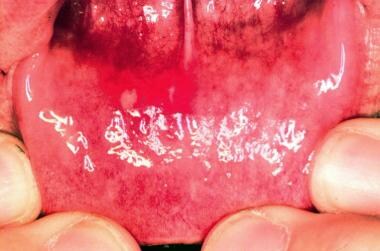
  • Initially, macular lesions appear on the buccal mucosa, tongue, and/or hard palate. These mucosal lesions rapidly progress to vesicles that erode and become surrounded by an erythematous halo.
  • Skin lesions, which present as tender macules or vesicles on an erythematous base, develop in approximately 75% of patients with hand-foot-and-mouth disease (HFMD).
  • A fever of 38-39°C may be present for 24-48 hours.
  • Atypical clinical features  
    • HFMD caused by coxsackievirus strains rarely presents with concomitant aseptic meningitis.
    • HFMD caused by EV-71 has a higher incidence of neurologic involvement, including a poliolike syndrome, aseptic meningitis, encephalitis, encephalomyelitis, acute cerebellar ataxia, acute transverse myelitis, Guillain-Barré syndrome, opsomyoclonus syndrome, and benign intracranial hypertension.

Causes

  • HFMD is most commonly caused by coxsackievirus A16, but it is also caused by coxsackieviruses A5, A7, A9 A10, B2, B5, and EV-71. Two major genotypes of EV-71, EV-71 B and C, have been identified as the strains principally involved in the EV-71 HFMD epidemics in Australia, Malaysia, Singapore, Taiwan, and Japan since 1997. These genotypes are considered particularly neurovirulent, accounting for the severe neurologic complications seen in EV-71 HFMD epidemics.


Enteroviruses
Erythema Multiforme (Stevens-Johnson Syndrome)
Herpangina
Herpes Simplex
Herpes Zoster
Kawasaki Disease
Pharyngitis, Viral
Toxic Epidermal Necrolysis

Other Problems to be Considered

Differential Diagnoses of Hand-Foot-and-Mouth Disease

Illness

Etiologic Agent

Usual Severity of Clinical Illness

Appearance of Lesions

Locations of Lesions

Other Features

HFMD
  • Coxsackievirus A16 (most common), A5, A7, A9, A10, B2, B5
  • Enterovirus 71
Mild
  • Papules®
  • Vesicles® ulcerations on an erythematous base
  • Usually 2-6 mm
  • Gingiva
  • Buccal mucosa
  • Tongue
  • Pharynx
  • Lesions may also be found on hands, feet, buttocks, and genitalia.
  • Low-grade fever
Herpangina
  • Coxsackievirus A1-A10, A16, A22
  • Echovirus 3, 6, 9, 16, 17, 25, 30
Moderate; can be severe
  • Papules®
  • Vesicles® ulcerations on an erythematous base
  • Usually 2-4 mm
  • Posterior oral cavity
  • Tonsils, soft palate, uvula
  • Temperature generally high
Herpetic gingivostomatitis
Herpes simplex virus-1
Moderate to severe
  • Vesicles
  • ulcerations
  • Anterior oral cavity
  • Lips, gingiva, buccal mucosa
  • Temperature generally high
  • Lymphadenopathy
Aphthous stomatitis
Unknown
Mild to severe
  • Ulcerations; larger than in viral enanthems
  • Lips, tongue, buccal mucosa; generally not diffuse
  • Afebrile
  • May be recurrent
Stevens-Johnson syndrome
Immunologic
Moderate to severe
  • Coalescent vesicles, which then ulcerate
  • Lips, gingiva, buccal mucosa, tongue, pharynx
  • Targetlike cutaneous lesions
  • Diffuse mucous membrane involvement


Lab Studies

  • Diagnosis of hand-foot-and-mouth disease (HFMD) is typically based on clinical grounds. Laboratory studies are usually unnecessary.
  • The virus can be isolated and identified via culture and immunoassay from cutaneous lesions, mucosal lesions, or stool samples. Oral specimens have the highest isolation rate. In patients with vesicles, vesicle swabs are also a good source for viral collection. In patients without vesicles, rectal swabs can be collected. For viral isolation, 2 swab collections are recommended—from the throat and the other from either vesicles or the rectum.
  • Serologic testing (eg, acute and convalescent antibody levels) may be obtained.
  • Differentiating coxsackie-associated from EV-71–associated HFMD may have prognostic significance. Polymerase chain reaction (PCR) and microarray technology are among the various ways of identifying the causative virus. Specific assays vary between hospitals.


Medical Care

The treatment of hand-foot-and-mouth disease (HFMD) is supportive. Ensure adequate fluid intake to prevent dehydration. Cold liquids are generally preferable. Spicy or acidic substances may cause discomfort. Intravenous hydration may be necessary if the patient has moderate-to-severe dehydration or if discomfort precludes oral intake. Fever may be treated with antipyretics. Pain may be treated with standard doses of acetaminophen or ibuprofen. Direct analgesia may also be applied to the oral cavity via mouthwashes or sprays.


The goals of pharmacotherapy are to reduce morbidity and to prevent complications.

Drug Category: Antipyretics/analgesics

These agents are used to control fever and pain.

Drug NameAcetaminophen (Tylenol, Aspirin Free Anacin, Feverall)
DescriptionReduces fever by acting directly on hypothalamic heat-regulating centers, which increases dissipation of body heat via vasodilation and sweating.
Adult Dose325-650 mg PO q4-6h or 1000 mg tid/qid; not to exceed 4 g/d
Pediatric Dose<12 years: 10-15 mg/kg/dose PO q4-6h prn; not to exceed 2.6 g/d
>12 years: 325-650 mg PO q4h; not to exceed 5 doses in 24 h
ContraindicationsDocumented hypersensitivity; known G-6-PD deficiency
InteractionsRifampin can reduce analgesic effects of acetaminophen; coadministration with barbiturates, carbamazepine, hydantoins, and isoniazid may increase hepatotoxicity
PregnancyB - Fetal risk not confirmed in studies in humans but has been shown in some studies in animals
PrecautionsHepatotoxicity possible in persons with chronic alcoholism following various dose levels; severe or recurrent pain or high or continued fever may indicate a serious illness; acetaminophen is contained in many OTC products, and combined use with these products may result in cumulative acetaminophen doses exceeding recommended maximum dose

Drug NameIbuprofen (Motrin, Ibuprin)
DescriptionOne of the few NSAIDs indicated for reduction of fever.
Adult Dose200-400 mg PO q4-6h while symptoms persist; not to exceed 3.2 g/d
Pediatric Dose<6 months: Not established
6 months to 12 years: 4-10 mg/kg/dose PO tid/qid
>12 years: Administer as in adults
ContraindicationsDocumented hypersensitivity; peptic ulcer disease, recent GI bleeding or perforation, renal insufficiency, or high risk of bleeding
InteractionsCoadministration with aspirin increases risk of inducing serious NSAID-related adverse effects; probenecid may increase concentrations and, possibly, toxicity of NSAIDs; may decrease effect of hydralazine, captopril, and beta-blockers; may decrease diuretic effects of furosemide and thiazides; may increase PT when taking anticoagulants (instruct patients to watch for signs of bleeding); may increase risk of methotrexate toxicity; phenytoin levels may be increased when administered concurrently
PregnancyB - Fetal risk not confirmed in studies in humans but has been shown in some studies in animals
D - Fetal risk shown in humans; use only if benefits outweigh risk to fetus
PrecautionsCaution in congestive heart failure, hypertension, and decreased renal and hepatic function; caution in anticoagulation abnormalities or during anticoagulant therapy

Drug Category: Topical anesthetics

These agents can be applied to ulcerations to control pain.

Drug NameLidocaine (Dermaflex)
DescriptionDecreases permeability to sodium ions in neuronal membranes. This results in the inhibition of depolarization, blocking the transmission of nerve impulses.
Adult DoseApply to the affected area prn
Pediatric DoseAdminister as in adults
ContraindicationsDocumented hypersensitivity; avoid use in Adams-Stokes syndrome and Wolff-Parkinson-White syndrome
InteractionsNone reported
PregnancyB - Fetal risk not confirmed in studies in humans but has been shown in some studies in animals
PrecautionsFor external or mucous membrane use only; do not use in eyes

Drug Category: Antihistamines

These agents act by competitive inhibition of histamine at the H1 receptor.

Drug NameDiphenhydramine hydrochloride (Benadryl, Benylin)
DescriptionFor symptomatic relief of symptoms caused by release of histamine in allergic reactions.
Adult Dose25-50 mg PO q6-8h prn; not to exceed 400 mg/d
10-50 mg IV/IM q6-8hprn; not to exceed 400 mg/d
Pediatric Dose12.5-25 mg PO tid/qid, or 5 mg/kg/d, or 150 mg/m2/d divided tid/qid; not to exceed 300 mg/d
5 mg/kg/d IV/IM or 150 mg/m2/d, divided qid; not to exceed 300 mg/d
ContraindicationsDocumented hypersensitivity; MAOIs
InteractionsPotentiates effect of CNS depressants; because of alcohol content, do not administer syrup dosage form to patients taking medications that can cause disulfiramlike reactions
PregnancyC - Fetal risk revealed in studies in animals but not established or not studied in humans; may use if benefits outweigh risk to fetus
PrecautionsMay exacerbate angle-closure glaucoma, hyperthyroidism, peptic ulcer, or urinary tract obstruction; xerostomia may occur


Further Inpatient Care

  • Patients with CNS manifestations (eg, encephalitis, aseptic meningitis) may require hospitalization.

Further Outpatient Care

  • Closely observe infants for development of dehydration.
  • Clinical improvement is observed after approximately 3-5 days; cutaneous and mucosal lesions resolve in 7-10 days. The patient may continue to shed virus through the stool for weeks.

Complications

  • Rarely, aseptic meningitis and other neurological complications accompany hand-foot-and-mouth disease (HFMD). More commonly, oral ulcerations can interfere with fluid intake and cause dehydration, the most common complication of HFMD.
  • Rare case reports show spontaneous abortions associated with HFMD.

Prognosis

  • Prognosis is excellent. The vast majority of patients are expected to recover fully.


Medical/Legal Pitfalls

  • Failure to make the diagnosis
  • Failure to maintain adequate hydration
  • Failure to recognize rare but serious neurological complications


  1. Chang LY, Lin TY, Huang YC, Tsao KC, Shih SR, Kuo ML, et al. Comparison of enterovirus 71 and coxsackie-virus A16 clinical illnesses during the Taiwan enterovirus epidemic, 1998. Pediatr Infect Dis J. Dec 1999;18(12):1092-6. [Medline].
  2. Chong CY, Chan KP, Shah VA, Ng WY, Lau G, Teo TE, et al. Hand, foot and mouth disease in Singapore: a comparison of fatal and non-fatal cases. Acta Paediatr. Oct 2003;92(10):1163-9. [Medline].
  3. Ahmad K. Hand, foot, and mouth disease outbreak reported in Singapore. Lancet. Oct 14 2000;356(9238):1338. [Medline].
  4. Chan KP, Goh KT, Chong CY, Teo ES, Lau G, Ling AE. Epidemic hand, foot and mouth disease caused by human enterovirus 71, Singapore. Emerg Infect Dis. Jan 2003;9(1):78-85. [Medline].
  5. Chan YF, AbuBaker S. Recombinant human enterovirus 71 in hand, foot and mouth disease patients. Emerg Infect Dis. Aug 2004;10(8):1468-70. [Medline].
  6. Chang LY, King CC, Hsu KH, Ning HC, Tsao KC, Li CC, et al. Risk factors of enterovirus 71 infection and associated hand, foot, and mouth disease/herpangina in children during an epidemic in Taiwan. Pediatrics. Jun 2002;109(6):e88. [Medline].
  7. Chen KT, Chang HL, Wang ST, Cheng YT, Yang JY. Epidemiologic features of hand-foot-mouth disease and herpangina caused by enterovirus 71 in Taiwan, 1998-2005. Pediatrics. Aug 2007;120(2):e244-52. [Medline].
  8. Chen SC, Chang HL, Yan TR, Cheng YT, Chen KT. An eight-year study of epidemiologic features of enterovirus 71 infection in Taiwan. Am J Trop Med Hyg. Jul 2007;77(1):188-91. [Medline].
  9. Chen TC, Chen GW, Hsiung CA, Yang JY, Shih SR, Lai YK, et al. Combining multiplex reverse transcription-PCR and a diagnostic microarray to detect and differentiate enterovirus 71 and coxsackievirus A16. J Clin Microbiol. Jun 2006;44(6):2212-9. [Medline].
  10. Cherry JD. Contemporary infectious exanthems. Clin Infect Dis. Feb 1993;16(2):199-205. [Medline].
  11. Faulkner CF, Godbolt AM, DeAmbrosis B, Triscott J. Hand, foot and mouth disease in an immunocompromised adult treated with aciclovir. Australas J Dermatol. Aug 2003;44(3):203-6. [Medline].
  12. Frydenberg A, Starr M. Hand, foot and mouth disease. Aust Fam Physician. Aug 2003;32(8):594-5. [Medline].
  13. Hooi PS, Chua BH, Lee CS, Lam SK, Chua KB. Hand, foot and mouth disease: University Malaya Medical Centre experience. Med J Malaysia. Mar 2002;57(1):88-91. [Medline].
  14. Kuo RL, Kung SH, Hsu YY, Liu WT. Infection with enterovirus 71 or expression of its 2A protease induces apoptotic cell death. J Gen Virol. Jun 2002;83(Pt 6):1367-76. [Medline].
  15. McMinn P, Stratov I, Nagarajan L, Davis S. Neurological manifestations of enterovirus 71 infection in children during an outbreak of hand, foot, and mouth disease in Western Australia. Clin Infect Dis. Jan 15 2001;32(2):236-42. [Medline].
  16. McMinn PC. An overview of the evolution of enterovirus 71 and its clinical and public health significance. FEMS Microbiol Rev. Mar 2002;26(1):91-107. [Medline].
  17. Miller GD, Tindall JP. Hand-foot-and-mouth disease. JAMA. Mar 4 1968;203(10):827-30. [Medline].
  18. Modlin JF. Enterovirus deja vu. N Engl J Med. Mar 22 2007;356(12):1204-5. [Medline].
  19. Modlin JF. Coxsachie Virus, Echoviruses, and Newer Enteroviruses. In: Mandell, Douglas, and Bennett's Principles and Practice of Infectious Disease. 5th ed. 2000:1904-17.
  20. Ooi MH, Solomon T, Podin Y, Mohan A, Akin W, Yusuf MA, et al. Evaluation of different clinical sample types in diagnosis of human enterovirus 71-associated hand-foot-and-mouth disease. J Clin Microbiol. Jun 2007;45(6):1858-66. [Medline].
  21. Ooi MH, Wong SC, Clear D, Perera D, Krishnan S, Preston T, et al. Adenovirus type 21-associated acute flaccid paralysis during an outbreak of hand-foot-and-mouth disease in Sarawak, Malaysia. Clin Infect Dis. Mar 1 2003;36(5):550-9. [Medline].
  22. Prager P, Nolan M, Andrews IP, Williams GD. Neurogenic pulmonary edema in enterovirus 71 encephalitis is not uniformly fatal but causes severe morbidity in survivors. Pediatr Crit Care Med. Jul 2003;4(3):377-81. [Medline].
  23. Scott LA, Stone MS. Viral exanthems. Dermatol Online J. Aug 2003;9(3):4. [Medline].
  24. Shekhar K, Lye MS, Norlijah O, Ong F, Looi LM, Khuzaiah R, et al. Deaths in children during an outbreak of hand, foot and mouth disease in Peninsular Malaysia--clinical and pathological characteristics. Med J Malaysia. Aug 2005;60(3):297-304. [Medline].
  25. Shimizu H, Okuyama K, Hirai Y. Epidemic of hand, foot and mouth disease in Kawasaki City, Japan. Jpn J Infect Dis. Oct 2005;58(5):330-1. [Medline].
  26. Shimizu H, Utama A, Onnimala N, Li C, Li-Bi Z, Yu-Jie M, et al. Molecular epidemiology of enterovirus 71 infection in the Western Pacific Region. Pediatr Int. Apr 2004;46(2):231-5. [Medline].
  27. Singh S, Poh CL, Chow VT. Complete sequence analyses of enterovirus 71 strains from fatal and non-fatal cases of the hand, foot and mouth disease outbreak in Singapore (2000). Microbiol Immunol. 2002;46(11):801-8. [Medline].
  28. Solomon T. Exotic and emerging viral encephalitides. Curr Opin Neurol. Jun 2003;16(3):411-8. [Medline].
  29. Sutton-Hayes S, Weisse ME, Wilson NW, Ogershok PR. A recurrent presentation of hand, foot, and mouth disease. Clin Pediatr (Phila). May 2006;45(4):373-6. [Medline].
  30. Thomas I, Janniger CK. Hand, foot, and mouth disease. Cutis. Nov 1993;52(5):265-6. [Medline].
  31. Toida M, Watanabe F, Goto K, Shibata T. Usefulness of low-level laser for control of painful stomatitis in patients with hand-foot-and-mouth disease. J Clin Laser Med Surg. Dec 2003;21(6):363-7. [Medline].
  32. Tsao KC, Chang PY, Ning HC, Sun CF, Lin TY, Chang LY, et al. Use of molecular assay in diagnosis of hand, foot and mouth disease caused by enterovirus 71 or coxsackievirus A 16. J Virol Methods. Apr 2002;102(1-2):9-14. [Medline].
  33. Tsao LY, Lin CY, Yu YY, Wang BT. Microchip, reverse transcription-polymerase chain reaction and culture methods to detect enterovirus infection in pediatric patients. Pediatr Int. Feb 2006;48(1):5-10. [Medline].
  34. Tseng FC, Huang HC, Chi CY, Lin TL, Liu CC, Jian JW, et al. Epidemiological survey of enterovirus infections occurring in Taiwan between 2000 and 2005: Analysis of sentinel physician surveillance data. J Med Virol. Dec 2007;79(12):1850-60. [Medline].
  35. Wang CY, Li Lu F, Wu MH, Lee CY, Huang LM. Fatal coxsackievirus A16 infection. Pediatr Infect Dis J. Mar 2004;23(3):275-6. [Medline].
  36. Zhu Z, Xu WB, Xu AQ, Wang HY, Zhang Y, Song LZ, et al. Molecular epidemiological analysis of echovirus 19 isolated from an outbreak associated with hand, foot, and mouth disease (HFMD) in Shandong Province of China. Biomed Environ Sci. Aug 2007;20(4):321-8. [Medline].

Hand-Foot-and-Mouth Disease excerpt

Article Last Updated: Mar 17, 2008