| Patient Education |
|
Click here for patient education.
|
|
You are in: eMedicine Specialties >
Gastroenterology > Systemic Disease
Familial Adenomatous Polyposis
Article Last Updated: Aug 22, 2006
AUTHOR AND EDITOR INFORMATION
Section 1 of 11
Author: Mohammad Wehbi, MD, Assistant Professor of Medicine, Associate Program Director, Department of Gastroenterology, Atlanta Veterans Affairs Medical Center, Emory University School of Medicine
Mohammad Wehbi is a member of the following medical societies: American College of Physicians, American Gastroenterological Association, and American Medical Association
Coauthor(s):
Vincent W Yang, MD, PhD, R Bruce Logue Professor, Director, Division of Digestive Diseases, Department of Medicine, Professor of Hematology and Oncology, Winship Cancer Institute, Emory University School of Medicine;
Kamil Obideen, MD, Assistant Professor of Medicine, Division of Digestive Diseases, Emory University School of Medicine; Consulting Staff, Division of Gastrointestinal Endoscopy, Atlanta Veterans Affairs Medical Center;
Jae W Nam, MD, Fellow in Gastroenterology, Division of Digestive Diseases, Department of Medicine, Emory University School of Medicine; Consulting Staff, Department of Critical Care, Decatur Hospital;
John M Carethers, MD, Professor of Medicine, Chief, Division of Gastroenterology, Department of Medicine, University of California at San Diego
Editors: John Gunn Lee, MD, Director of Pancreaticobiliary Service, Associate Professor, Department of Internal Medicine, Division of Gastroenterology, University of California at Irvine School of Medicine; Francisco Talavera, PharmD, PhD, Senior Pharmacy Editor, eMedicine; Simmy Bank, MD, Chair, Professor, Department of Internal Medicine, Division of Gastroenterology, Long Island Jewish Hospital, Albert Einstein College of Medicine; Alex J Mechaber, MD, FACP, Assistant Dean for Medical Curriculum, Associate Professor of Medicine, Division of General Internal Medicine, University of Miami Miller School of Medicine; Julian Katz, MD, Clinical Professor of Medicine, Drexel University College of Medicine; Consulting Staff, Department of Medicine, Section of Gastroenterology and Hepatology, Hospital of the Medical College of Pennsylvania
Author and Editor Disclosure
Synonyms and related keywords:
FAP, adenomatous polyposis coli, adenomatous polyps, APC gene, b-catenin, colonic neoplasia, colorectal cancer, rectal bleeding, Gardner variant of FAP, Turcot syndrome, intra-abdominal desmoids, desmoid tumors, intestinal polyposis, endoscopic polypectomy, colectomy, rectal resection, subtotal colectomy with ileoanal anastomosis, total proctocolectomy with ileostomy, duodenal adenocarcinoma, periampullary adenocarcinoma, medulloblastoma, hepatoblastoma, thyroid cancers, adrenal cancers, upper gastrointestinal cancers
Background
Familial adenomatous polyposis (FAP) is the most common adenomatous polyposis syndrome. It is an autosomal dominant inherited disorder characterized by the early onset of hundreds to thousands of adenomatous polyps throughout the colon. If left untreated, all patients with this syndrome develop colon cancer by age 35-40 years. In addition, an increased risk exists for the development of other malignancies.
The genetic defect in FAP is a germline mutation in the adenomatous polyposis coli (APC) gene. Syndromes once thought to be distinct from FAP are now recognized to be, in reality, part of the phenotypic spectrum of FAP. Syndromes with a germline mutation in the APC gene include FAP, Gardner syndrome, some families with Turcot syndrome, and attenuated adenomatous polyposis coli (AAPC). Gardner syndrome is characterized by colonic polyposis typical of FAP, along with osteomas (bony growth most commonly on the skull and the mandible), dental abnormalities, and soft tissue tumors. Turcot syndrome is characterized by colonic polyposis typical of FAP, along with central nervous system tumors (medulloblastoma). AAPC is characterized by fewer colonic polyps (average number of polyps, 30-35) as compared to classic FAP. The polyps also tend to develop at a later age (average age, 36 y), and they tend to involve the proximal colonic area.
Pathophysiology
The APC gene is a tumor suppressor gene that is located on band 5q21. Normal APC protein promotes apoptosis in colonic cells. Its most important function may be to sequester the growth stimulatory effects of b-catenin, a protein that transcriptionally activates growth-associated genes in conjunction with tissue-coding factors. Mutations of the APC gene result in a truncated/nonfunctional protein. The resultant loss of APC function prevents apoptosis and allows b-catenin to accumulate intracellularly and to stimulate cell growth with the consequent development of adenomas. As the clonal expansion of cells that lack APC function occurs, their rapid growth increases the possibility for other growth-advantageous genetic events to occur. This causes alterations in the expression of a variety of genes, thereby affecting the proliferation, differentiation, migration, and apoptosis of cells.
Ultimately, enough genetic events happen that allow the adenomatous polyps to become malignant in patients with FAP. This process is similar to that which occurs in sporadic adenomas. As a result, APC is considered the gatekeeper of colonic neoplasia. Its mutation/inactivation is the initial step in the development of colorectal cancer in patients with FAP.
Germline (ie, inherited) mutations of the APC gene, as is the case with FAP, result in cells containing 1 mutated and 1 normal copy of the gene. Patients inherit one mutated APC allele from an affected parent, and adenomas develop as the second allele from the unaffected parent becomes mutated or lost. Consequently, every colonic epithelial cell in patients with FAP has 1 mutated APC allele. Inactivation of the remaining normal copy of the APC gene, by deletion or mutation, completely removes the tumor suppressive function of APC, thus initiating the growth of adenomatous polyps. Inactivation of the second APC allele occurs frequently in the colon, resulting in the development of numerous adenomas.
Frequency
United States
Estimates vary from 1 case in 6,850 persons to 1 case in 31,250 persons.
International
The frequency is constant worldwide.
Mortality/Morbidity
- The principal cause of mortality is colorectal cancer, which develops in all patients unless they are treated. The mean age at which colorectal cancer develops in patients with classic FAP is 39 years. Patients with adenomatous polyposis itself often are asymptomatic.
- The second reported lethal complication of FAP is diffuse mesenteric fibromatosis and is referred to as a desmoid tumor. It involves intra-abdominal organs and vessels, causing gastrointestinal obstruction and constriction of veins, arteries, and ureters. Desmoid tumors are reported in 4-32% of patients. Even after the appropriate surgical treatment of FAP, 20% of patients may develop desmoid tumors after colectomy. The mortality from these tumors is 10-50%. The second most common malignancy in patients with FAP is adenocarcinoma of the duodenum and the papilla of Vater. It affects as many as 12% of patients.
- Rarer cancers associated with FAP include medulloblastomas (Turcot syndrome), hepatoblastoma, thyroid cancer, gastric cancer, pancreatic cancer, and adrenal cancer.
Race
- FAP has been described in all races.
Sex
- The male-to-female ratio is 1:1.
Age
- The average age of onset of polyposis in FAP is 16 years.
- The average age of onset for colorectal cancer is 39 years.
- The average age of onset for polyps in AAPC is 36 years, and the average age of onset for cancer in AAPC is 54 years. These patients have fewer polyps (approximately 30 polyps) compared to patients with FAP.
History
- Most patients with FAP are asymptomatic until they develop cancer. As a result, diagnosing presymptomatic patients is essential.
- Of patients with FAP, 75-80% have a family history of polyps and/or colorectal cancer at age 40 years or younger.
- Nonspecific symptoms, such as unexplained rectal bleeding (hematochezia), diarrhea, or abdominal pain, in young patients may be suggestive of FAP.
Physical
- Congenital hypertrophy of the retinal pigment epithelium is highly specific for FAP and is best seen by slit-lamp examination.
- They are discrete flat pigmented lesions of the retina. They are often multiple (63%) and bilateral (87%). They do not cause any clinical problems.
- They indicate that a family member has inherited the gene that causes FAP and is at risk. As a result, they precede polyposis and correlate with mutations between exons 9 and 15 of the gene that causes FAP.
- Some lesions are indicative of a Gardner variant of FAP.
- Osteomas (painless bony overgrowth) of the skull and the mandible may be present. They usually precede the clinical or radiologic diagnosis of intestinal polyposis.
- Dental abnormalities, often diagnosed by using x-ray films, may include supernumerary teeth, impacted teeth, dentigerous cysts, and odontomas.
- In prepubescent patients, epidermoid cysts on the legs, face, scalp, and arms may be present. They are the most common cutaneous manifestation of Gardner syndrome. These cysts are benign and mainly pose a cosmetic concern.
- Fibromas may be present, located on the scalp, shoulders, arms, and back.
- Desmoid tumors are discussed in Mortality/Morbidity.
- A palpable abdominal mass in a young patient is suggestive of FAP.
- A palpable mass upon rectal examination in a young patient is suggestive of FAP.
Causes
- FAP is caused by a germline mutation of the APC tumor suppressor gene, located on band 5q21.
- Most mutations of the APC gene are nonsense or frameshift mutations, leading to truncation of the APC protein (nonfunctional protein).
- More virulent forms of FAP are associated with a mutation in exon 15 between codons 1250 and 1464, the middle portion of the gene.
- In patients with AAPC, mutations of the APC gene occur at the extreme amino terminus of the protein.
Peutz-Jeghers Syndrome
Other Problems to be Considered
Bannayan-Riley-Ruvalcaba syndrome
Cowden disease
Juvenile polyposis syndrome
Cronkhite-Canada syndrome
Hereditary nonpolyposis colon cancer
Hyperplastic polyposis
Nodular lymphoid hyperplasia
Lymphomatous polyposis
Neurofibromatosis type 1 (NF-1)
Inflammatory polyposis
MYH-associated polyposis
Lab Studies
- CBC
- Alpha-fetoprotein (AFP) blood test - For children with FAP until age 5 years as part of a screening program for hepatoblastoma
Imaging Studies
- Flexible sigmoidoscopy: Visualization of more than 100 polyps usually establishes the diagnosis because of the diffuse nature of the polyposis.
- Colonoscopy is usually reserved for patients thought to have AAPC because of the higher incidence of right-sided polyps (proximal colonic involvement).
- Front- and side-viewing esophagogastroduodenoscopy is recommended if the sigmoidoscopy or the colonoscopy establishes the diagnosis of FAP. It is an essential component of the surveillance program in FAP, especially in that the second most common cancer involves the duodenum. This test helps to evaluate the presence of gastric, duodenal, and periampullary adenomas. It is recommended every 1-3 years. Benign gastric polyps are part of the spectrum of FAP. They are usually confined to the fundus.
- Dental and skull x-ray films are recommended in patients thought to have a Gardner variant of FAP. The films help to detect osteomas and dental abnormalities.
- Barium studies may be performed to visualize intestinal polyposis.
- Periodic ultrasounds or abdominal computed tomography scans are used to check for intra-abdominal desmoid tumors and pancreatic cancer.
- Periodic ultrasound of the thyroid: This imaging study is considered because of the increased risk of thyroid cancer. It can supplement the recommended annual physical examination of the thyroid.
Other Tests
- Three genetic tests are available. Patients should receive genetic counseling from a trained individual prior to the performance of these tests.
- In vitro protein synthesis assay
- This is the genetic test of choice for the proband patient (patient with FAP). This test is commercially available.
- DNA from peripheral blood is analyzed for a truncated APC gene product.
- Because of the size of the APC protein, it is analyzed in 5 overlapping segments.
- If the proband has a mutation, other family members can be tested (after genetic counseling) for the identical mutation. The test generally has 100% accuracy in detecting other gene carriers in the family.
- APC gene sequencing is the most accurate test. However, it is hard logistically and, hence, is only reserved for research purposes.
- Linkage testing
- DNA markers near or in the APC locus are used to identify mutant gene carriers.
- This test requires 2 affected family members to achieve an appropriate linkage relationship resulting in 90% accuracy. As a result, this is not appropriate logistically.
Procedures
- Representative polyps should be removed by endoscopic polypectomy to confirm the diagnosis by histologic examination.
Histologic Findings
Characteristic pathology of a polyp from patients with FAP is a tubular adenoma.
Medical Care
Medical care is mainly based on endoscopic surveillance to detect the onset of polyposis. Consequently, surgery would prevent the development of colon cancer. However, in view of the increased risk for the development of other cancers, continued medical follow-up is required with a number of surveillance tests, as colectomy would only address the potential risk of colon cancer. A number of drugs (eg, celecoxib, sulindac) have been used successfully to reduce the number and the size of polyps in patients with FAP. However, they are insufficient as a primary modality of therapy.
- Endoscopic surveillance
- Flexible sigmoidoscopy should be performed every 1-2 years starting at age 10-12 years in patients with FAP to document the onset of polyposis.
- Sigmoidoscopic surveillance and ablation of any polyps in the retained rectum or ileal pouch should be performed every 3-6 months in patients with FAP who have undergone colonic (total or subtotal) resection.
- Once polyps are detected, colonoscopic surveillance is recommended to remove large polyps in patients who have not had an operation. This is important because surgery (colectomy) is usually deferred until an appropriate psychological age is reached (usually late teenaged years to early twenties). However, if the polyps have advanced histologic features, then early surgery is recommended.
- Front- and side-view esophagogastroduodenoscopy should be performed every 1-3 years once the diagnosis is made and after surgical therapy. The front-view esophagogastroduodenoscopy allows for the detection of gastric and duodenal polyps. The side-view duodenoscope allows for the examination of the ampulla of Vater.
- Drugs used in the treatment of FAP include sulindac and celecoxib.
- Because of the association between cyclooxygenase 2 (COX-2) inhibitors (celecoxib is a member of this drug family) and coronary artery disease, celecoxib is no longer widely used.
- These drugs have no primary role as sole therapy for patients with FAP who have not had surgical therapy. However, in patients with FAP who have had colectomy with ileoanal anastomosis, sulindac or celecoxib may be beneficial in reducing the size and the number of adenomatous polyps in the remaining rectum.
- The use of other nonsteroidal anti-inflammatory drugs (NSAIDs) and similar drugs is being studied.
- Cancers of the rectum (in patients who have had subtotal colectomy with ileorectal anastomosis) have been reported with sulindac and celecoxib therapy. Because of the inability to control polyps medically, eventual rectal resection is usually necessary. This is why subtotal colectomy with ileorectal anastomosis (IRA) is not the preferred surgical procedure.
- Screening of family members of patients with FAP should begin by age 12 years. Flexible sigmoidoscopy every 1-2 years until the patient is aged 35 years is adequate, then every 3 years thereafter. Genetic testing may eliminate the need for surveillance in some family members.
- Desmoid tumors (intra-abdominal) may respond to antiestrogen therapy (tamoxifen) and sulindac because estrogen appears to promote their growth.
- Chemotherapy with doxorubicin and dacarbazine may be attempted if no response is observed with other therapies.
Surgical Care
Because of the diffuse nature of the polyposis and the inevitability of colorectal cancer, surgical therapy is ultimately required. Surgical therapy should be performed before the typical onset of cancer.
- Colectomy with mucosal proctectomy and ileoanal pouch pull-through (proctocolectomy with ileal pouch-anal anastomosis/IPAA) is the procedure of choice at many centers.
- This procedure allows retention of rectal function.
- Other options include subtotal colectomy with ileoanal anastomosis and total proctocolectomy with ileostomy.
- If medical therapy and endoscopic therapy do not control polyp growth, rectal resection may be needed in patients who have a retained rectum (such as in subtotal colectomy). Desmoid tumors may be resected with adequate margins. This generally is reserved for patients with ureteral or intestinal obstruction.
Consultations
- A gastroenterologist familiar with FAP should supervise follow-up care. This is important because appropriate surveillance should be pursued to detect and treat other cancers/complications of FAP after surgery.
- Appropriate genetic counseling for both the patients and their family members should be initiated.
The goal of pharmacotherapy is to reduce morbidity and to prevent complications.
Drug Category: Nonsteroidal anti-inflammatory drugs
These agents are used to reduce the number and the size of adenomatous polyps that remain in the rectum or ileal pouch after colectomy in patients with FAP. Celecoxib is not widely used because of the association between COX-2 inhibitors (celecoxib is a member of this drug family) and coronary artery disease.
| Drug Name | Sulindac (Clinoril) |
| Description | Sulfoxide nonsteroidal anti-inflammatory agent that is metabolized to the anti-inflammatory sulfide metabolite and a sulfone metabolite. Sulfide metabolite is now known to have apoptotic activity on colonic epithelial cells and is presumed to be responsible for the regression of adenomatous polyps. |
| Adult Dose | 150 mg PO bid |
| Pediatric Dose | Not established |
| Contraindications | Documented hypersensitivity; patients in whom aspirin, iodides, or other NSAIDs induce hypersensitivity; GI bleed and renal insufficiency |
| Interactions | Probenecid and lithium may increase concentrations and possibly toxicity of NSAIDs; effect of loop diuretics may decrease when administered concurrently; PT may increase when coadministered with anticoagulants; monitor PT closely and instruct patients to watch for signs and symptoms of bleeding; concurrent administration with phenytoin may increase pharmacologic and toxic effects of phenytoin |
| Pregnancy | C - Safety for use during pregnancy has not been established.
|
| Precautions | Acute renal insufficiency, hyperkalemia, hyponatremia, interstitial nephritis, and renal papillary necrosis may occur; increases risk of acute renal failure in preexisting renal disease or compromised renal perfusion; low WBC counts occur rarely and usually return to normal in ongoing therapy; discontinuation of therapy may be necessary if persistent leukopenia, granulocytopenia, or thrombocytopenia is present; caution in anticoagulation defects or those receiving anticoagulant therapy |
| Drug Name | Celecoxib (Celebrex) |
| Description | Primarily inhibits COX-2. COX-2 is considered an inducible isoenzyme, induced during pain and inflammatory stimuli. COX-2 is overexpressed in colonic adenomas, which may contribute to adenoma growth, and inhibition of COX-2 may be the mechanism for polyp regression. |
| Adult Dose | 400 mg PO bid |
| Pediatric Dose | Not established |
| Contraindications | Documented hypersensitivity |
| Interactions | Coadministration with fluconazole may cause increase in celecoxib plasma concentrations because of inhibition of celecoxib metabolism; coadministration with rifampin may decrease celecoxib plasma concentrations |
| Pregnancy | B - Usually safe but benefits must outweigh the risks.
|
| Precautions | May cause fluid retention and peripheral edema; caution in compromised cardiac function, hypertension, and conditions predisposing to fluid retention; severe heart failure and hyponatremia because may deteriorate circulatory hemodynamics; NSAIDs may mask usual signs of infection; caution in the presence of existing controlled infections; evaluate symptoms and signs suggesting liver dysfunction or with abnormal liver lab results |
Complications
- Colorectal cancer (100% in untreated patients)
- Duodenal or periampullary adenocarcinoma (4-12%)
- Desmoid formation (as many as 20%, typically postcolectomy)
- Other cancers include the following:
- Medulloblastoma
- Hepatoblastoma
- Thyroid cancer
- Gastric and pancreatic cancer
- Adrenal cancer
- Development of rectal cancer in patients with a retained rectum
Prognosis
- Patients with untreated FAP have a median life expectancy of 42 years.
- Life expectancy is extended greatly in those treated with colectomy.
- Upper gastrointestinal cancers and desmoid tumors are the most common causes of death in patients who have undergone colectomy. This is why surveillance programs, especially after colectomy, are essential. Colectomy only addresses the risk of colon cancer development.
- The cumulative probability of developing any type of a noncolorectal cancer, mostly periampullary tumors, is 11% by age 50 years and 52% by 75 years.
Patient Education
- Educate patients about the need for cancer surveillance after colectomy.
- Inform family members so that they may undergo screening.
Medical/Legal Pitfalls
- Failure to adequately follow up and monitor for the development of other cancers (eg, rectal pouch, duodenum) may lead to legal problems. Surveillance programs are important.
- Offer genetic counseling before any genetic testing is performed. The patient and family members should be made aware of the limitations of genetic testing and the associated consequences. Genetic counseling should be performed by someone familiar with FAP and the genetic tests available.
Special Concerns
- A gastroenterologist familiar with FAP should direct overall care.
- A geneticist is part of the medical team involved in therapy for FAP.
- Treatment frequently involves the input of a surgeon who is familiar with FAP.
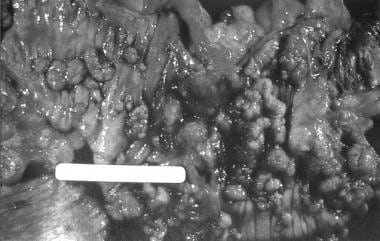
| Media file 1:
Colectomy specimen obtained from a patient with familial adenomatous polyposis. Note the presence of numerous synchronous adenomatous polyps lining the luminal surface. |

 | View Full Size Image | |
Media type: Photo
|
- Bresalier RS. Sleisenger and Fordtran's Gastrointestinal and Liver Disease. 2006:2759-2810.
- Brosens LA, Keller JJ, Offerhaus GJ. Prevention and management of duodenal polyps in familial adenomatous polyposis. Gut. Jul 2005;54(7):1034-43.
- Burke CA, Beck GJ, Church JM. The natural history of untreated duodenal and ampullary adenomas in patients with familial adenomatous polyposis followed in an endoscopic surveillance program. Gastrointest Endosc. Mar 1999;49(3 Pt 1):358-64. [Medline].
- Burt R, Neklason DW. Genetic testing for inherited colon cancer. Gastroenterology. May 2005;128(6):1696-716.
- Bussey HJR. Genetic and epidemiological features of familial polyposis coli. In: Bussey HJR, ed. Familial Polyposis Coli. Baltimore, Md: Johns Hopkins University Press; 1975:. 9-17.
- Doxey BW, Kuwada SK, Burt RW. Inherited polyposis syndromes: molecular mechanisms, clinicopathology, and genetic testing. Clin Gastroenterol Hepatol. Jul 2005;3(7):633-41.
- Galiatsatos P, Foulkes WD. Familial adenomatous polyposis. Am J Gastroenterol. Feb 2006;101(2):385-98.
- Giardiello FM, Brensinger JD, Petersen GM. The use and interpretation of commercial APC gene testing for familial adenomatous polyposis. N Engl J Med. Mar 20 1997;336(12):823-7. [Medline].
- Giardiello FM, Hamilton SR, Krush AJ. Treatment of colonic and rectal adenomas with sulindac in familial adenomatous polyposis. N Engl J Med. May 6 1993;328(18):1313-6. [Medline].
- Giardiello FM, Yang VW, Hylind LM, et al. Primary chemoprevention of familial adenomatous polyposis with sulindac. N Engl J Med. Apr 4 2002;346(14):1054-9.
- Thun MJ, Henley SJ, Patrono C. Nonsteroidal anti-inflammatory drugs as anticancer agents: mechanistic, pharmacologic, and clinical issues. J Natl Cancer Inst. Feb 20 2002;94(4):252-66.
Familial Adenomatous Polyposis excerpt Article Last Updated: Aug 22, 2006
|