| Patient Education |
|
Click here for patient education.
|
|
You are in: eMedicine Specialties >
Allergy and Immunology > Complement-Related Abnormalities
Complement Deficiencies
Article Last Updated: Jun 2, 2006
AUTHOR AND EDITOR INFORMATION
Section 1 of 11
Author: R Krishna Chaganti, MD, Fellow, Department of Rheumatology, Hospital for Special Surgery
R Krishna Chaganti is a member of the following medical societies: American College of Rheumatology
Coauthor(s):
Darrilyn Moyer, MD, Associate Program Director, Department of Internal Medicine, Associate Professor, Temple University School of Medicine;
Margaret R Donohoe, MD, Active Staff, Department of Internal Medicine/Allergy and Immunology, Albemarle Hospital;
Robert A Schwartz, MD, MPH, Professor and Head of Dermatology, Professor of Medicine, Professor of Preventive Medicine and Community Health, Professor of Pediatrics, Professor of Pathology, UMDNJ-New Jersey Medical School
Editors: Jeffrey Lee Kishiyama, MD, Assistant Clinical Professor of Medicine, Consulting Staff, University of California at San Francisco School of Medicine, Allergy and Asthma Associates of Santa Clara Valley Research Center; Francisco Talavera, PharmD, PhD, Senior Pharmacy Editor, eMedicine; Samuel R Marney, Jr, MD, Director, Department of Internal Medicine, Division of Allergy and Immunology, Associate Professor, Vanderbilt University School of Medicine; Timothy D Rice, MD, Departments of Internal Medicine and Pediatrics and Adolescent Medicine, Associate Professor, Saint Louis University School of Medicine; Michael A Kaliner, MD, Clinical Professor of Medicine, Section of Allergy and Immunology, Washington Hospital Center, George Washington University School of Medicine; Chief, Medical Director, Institute for Asthma and Allergy
Author and Editor Disclosure
Synonyms and related keywords:
C1qrs deficiency, C3 deficiency, C2-C4 deficiency, C5-9 deficiency, terminal membrane attack complex deficiency, MAC deficiency, mannan-binding lectin deficiency, MBL deficiency, immune system, bacterial infection, sepsis, host defense mechanism, immune complex disease, systemic lupus erythematosus, SLE, complement activation, disseminated meningococcal disease, Streptococcus pneumoniae, S pneumoniae, Haemophilus influenzae, H influenzae, Neisseria meningitidis, N meningitidis, meningococcemia
Background
The complement system is part of the innate immune system. The complement system plays an important part in defense against pyogenic organisms. It promotes the inflammatory response, eliminates pathogens, and enhances the immune response. Deficiencies in the complement cascade can lead to overwhelming infection and sepsis. In addition to playing an important role in host defense against infection, the complement system is a mediator in both the pathogenesis and prevention of immune complex diseases, such as systemic lupus erythematosus (SLE). These findings underscore the duality of the complement system. It has a protective effect when functioning in moderation against pathogens; at the same time, the inflammation promoted by complement activation can result in cellular damage when not kept in check. Knowledge about the complement system is continuing to expand. New studies point to the complex interplay between the complement cascade and adaptive immune response, and complement is also being studied in association with ischemic injury as a target of therapy. Although the complement system is part of the body's innate, relatively nonspecific defense against pathogens, its role is hardly primitive or easily understood. This article outlines some of the disease states associated with complement deficiencies and their clinical implications.
Pathophysiology
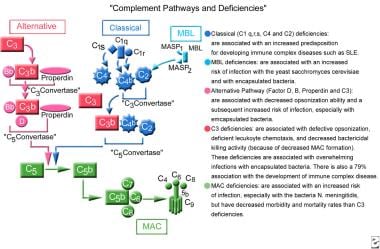
The complement cascade consists of 3 separate pathways that converge in a final common pathway. The pathways include the classical pathway (C1qrs, C2, C4), the alternative pathway (C3, factor B, properdin), and the lectin pathway (mannan-binding lectin [MBL]). The classical pathway is triggered by interaction of the Fc portion of an antibody (immunoglobulin [Ig] M, IgG1, IgG2, IgG3) or C-reactive protein with C1q. The alternative pathway is activated in an antibody-independent manner. Lectins activate the lectin pathway in a manner similar to the antibody interaction with complement in the classical pathway. These 3 pathways converge at the component C3. Although each branch is triggered differently, the common goal is to deposit clusters of C3b on a target. This deposition provides for the assembly of the membrane attack complex (MAC), components C5b-9. The MAC exerts powerful killing activity by creating perforations in cellular membranes. Deficiencies in complement predispose patients to infection via 2 mechanisms: (1) ineffective opsonization and (2) defects in lytic activity (defects in MAC). Specific complement deficiencies are also associated with an increased risk of developing autoimmune disease, such as SLE. An intricate system regulates complement activity. The important components of this system are various cell membrane–associated proteins such as complement receptor 1 (CR1), complement receptor 2 (CR2), and decay accelerating factor (DAF). In addition to these cell surface–associated proteins, other plasma proteins regulate specific steps of the classic or alternative pathway; for example, the proteins factor H and factor I inhibit the formation of the enzyme C3 convertase of the alternative pathway. Similarly, the enzyme C1q esterase acts as an inhibitor of the classic pathway serine proteases C1r and C1s. Deficiency of any of these regulatory proteins results in a state of overactivation of the complement system, with damaging inflammatory effects. Two clinical manifestations of such deficiencies are paroxysmal nocturnal hemoglobinuria and hereditary angioedema, both of which are discussed in other eMedicine articles (see Paroxysmal Nocturnal Hemoglobinuria and Angioedema).
Frequency
International
Complement deficiencies are relatively rare worldwide, and estimates of prevalence are based on results from screening high-risk populations. Retrospective studies of persons with frequent meningococcal infections report varying prevalence based on geographic location. In populations with recurrent meningococcal infection, the prevalence rate is as high as 30%. Individuals with C1q deficiency have a 93% chance of developing SLE. Similarly, C1rs deficiency has a 57% association with SLE and C4 deficiency has a 75% association with SLE.
Mortality/Morbidity
- Individuals with complement deficiencies that hinder opsonization present with frequent recurrent infections and a high rate of morbidity and mortality. Deficiency of C3, the major opsonin, results in recurrent pyogenic infections, particularly with encapsulated bacteria.
- Deficiencies of early classical pathway components (C1, C4, C2) do not usually predispose individuals to severe infections but are associated with autoimmune disorders, especially SLE.
- Patients with a defect in formation of the MAC have a lesser degree of morbidity and mortality than, for example, patients with a defect in C3; the deficiency in the lytic component of the complement cascade is thought to have some protective effect against the generation of full-blown sepsis. These patients are at high risk for recurrent infection with Neisseria gonorrhoeae or Neisseria meningitidis. Severe pyogenic infections and sepsis occur in children and neonates who have a deficiency of a MAC component.
Race
- While no definitive racial patterns of association have been established for the majority of complement deficiencies, ethnic predispositions have been described for certain complement deficiencies. For example, deficiencies in properdin and C2 have been associated with the white race, C6 deficiencies have been shown to have a possible predisposition in African populations, and deficiencies in C8 and C9 have been associated with an Asian racial background. However, for most of these deficiencies, the absolute number of patients studied has been quite small.
Sex
- Most complement deficiencies affect both sexes equally.
-
- The majority of complement deficiencies are inherited in an autosomal recessive pattern (although MBL deficiency has been described as having both an autosomal dominant and recessive pattern). An exception to the autosomal pattern of inheritance is properdin deficiency, which is an X-linked trait.
Age
- Individuals with complement deficiencies that hinder opsonization often present at an early age (months to a few years) because of increased susceptibility to overwhelming infection.
-
- Patients with deficiencies in formation of the MAC tend to present when slightly older (late-teenage years).
-
- Complement deficiencies associated with immune complex diseases, such as SLE, do not show a clear pattern of age at first presentation.
History
Infants may have Leiner disease, which manifests as recurrent diarrhea, wasting, and generalized seborrheic dermatitis. The defect in persons with Leiner disease is usually attributed to a defect of the fifth component of complement (C5). However, a child was described by Sonea and associates who had Leiner disease associated with diminished C3, and another was described by Goodyear and Harper with a low level of the fourth component of complement and reduced neutrophil mobility Thus, the C5 defect may not be the sole cause of Leiner disease, as has been suggested; diminished C3 or C4, or C5 dysfunction or deficiency with hypogammaglobulinemia or other lymphoid deficiency, is also required for its expression. The 3 major sequelae of complement deficiencies, based on the pathophysiology of each defect, are (1) defects that result in inadequate opsonization, (2) defects in cell lysis, and (3) the association of complement deficiencies with immune complex diseases.
- Defects that result in inadequate opsonization
- Opsonization is the process of coating a pathogenic organism so that it is more easily ingested by the macrophage system. The complement protein C3b, along with its cleavage product C3bi, is a potent agent of opsonization in the complement cascade. Any defect that causes decreased production of C3b results in inadequate opsonization ability. Such opsonization defects can be caused by deficiencies in components of the classic, alternative, or MBL pathways, or defects may be caused by deficiencies of the C3b component itself.
- The clinical history of patients with classic pathway deficiencies varies slightly from other complement-deficient patients. In the small number of patients studied, patients with classic pathway deficiencies (ie, deficiency of C1qrs, C2, or C4) are similar in presentation to patients with primary immunoglobulin deficiencies. For example, patients tend to have frequent sinopulmonary infections with organisms such as Streptococcus pneumoniae. More commonly, these patients develop autoimmune syndromes.
- In order to generate an antibody response, an antigen must bind to the complement receptor (CR2) on B cells and the complement protein C3d. A deficiency of C1-C4 proteins leads to an inadequate humoral response in these patients. Patients also have a decrease in classic pathway production of the opsonin C3b, but the alternative and MBL pathways seem to compensate for this defect because opsonin is not completely absent.
- Opsonization defects can also be caused by alternative pathway deficiencies. In the alternative pathway, a deficiency of factor B, factor D, or properdin can result in a decreased amount of C3b. Deficiencies in properdin have been described in some detail. Properdin is a protein encoded on the X chromosome. Properdin stabilizes the C3 convertase (C3bBb) of the alternative pathway. Stabilization of C3 convertase increases the half-life of the complex from 5 minutes to 30 minutes, exponentially increasing the amount of C3b that can be deposited on a microbial surface. The role of C3b as an opsonin is essential in defense against neisserial infection, and the risk of overwhelming neisserial infection increases in the absence of properdin.
- The third pathway whose deficiencies can result in opsonization defects is the MBL pathway. MBL is one of the collectin proteins. These proteins share specific structural characteristics, namely the presence of a collagenlike region and a Ca2+-dependent lectin domain. Of all the lectin proteins, only MBL has been shown to have the ability to activate the complement system. The MBL protein can activate the C4 and C2 components of complement by forming a complex with serine proteases known as MASP1 and MASP2. MASP1 and MASP2 activation results in the protein products C3 and C3b. The MBL protein is versatile because it can bind to a variety of substrates, prompting some to describe the MBL as a kind of universal antibody. Clinically, MBL deficiencies increase risk of infection with the yeast Saccharomyces cerevisiae and encapsulated bacteria such as Neisseria meningitides and S pneumoniae.
- Finally, absolute deficiencies of C3 itself also result in defective opsonization. The C3 component occupies an important place at the junction of both the classic and alternative pathways. As such, C3 deficiency results in severe opsonization dysfunction. C3 deficiency also causes deficient leukocyte chemotaxis because of decreased C3a concentrations and decreased bactericidal killing secondary to decreased formation of MAC. Clinically, patients present at an early age with overwhelming infections from encapsulated bacteria. In addition to opsonization problems, C3 deficiency also impairs adequate clearance of circulating immune complexes, and 79% of patients with C3 deficiency develop some form of collagen vascular disease.
- Deficiencies of the inhibitory proteins of the classic and alternative pathways can also result in a functional C3 deficiency through uncontrolled consumption of C3. Factors H and I are proteins that inhibit C3 formation in the alternative and classic pathways, respectively. Deficiencies in either of these C3 inhibitors can result in an overactivation of C3 and subsequent C3 depletion. Clinically, these patients are similar to patients with absolute C3 deficiency.
- While deficiencies in complement proteins can predispose patients to infections such as the clinical conditions described above, a deficiency in regulation of complement can also lead to disease. Deficiencies or defective regulation of the alternative complement pathway can occur because of genetic mutations or deficiencies in the regulatory protein Factor H. This defective regulation of the alternative pathway can be associated with diseases such as an atypical form of hemolytic uremic syndrome, membranoproliferative glomerulonephritis (type I and II), and age-related macular degeneration.
- Defects in cell lysis
- Complement deficiencies of the terminal cascade proteins also predispose patients to infection, but the clinical history of these patients is different. The terminal complement proteins are the proteins in the cascade that form the MAC, ie, complement proteins C5-C9. These proteins are responsible for bactericidal killing of organisms such as N meningitidis. The frequency rate of meningococcal infection in patients with terminal complement deficiency is as high as 66%. In addition to this high rate of first-time infection, the frequency rate of recurrence with the same organism is also as high as 50%. The serogroups of N meningitidis responsible for infections in this group tend to be the more rare serogroups Y and W135, rather than the more common serogroups B, A, and C.
- Clinically, patients with terminal deficiency tend to present with infection at an older age compared with patients with other complement deficiencies. These individuals also have less morbidity and mortality associated with infection. Unlike patients with a classic pathway deficiency, humoral immunity is intact but lysis of pathogenic organisms is impaired.
- Both the opsonization and lytic function of complement protect against a variety of other nonbacterial pathogens, such fungi, viruses, and mycobacteria. The role of complement in defense against viral infection is sufficiently important that pathogenic viruses have had to develop strategies to evade complement activation. For example, human immunodeficiency virus type 1 has recently been described as escaping complement-mediated lysis through the incorporation of regulatory proteins, such as DAF, into the viral envelope. Similarly, other viruses have also evolved complement-specific means of escape.
- Complement deficiencies and associated immune complex diseases
- Patients with complement deficiencies of the classic pathway are predisposed to develop immune complex diseases.
Patients with deficiencies of the classic pathway components C1qrs, C2, or C4 have been shown to have an increased likelihood of developing SLE. Homozygous deficiency of C1q has the highest association with SLE, with a recently quoted prevalence rate of 93%. Subsequent components of the classic pathway have respective prevalence rates of 57% for C1rs deficiency, 75% association with homozygous C4 deficiencies, and 10% prevalence in patients with C2 deficiencies. - The reason complement deficiency increases the risk of developing SLE is that complement helps in the prevention of immune complex disease by decreasing the number of circulating immune complexes; the greater the concentration of these precipitating immune complexes, the higher the likelihood that they will deposit in nearby tissues and cause an inflammatory response.
- Complement aids in neutralization and clearance of antigen-antibody complexes in several ways. The classic pathway acts to inhibit immune complex precipitation by physically interfering with immune complex aggregation. Secondly, complement enhances the clearance of circulating immune complexes by binding to complement receptors (CR1) on cells such as erythrocytes, B lymphocytes, T lymphocytes, and macrophages. When complement (specifically C3b) binds to CR1 on erythrocytes, the immune complex can be transported through the circulation to be presented to the macrophage systems in the spleen and liver.
- Components of the classical pathway also play an important role in the recognition and clearance of apoptotic cells. Normally, intracellular proteins are displayed on the surface of cells undergoing apoptosis. If these apoptotic cells are not cleared efficiently by the complement system, these cell surface proteins have the potential to act as autoantigens, acting as potential triggers for autoimmune diseases such as systemic lupus.
- In addition to its role in the development of diseases such as SLE, complement activation also likely plays a role in the pathogenesis of the antiphospholipid antibody syndrome (APS), a thrombophilic inflammatory disorder that can be associated with SLE or can occur independently. In a mouse model of antiphospholipid-antibody associated fetal death, mice who were deficient in C3 and mice who were treated with a regulatory protein that inhibits C3 cleavage were protected from fetal loss. While the clinical implications of these findings in human patients are being further studied, both the classical and alternative pathways of complement activation may play a role in disease pathogenesis.
Physical
- No specific physical findings are pathognomonic for complement deficiencies. Rather, clinical manifestations are representative of the infections and immune complex diseases to which patients are predisposed.
-
- Because N meningitides is the overwhelmingly prevalent bacterial pathogen in these patients, knowledge of the physical characteristics of disseminated meningococcal disease is important. The characteristic maculopapular rash that occurs in up to 75% of individuals with meningococcemia occurs soon after disease onset. The rash consists of pink lesions on the trunk and extremities; lesions are approximately 2-10 mm in diameter. The rash can quickly progress to hemorrhagic lesions. Petechiae are also a prominent finding and can occur on the skin of the trunk and extremities or on mucous membranes, such as the palate and conjunctivae.
-
- Noninfectious diseases, such as SLE, that are associated with complement deficiencies can also have a characteristic physical presentation. Complement deficiencies associated with the deposition of immune complexes in various tissues can result in many of the sequelae of SLE, such as glomerulonephritis, arthralgia, uveitis, and vasculitic rash.
Causes
- Most complement deficiencies are caused by a genetic defect in one of the genes that code for the various complement proteins.
- No clear environmental or drug-related causes have been identified.
Hypocomplementemia
Hypogammaglobulinemia
Immunoglobulin A Deficiency
Immunoglobulin D Deficiency
Immunoglobulin G Deficiency
Immunoglobulin M Deficiency
Immunosuppression
Meningococcal Infections
Meningococcemia
Sepsis, Bacterial
Septic Shock
Systemic Lupus Erythematosus
Urticaria
Other Problems to be Considered
Childhood erythroderma
Childhood seborrheic dermatitis
Hypocomplementemic urticarial vasculitis syndrome
Lab Studies
- One can screen for deficiencies in complement by performing the total serum classic hemolytic complement (CH50) test or the alternative hemolytic complement (AP50) test. The CH50 test specifically tests for deficiencies in the classic pathway by measuring the ability of the patient's serum to lyse antibody-coated sheep erythrocytes. A deficiency in any of the classic proteins results in a CH50 of zero. Similarly, the AP50 tests for alternative pathway activity. Direct measurement of individual serum complement proteins, such as C3 and C4, can also be performed and is helpful in determining the diagnosis.
Imaging Studies
- No specific imaging studies are indicated. Consider performing a head CT scan prior to a lumbar puncture in a patient thought to have meningitis.
Other Tests
- Patients with classic complement pathway deficiencies should be screened for sequelae of immune complex diseases. Urinalysis and a complete blood cell count should be performed on these patients.
Procedures
- A lumbar puncture should be performed on patients with possible meningitis to assist in the definitive diagnosis of bacterial meningitis.
Medical Care
- Definitive treatment of complement deficiencies requires replacing the missing component of the cascade, either through direct infusion of the protein or through gene therapy. Because neither of these options is currently available, treatment of these patients focuses on managing the sequelae of the particular complement deficiencies.
-
- For many patients, treatment must be focused on eradicating a particular infection, especially with encapsulated organisms such as N meningitidis. In most cases of meningococcal disease, treatment with meningeal doses of a third-generation cephalosporin covers most strains of N meningitidis.
- For other patients, the complement deficiency may manifest as episodic flares of autoimmune diseases; treatment of these patients focuses on immunosuppressive therapy of these diseases.
- Importantly, note that some overlap often exists between an increased susceptibility to infection and the greater tendency to develop autoimmune disease; both of these clinical situations may need to be addressed simultaneously in any one patient.
Consultations
- In a patient with a possible complement deficiency, consider consultation with an allergist and immunologist to determine appropriate diagnostic tests.
-
- Also, consider consultation with a rheumatologist or infectious disease specialist to help manage acute complications of the complement deficiency.
Diet
- No specific diet restrictions are required.
Activity
- Activity can continue as tolerated by the patient.
Cephalosporins are often used for treatment of N meningitidis infection in patients with complement deficiency. Third- or fourth-generation cephalosporins are used for coverage of infection with any of the encapsulated bacteria.
Drug Category: Antibiotics
Therapy must cover all likely pathogens in the context of this clinical setting. Antibiotic selection should be guided by blood culture sensitivity results whenever feasible.
| Drug Name | Ceftriaxone (Rocephin) |
| Description | Third-generation cephalosporin with broad-spectrum, gram-negative activity; lower efficacy against gram-positive organisms; higher efficacy against resistant organisms. Arrests bacterial growth by binding to one or more penicillin-binding proteins. |
| Adult Dose | Meningitis: 2 g IV qd for 14-21 d |
| Pediatric Dose | Not established |
| Contraindications | Documented hypersensitivity |
| Interactions | Probenecid may increase levels; coadministration with ethacrynic acid, furosemide, and aminoglycosides may increase nephrotoxicity |
| Pregnancy | B - Usually safe but benefits must outweigh the risks.
|
| Precautions | Adjust dose in renal impairment; caution in breastfeeding and allergy to penicillin |
| Drug Name | Cefepime (Maxipime) |
| Description | Fourth-generation cephalosporin with good gram-negative coverage. Similar to third-generation cephalosporins but has better gram-positive coverage. |
| Adult Dose | 1-2 g IV q12h for 5-10 d; may administer higher or more frequent doses depending on severity of infection |
| Pediatric Dose | Not established |
| Contraindications | Documented hypersensitivity |
| Interactions | Probenecid may increase effects; aminoglycosides increase nephrotoxic potential |
| Pregnancy | B - Usually safe but benefits must outweigh the risks.
|
| Precautions | Adjust dose in severe renal insufficiency (high doses may cause CNS toxicity); prolonged use may predispose to superinfection |
Further Inpatient Care
- Serious infectious states warrant hospitalization for treatment.
-
- Inpatient treatment is not necessarily needed to screen for complement deficiencies if the patient is asymptomatic.
Further Outpatient Care
- Patients with a known complement deficiency should be screened for glomerular or immune complex disease. Obtain urinalysis results to check for proteinuria and rheumatologic serology results to screen for SLE.
In/Out Patient Meds
- Cephalosporins (third- or fourth-generation) are needed for treatment of meningeal infection.
Deterrence/Prevention
- Administration of the multivalent meningococcal vaccine is recommended in patients with known complement deficiency, especially those patients deficient in the MAC proteins. Similarly, administration of the pneumococcal vaccine and the Haemophilus influenzae vaccine also may provide protection against these encapsulated organisms.
Complications
- Complications of complement deficiencies can be serious; severe CNS damage and death from meningitis are among the worst possible adverse outcomes.
Prognosis
- In general, the prognosis for patients with C3 deficiencies is poorer than that of individuals with other complement deficiencies. Patients may have severe, recurrent episodes of pyogenic infection beginning when as young as a few months. Many can die from sepsis early in life.
- Patients with a deficiency of one of the early components of the classical pathway (C1, C4, C2) are at high risk for autoimmune disease but at lower risk for overwhelming sepsis with pyogenic infections.
- Deficiency of a MAC component (C5, C6, C7, C8) or of properdin increases the risk for recurrent infections caused by Neisseria organisms.
- Mannan-binding lectin (MBL) deficiency has been linked to an increased frequency of pyogenic infections and sepsis, especially in neonates and children.
Patient Education
- Patients with an identified complement deficiency should be counseled regarding possible complications and risks associated with this deficiency.
-
- Family members should be screened for complement deficiencies and counseled regarding possible risks.
Medical/Legal Pitfalls
- Failure to make the diagnosis
- Beynon HL, Davies KA, Haskard DO, Walport MJ. Erythrocyte complement receptor type 1 and interactions between immune complexes, neutrophils, and endothelium. J Immunol. Oct 1 1994;153(7):3160-7. [Medline].
- Brandtzaeg P, Mollnes TE, Kierulf P. Complement activation and endotoxin levels in systemic meningococcal disease. J Infect Dis. Jul 1989;160(1):58-65. [Medline].
- Carroll MC. The role of complement in B cell activation and tolerance. Adv Immunol. 2000;74:61-88. [Medline].
- Davies KA, Erlendsson K, Beynon HL, et al. Splenic uptake of immune complexes in man is complement-dependent. J Immunol. Oct 1 1993;151(7):3866-73. [Medline].
- Davies KA, Peters AM, Beynon HL, Walport MJ. Immune complex processing in patients with systemic lupus erythematosus. In vivo imaging and clearance studies. J Clin Invest. Nov 1992;90(5):2075-83. [Medline].
- Dempsey PW, Allison ME, Akkaraju S, et al. C3d of complement as a molecular adjuvant: bridging innate and acquired immunity. Science. Jan 19 1996;271(5247):348-50. [Medline].
- Densen P, Weiler JM, Griffiss JM, Hoffmann LG. Familial properdin deficiency and fatal meningococcemia. Correction of the bactericidal defect by vaccination. N Engl J Med. Apr 9 1987;316(15):922-6. [Medline].
- Doody GM, Dempsey PW, Fearon DT. Activation of B lymphocytes: integrating signals from CD19, CD22 and Fc gamma RIIb1. Curr Opin Immunol. Jun 1996;8(3):378-82. [Medline].
- Fauci A, Braunwald E, Isselbacher KJ. Meningococcal Infections. In: Fauci A, Braunwald E, Isselbacher KJ, Wilson JD, Martin JB, Kasper DL, Hauser SL, Longo DL, Harrison TR, eds. Harrison's Principles of Internal Medicine. 14th ed. New York, NY: McGraw-Hill; 1998:. 910-5.
- Figueroa JE, Densen P. Infectious diseases associated with complement deficiencies. Clin Microbiol Rev. Jul 1991;4(3):359-95. [Medline].
- Frank MM. Complement deficiencies. Pediatr Clin North Am. Dec 2000;47(6):1339-54. [Medline].
- Girardin E, Grau GE, Dayer JM, et al. Tumor necrosis factor and interleukin-1 in the serum of children with severe infectious purpura. N Engl J Med. Aug 18 1988;319(7):397-400. [Medline].
- Goodnow CC. Pathways for self-tolerance and the treatment of autoimmune diseases. Lancet. Jun 30 2001;357(9274):2115-21. [Medline].
- Goodyear HM, Harper JI. Leiner's disease associated with metabolic acidosis. Clin Exp Dermatol. Sep 1989;14(5):364-6. [Medline].
- Kang HJ, Kim HS, Lee YK, Cho HC. High incidence of complement C9 deficiency in Koreans. Ann Clin Lab Sci. 2005;35(2):144-8. [Medline].
- Kuby J. The Complement System. In: Immunology. 3rd ed. New York, NY: WH Freeman; 1997:. 335-55.
- Lehner PJ, Davies KA, Walport MJ, et al. Meningococcal septicaemia in a C6-deficient patient and effects of plasma transfusion on lipopolysaccharide release. Lancet. Dec 5 1992;340(8832):1379-81. [Medline].
- Leitao MF, Vilela MM, Rutz R, et al. Complement factor I deficiency in a family with recurrent infections. Immunopharmacology. Dec 1997;38(1-2):207-13. [Medline].
- Lutz HU. How pre-existing, germline-derived antibodies and complement may help induce a primary immune response to nonself. Scand J Immunol. Mar 1999;49(3):224-8. [Medline].
- Manzi S, Ahearn JM, Salmon J. New insights into complement: a mediator of injury and marker of disease activity in systemic lupus erythematosus. Lupus. 2004;13(5):298-303. [Medline].
- Medof ME, Iida K, Mold C, Nussenzweig V. Unique role of the complement receptor CR1 in the degradation of C3b associated with immune complexes. J Exp Med. Dec 1 1982;156(6):1739-54. [Medline].
- Pickering MC, Botto M, Taylor PR, et al. Systemic lupus erythematosus, complement deficiency, and apoptosis. Adv Immunol. 2000;76:227-324. [Medline].
- Prodinger WM. Complement receptor type two (CR2,CR21): a target for influencing the humoral immune response and antigen-trapping. Immunol Res. 1999;20(3):187-94. [Medline].
- Ross GD, Yount WJ, Walport MJ, et al. Disease-associated loss of erythrocyte complement receptors (CR1, C3b receptors) in patients with systemic lupus erythematosus and other diseases involving autoantibodies and/or complement activation. J Immunol. Sep 1985;135(3):2005-14. [Medline].
- Rother K, Till GO, Hansch GM, eds. The Complement System. New York, NY: Springer-Verlag; 1997.
- Schlesinger M, Nave Z, Levy Y, et al. Prevalence of hereditary properdin, C7 and C8 deficiencies in patients with meningococcal infections. Clin Exp Immunol. Sep 1990;81(3):423-7. [Medline].
- Soderstrom C, Braconier JH, Danielsson D, Sjoholm AG. Bactericidal activity for Neisseria meningitidis in properdin-deficient sera. J Infect Dis. Jul 1987;156(1):107-12. [Medline].
- Sonea MJ, Moroz BE, Reece ER. Leiner's disease associated with diminished third component of complement. Pediatr Dermatol. Aug 1987;4(2):105-7. [Medline].
- Sullivan KE, Winkelstein JA. Genetically Determined Deficiencies of the Complement System. In: Ochs HD, Edvard Smith CI, Puck J, eds. Primary Immunodeficiency Diseases: A Molecular and Genetic Approach. New York, NY: Oxford University Press; 1999:. 397-416.
- Sumiya M, Super M, Tabona P, et al. Molecular basis of opsonic defect in immunodeficient children. Lancet. Jun 29 1991;337(8757):1569-70. [Medline].
- Summerfield JA, Sumiya M, Levin M, Turner MW. Association of mutations in mannose binding protein gene with childhood infection in consecutive hospital series. BMJ. Apr 26 1997;314(7089):1229-32. [Medline].
- Super M, Thiel S, Lu J, et al. Association of low levels of mannan-binding protein with a common defect of opsonisation. Lancet. Nov 25 1989;2(8674):1236-9. [Medline].
- Tolnay M, Tsokos GC. Complement receptor 2 in the regulation of the immune response. Clin Immunol Immunopathol. Aug 1998;88(2):123-32. [Medline].
- Turner MW. Mannose-binding lectin: the pluripotent molecule of the innate immune system. Immunol Today. Nov 1996;17(11):532-40. [Medline].
- Volanakis JE, Frank MM, eds. The Human Complement System in Health and Disease. New York, NY: Marcel Dekker; 1998.
- Walport MJ. Complement. First of two parts. N Engl J Med. Apr 5 2001;344(14):1058-66. [Medline].
- Walport MJ. Complement. Second of two parts. N Engl J Med. Apr 12 2001;344(15):1140-4. [Medline].
- Walport MJ, Davies KA, Botto M. C1q and systemic lupus erythematosus. Immunobiology. Aug 1998;199(2):265-85. [Medline].
- Walport MJ, Lachmann PJ. Erythrocyte complement receptor type 1, immune complexes, and the rheumatic diseases. Arthritis Rheum. Feb 1988;31(2):153-8. [Medline].
- Wisnieski JJ, Baer AN, Christensen J, et al. Hypocomplementemic urticarial vasculitis syndrome. Clinical and serologic findings in 18 patients. Medicine (Baltimore). Jan 1995;74(1):24-41. [Medline].
- Zipfel PF, Heinen S, Jozsi M, Skerka C. Complement and diseases: defective alternative pathway control results in kidney and eye diseases. Mol Immunol. Jan 2006;43(1-2):97-106. [Medline].
Complement Deficiencies excerpt Article Last Updated: Jun 2, 2006
|