Continually Updated Clinical Reference
 
 
  All Sources     eMedicine     Medscape     Drug Reference     MEDLINE
 
eMedicine - Multicentric Reticulohistiocytosis : Article by

Quick Find
Authors & Editors
Introduction
Clinical
Differentials
Workup
Treatment
Medication
Follow-up
Miscellaneous
Multimedia
References

Related Articles
Dermatomyositis

Gout

Leprosy

Lymphoma, B-Cell

Lymphoma, Cutaneous T-Cell

Rheumatoid Arthritis

Sarcoidosis


Patient Education
Click here for patient education.


Author: Jeffrey P Callen, MD, Professor of Medicine, Chief, Division of Dermatology, University of Louisville School of Medicine

Jeffrey P Callen is a member of the following medical societies: Alpha Omega Alpha, American Academy of Dermatology, American College of Physicians, and American College of Rheumatology

Editors: Bryan L Martin, DO, Chief, Allergy Immunology Department, Walter Reed Army Medical Center, Washington, DC; Associate Professor of Medicine and Pediatrics, Uniformed Services University of the Health Sciences, Bethesda, MD; United States Army Consultant in Allergy Immunology and Immunizations; Francisco Talavera, PharmD, PhD, Senior Pharmacy Editor, eMedicine; Marcel E Conrad, MD, BS, (Retired) Distinguished Professor of Medicine, University of South Alabama; Rajalaxmi McKenna, MD, FACP, Consulting Staff, Department of Medicine, Southwest Medical Consultants, SC, Good Samaritan Hospital, Advocate Health Systems; Herbert S Diamond, MD, Professor of Medicine, Temple University School of Medicine; Chairman Emeritus, Department of Internal Medicine, Western Pennsylvania Hospital

Author and Editor Disclosure

Synonyms and related keywords: multicentric reticulohistiocytosis, MRH, lipoid dermatoarthritis, destructive arthritis, multiple cutaneous nodules, histiocytic multinucleated giant cells, eosinophilic ground-glass cytoplasm, inflammatory arthropathy, inflammatory joint disease, symmetrical polyarthritis


Background

In 1954, Goltz and Laymon coined the term multicentric reticulohistiocytosis (MRH) to describe patients with destructive arthritis and multiple cutaneous nodules that histologically manifest as an infiltrate of histiocytic multinucleated giant cells with eosinophilic ground-glass cytoplasm.1 This is a rare condition; fewer than 200 cases have been reported in the world literature. Various diseases have been associated with MRH, including malignancy.2

Pathophysiology

The pathogenesis of this condition is unknown but probably has an immunologic basis. Some studies have demonstrated increased levels of tumor necrosis factor (TNF)–alpha in the blood and in the tissue.3, 4

Frequency

United States

This is a rare condition.

International

This is a rare condition.

Mortality/Morbidity

The disease is a debilitating process but rarely causes death unless the patient has an associated malignancy.

Race

This disease has been reported primarily in whites.

Sex

Women are affected more commonly than men, with a female-to-male ratio of 2:1.

Age

The disease may occur at any age, but it has been reported primarily in middle-aged adults, with a mean age of 43 years.


History

  • The primary manifestations of multicentric reticulohistiocytosis (MRH) are joint and skin diseases.
    • Inflammatory joint disease is a frequent presenting symptom, and it is the sole symptom in 45% of patients.
    • Skin disease is common, and it is the presenting manifestation in 30% of patients.

Physical

  • The joint disease usually manifests as destructive and deforming symmetrical polyarthritis with a predilection for the distal interphalangeal joints.
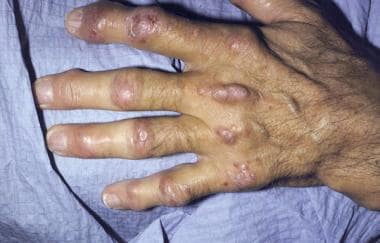
  • The classic skin lesions are multiple nodules that have a predilection for the hands, particularly the base of the nails, but they may occur on any body surface.
    • The lesions are usually nontender.
    • The nodules may be skin colored, red, or yellowish.
    • They vary in size from 1-10 mm and can coalesce to form plaques with a cobblestone surface.
    • One third of patients also have a xanthelasma.
    • The nodules grow slowly, and they rarely ulcerate.
    • Infiltrated plaques may resemble mucinosis.

Causes

The cause of MRH is unknown, but various associated diseases have been reported in patients with MRH.

  • Malignancy has been reported in multiple patients (as many as 25%).
    • No specific site or type of malignancy has been reported.
    • Those reported include melanoma, sarcoma, leukemia, lymphoma, and carcinomas (usually adenocarcinoma) of the breast,5 colon, bronchus, cervix, stomach, and ovaries.
  • Various endocrinopathies have been reported, including diabetes mellitus and hypothyroidism.
  • Other associated conditions include rheumatoid arthritis, systemic lupus erythematosus, Sjögren syndrome, primary biliary cirrhosis, and pregnancy.


Dermatomyositis
Gout
Leprosy
Lymphoma, B-Cell
Lymphoma, Cutaneous T-Cell
Rheumatoid Arthritis
Sarcoidosis

Other Problems to be Considered

Generalized eruptive histiocytosis
Juvenile rheumatoid arthritis
Juvenile xanthogranuloma
Langerhans cell histiocytosis
Non–X histiocytosis
Xanthomas
Psoriatic arthritis
Fibroblastic rheumatism


Lab Studies

  • No specific laboratory studies are specific for multicentric reticulohistiocytosis (MRH). Rheumatoid factor findings are usually negative.

Imaging Studies

  • Radiography of the affected joints reveals destruction of bone disproportionate to loss of cartilage. Lesions may resemble gouty erosions.
    • Mild osteopenia is noted.
    • Marked resorption of subchondral bone is common.
    • The findings may develop rapidly and can resemble arthritis mutilans.
  • The cutaneous nodules may be seen as soft tissue swellings.

Other Tests

  • Findings on joint fluid analysis vary. The effusions may demonstrate polymorphonuclear leukocytes or mononuclear cells.

Histologic Findings

Early skin lesions demonstrate a lymphohistiocytic infiltrate. Mature lesions demonstrate a dermis filled by giant multinucleated cells with a pale, fine, granular (ie, ground glass) eosinophilic cytoplasm. Periodic acid-Schiff stain results are positive and are diastase-resistant. Lipid stain results may be positive. Results of acid phosphatase, nonspecific esterase, and lysozyme stains are usually positive. Results of S100 protein and alpha-1-antitrypsin are negative. Langerhans granules are absent on electron microscopy. In synovial biopsy, lipid-laden giant cells and histiocytes are similar to those seen on skin biopsy.


Medical Care

  • No effective treatment is known for multicentric reticulohistiocytosis (MRH).
  • Therapy with nonsteroidal anti-inflammatory agents may help the arthritis.
  • Systemic corticosteroids and/or cytotoxic agents, particularly cyclophosphamide,6, 7 chlorambucil,6 or methotrexate,8, 9, 7, 10 may affect the inflammatory response, prevent further joint destruction, and cause skin lesions to regress.
  • Antimalarials have also been used.
  • Alendronate and other bisphosphonates have been reported to be effective in an individual patient.11
  • TNF-alpha antagonists have been reported to be effective in many, but not all, patients. Reports of both etanercept3, 4 and infliximab12 have been reported as effective in recent literature, and one would expect that adalimumab might also be effective in an individual patient.

Surgical Care

Joint replacement may improve function in patients with burned-out disease that has resulted in deformity.

Consultations

A rheumatologist and a dermatologist may be consulted.

Activity

Activity may be limited by the severity of the disease. Physical therapy may prevent deformities and relieve symptoms.


No drug of choice is known. Most patients with multicentric reticulohistiocytosis (MRH) are treated with oral prednisone, with or without a cytotoxic/immunosuppressive agent such as methotrexate, cyclophosphamide, or chlorambucil.

Drug Category: Corticosteroids

These agents have anti-inflammatory properties and cause profound and varied metabolic effects. Corticosteroids modify the body's immune response to diverse stimuli.

Drug NamePrednisone (Deltasone, Meticorten, Orasone)
DescriptionImmunosuppressant for treatment of autoimmune disorders; may decrease inflammation by reversing increased capillary permeability and suppressing PMN activity. Stabilizes lysosomal membranes and suppresses lymphocytes and antibody production. Regularly used but not proven to be effective.
Adult Dose1 mg/kg/d PO
Pediatric DoseAdminister as in adults
ContraindicationsDocumented hypersensitivity; viral infection; peptic ulcer disease; hepatic dysfunction; connective tissue infections; fungal or tubercular skin infections; GI disease
InteractionsEstrogens may decrease clearance; may cause digitalis (ie, digoxin) toxicity secondary to hypokalemia; phenobarbital, phenytoin, and rifampin may increase metabolism of glucocorticoids (consider increasing maintenance dose); monitor for hypokalemia with coadministration of diuretics
PregnancyB - Fetal risk not confirmed in studies in humans but has been shown in some studies in animals
PrecautionsAbrupt discontinuation of glucocorticoids may cause adrenal crisis; hyperglycemia, edema, osteonecrosis, myopathy, peptic ulcer disease, hypokalemia, osteoporosis, euphoria, psychosis, myasthenia gravis, growth suppression, and infections may occur with glucocorticoid use

Drug Category: Cytotoxic/immunosuppressive agents

These are steroid sparing. None have been documented to be effective, except in anecdotal reports.

Drug NameMethotrexate (Folex PFS, Rheumatrex)
DescriptionUnknown mechanism of action in treatment of inflammatory reactions; may affect immune function. Ameliorates symptoms of inflammation (eg, pain, swelling, stiffness).
Adjust dose gradually to attain satisfactory response.
Adult Dose15-25 mg/wk PO/IM
Pediatric DoseAdminister as in adults
ContraindicationsDocumented hypersensitivity; alcoholism; hepatic insufficiency; documented immunodeficiency syndromes; preexisting blood dyscrasias (eg, bone marrow hypoplasia, leukopenia, thrombocytopenia, significant anemia); renal insufficiency
InteractionsCoadministration with NSAIDs may be fatal
Oral aminoglycosides may decrease absorption and blood levels of oral methotrexate (MTX); charcoal lowers levels; etretinate may increase hepatotoxicity; folic acid or its derivatives contained in some vitamins may decrease response
Indomethacin and phenylbutazone can increase plasma levels; may decrease phenytoin serum levels
Probenecid, salicylates, procarbazine, and sulfonamides, including TMP-SMX, may increase effects and toxicity; may increase plasma levels of thiopurines
PregnancyD - Fetal risk shown in humans; use only if benefits outweigh risk to fetus
PrecautionsMonitor CBC count monthly and liver and renal function every 1-3 mo during therapy (monitor more frequently during initial dosing, during dose adjustments, or when elevated MTX levels is a risk, eg, dehydration); has toxic effects on hematologic, renal, GI, pulmonary, and neurologic systems
Discontinue if blood counts significantly drop; aspirin, NSAIDs, or low-dose steroids may be administered concomitantly (possibility of increased toxicity with NSAIDs, including salicylates, has not been tested)

Drug NameCyclophosphamide (Cytoxan, Neosar)
DescriptionChemically related to nitrogen mustards. As alkylating agent, mechanism of action of active metabolites may involve cross-linking of DNA, which may interfere with growth of normal and neoplastic cells.
Adult Dose1-2 mg/kg/d PO or IV
Pediatric DoseAdminister as in adults
ContraindicationsDocumented hypersensitivity; severely depressed bone marrow function
InteractionsAllopurinol may increase risk of bleeding or infection and exacerbate myelosuppressive effects; may potentiate doxorubicin-induced cardiotoxicity; may reduce digoxin serum levels and antimicrobial effects of quinolones
Chloramphenicol may increase half-life while decreasing metabolite concentrations; may increase effect of anticoagulants; high doses of phenobarbital may increase rate of metabolism and leukopenic activity; thiazide diuretics may prolong cyclophosphamide-induced leukopenia and neuromuscular blockade by inhibiting cholinesterase activity
PregnancyD - Fetal risk shown in humans; use only if benefits outweigh risk to fetus
PrecautionsRegularly examine hematologic profile (particularly neutrophils and platelets) to monitor for hematopoietic suppression; regularly examine urine for RBCs, which may precede hemorrhagic cystitis

Drug Category: Antimalarial

Derivatives of 4-aminoquinoline are active against various autoimmune disorders.

Drug NameHydroxychloroquine (Plaquenil)
DescriptionAlthough not demonstrated to be effective in studies, anecdotal reports suggest possible effect. Inhibits chemotaxis of eosinophils and locomotion of neutrophils and impairs complement-dependent antigen-antibody reactions.
Hydroxychloroquine sulfate 200 mg is equivalent to 155 mg hydroxychloroquine base and 250 mg chloroquine phosphate.
Adult Dose200-400 mg/d PO
Pediatric Dose<6.5 mg/kg/d PO
ContraindicationsDocumented hypersensitivity; psoriasis; retinal and visual field changes attributable to 4-aminoquinolones
InteractionsCimetidine increases serum levels; magnesium trisilicate may decrease absorption
PregnancyC - Fetal risk revealed in studies in animals but not established or not studied in humans; may use if benefits outweigh risk to fetus
PrecautionsCaution in hepatic disease, G-6-PD deficiency, psoriasis, and porphyria; not recommended for long term in children; perform periodic (every 6 mo) ophthalmic examinations; test periodically for muscle weakness

Drug Category: TNF antagonists

Individual case reports suggest a benefit.

Drug NameInfliximab (Remicade)
DescriptionNeutralizes cytokine TNF-alpha and inhibits it from binding to TNF-alpha receptor. Consult rheumatologist for use.
Adult Dose5 mg/kg single IV infusion
Pediatric DoseNot established
ContraindicationsDocumented hypersensitivity; active infection; concurrent live vaccination
InteractionsNone reported
PregnancyB - Fetal risk not confirmed in studies in humans but has been shown in some studies in animals
PrecautionsTNF-alpha modulates cellular immune responses; anti-TNF therapies, such as infliximab, may adversely affect normal immune responses and allow development of superinfections; more cases of lymphoma were observed in TNF-alpha blockers compared with controlled groups; may increase risk of reactivation of tuberculosis in patients with particular granulomatous infections

Drug NameEtanercept (Enbrel)
DescriptionSoluble p75 TNF receptor fusion protein (sTNFR-Ig). Inhibits TNF binding to cell surface receptors, which, in turn, decreases inflammatory and immune responses.
Adult Dose25-50 mg SC qwk or 2 times/wk with or without concomitant administration of MTX
Pediatric Dose<4 years: Not established
4-17 years: 0.4 mg/kg SC 2 times/wk (72-96 h apart); not to exceed 25 mg/dose
>17 years: Administer as in adults
ContraindicationsDocumented hypersensitivity; active infection; sepsis; concurrent live vaccination
InteractionsNone reported
PregnancyB - Fetal risk not confirmed in studies in humans but has been shown in some studies in animals
PrecautionsSerious infections may develop and therapy should be discontinued if they occur; possible adverse effects include injection site pain, redness and swelling at injection site, and headaches; rare cases of lupuslike symptoms and heart failure have been reported (discontinue treatment if symptoms develop)

Drug Category: Bisphosphonates

These agents are analogs of pyrophosphate and act by binding to hydroxyapatite in bone matrix, thereby inhibiting the dissolution of crystals. These drugs prevent osteoclast attachment to the bone matrix and osteoclast recruitment and viability.

Drug NameAlendronate (Fosamax)
DescriptionInhibits bone resorption via actions on osteoclasts or osteoclast precursors. Used to treat osteoporosis in both men and women. May reduce bone resorption and incidence of fracture at spine, hip, and wrist by approximately 50%. Should be taken with large glass of water at least 30 min before eating and drinking to maximize absorption. Because of possible esophageal irritation, patients must remain upright after taking the medication. Since it is renally excreted, it is not recommended in patients with moderate-to-severe renal insufficiency, ie, CrCl <30 mL/min or CrCl >3 mg/dL, and, thus, its use in perirenal transplantation is limited.
Adult DoseTreatment: 10 mg PO qd; alternatively, 70 mg PO qwk for osteoporosis prevention or treatment; no dose established in patients with MRH
Pediatric DoseNot determined
ContraindicationsDocumented hypersensitivity; hypocalcemia; abnormalities of the esophagus; inability to stand upright for 30 min
InteractionsNone reported
PregnancyC - Fetal risk revealed in studies in animals but not established or not studied in humans; may use if benefits outweigh risk to fetus
PrecautionsMust be taken at least 30 min before first food, beverage, or medication of the day and should be taken with large amounts of water; caution in patients with renal impairment


Further Inpatient Care

  • Inpatient care is often unnecessary.

Further Outpatient Care

  • Patients with multicentric reticulohistiocytosis (MRH) should be monitored at regular intervals to track the activity of the disease and its therapy.

Transfer

  • MRH is a rare condition. The patient should be referred to a medical center at least once following diagnosis.

Complications

  • This disease can cause deformities of the joints and disfigurement due to the skin lesions.
  • If cytotoxic agents are used, the patient should be monitored for development of a malignancy in the future.

Prognosis

  • The disease is debilitating but is not life threatening.
  • If the patient has an associated malignancy, the prognosis relates to that of the malignancy.


Medical/Legal Pitfalls

  • Misdiagnosis
  • Toxicity of therapy in patients who may not have been informed of the risks


Media file 1:  Multiple erythematous nodules are present on the dorsal hands of this adolescent with an inflammatory arthropathy.
Click to see larger pictureClick to see detailView Full Size Image
Media type:  Photo

Media file 2:  Multiple erythematous to brown nodules on the fingers.
Click to see larger pictureClick to see detailView Full Size Image
Media type:  CT

Media file 3:  Erythematous, poikilodermatous mamillated plaque on the anterior chest.
Click to see larger pictureClick to see detailView Full Size Image
Media type:  Photo

Media file 4:  Histopathology of multicentric reticulohistiocytosis (MRH) skin lesions.
Click to see larger pictureClick to see detailView Full Size Image
Media type:  Photo

Media file 5:  Histopathology of multicentric reticulohistiocytosis (MRH) skin lesions. Higher power demonstrating the ground glass cytoplasm and multinucleated giant cells.
Click to see larger pictureClick to see detailView Full Size Image
Media type:  Photo


  1. Goltz RW, Laymon CW. Multicentric reticulohistiocytosis of the skin and synovia; reticulohistiocytoma or ganglioneuroma. AMA Arch Derm Syphilol. Jun 1954;69(6):717-31. [Medline].
  2. Nunnink JC, Krusinski PA, Yates JW. Multicentric reticulohistiocytosis and cancer: a case report and review of the literature. Med Pediatr Oncol. 1985;13(5):273-9. [Medline].
  3. Kovach BT, Calamia KT, Walsh JS, Ginsburg WW. Treatment of multicentric reticulohistiocytosis with etanercept. Arch Dermatol. Aug 2004;140(8):919-21. [Medline].
  4. Lovelace K, Loyd A, Adelson D, Crowson N, Taylor JR, Cornelison R. Etanercept and the treatment of multicentric reticulohistiocytosis. Arch Dermatol. Sep 2005;141(9):1167-8. [Medline].
  5. Valencia IC, Colsky A, Berman B. Multicentric reticulohistiocytosis associated with recurrent breast carcinoma. J Am Acad Dermatol. Nov 1998;39(5 Pt 2):864-6. [Medline].
  6. Ginsburg WW, O'Duffy JD, Morris JL, Huston KA. Multicentric reticulohistiocytosis: response to alkylating agents in six patients. Ann Intern Med. Sep 1 1989;111(5):384-8. [Medline].
  7. Liang GC, Granston AS. Complete remission of multicentric reticulohistiocytosis with combination therapy of steroid, cyclophosphamide, and low-dose pulse methotrexate. Case report, review of the literature, and proposal for treatment. Arthritis Rheum. Jan 1996;39(1):171-4. [Medline].
  8. Franck N, Amor B, Ayral X, et al. Multicentric reticulohistiocytosis and methotrexate. J Am Acad Dermatol. Sep 1995;33(3):524-5. [Medline].
  9. Gourmelen O, Le Loet X, Fortier-Beaulieu M, et al. Methotrexate treatment of multicentric reticulohistiocytosis. J Rheumatol. Apr 1991;18(4):627-8. [Medline].
  10. Rentsch JL, Martin EM, Harrison LC, Wicks IP. Prolonged response of multicentric reticulohistiocytosis to low dose methotrexate. J Rheumatol. May 1998;25(5):1012-5. [Medline].
  11. Goto H, Inaba M, Kobayashi K, et al. Successful treatment of multicentric reticulohistiocytosis with alendronate: evidence for a direct effect of bisphosphonate on histiocytes. Arthritis Rheum. Dec 2003;48(12):3538-41. [Medline].
  12. Sellam J, Deslandre CJ, Dubreuil F, et al. Refractory multicentric reticulohistiocytosis treated by infliximab: two cases. Clin Exp Rheumatol. Jan-Feb 2005;23(1):97-9. [Medline].
  13. Barrow MV, Holubar K. Multicentric reticulohistiocytosis. A review of 33 patients. Medicine (Baltimore). Jul 1969;DA - 19690930(4):287-305. [Medline].
  14. Blanco JJ, Hernandez FJ, Cerezo JG, et al. Multicentric reticulohistiocytosis. The long course of a rare disease. Scand J Rheumatol. 2002;31(2):107-9. [Medline].
  15. Callen JP. Miscellaneous disorders that commonly affect both skin and joints. In: Provost TT, ed. Cutaneous Manifestations of Rheumatic Diseases. Lippincott Williams & Wilkins; 1996:278-9.
  16. Candell Chalom E, Elenitsas R, Rosenstein ED, Kramer N. A case of multicentric reticulohistiocytosis in a 6-year-old child. J Rheumatol. Apr 1998;25(4):794-7. [Medline].
  17. Cox NH, West NC, Popple AW. Multicentric reticulohistiocytosis associated with idiopathic myelofibrosis. Br J Dermatol. Dec 2001;145(6):1033-4. [Medline].
  18. Hiramanek N, Kossard S, Barnetson RS. Multicentric reticulohistiocytosis presenting with a rash and arthralgia. Australas J Dermatol. May 2002;43(2):136-9. [Medline].
  19. Hsiung SH, Chan EF, Elenitsas R, et al. Multicentric reticulohistiocytosis presenting with clinical features of dermatomyositis. J Am Acad Dermatol. Feb 2003;48(2 Suppl):S11-4. [Medline].
  20. Lesher JL Jr, Allen BS. Multicentric reticulohistiocytosis. J Am Acad Dermatol. Oct 1984;DA - 19841212(4 Pt 2):713-23. [Medline].
  21. Orkin M, Goltz RW, Good RA, et al. A study of multicentric reticulohistiocytosis. Arch Dermatol. May 1964;89:640-54. [Medline].
  22. Outland JD, Keiran SJ, Schikler KN, Callen JP. Multicentric reticulohistiocytosis in a 14-year-old girl. Pediatr Dermatol. Nov-Dec 2002;19(6):527-31. [Medline].
  23. Peters MS. Histiocytic and Langerhans cell reactions. In: Farmer ER, Hood AF, eds. Pathology of the Skin. 1990:263-5.
  24. Raphael SA, Cowdery SL, Faerber EN, et al. Multicentric reticulohistiocytosis in a child. J Pediatr. Feb 1989;114(2):266-9. [Medline].
  25. Santilli D, Lo Monaco A, Cavazzini PL, Trotta F. Multicentric reticulohistiocytosis: a rare cause of erosive arthropathy of the distal interphalangeal finger joints. Ann Rheum Dis. Jun 2002;61(6):485-7. [Medline].
  26. Trotta F, Castellino G, Lo Monaco A. Multicentric reticulohistiocytosis. Best Pract Res Clin Rheumatol. Oct 2004;18(5):759-72. [Medline].
  27. Weber FP, Freudenthal W. Nodular non-diabetic cutaneous xanthomatosis with hypercholesterolemia and atypical histologic features. Proc R Soc Med. 1937;30:522-6.
  28. Yee KC, Bowker CM, Tan CY, Palmer RG. Cardiac and systemic complications in multicentric reticulohistiocytosis. Clin Exp Dermatol. Nov 1993;18(6):555-8. [Medline].
  29. Zvaifler NJ. Uncommon arthropathies. In: Klippel JH, Dieppe PA, eds. Rheumatology. 2nd ed. 1998:4-5.

Multicentric Reticulohistiocytosis excerpt

Article Last Updated: Oct 31, 2007