Continually Updated Clinical Reference
 
 
  All Sources     eMedicine     Medscape     Drug Reference     MEDLINE
 
eMedicine - Nerve Entrapment Syndromes : Article by

Quick Find
Authors & Editors
Introduction
Indications
Workup
Treatment
Complications
Outcome and Prognosis
Future and Controversies
References


Patient Education
Bone, Joint, and Muscle Center

Carpal Tunnel Syndrome Overview

Carpal Tunnel Syndrome Causes

Carpal Tunnel Syndrome Symptoms

Carpal Tunnel Syndrome Treatment


Author: James S Harrop, MD, Assistant Professor, Department of Neurosurgery, Jefferson Medical College

James S Harrop is a member of the following medical societies: North American Spine Society

Coauthor(s): Amgad Hanna, MD, Staff Physician, Department of Neurosurgery, Jefferson University Hospital; Dachling Pang, MD, FRCS(C), FACS, Clinical Professor of Neurosurgery, Chief of Pediatric Neurosurgery, University of California Davis School of Medicine; Chief, Regional Center for Pediatric Neurosurgery, Kaiser Permanente Hospitals of Northern California; Kamran Sahrakar, MD, Clinical Professor, Department of Neurosurgery, University of California-Davis

Editors: Michael G Nosko, MD, PhD, Chief, Division of Neurosurgery, Director of Neurovascular Surgery, Medical Director of Neuroscience Unit, Associate Professor, Department of Surgery, University of Medicine and Dentistry at New Jersey; Francisco Talavera, PharmD, PhD, Senior Pharmacy Editor, eMedicine; Ryszard M Pluta, MD, PhD, Associate Professor, Neurosurgical Department Medical Research Center, Polish Academy of Sciences at Warsaw, Poland; Senior Researcher, Surgical Neurology Branch, National Institute of Neurological Disorders and Stroke, NIH; Herbert H Engelhard III, MD, PhD, Director, UIC Neuro-Oncology Program, Chief, Division of Neuro-Oncology, Associate Professor, Department of Neurosurgery, University of Illinois at Chicago; Allen R Wyler, MD, Medical Director, Northstar Neuroscience, Inc

Author and Editor Disclosure

Synonyms and related keywords: nerve entrapment syndromes, nerve compression, chronic nerve injury, entrapment, carpal tunnel, cubital tunnel, meralgia paresthetica, decompression, nerve decompression, nerve entrapment, entrapment neuropathies, chronic compression, carpal tunnel syndrome, posterior interosseous nerve syndrome, PIN, suprascapular nerve entrapment, tarsal tunnel syndrome


The brain and spinal cord receive and send information through muscles and sensory receptors. The information sent to organs is transmitted through nerves. The nerves travel to the upper and lower extremities and traverse the various joints along their paths. Unfortunately, these nerves can become compressed or entrapped at various regions of the extremities.

This article covers some basic principles of entrapment neuropathies, and, within each section, the specifics of the most common entrapment syndromes are summarized. Together, this information should provide the reader with a solid basis for further investigation.

For excellent patient education resources, visit eMedicine's Bone, Joint, and Muscle Center. Also, see eMedicine's patient education article Carpal Tunnel Syndrome.

History of the Procedure

The first operations or decompressions for nerve entrapment were performed in the 1930s by Learmonth, but the disorders were described a century earlier by such pioneering physicians as Paget (1850s) and Sir Astley Cooper (1820s).

Problem

Entrapment neuropathies are a group of disorders of the peripheral nerves that are characterized by pain and/or loss of function of the nerves as a result of chronic compression.

Frequency

Neurosurgical practices, among other specialty practices, treat these entrapment neuropathies, which can account for 10-20% of the practice’s cases. Orthopedic and plastic surgeons also perform these types of surgery. 
 
Carpal tunnel syndrome (CTS) is the most common entrapment neuropathy. Ulnar neuropathy is the second most common and is caused by a compression at the elbow or the wrist, which may cause other compression syndromes of the deep branch of the ulnar nerve. Other rare nerve entrapment syndromes include suprascapular nerve, which accounts for approximately 0.4% of upper girdle pain symptoms, and meralgia paresthetica.

Etiology

Nerve entrapment syndromes result from chronic injury to a nerve as it travels through an osseoligamentous tunnel; the compression is typically between the ligamentous canal and bony surfaces. Exceptions to this anatomical generalization include the entrapment of the posterior intraosseous nerve (PIN) by the muscular arcade of the supinator (also known as the arcade of Frohse), compression of the sciatic nerve as it exits the pelvis by the opposing aponeurotic edges of the piriformis and gemelli muscles, and some cases of thoracic outlet syndrome. In cases of nerve entrapment, at least one portion of the compressive surfaces is mobile. This results in either a repetitive "slapping" insult or a "rubbing/sliding" compression against sharp, tight edges, with motion at the adjacent joint that results in a chronic injury. Immobilization of the nerve with a splint or lifestyle adjustments may therefore resolve the symptoms. Entrapment neuropathies can also be caused by systemic disorders, such as rheumatoid arthritis, pregnancy, acromegaly, or hypothyroidism.

Pathophysiology

Repetitive injury and trauma to a nerve may result in microvascular (ischemic) changes, edema, injury to the outside layers of the nerve (myelin sheath) that aid in the transmission of the nerve’s messages, and structural alterations in membranes at the organelle levels in both the myelin sheath and the nerve axon. Focal segmental demyelination at the area of compression is a constant feature of compression syndromes. Complete recovery of function after surgical decompression reflects remyelination of the injured nerve. Incomplete recovery in more chronic and severe cases of entrapment is due to Wallerian degeneration of the axons and permanent fibrotic changes in the neuromuscular junction that prevents reinnervation and restoration of function.

Clinical

The symptoms of nerve compression vary, based on the particular nerve involved. In general, however, the temporal sequence of neurological manifestations is as follows:

  • Irritative or inflammation (sensory nerves)
    • Pain
    • Paresthesia
  • Ablative symptoms
    • Numbness (sensory nerves)
    • Weakness and atrophy (motor nerves)

In a major mixed nerve (both sensory and motor), such as the sciatic or median nerves, signs of sympathetic dystrophy may be prominent features in chronic cases. These changes manifest as the following:

  • Dry, thin, hairless skin
  • Ridged, thickened, crackly nails
  • Recurrent skin ulcerations

Most entrapment syndromes involve mixed sensory and motor nerves and, thus, conform to the aforementioned pattern. Some exceptions are the deep branch of the ulnar nerve at Guyon canal, the PIN (pure motor), and the lateral femoral cutaneous nerve (pure sensory) near the anterior superior iliac spine.
 
Median nerve at the wrist (carpal tunnel syndrome)

Carpal tunnel syndrome (CTS) is the most commonly encountered nerve entrapment condition.

  • Relevant anatomy
    • Median nerve compression at the wrist is near the TCL, which attaches to and arches between the pisiform and hamate on the ulnar side and the scaphoid and trapezium on the radial portion. The palmar fascia is fused to the TCL proximally and then fans out to the soft tissue of the palmar skin as the palmar aponeurosis. The combined layers of the TCL and proximal palmar fascia form the flexor retinaculum.
    • The palmaris longus tendon inserts in the palmar aponeurosis and lies directly over the median nerve just proximal to the TCL. but is absent in 25% of individuals. In these people, the nerve is beneath a fascial membrane between the flexor carpi radialis and the flexor digitorum superficialis tendons.
    • The median palmar cutaneous nerve originates from the radial side of the median nerve proximal to or just deep to the flexor retinaculum, then transverses superficially to the flexor retinaculum to innervate the thenar eminence (thumb) and the palm roughly up to the vertical line overlying the fourth metacarpal (finger).
    • Motor nerve to the thenar muscles leaves the median nerve radially just beyond the distal edge of the flexor retinaculum, but variant nerves may pierce through the flexor retinaculum or arise from the ulnar aspect of the median nerve and an accessory motor branch may even emerge proximal to the flexor retinaculum.
    • The ulnar nerve (10%) and artery (4%) lie radial to the hook of the hamate outside of the Guyon canal, placing them at risk for injury during carpal tunnel surgery.
  • Clinical presentation
    • Patients note a dull, aching pain at the wrist that may extend up the forearm to the elbow. Typically, patients rub their wrists or shake their hands to try to "get the blood back into their wrists." The pain is typically worse at night and disturbs their sleep. Often, it is associated with distressing paresthesia in the thumb and index finger, particularly upon awakening. As the symptoms worsen, sensation may be decreased at the volar pads of the thumb and index finger. The symptoms are the result of compression of the median nerve as it passes through the wrist and carpal tunnel. The median nerve at the wrist supplies the following functions to the LOAF muscles:
      • L: Lumbricals 1 and 2 are affected very late in the course of the disease.
      • O: Opponens pollicis is affected only very late.
      • A: Abductor pollicis brevis (APB) loss results in weakness and atrophy, causing thinning of the lateral contour of the thenar bulk.
      • F: Flexor pollicis brevis (FPB) is dually innervated by both the median and ulnar nerves; therefore, compression of only the median nerve does not cause appreciable symptoms because of the ulnar nerve contribution.
    • Sensation in the palmar surface of the lateral 3.5 fingers can also be affected; however, the palm is supplied by the palmar cutaneous branch, which does not travel through the carpal tunnel. Therefore, if palmar sensation is lost, the nerve injury is most likely more proximally located.
    • Forced wrist flexion causes increasing paresthesia and pain (Phalen sign), as does extreme wrist extension due to compression of the nerve in the carpal tunnel. Gentle tapping of the nerve over the flexor retinaculum (wrist) produces paresthesia (Tinel sign), but this test is not very sensitive.

Ulnar nerve at the elbow (cubital tunnel)

  • Relevant anatomy 
    • The ulnar nerve travels on the medial side of the brachial artery in the upper arm, pierces the medial intermuscular septum at mid arm, and continues toward the elbow on the medial head of the triceps. At the elbow, it passes through the cubital tunnel, a groove between the medial humeral epicondyle and the olecranon. The nerve travels beneath the aponeurotic arcade between the 2 heads of the flexor carpi ulnaris and down the forearm between the deep and superficial finger flexors.
    • The following 5 potential areas of ulnar nerve injury exist within its course into and out of the elbow:
      • The arcade of Struthers (present in 70% of the population; differs from the Struther ligament, which can compress the median nerve) stretches from the medial head of the triceps to insert into the medial intermuscular septum. This can compress the ulnar nerve approximately 6-8 cm above the medial epicondyle.
      • The medial intermuscular septum presents a sharp edge that can indent the nerve, particularly after anterior transposition, in which the nerve may be kinked.
      • The cubital tunnel is floored by the medial collateral ligament of the elbow and roofed by the arcuate ligament (retinaculum) that stretches between the medial humeral epicondyle and the medial aspect of the olecranon.
      • The arching band of aponeurosis between the 2 heads of the flexor carpi ulnaris (Osborne band) often compresses the nerve, especially during repetitive contraction of the muscle.
      • The aponeurotic covering between the flexors digitorum profundus and superficialis is occasionally a site of compression.
  • Pathophysiology 
    • Ulnar neuropathy at the elbow may be from a posttraumatic or nontraumatic etiology. Trauma may be caused by a single event or, more typically, due to mild repetitive injuries. The resulting pathophysiologic basis for the traumatic neuropathy is likely due to scarring and adhesion at the cubital tunnel, compression at the heads of the flexor carpi ulnaris aponeurosis, or both.
    • Patients with an ulnar neuropathy from a nontraumatic etiology often have jobs that require repetitive elbow flexion and extension or prolonged resting of the elbow on a hard surface. Elbow flexion creates narrowing of the cubital tunnel as a result of traction on the arcuate ligament and bulging of the medial collateral ligament. Elbow flexion may also contribute to the injury by stretching the nerve, thus creating an increase in the intraneural pressure. With scarring and adhesion on the epineurium, elongation accentuates the tethering effect on the axons. These effects may be accentuated at night when the patient sleeps with the elbow in flexion.
    • Spontaneous subluxation of the ulnar nerve out of the cubital tunnel occurs in 15% of the population, aggravating symptoms of entrapment by the rubbing action exerted by the bony surfaces.
  • Symptoms in the clinical presentation include the following:
    • Intermittent paresthesia along the ring and little fingers
    • Discomfort along the medial aspect of the forearm
    • Pain typically presents as a deep ache around the elbow region
    • Pain is exacerbated when the medial elbow is impacted
  • Signs of ulnar compression include the following:
    • A gentle tapping of the nerve at and around the cubital tunnel elicits distressing electrical shock, tingling, or both down the ulnar fingers (the Tinel sign).
    • Sensation over the palmar portion of the fifth digit and the ulnar half of the fourth digit specifically is decreased, specifically to the following stimuli: 
      • Pinprick
      • Light touch
      • Two-point discrimination
    • Provocative test: Sustained elbow flexion combined with gentle digital pressure on the cubital tunnel causes paresthesia and pain.
    • Weakness of finger abductors and adductors except for thumb abductors is variable.
    • Late symptoms include dense numbness and profound weakness and atrophy of the intrinsic hand muscles.  
    • An ulnar claw hand forms during extension.
    • Flexion at the metacarpal phalangeal joints and flexion at the intraphalangeal joints is caused by the loss of lumbricals 3 and 4.
Deep ulnar nerve compression at the wrist (Guyon canal)
  • Relevant anatomy
    • At the wrist, the ulnar nerve runs above the flexor retinaculum lateral to the flexor carpi ulnaris tendon and medial to the ulnar artery. At the proximal carpal bones, it dips between the pisiform and the hook of the hamate at the entrance to the Guyon canal, roofed over by an extension of the TCL between these 2 bones.
    • The superficial hypothenar sensory branch, its first, comes out just outside the Guyon canal in 65% of the population. This sensory nerve supplies sensation to the hypothenar skin ulnar to the vertical line at the base of the ring finger and ends as the 2 ulnar digital nerves for the little finger and ulnar half of the ring finger. Its only motor fibers are to the palmaris brevis, which wrinkles the hypothenar skin to cup the palm. In these individuals, compression at the Guyon canal spares the sensory branch; therefore, intrinsic hand paralysis is silent, painless, and more treacherous.
    • In the other 35% of individuals, some pain and hypothenar numbness is expected with ulnar compression. After entering the Guyon canal, the deep motor branch first supplies the abductor digiti minimi (ADM), then crosses under one head of the flexor digiti minimi (FDM), supplies this muscle, and crosses over to supply the opponens digiti minimi before rounding the hook of the hamate to enter the mid palmar space. Depending on the exact site of compression within the Guyon canal, the ADM or both the ADM and the FDM may be spared. The opponens always is affected, together with the interossei, lumbricals 3 and 4, and the adductor pollicis.
    • Proximal compression within the Guyon canal is often attributed to thickening of the tendinous arch that is stretched between the pisiform and hamate. The hook of the hamate may be sharp edged and forms an acute angle where the nerve turns radially. Injury to the nerve in this distal part of the canal may be accentuated by fibrous bands. The distal canalis also the common site for ganglions.
  • Causes
    • Patients typically have repeated trauma or compression at the wrist. Examples of this are as follows:
      • Paraplegics who use hand crutches that have a horizontal bar across the palm
      • Motorcyclists who firmly grasp the handlebar
      • Operators of pneumatic drills
  • Clinical presentation
    • The classic presentation is a young man with painless atrophy of the hypothenar muscles and interossei with sparing of the thenar group. Variable sensory loss over the ulnar fingers or hypothenar eminence, together with aching pain in the palm, may be present in patients whose sensory branch is a recurrent nerve that arises from within the proximal canal.
    • This can be differentiated from ulnar compression at the elbow because the dorsal sensation to the fourth and fifth digit comes from the dorsal cutaneous branch, which leaves the ulnar nerve prior to entering Guyon canal, approximately 9 cm proximal to the wrist.

Radial nerve in the forearm - posterior interosseous nerve syndrome

  • Relevant anatomy
    • At mid arm, the radial nerve descends behind the humerus, deep to the long head of the triceps, and then spirals around the humerus in between the medial and lateral heads of the triceps in the spiral groove. Approximately 5-10 cm above the lateral humeral epicondyle, the nerve pierces the lateral intermuscular septum to gain the anterior compartment of the arm. Here, it immediately enters the deep, muscular groove bordered medially by the biceps and laterally by the brachioradialis, the extensor carpi radialis longus (ECRL), and the extensor carpi radialis brevis (ECRB). The nerve then courses immediately in front of the radiocapitellar joint capsule, where it divides into the motor PIN and the sensory superficial radial nerve (SRN).
    • Branches to the brachioradialis and ECRL come off before the bifurcation and the nerve to ECRB comes off the PIN. The PIN enters the radial tunnel underneath a musculo-tendinous arcade, the arcade of Frohse, formed by the upper free border of the superficial head of the supinator. Within the tunnel, the PIN rests on the deep head of the supinator. A leash of arterial branches (of Henry) that arises from the recurrent radial artery cross over the PIN just before the arcade of Frohse.
    • After emerging from the radial tunnel beneath the supinator, the PIN lies posteriorly to the intraosseous membrane of the forearm and innervates the extensor digiti minimi, extensor carpi ulnaris, and the extensor digitorum communis medially and the extensor indicis proprius, extensor pollicis longus and brevis, and abductor pollicis longus laterally.
    • PIN compression is most commonly associated with tendinous hypertrophy of the arcade of Frohse and fibrous thickening of the radiocapitellar joint capsule. Vascular compression by a hypertrophic leash of Henry has been reported. Lesions, such as lipoma, synovial cyst, rheumatoid synovitis, and vascular aneurysms, have been found in some cases. Hobbies or occupations associated with repetitive and forceful supination predispose the individual to PIN neuropathy. Chronic trauma to the flexion surface of the forearm likewise causes problems. For example, the constricting rings of the Canadian crutches, which exert direct pressure over the supinator surface, typically cause PIN neuropathy in patients with paraplegia.
    • The clinical picture is as follows:
      • The PIN is purely a motor nerve.
      • Paralysis of the extensor muscles is heralded by a feeling of fatigue during finger extension and elbow supination.
      • The extension in the metacarpophalangeal joints is weakened, but it is not weakened in the interphalangeal joints because the lumbricals are intact.
      • The index and fifth fingers receive both their own extensor tendon and tendon branch from the common extensor and are less affected than the extension of the third and fourth digits. Thus, in the early stage of entrapment, the hand exhibits a characteristic pattern upon finger extension, in which the middle 2 fingers fail to extend, while the index and little fingers hold erect.
      • Progression of paralysis eventually causes weakness in all of the finger extensors and in thumb abduction.
      • Radial wrist extensors are intact because of the proximal innervation of the extensor carpi radialis (ECR) muscles.
      • No sensory symptoms are present.
      • Dull, aching pain is sometimes present over the front of the elbow, and palpation over the radiohumeral joint often aggravates the pain, probably because of irritation of the nervi nervorum of the PIN.
Suprascapular nerve entrapment   
  • Relevant anatomy
    • The suprascapular nerve arises from the lateral aspect of the upper trunk of the brachial plexus, runs across the posterior triangle of the neck together with the suprascapular artery and the omohyoid muscle, dips under the trapezius, and then passes through the suprascapular notch at the superior border of the scapula. As the nerve enters the supraspinous fossa, it supplies the supraspinatus muscle, then curls tightly around the base of the spine of the scapula, enters the infraspinous fossa, and supplies the infraspinatus.1
    • A stout, strong suprascapular ligament closes over the free upper margins of the suprascapular notch. Suprascapular nerve entrapment is caused by this ligament, often in conjunction with a tight, bony notch. The only sensory fibers in the suprascapular nerve supply the posterior aspect of the shoulder joint. These articular fibers are the source of the ill-localized, dull shoulder pain of the syndrome. The syndrome often afflicts athletes, particularly those involved in basketball, volleyball, weightlifting, and gymnastics.
  • Clinical presentation
    • Pain symptoms
      • Pain with insidious onset
      • Deep, dull aching pain in the posterior part of the shoulder and upper periscapular region
      • Noncircumscribed pain
      • No neck or radicular symptoms
    • Signs
      • Weakness is confined to the supraspinatus, which initiates shoulder abduction or the infraspinatus, which externally rotates the arm.
      • Atrophy can manifest as hollowing of the infraspinous fossa and prominence of the scapular spine. Supraspinatus atrophy may not be obvious because of the overlying trapezius. Deep pressure over the midpoint of the superior scapular border may produce discomfort.

Lateral femoral cutaneous nerve (meralgia paresthetica)

  • Relevant anatomy
    • The lateral femoral cutaneous nerve (LFCN) arises from the ventral rami of the L2 and L3 nerve roots. This purely sensory nerve is formed just deep to the lateral border of the psoas muscle, then descends in the pelvis over the iliacus muscle deep to the iliacus fascia. Just medial to the ASIS, the nerve exits the pelvis by passing through the deep and superficial bands of the inguinal ligament as they attach to the ASIS. The nerve is almost horizontal while still within the pelvis before it passes the inguinal ligament, but then it takes a vertical course out to the surface of the thigh.
    • This almost 90º kink of the nerve is often exaggerated by a thickened ridge in the iliacus fascia, where it attaches to the posterior aspect of the inguinal ligament. Beyond the groin, the nerve quickly enters the fascial covering of the sartorius, which originates from the ASIS. The most constant relationship of the LFCN is with the medial border of the sartorius about 2-5 cm distal to the ASIS. After this, the nerve usually crosses over the muscle and divides into an anterior and posterior branch, supplying sensation to the anterolateral surface of the thigh down to the top of the patella.
    • A protruding, pendulous abdomen, as seen in obesity and pregnancy, compresses the inguinal ligament downward and onto the nerve, causing it to be kinked. This angulation of the nerve is further exaggerated with extension of the thigh and relaxed with flexion. Extension also tenses the deep fascia and may add to the compression from the front.
  • Clinical presentation
    • The main symptoms are an uncomfortable numbness, tingling, and painful hypersensitivity in the distribution of the lateral femoral cutaneous nerve (LFCN), usually in the anterolateral thigh down to the upper patella region. The symptoms are often accentuated by walking down slopes and stairs; prolonged standing in the erect posture; and, sometimes, lying flat in bed. The patient learns to relieve symptoms by placing a pillow behind the thighs and assuming a slightly hunched posture while standing.
    • Decreased appreciation of pinprick is elicited, together with a hyperpathic reaction to touch and even an after-discharge phenomenon of persistent, spontaneous tingling after the touch. Deep digital pressure medial to the anterior superior iliac spine (ASIS) may set off shooting paresthesia down the lateral thigh. The diagnosis is confirmed with a nerve block using 0.5% bupivacaine injected a finger's breadth medial to the ASIS. The resulting anesthesia over the sensory territory of the LFCN should be concomitant with the complete cessation of pain and tingling. Differential diagnosis includes lumbar disc herniation at the L1/L2 or L2/L3 levels, which may require an MRI.

Tarsal tunnel syndrome

Compression of the posterior tibial nerve behind the medial malleolus, or tarsal tunnel syndrome (TTS), is an uncommon entrapment neuropathy.

  • Relevant anatomy
    • The roof of the tunnel is formed by the flexor retinaculum stretched between the medial malleolus and the calcaneus. The tarsal bones are the floor. Numerous fibrous septae between the roof and the floor subdivide the tunnel into separate compartments at various points. The contents of the tarsal tunnel at its proximal end are, from front to back, as follows:
      • The tibialis posterior tendon
      • The flexor digitorum longus tendon
      • The posterior tibial artery and vein
      • The posterior tibial nerve
      • The flexor hallucis longus tendon.
    • The posterior tibial nerve has 3 terminal branches. It bifurcates into the medial and lateral plantar nerves within 1 cm of the malleolar-calcaneal axis in 90% of cases; in the other 10% of cases, the medial and plantar nerves are 2-3 cm proximal to the malleolus.
    • The calcaneal branch usually comes off the lateral plantar fascicles, but around 30% leave the main nerve trunk just proximal to the tunnel. Distally, the medial and lateral plantar nerves travel in separate fascial compartments. The medial branch supplies the intrinsic flexors of the great toe, the first lumbrical, and the sensation over the medial plantar surface of the foot inclusive of at least the first 3 toes. The lateral branch supplies all of the interossei and the lateral 3 lumbricals, as well as sensation over the lateral plantar surface of the foot. The calcaneal branch provides sensation to the heel.
  • Clinical presentation
    • Early symptoms are burning, tingling, and dysesthetic pain over the plantar surface of the foot. Characteristically, the pain is set off by pressing or rubbing over the plantar skin, sometimes with after-discharge phenomenon. A Tinel sign is often evident over the course of the main nerve or its branches, and the pain may be aggravated by forced eversion and dorsiflexion of the ankle.
    • In advanced cases, the intrinsic flexors of the great toe are weak and atrophied, producing hollowing of the instep. The lateral toes may also show clawing due to paralysis of the intrinsic toe flexors. The calcaneal branch is often spared because of its proximal takeoff.


See Medical therapy and Intraoperative details.


Imaging Studies

  • Magnetic resonance imaging (MRI) using the short inversion imaging recovery (STIR) technique displays high signal intensity in the affected nerve segment at the site of the compression, probably due to the presence of edema in the myelin sheath and perineurium. Magnetic resonance (MR) neurography is evolving as an important tool in sorting out various painful limb syndromes involving the forearm and shoulder. So far, only large nerves, such as the ulnar, median, and sciatic, are reliably identifiable by this technique, and diagnosis of the most common syndromes is not made with imaging studies.

Diagnostic Procedures

  • The diagnosis of most entrapment neuropathies is usually made on clinical grounds. For typical cases of carpal tunnel and ulnar cubital syndromes, electrodiagnostic tests are often unnecessary. In other neuropathies, such as posterior interosseous nerve entrapment at the muscular arcade of the supinator and compression of the deep ulnar branch at the Guyon canal, nerve conduction abnormalities across the entrapment tunnel and electromyographic (EMG) signs of denervation are useful data to confirm the clinical diagnosis. In suprascapular nerve entrapment deep behind the thick trapezius muscles, where clinical examination may yield ambiguous findings, EMG evidence of denervation of the supraspinatus and infraspinatus muscles establishes the diagnosis. 
  • Local nerve block with a local anesthetic agent is useful in confirming the diagnosis of meralgia paresthetica.


Medical therapy

Conservative measures should be tried first in most cases of entrapment neuropathy. Meralgia paresthetica secondary to pregnancy and obesity and intrapartum median nerve compression at the wrist may become completely asymptomatic after delivery or weight loss. Compression neuropathies secondary to systemic disease, such as hyperthyroidism and autoimmune conditions, may be effectively managed with treatment of the etiological factors. In uncomplicated, nonsystemic cases, conservative management mainly consists of educating the patient to adopt avoidance behaviors. This seldom is practical in young, physically active patients, especially if symptoms are occupation related. In cases of posterior interosseus nerve entrapment at the elbow caused by certain kinds of prosthetic devices (eg, Canadian crutches), redesigning or substituting the device may result in relief. Wrist splints for CTS are commonly prescribed but almost never provide long-term control. 

Conditioning exercises and periodically injecting the nerve with bupivacaine and dexamethasone may accord long-term relief. Surgery is recommended for physically active patients and those with severe and long-standing symptoms or weakness.

Because PIN entrapment is a motor neuropathy, its diagnosis mandates surgical decompression. Conservative treatment has no place in its management.

Intraoperative details

Carpal tunnel syndrome

Anesthesia may be general, local, or regional, but general anesthesia is recommended for revision or recurrent surgery. The use of a tourniquet is optional. The surgical incision should be made directly over the palmaris longus tendon in line with the radial aspect of the ring finger, roughly coinciding with the longitudinal midpalmar crease. The proximal end is at the proximal wrist crease, which exposes the median nerve just before it dips under the flexor retinaculum. This way, the cut in the retinaculum can be accurately made over the midpoint of the nerve surface so as to avoid sliding down the dangerous radial side of the nerve.

The distal end stops at about 1.5 cm beyond the distal wrist crease, which should limit the length of the incision to less than 3 cm and still afford good visualization of the scissor cut on the retinaculum. Postoperative wrist pain is somewhat proportional to the length of the incision. Retracting the palmaris longus reliably locates the median nerve, or the nerve can be found in between the superficial finger flexor tendon and that of the flexor carpi radialis.
 
The incision in the retinaculum should follow the course of the nerve as it is exposed gradually by the advancing cut, preferably with visualization of the thenar motor and sensory branches. Care should be taken not to injure the ulnar neurovascular bundle with the blade of the retractor. Also, damage to the palmar cutaneous branch, superficial to the flexor retinaculum, should be avoided. The completeness of the distal cut is confirmed by checking for remaining cross bands while dragging a curve-tipped clamp backward toward the opening. The fat surrounding the superficial palmar arch needs to be visualized. The tourniquet, if used, has to be released and hemostasis achieved before closure. A wrist splint in a plaster slab is used for 72 hours after the operation.

Endoscopic retinaculotomy using either the 2-portal or single-portal technique has recently been advocated, with claims that more rapid recovery (including a faster return to work) and less postoperative pain are achievable compared with open surgery. The benefits are short-lived and must be counted against a higher complication rate of injury to the ulnar and median nerves and to the superficial palmar (arterial) arch.

Ulnar entrapment at the elbow
 
Five surgical procedures can be used to correct ulnar entrapment at the elbow, but, according to the literature, the specific indications for each are far from clear. Aside from a few simple rules, the rest are associated with the surgeon's preference and expertise.

  • In situ decompression
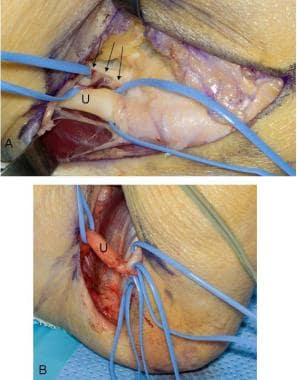
    • An incision is made posterior to the medial humeral epicondyle parallel to the ulnar nerve. The nerve is identified proximal to the epicondyle and completely released from where it pierces the intermuscular septum to well beyond the Osborne bands. This involves cutting the intermuscular septum, Struthers arcade, and the arcuate cubital ligament and widely splitting open the aponeurotic bands between the 2 heads of the flexor carpi ulnaris.
    • The nerve is not circumferentially dissected out, which presumably avoids devascularization and damage to slender muscular branches to the flexor carpi ulnaris. This procedure works well with milder and less chronic forms of the disease. In cases of spontaneous nerve subluxation or cases of excessive scarring or osteophytes formation within the cubital tunnel, the nerve should be anteriorly transposed.
  • Medial epicondylectomy: The nerve is first decompressed in situ. The medial epicondyle is subperiosteally exposed and removed without disturbing the common flexor origin of the pronator teres. Then, the soft tissues over the osteotomy bed are carefully approximated. An S-shaped skin incision is made to fashion a flap overlying the ulnar side of the antecubital fossa.
  • Anterior subcutaneous transposition
    • After decompression, the nerve is circumferentially dissected and lifted out of its cubital tunnel bed. Sensory fibers to the elbow joints are severed. Twigs that supply the upper fibers of the flexor carpi ulnaris may come off quite proximally and should be carefully dissected away from the epineurium to gain length to allow the nerve to be moved onto the anterior surface of the elbow flexor muscles in front of the medial epicondyle.
    • To avoid kinking the nerve at both ends of the transposition, a block of the intermuscular septum is removed in the proximal end, and the aponeurosis and muscles fibers of the flexor carpi ulnaris are split longitudinally between the 2 heads. The nerve is then gently placed in a subcutaneous bed under the preformed flap and held from slipping backward by a row of absorbable sutures placed between the flap and the surface of the pronator teres aponeurosis of the common flexor origin just in front of the medial epicondyle.
  • Intramuscular transposition: Adson originated this procedure, supposedly to lessen the vulnerability of the nerve in a subcutaneous location. After transposition, the nerve is placed in a shallow muscular trough created in the pronator teres and flexor carpi ulnaris. In truth, recurrent symptoms secondary to postoperative scarring within the intramuscular bed are more common in this procedure than in subcutaneous transposition. Most surgeons believe that intramuscular transposition has no role.
  • Submuscular transposition
    • In 1942, Learmonth described this procedure of placing the nerve in an intermuscular plane lined by muscle fascia, where the nerve can glide with joint motions without being “stuck down,” as in the intramuscular or subcutaneous compartments. The anterior surface of the pronator teres is superficial flexor muscles that are dissected free over a length of 4 x 4 x  2.5 cm beyond their origin, often necessitating severance of the lacertus fibrosis, a fibrous extension of the medial free edge of the biceps aponeurosis across the antecubital fossa.
    • The pronator origin is divided using a step-cut lengthening format, as is the origin of the flexor carpi ulnaris. The anteriorly transposed ulnar nerve is placed under the divided muscles on a fascial bed over the flexor digitorum superficialis and brachialis. The cut ends of the divided tendons are reapproximated in the Z-plasty format so that they are lengthened, in effect to lessen the tightness over the underlying nerve bed.
    • The elbow is cast at 90º flexion for 2 weeks. Gentle physical therapy is instituted to gradually return the joint to full extension over 3 weeks.
    • Many surgeons have also abandoned the submuscular transposition because of complications such as constriction, adhesion, and distortion of the nerve.

Ulnar nerve entrapment at the wrist

A longitudinal incision is made across the wrist crease, along the course of the ulnar nerve, and is then made to curve slightly toward the hook of the hamate. The fibrotendinous bands over the deep branch are cut. The nerve is traced straight through, past the hamate, and extraneurally decompressed all along. A particularly sharp and downward pinching hook may need to be resected by a Kerrison punch.

Posterior interosseous nerve syndrome

Because posterior interosseous nerve (PIN) entrapment is a motor neuropathy, its diagnosis mandates surgical decompression. Conservative treatment has no place in management.

The incision is made on the lateral side of the biceps muscle and is extended across the elbow and along the border of the brachioradialis. The radial nerve is picked up within the groove made by the biceps and the forearm extensor group. This groove is held open by self-retaining retractors. The radial nerve is then traced toward the upper border of the supinator. The bifurcation into the PIN and SRN are readily seen just above and in front of the radiocapitellar joint. The SRN courses deep to the brachioradialis and may be picked up first, in which case it is traced backward to locate the much deeper PIN.

Once the arcade is found, it is divided, together with fibers of the superficial supinator muscle, to expose the entire length of the PIN within the radial tunnel. The fascial thickening associated with the joint capsule also is divided, as is the arterial leash of Henry. The nerve can also be exposed through a posterolateral incision with forward reflection of the extensor muscles.
 
Suprascapular nerve entrapment
 
The patient is placed prone. An incision is made 2 cm above and parallel to the scapular spine. The horizontal trapezial fibers are atraumatically split to expose the constant fat pad that separates the trapezius from the supraspinatus muscle. Digital palpation along the sharp, bony edge of the superior scapular border detects the abrupt change into rubbery springiness of the suprascapular ligament. Blunt dissection by firm, sweeping motion using a “peanut” dissector readily reveals the glistening, taut ligament. The suprascapular artery, which crosses above the ligament, is swept aside. The ligament is cut and the bony notches enlarged with a rongeur, if necessary. The nerve is exposed and widely decompressed by clearing off the encasing fibrofatty tissue.
 
Ulnar nerve entrapment at the wrist
 
A longitudinal incision is made across the wrist crease, along the course of the ulnar nerve, and is then made to curve slightly toward the hook of the hamate. The fibrotendinous bands over the deep branch are cut. The nerve is traced straight through, past the hamate, and extraneurally decompressed all along. A particularly sharp and downward pinching hook may need to be resected by a Kerrison punch.
 
Meralgia paresthetica
 
Surgical decompression is very effective, but the recurrence rate is 15-20%. The skin incision is made along the medial border of the sartorius, 2 cm below the ASIS, and extends about 6-7 cm. The fascia over the sartorius is exposed. The fascia is then opened carefully. The nerve is located at the medial border of the muscle or just behind it. It may also be attached to the underside of the fascial sheath, so careful handling is necessary to avoid accidentally cutting the nerve.

The nerve then is traced proximally toward its exit site just medial to the ASIS. The bands of the inguinal ligament over the nerve are divided. If a sharp ridge is palpable just below the nerve, it should also be divided to completely free the nerve of sharp surfaces. The nerve is then followed into the pelvis for a distance of 2-3 cm to ensure clearance of other iliacus fascial bands.

In spite of the aggressive incision on the inguinal ligament, hernia is extremely rare after this procedure. Recurrence of symptoms should probably be treated with transection of the nerve. After freeing the nerve at the ASIS and proximally toward the pelvis, a ligature is tied tightly around the nerve. The nerve is then firmly tugged downward while the cut is made just proximal to the tie. The upper cut end of the nerve springs back and disappears into the pelvic cavity. This prevents painful neuroma formation on the surface of the thigh months afterwards. The pain is gone after neurectomy, and the patient usually adjusts well to the numbness. Several recent studies report excellent long-term control of symptoms with nerve transection as a primary treatment.
 
Tarsal tunnel syndrome
 
The incision should begin 2 cm proximal to the medial malleolus to pick up the neurovascular bundle above the flexor retinaculum. The nerve is then followed distally with release of the retinacular fibers. Mass lesions or fibrous septae are identified and removed. Each of the plantar nerve canals is opened into the plantar surface. A tight fascial band that arises from the border of the abductor hallucis muscle and roofing over the plantar canals is divided. All intersecting septae are cut to convert the tunnels into a single cavity. The ankle is placed in a soft splint and elevated for 3 days, with minimal weight-bearing allowed for an additional week.


Most decompressions are performed safely in an outpatient setting. Surgical complications from anesthesia and nerve manipulation are rare. Damage to surrounding nerves or arteries can occur during surgical manipulations.
 
Postoperative infections do occur and, unfortunately, predispose the patient to recurrence of entrapment. In these cases, re-exploration is more fraught with complications and yields less satisfactory results.


Carpal tunnel syndrome

Open surgery is associated with a 70-90% rate of improvement in median nerve function. The potential complications, although extremely rare with careful technique, include the following:

  • Incomplete sectioning of the TCL
  • Palmar pain
  • Pillar pain along the thenar end hypothenar eminences (probably related to adjustment of the carpal bone alignments)
  • Temporary loss of grip strength secondary to relocation of the origin of the hypothenar and thenar muscles and bowing of the flexor tendons through the TCL incision.

Most of these complications are transient. Cutting of the ulnar and median anastomotic branch that runs parallel to and about 1 cm beyond the distal TCL edge may result in paresthesia and weakness of the opposing surface of the middle and ring fingers. These nerve injuries are avoidable.

Postoperative infection is reported in approximately 0-5% of patients. Palmar space infection is an extremely serious emergency that can result in permanent adhesive tenosynovitis and recurrent median nerve compression. Open drainage, use of a drain, and high-dose intravenous antibiotics should be instituted immediately.

Ulnar nerve compression at the elbow

Adherence to strict surgical principles results in a satisfactory outcome for 85-95% of patients regardless of the procedure chosen. Surgical failure is usually due to inadequate release at the intermuscular septum or between the heads of the flexor carpi ulnaris. Late recurrence is caused by scarring of the soft tissue bed, most commonly with the intramuscular technique. Failure of the in situ decompression and epicondylectomy should be treated by subcutaneous transposition. Failure of the latter should be explored with the intent of removing kinking of the nerve at both ends of the transposition. If exquisite tenderness of the nerve is present in its palpable subcutaneous course, then revision surgery should be the submuscular transposition, although this technique is by far the most complex and difficult to perfect.

Posterior interosseous syndrome

Excellent outcome is observed in 90-95% of patients with decompression.

Suprascapular nerve entrapment

Symptomatic improvement is expected in 95% of patients who undergo decompression, often within days of the surgery. However, long-term weakness and atrophy may take many months to improve, and some patients never regain full strength. Early detection is the most important predictor of outcome in suprascapular entrapment.

Ulnar nerve compression at the wrist

Improvement is expected in the painful cases and in those with mild motor loss. A severely atrophic hand is not likely to show return of function.

Meralgia paresthetica

Surgical decompression is very effective, but the recurrence rate is 15-20%.

Tarsal tunnel syndrome

In general, 75% of patients enjoy significant improvement with surgical decompression of the tarsal tunnel. The best surgical results are observed in patients with mass lesions within the tunnel; the worst results are observed in patients who have undergone previous exploration for pain and those with plantar fasciitis and autoimmune diseases.


One area of controversy is the use of endoscopic techniques in the management of CTS. Proponents claim shorter surgical time; less postsurgical pain, especially in the wrist; and faster recovery. Opponents debate the benefit of a minimally reduced incisional size at the cost of clear visualization of the relevant structures.

The correct procedure for ulnar nerve decompression at the elbow is still debated. For more information, see Intraoperative details.

Grafting techniques and nerve growth factors will likely change the way peripheral nerve entrapment is treated in the next decade.


  1. Bigliani LU, Dalsey RM, McCann PD, April EW. An anatomical study of the suprascapular nerve. Arthroscopy. 1990;6(4):301-5. [Medline].
  2. Birch R, Bonney G, Wynn Parry CB. Entrapment neuropathy. In: Surgical disorders of the peripheral nerves. Churchill Livingstone; 1998:245-291.
  3. Cimino WR. Tarsal tunnel syndrome: review of the literature. Foot Ankle. Aug 1990;11(1):47-52. [Medline].
  4. Cravens G, Kline DG. Posterior interosseous nerve palsies. Neurosurgery. Sep 1990;27(3):397-402. [Medline].
  5. Dellon AL, Hament W, Gittelshon A. Nonoperative management of cubital tunnel syndrome: an 8-year prospective study. Neurology. Sep 1993;43(9):1673-7. [Medline].
  6. Fritz RC, Helms CA, Steinbach LS, Genant HK. Suprascapular nerve entrapment: evaluation with MR imaging. Radiology. Feb 1992;182(2):437-44. [Medline].
  7. Gabel GT, Amadio PC. Reoperation for failed decompression of the ulnar nerve in the region of the elbow. J Bone Joint Surg Am. Feb 1990;72(2):213-9. [Medline].
  8. Galardi G, Amadio S, Maderna L, Meraviglia MV, Brunati L, Dal Conte G, et al. Electrophysiologic studies in tarsal tunnel syndrome. Diagnostic reliability of motor distal latency, mixed nerve and sensory nerve conduction studies. Am J Phys Med Rehabil. Jun 1994;73(3):193-8. [Medline].
  9. Kline DG, Hudson AR. Vertebral artery compression. J Neurosurg. Oct 1995;83(4):759. [Medline].
  10. Kureshi SA, Friedman AH. Carpal Tunnel Release: Surgical consideration. Techniques in Neurosurgery. 2000;6(1):5-13.
  11. Kuschner SH, Brien WW, Johnson D, Gellman H. Complications associated with carpal tunnel release. Orthop Rev. Apr 1991;20(4):346-52. [Medline].
  12. Lanz U. Anatomical variations of the median nerve in the carpal tunnel. J Hand Surg [Am]. Jan 1977;2(1):44-53. [Medline].
  13. Learmonth JR. Technique for transplantation of the ulnar nerve. Surg Gynecol Obstet. 1942;75:792-3.
  14. LeRoux PD, Ensign TD, Burchiel KJ. Surgical decompression without transposition for ulnar neuropathy: factors determining outcome. Neurosurgery. Nov 1990;27(5):709-14; discussion 714. [Medline].
  15. Mackinnon SE, Dellon AL. Lower extremity nerves. In: Kline DG, Hudson AR. Nerve Injuries: Operative Results for Major Nerve Injuries, Entrapments, and Tumors. ed. WB Saunders Co: 1995:389-394.
  16. Manske PR, Johnston R, Pruitt DL, Strecker WB. Ulnar nerve decompression at the cubital tunnel. Clin Orthop Relat Res. Jan 1992;(274):231-7. [Medline].
  17. McGillicuddy JE, Harrigan MR. Meralgia Paresthetica. Techniques in Neurosurgery. 2000;6(1):50-56.
  18. Osterman AL, Davis CA. Subcutaneous transposition of the ulnar nerve for treatment of cubital tunnel syndrome. Hand Clin. May 1996;12(2):421-33. [Medline].
  19. Palmer DH, Paulson JC, Lane-Larsen CL, Peulen VK, Olson JD. Endoscopic carpal tunnel release: a comparison of two techniques with open release. Arthroscopy. 1993;9(5):498-508. [Medline].
  20. Pirela-Cruz MA, Omer GF. Surgical exposure of the peripheral nerves of the upper extremity. In: Benzel EC, ed. Practical Approaches to Peripheral Nerve Surgery. American Association of Neurological Surgeons; 1992:139-142.
  21. Rengachary SS, Neff JP, Singer PA, Brackett CE. Suprascapular entrapment neuropathy: a clinical, anatomical, and comparative study. Part 1: clinical study. Neurosurgery. Oct 1979;5(4):441-6. [Medline].
  22. Ruder JR, Wood VE. Ulnar nerve compression at the arch of origin of the adductor pollicis muscle. J Hand Surg [Am]. Sep 1993;18(5):893-5. [Medline].

Nerve Entrapment Syndromes excerpt

Article Last Updated: Dec 7, 2007