Practice Essentials
Lightning is the most common weather threat to life that people worldwide encounter, sometimes on a daily basis and often without knowledge of behaviors they can use to avoid injury.
Lightning is not "scalable"—one cannot use his or her experience and knowledge of 110-volt household current or high-voltage injuries to predict what lightning will do. The physics of lightning is incredibly complex and substantially different from the physics of human-generated electricity.
Lightning is a neurological injury in developed countries, and not a significant burn injury in most cases. In developing countries, it causes significant burns under special circumstances, as well as neurological and long-term injury. [1, 2, 3]
In developed countries, lightning burns are generally superficial. [1, 2, 4] Lightning injuries are not like electrical injuries and very rarely cause myoglobinuria or deep muscle injury that might require an escharotomy, fluid loading, or other measures used for electrical injuries.
Lightning has a very different behavior, different physics, and different injury patterns than manufactured electricity. [2]
Lightning injuries are largely preventable in developed countries, but not in developing countries, owing to the lack of safe areas (eg, substantial, inhabitable buildings or all metal vehicles) that people can evacuate to and lack of knowledge on what behaviors to take [1, 2]
Direct lightning strikes cause only 3-5% of injuries and deaths, so safety measures and injury prevention education must always take into account the other mechanisms of injury: ground current (~50-55% of deaths and injuries), side-flash, upward streamer, and contact. [5, 6] Survivors may also show signs of blast injury, including shrapnel, since being close to a lightning strike is similar to being within the blast range of an explosion; the thermodynamics within 10 m of lightning is equivalent to approximately a 10-lb (4.5-kg) TNT explosive. A 10-lb TNT-equivalent bomb would rupture an eardrum within 10 m, lung damage would occur at about 5 m, and the body would be injured at about 3 m. [7]

Background
Lightning is the most common weather threat to life that people worldwide encounter, often on a daily basis and sometimes with little knowledge of behaviors that can change their risk of injury or death. For over a century, lightning injuries had been the second most common cause of storm-related death documented in the United States, but it has fallen to third after flash floods and tornados since about 2012. [8, 9] The annual death toll has decreased from 55 deaths per year for a 10-year average in 2001 to fewer than 20 deaths per year for the last several years, largely because of the educational efforts of the National Lightning Safety Council and its predecessor, the NOAA Lightning Safety Week Committee. [8] The general consensus is that 90% of people injured by lightning survive but may have permanent disabling brain injury and chronic pain syndromes. [10]
Far more injuries and deaths occur in tropical and subtropical developing countries (see Epidemiology and Etiology), and newspaper reports frequently list multiple injuries and deaths in each event. [11, 12, 13] Complicating the increased risk people in these countries have because of higher lightning density (lightning strikes/km2/year), lightning-unsafe housing, and greater everyday exposure are the folk beliefs that may prevent adequate prevention and mitigation. People in many countries believe in two kinds of lightning: "natural lightning" and "man-made lightning" that can be called down by witches or can be prevented with muti (folk medicine/charm). [14, 15, 16] In many African countries, many believe wearing red attracts lightning. Communication to this author by the Basic (primary) Education division of the Ministry of Education in Uganda related that several Ugandan schools changed the color of student uniforms from green because all three schools with lightning deaths one year used green uniforms and they believed this was not a coincidence but that is was proof that the color green attracted lightning. Many believe that talking about lightning injury brings lightning down to injure themselves or their families. Others believe that anyone injured by lightning has been cursed, is a demon, or is being punished for hidden sins such as beating his children or wife. Communities shun the victim and his or her family to such an extent in some areas that the family comes to believe their only recourse is to move and start over in a village where their history is unknown. [16, 17, 18]
For most thunderstorms, 70-90% of lightning strikes are intracloud or from cloud to cloud. [9] From 10-30% of lightning can be cloud to ground, depending on the storm. Lightning strikes the earth more than 100 times each second, 8 million times per day, and over 2 billion times per year globally. [2, 9, 19] Worldwide, approximately 50,000 thunderstorms occur per day that may result in forest fires, injury to animals and people, and/or damage to electrical and communications lines and electronics, leading to millions of dollars in downtime and lost data for businesses. Everyone is a potential victim.
In the United States, cloud-to-ground lightning strikes occur approximately 30 million times each year. [2, 4, 9] Lightning strikes in the United States are most common in the Southeast, including Florida, Oklahoma, the Atlantic coast, and along the southeastern coast of the Gulf of Mexico. [2, 4] The danger of lightning may not be apparent to an individual because lightning can strike 10 miles or more away from the rain of a thunderstorm, even when it is sunny with blue sky overhead (See Epidemiology.) By the time thunder is heard, people are already in danger.
Lightning starts with short (30-50 m) spurts of static energy in a cloud. The lightning leader retreats back to its origin, then refills the original channel and branches at the end of the original channel to make a second generation of 30- to 50-m channels. Lightning continues with the retreats and new generations until the charge is either expended (intracloud lightning) or randomly works its way downward as a cloud-to-ground flash. [2, 4]
Any object near the intense electrical field of a thundercloud will have an opposite charge induced in it, be it a television tower, a tree, a person, a football stadium, or a blade of grass. Multiple upward leaders of current rise from these objects. Most do not contact the main lightning channel but may have sufficient energy to cause significant injury. [20] Eventually, the downward leader may join one or more of the upward streamers to complete the lightning channel. At that point, a return stroke fills all the branches, and the lightning becomes visible. Lightning has more than one ground contact about 50% of the time.
Only three factors predispose to a lightning hit: height of an object, isolation, and "pointiness," which is not a factor with people. [9] However, while lightning has a tendency to hit the tallest object, this 30- to 50-m radius from the last branch point means that tall objects, such as a mountaintop half a mile away, a television tower 300 yards away, a tree 75 yards away, or even the goal posts on a football field, are outside the range for protecting anyone (ie, the field's goalposts are unlikely to protect someone standing in the middle of a football field if lightning is coming from over the person's head). There are multiple instances and videos of strike points to cars passing tall telephone or electrical poles and other hits where lightning seems to “ignore” the height rule. [4] (See Etiology and Prevention.)
While lightning science strives to describe the behavior of lightning and explain it, mostly in a statistical manner, there are no absolute rules governing its behavior. Lightning is capricious and random, and any individual strike may defy common public assumptions.
Although most injuries occur outdoors, occasionally people are injured indoors from contact injuries with plumbing or wiring. Indoor injuries from the direct transmission of lightning energy have markedly decreased, both because of education and because of the decrease in hard-wired landline telephones and the increase in cell phones and other communication tools worldwide, which prohibit a direct flow of energy. [2, 4, 11, 21] While use of cell phones, iPods, and other portable electronic devices may change the pathway of lightning around a person, it does not increase the risk of injury except by distracting the individual from paying attention to warning signs, such as storm clouds and thunder. [22] In fact, the worldwide availability of cell phones is offering an ideal opportunity for texted or tweeted severe weather warnings and other public education. [15, 23]
The most important characteristic features of lightning injuries are multisystem, primarily neurologic, injuries and widely variable severity. This article discusses the physics of lightning and the pathophysiology and treatment of lightning injuries. [4] Because persons struck by lightning have a better chance of survival than persons who experience cardiopulmonary arrest from other causes, resuscitation for persons struck by lightning must be instituted immediately, followed by a comprehensive treatment program of the other systemic manifestations. [2, 4, 24] (See Prognosis, Presentation, and Treatment.)
In 2017, a proposal for an American Psychiatric Association Diagnostic and Statistical Manual (DSM) classification of post electrical and post lightning injury syndrome was published. [25]
Types of injuries
Injuries range from tiny static electricity–like exposures to cardiac arrest. [4, 24, 26, 27] No good statistics are available for the distribution of severity across the injured population.
Few individuals experience the full energy of a lightning strike because only about 3-5% of injuries are from a direct strike. [5, 6] For most injuries, most lightning energy is mediated by the ground, a tree, or other object that once hit by lightning, transmits a fraction of the original energy to the person. In fact, fewer than half of affected persons have signs of burns or any other marks. [28] When burns do occur in developed countries, they are usually superficial. In addition to electrical injury, many may experience concussive blunt force trauma if they are close to the strike point. [4, 6, 7] Internal burns or deep burns, such as occur with high-voltage electrical injury, are rare in the developed world such that fasciotomies are almost never indicated.
In the developed world, lightning-safe areas (all metal vehicles or habitable buildings with plumbing and wiring) are usually within a few feet and a few seconds travel time. However, in the developing world, such as sub-Saharan Africa, 90% of the housing is not considered lightning safe, with construction of mud brick with thatch or sheet metal roofs. [1] Keraunoparalysis, a temporary paralysis after lightning injury that may last for minutes to hours, can keep even healthy individuals from escaping their home as the overhead thatch, ignited by lightning, burns and falls on them. [3] Recovery may also be decreased by lack of access to good and timely medical care. [1]
Myoglobinuria is rarely caused by lightning, whereas cardiac and respiratory arrest, vascular spasm, neurologic damage, and autonomic instability are common. [29] Blunt force injuries may occur from falling, being thrown by muscle contractions, or barotrauma from the explosive force of a nearby lightning strike. [4, 7] Occasionally, a person may receive secondary shrapnel-like injuries by being hit by pavement or bits of an exploded tree. [30]
Lightning strikes are primarily a neurologic injury that affects all three components of the nervous system: central, autonomic, and peripheral. [4]
Classification of lightning injuries
Because exposure to the effects of lightning can be so variable in mechanism and intensity, it is useful to characterize lightning injuries as mild, moderate, or severe. [4]
Mild lightning injury is rarely associated with superficial burns, but survivors often report loss of consciousness, amnesia, confusion, tingling, and numerous other nonspecific symptoms. Lightning burns are invariably superficial and have little or no deep-tissue damaging effects. Provided the patient is stable and there are no contraindications such as chest pain, hypotension, or continuing mental status changes, many of these patients can be released home with reliable caretakers. Since there is little known at this time that can be done to mitigate the outcome and sequelae, there is usually little benefit to hospitalization.
Moderate lightning injury may cause seizures, respiratory arrest, or cardiac standstill, which spontaneously resolves with resumption of normal cardiac activity. Much of the symptomatology mirrors that of mild lightning injury, except superficial burns are much more common, both initially and in a delayed fashion. These patients may have lifelong symptoms of brain injury, chronic pain, irritability, and sleep disorders. There is still little that hospitalization can offer these patients except careful monitoring for acute complications connected to the initial manifestations.
Patients with severe lightning injury usually present with cardiopulmonary arrest, often complicated by a prolonged period in which they did not receive CPR. The delay may be because the individuals are in an isolated location when injured or because of the myth that the person retains an electrical charge, making him or her dangerous to touch. Survival is rare in this group unless a bystander begins CPR immediately. There have been rare cases of recovery from this more severe group but usually only after prolonged ICU and rehabilitative care.
Additionally, as noted above, victims in developing countries may have more severe burns resulting from keraunoparalysis and burns by secondary fire. While 90% of those injured in developing countries survive, survivability is not known for developing countries.
Physics of lightning
Lightning is a natural atmospheric electrical discharge that occurs between regions of net positive and net negative electrical charges. It is dependent on a complex interaction of updrafts, moisture, atmospheric instability, temperature, and other factors. Readers with a special interest in this are referred to the National Oceanic and Atmospheric Administration (NOAA) website article Understanding Lightning. [9, 31] for a thorough but understandable discussion with animations.
Lightning
There are two basic types of lightning: cloud-to-cloud or intracloud (CC or IC) and cloud-to-ground (CG). A lightning flash is initiated by an electrical breakdown between the positive and negative charge regions in a cloud. Depending on the storm, 60-90% of lightning is intracloud. When the flash turns towards the ground, a barely visible downward leader descends in regular steps, typically 30-50 m long at intervals of 0.05 ms in a downward, branching fashion toward the ground. This initial flow of electricity, the leader stroke, reaches the ground in approximately 20 ms. The diameter of the stepped leader ranges from a few centimeters to a few meters, depending on what parameter is measured. Within the leader is a current-carrying core 1-2 cm in diameter. [9]
As the branching process nears the ground, an upward discharge, termed the upward leader, completes the path of ionization approximately 30-50 m above the ground. At this moment of attachment, the cloud is short-circuited to the ground, and the major electrical discharge, a luminous return stroke of high current, occurs. Following the initial stroke, secondary leader and return strokes frequently occur.
See Lightning Safety Tips and Resources for many other interesting facts about lightning. [32]
Thunder
Air that is crossed by lightning is heated rapidly, and the cylindrical column expands at supersonic speeds. Within 1-2 m, the shockwave decays to a sound wave called thunder. Thunder comes from the entire lightning channel length, producing a mixture of different tones that are further modified as it spreads outward. Thunder rarely is heard at distances greater than 10 miles because of such factors as terrain, atmospheric temperature, wind shear, large intervening structures, and urban noise. [9]
The power of lightning is awesome, an estimated 10,000-200,000 amperes (A) of current and 20 million to 1 billion volts. A current of 100,000 A can shift blocks of stone weighing 5 tons and rocks weighing 50 pounds may be thrown 20 yards or more. However, a typical lightning stroke can only power a 100 watt bulb for 3-4 months and there is no way to harness the energy. [9]
Types of lightning
Cloud-to-ground lightning (see image below) accounts for human injuries. “Heat lightning” is a misnomer for lightning that does not appear to be connected with rain and is usually far enough away to make a wonderful show. It is equally as dangerous as any other form of lightning and can turn into deadly cloud-to-ground lightning just as easily.
A single lightning flash may be made up of many strokes going in either direction, ground-to-cloud or cloud-to-ground. With the development of ultra–high-speed cameras (millions of frames per second), many previously unknown features of lightning have become apparent for investigation and can be easily enjoyed online.
Rarer forms of lightning are ribbon (see image below) and bead lightning. These are forms of cloud-to-ground discharge with a flash consisting of several strokes. Ribbon lightning occurs when the channel is blown perpendicular to the line of sight by the wind, displacing subsequent strokes so that the flash appears as a ribbon of several similarly shaped strokes. In bead lightning, the main lightning flash breaks into luminous sections, or beads, as the light intensity of the channel decays. The etiology of this is not known.
The most rare and mysterious form of lightning is ball lightning (see image below). [33, 34] A mix of fire and electricity concentrated in a fireball with a diameter of 10-30 cm, ball lightning usually appears suddenly, even indoors, during a thunderstorm. It moves quickly for several meters, can change direction, and ultimately disappears sometimes soundlessly and other times with a pop or larger explosive sound. It has a life span of several seconds, and its color is quite variable, but most described as white, yellow, or orange.
See the images below.
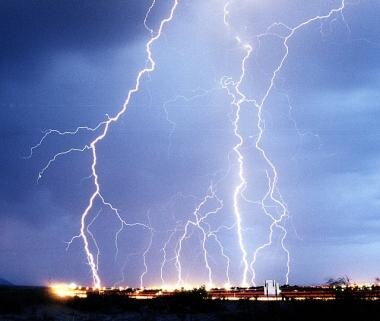 Cloud-to-ground lightning. Courtesy of Wikimedia Commons [US Air Force photo by Edward Aspera, Jr, https://commons.wikimedia.org/wiki/File:Lightning3.jpg].
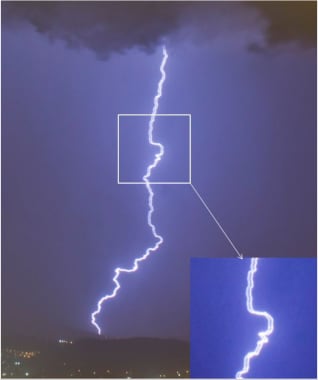 Ribbon lightning. Courtesy of Wikimedia Commons [Christos Doudoulakis, https://commons.wikimedia.org/wiki/File:Ribbon_lightning.png].
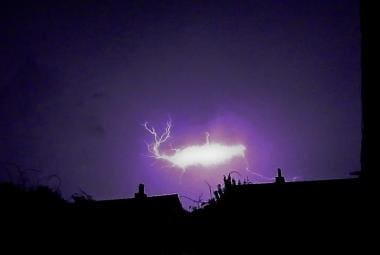 Ball lightning. Courtesy of Wikimedia Commons [Joe Thomissen, https://commons.wikimedia.org/wiki/File:Great_Balls_of_Lightning.jpg].
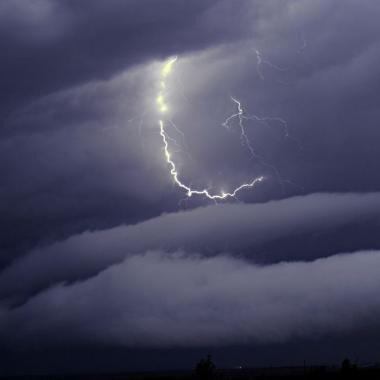 Cloud-to-cloud lightning. Courtesy of Wikimedia Commons [Xyzt1234, https://commons.wikimedia.org/wiki/File:Lightning_between_clouds.jpg].
Etiology
Lightning can be considered the ultimate in cosmic cardioversion, producing atrial and ventricular arrhythmias, myocardial injury, autonomic nervous system instability, and vasomotor responses. [4]
The exact mechanism of cardiac arrest is not known. It may be from direct depolarization of the myocardium; damage or shock to the electrical systems of the heart, carotid body, atrioventricular node, or other parts; or damage to the autonomic nervous system or other mechanisms or even a combination of these.
It has been theorized that lightning depolarizes the entire myocardium at once, causing a single systolic contraction followed by a variable period of asystole (primary cardiac arrest). Cardiac activity may return spontaneously, first at a markedly bradycardic rate and then slowly increasing in speed. This rhythm may deteriorate from apnea and hypoxia resulting from paralysis of the respiratory center in the medulla or from other mechanisms that are unknown at this time. Since neither lightning's location nor timing can be predicted and because instrumentation is often destroyed by the energy, there have been no studies of natural lightning's effect on the heart. Because laboratory lightning is expensive to generate, available in only a few places worldwide, and the scientists working with it unlikely to do animal studies, the instantaneous mechanisms of injury may never be known, only the aftermaths.
Lightning Injuries versus common electrical injuries
Although lightning injuries can be classified as a special case of electrical injuries, the physics of lightning is far different from human-generated electricity, leading to significant differences in the pathophysiology and injury patterns. [4]
Lightning cannot be classified as either direct current or alternating current. Lightning is not "scalable"—one cannot use his or her experience and knowledge of 110-volt household current or high-voltage injuries to predict what lightning will do. The physics of lightning is incredibly complex and substantially different from the physics of generated electricity.
Although the vast majority of news and witness reports credit direct strikes, this is often because of second-hand reporting, seeing only a portion of an unexpected and incredibly fast incident, lack of knowledge of other mechanisms, over-dramatization, and other factors. [5] Less than 5% of lightning deaths are caused by direct strike. The vast majority of lightning injuries are from indirect mechanisms. [4, 5, 6] The other 95% of deaths are caused as lightning first hits another object (eg, tree, tower, ground) and then side flashes to a nearby person or passes through the roots, ground, pipes, wires, or other objects on its pathway to the person as a contact, ground current injury, or upward streame. [5, 6, 35] Fewer than half of all survivors have any signs of burns or marks on their skin, probably because the lightning energy is mitigated by these primary targets and transit through other materials before it reaches the person. [28]
Probably the most important difference between lightning and high-voltage electrical injuries is the duration of exposure to the current, which also affects the path it takes. While the energy from a direct lightning strike may flow through the person for an incredibly brief period (4-6 µs), usually the vast majority of lightning energy flashes around the person's body surface, often vaporizing sweat or rainwater to cause secondary steam burns rather than primary lightning burns. [4, 36] With the other mechanisms of injury, the amount or energy and pathway is even more unpredictable and less likely to cause deep burns, myoglobinuria, or the severe, limb-compromising injuries that high-voltage exposure produces.
Lightning has only brief contact with skin, and, in most instances, the contact is too brief to burn the skin substantially. Entry and exit are inappropriate terms to apply to lightning injuries. [4] In addition, because of this “flashover” effect by lightning, myoglobinuria, renal failure, and compartment syndrome occur much more rarely from lightning injury than from commercial electrical injury. When current does enter the body, almost every organ system is vulnerable. A wide variety of complications can result from damage to these organ systems, and specific sequelae dictate the choice of therapy.
Lightning also has a shockwave component that can cause injury like being in a blast zone. [7]
Although it is nearly impossible to document which mechanism of lightning injury was involved in a particular case, such knowledge or speculation of the mechanism of injury has no effect on patient care. A physician treats what they observe on a good physical examination and testing, not what they would expect from a specific mechanism or pathway of energy.
Types of human lightning strikes
Lightning may injure an individual in the following six ways [2, 4, 5, 6, 9, 20, 35, 37] :
-
Direct strike (approximately 3-5% of injuries)
-
Side splash from another object (approximately 30% of injuries) where only a portion of the energy splashes over from the primarily hit object (eg, tree, tower)
-
Contact voltage from an object that is struck and conducts electricity to the site of touch, such as plumbing or wiring (approximately 3-5% of injuries)
-
Ground current effect as the energy spreads out across the surface of the earth when lightning hits a distance away from the person (approximately 40-50% of injuries)
-
Upward leader that does not connect with the downward leader to complete a lightning channel (approximately 15-20% of injuries)
Direct strikes occur to victims who are outside. Although not always fatal, direct strikes are associated with high morbidity because they frequently involve the head. Lightning strikes near the head may enter the eyes, ears, and mouth to cause multiple problems. While most would conclude that a direct strike would be more likely to end in death than other mechanisms, there is no research nor epidemiologic data to support this hypothesis to date.
More commonly, the victim is struck by a flash discharge from another struck object. This type of splash injury occurs, for example, when someone seeks shelter beneath a tree, picnic shelter, or other object that is struck by lightning. A portion of the lightning may jump from the object struck to the victim. Splash injury also occurs from person to person when several people are standing close together and is the reason that people in a storm are directed to scatter yards from each other.
Contact injury occurs when a person is touching a conducting object that is either hit or splashed by lightning at a distance, such as indoor plumbing or wiring, hard-wired phones, a metal fence, bleachers, or other objects.
Lightning also can result in harmful ground current that causes mass casualties in fields or other open areas. The severity of ground current injuries tends to decrease with distance from the point of the lightning strike.
An upward streamer, induced in a person as an electrically charged thundercloud approaches, can contain several hundred amperes, and, even when lightning does not attach to it, can cause death or injury as the charge collapses. [20] A 2021 paper analyzing ground current concludes that upward streamer mechanisms should be increased and ground current decreased. [35]
Blunt trauma can occur in at least two ways. One occurs when a person is thrown by a massive opisthotonic contraction caused by the lightning strike. It can also occur because of the blast wave generated by nearby lightning explosively heating the air close to a victim, which has been estimated to be similar to a 10-kg blast of TNT. [7, 30] There have been reports of both superficial and internal injury from these blast effects as well as shrapnel-type injuries from nearby objects, such as a sidewalk, that had been hit by the lightning. [30, 38, 7, 39]
Risk factors
The primary risk factors for lightning injury is the failure to acknowledge that lightning poses a threat. Lightning safety and injury prevention are not convenient. They involve being aware of weather predictions, sometimes changing plans, and proactively planning evacuation to safer areas and allotting the time to reach them. No place outside is safe when thunderstorms are in the area. [32, 40, 41, 42, 43, 44, 45, 46] While safe areas are within a few yards at least 98% of the time in developed countries, in developing countries, there may be no safe place within many miles to which people could evacuate.
Lack of knowledge of lightning danger and the mechanisms of injury also contribute to the risk. Many people try to finish one more inning or wait until rain begins before seeking shelter. This is often too late because lightning can travel as far as 10 miles in any direction from the thunderstorm clouds. The interstrike distance, depending on the local terrain and geography, may be as far as 5 ±5 miles, for a range of 0-10 miles (and sometimes more) from the last stroke. [47]
Despite popular belief, nothing attracts lightning. [4, 9] The primary physical factors that make an object statistically more likely to be struck are isolation, height, and narrowness of the tip of the object facing the cloud. Only the first two factors apply to people.
While lightning can be seen hundreds of miles away on the Great Plains or not at all in heavily forested areas, thunder usually cannot be heard more than about 10 miles away. By the time one hears thunder, one is already in danger and should be seeking a safer structure or fully enclosed metal vehicle. [32, 45, 47] The following three themes correctly summarize all of lightning safety in developed countries and are the basis for Lightning Safety Week:
-
When thunder roars, go indoors! (to a substantial building or fully enclosed metal vehicle)
-
No place outside is safe when thunderstorms are in the area.
-
Half an hour since thunder roars, now it’s safe to go outdoors.
The only reason that cell phones and iPods are dangerous in thunderstorms is that they distract the individual from paying attention to the weather and hearing thunder, the primary warning signal for lightning (see Telephone injuries below). [4, 22]
The circumstances under which one is most likely to be injured by lightning have shifted over the years from farming and construction (early and mid 1900s), to work related (1960-80s), to recreational activities (1990s to present). [8, 45] Lightning safety education, industrialization of farming, and sports organizations have changed these categories as people become aware of risks, change their behaviors, and actions are taken to prevent injury. [8, 46, 48] Work-related lightning injuries have decreased markedly as many industries have adopted lightning safety guidelines for their workers. From 2010 to 2016, the vast majority of those killed were within a few feet of safety. [8, 49] As people have become educated and more careful about seeking safety quickly, water activities (boating, fishing, and swimming) have become the highest areas for injury, perhaps because many cannot reach safety in time to avoid lightning. See Lightning Safety for statistics on the last two decades of deaths in the United States by year, state, sex, age, and activity. “Lightning Toolkits” have been developed for larger venues such as stadia, beaches, racing, open air concerts, and other mass gatherings. [32, 45]
In the United States, certain geographic areas such as mountains, parts of Florida and the Gulf Coast, the Eastern Seaboard, and the major river valley areas of the Midwest are more prone to lightning because of weather patterns, moisture content of the air, and updrafts. [50]
Around the world, the tropical and subtropical areas of the world, where most developing countries are located, have far more lightning. [19] When coupled with less substantial housing that is not considered lightning-safe, there is much more risk of lightning injury and death. [11, 12, 13, 51, 52, 53, 54, 55]
Indoor exposures
Deaths inside buildings are rare in the United States and are usually to the infirm who are unable to escape secondary fires. [56] In general, being inside a substantial, habitable building such as a house, library, or school is one of the safer areas to seek shelter. The increased safety is credited, in part, to the fact that these structures usually have plumbing, wiring, and metal structural components in them, acting as a faux-Faraday cage to transmit any electricity around those inside. [41, 44]
Unfortunately, it is also true that lightning may hit or hit near a structure or recreational facility and be transmitted into the building through the plumbing, electrical wiring, hardwired emergency medical service (EMS) or fire dispatch radio, or other routes. This includes facilities with indoor pools, which should be evacuated using the same rules as outdoor pools. Individuals should avoid touching plumbing or objects that are electrically hard-wired to the structure's electrical system, including telephones, computers, and electronic games wired to televisions and computers.
It may be unclear to some why it is recommended not to touch metal window or door frames since these are seldom connected to anything that can transmit the lightning energy to the person. The reason is like the upward streamer effect: significant charges can be induced in metal near thunderstorms. There have been many reports of someone going out to the parking lot after a thunderstorm, touching a vehicle, and receiving a shock retained on the vehicle that is just large enough that it could not jump the rubber tires or other insulators to ground. While these are not technically a lightning injury and much less likely to be deadly, the static charge can still be unpleasant.
Taking shelter in any structure that includes the word shelter (eg, bus shelter, sun shelter, park shelter, golf shelter, rain shelter) is unsafe in part because they are generally open on several sides and have few metal components to act as a faux-Faraday cage. Many believe that these structures may substantially increase the risk of lightning injury by increasing the functional height of the individuals standing under them, by increasing the risk of a side flash or ground current from a transmitted strike in structures with a lightning protection system, or by other mechanisms.
Being inside a fully enclosed metal vehicle is a very safe place because electricity will flow along the outside of any metal structure that it hits, not because of the miniscule effect of rubber composite tires. [9, 54, 55] While being inside a vehicle when it is hit has been likened to "being inside a garbage can where someone threw two cherry bombs" and may be quite unpleasant, there has never been a substantiated electrical injury to a person inside a vehicle unless that person was touching a handheld radio hard-wired to the car’s lightning rod (antenna) or some similar connection to the outside. With modern wireless technologies, most of these mechanisms of injury have been eliminated.
Telephone injuries
As landline telephones have become less frequently used, indoor injuries from hard-wired telephones have substantially decreased. Hard-wired telephones, which are generally not part of a home’s electrical system, become the conduit for the lightning charge to enter or to escape the home, resulting in a contact injury mechanism for someone using the phone. [4, 6, 21] Although the telephone system may be grounded adequately for electrical surge protection, the surge from lightning is much too fast and strong for typical grounding and surge protection strips or systems to be effective so the charge reaches the person before the circuit breaker, ground fault circuit interrupter, or other protection can be effective.
Injuries to persons using telephones or telephone headsets, common for dispatchers and those who took phone orders, have decreased substantially now that wireless systems are more in use.
Older, portable phones, now seldom used in the United States, were a rare source of lightning injury to people standing within a yard or so of the base station or charger. Those injuries were caused by the lightning jumping (side splash mechanism) from the charger to anything close by and had little to do with the phone the person was carrying.
While many reports of lightning injuries involve people who are using cellphones, these reports are more a reflection of the ubiquity of cellphones and of their users' inattentiveness to weather conditions and have nothing to do with the phones themselves. A recent theoretical engineering paper examined the likelihood of a direct strike or sideflash to someone carrying a small metal object (cell phone) close to their head. [9, 22]
Although it is theorized that cell phones or wearing earbuds or wires around the head may change the pathway of the lightning if a person experiences a lightning injury, they do not attract lightning. Conversely, since 90% of the world's population has access to cell phones, it may be possible to use them as a primary way of warning people in developing countries where forecasting and nowcasting are not available and weather reports are not easily accessed. [15, 23, 57]
In the past, acoustic injury was possible from the loud static noise in the earpiece of early portable phones, but to date, acoustic damage involving more modern mobile phones has not been reported. [21]
Epidemiology
In the United States and northern hemisphere, thunderstorms and lightning are most common from June through September. Lightning strikes usually occur in the afternoon and evening, coinciding with times when people are active and outdoors. Hikers, campers, and other outdoor sports enthusiasts most often sustain lightning injuries. Lightning injuries are more common in rural or exposed environments than in the city, where high buildings have metal frames and lightning-protection devices. In the past 5 years, most deaths have been to individuals who were within a few feet of safety and doing routine things, including mowing the lawn or going outside of a store to get better phone reception. [32, 45, 58] Because lightning deaths have been decreased so drastically by public education, [5, 58, 59, 60, 61, 62] only the outliers remain. In particular, boating and fishing have more recently shown a disproportionate number of fatalities. [58]
In tropical and subtropical countries, lightning deaths may occur at any time of year but are more common during the rainy seasons. In developed countries, safe areas are usually all metal enclosed vehicles, homes, or other substantial buildings because of the wiring and plumbing in the walls, which tend to channel any lightning energy through the walls to ground. Unfortunately, risk of death or injury from lightning is much higher for most developing countries because of much higher lightning density; greater exposure from labor-intense work practices such as farming, tending animals, and growing rice; long unprotected distances to walk to school, work, or markets; and the lack of safe areas people can use. [43, 50, 52, 55, 63, 64, 65, 66, 67, 68, 69, 70]
Many homes in developing countries are simple huts or rondavels with thatched or metal sheet roofs, so that entire families are at risk at all times, even when they are sleeping. Unlike developed countries where injuries and deaths are usually isolated and individual, mass casualty incidents are common in developing countries, whether in open-air church meetings, sporting events, classrooms, or homes. [1, 2, 4, 71]
Lightning may strike as far as 10 miles in any direction from a thunderstorm, before the rain starts, or while the sky above is still clear. At least 10% of lightning hits when blue sky is visible. [9, 40, 41, 47, 72] The most dangerous times for lightning injury are when the person underestimates the likelihood of being hit (ie, before the storm or at the apparent end of the storm).
Occurrence in the United States
For the past 40 years, lightning has consistently been the second largest storm-related killer in the United States, [73] with 45-50 persons killed annually by lightning. From 2000-2006, the estimated annual rate of deaths attributed to lightning strikes was 0.2 deaths per million people. [8, 58, 60, 61, 63, 74] Since 2010, deaths from lightning have gone to third place behind tornado deaths, in large part because of a decade of public education by the media and the Lightning Safety Week team. [8, 50] By 2021, US annual lightning mortality had slipped to the low 20s or teens, for a rate of 0.05-0.7 deaths per million population. [8, 45, 58, 59, 60]
Traditional sources of lightning injury data (the National Center for Health Statistics and Storm Data) systematically underestimate the number of fatalities by 28-42%. [4, 10] One reason is that much of the older data are taken from newspaper accounts using clipping services to catch them, so if people struck by lightning do not make the news, they are not entered into the statistics. Newspaper reports have been a major source of national statistics on lightning deaths for many years. In the last 15 years, search engines such as Google have supplemented or replaced clipping services for collection of lightning fatality data by the National Climate Data Center’s (NCDC’s) Storm Data and Lightning Safety Week (LSW) committee. [45, 58]
As for using medical data to catalog injuries or deaths, most survivors of lightning strikes do not need to be admitted to a hospital and, as a result, do not show up in medical databases. Moreover, many survivors do not seek immediate medical care and only come to the attention of medical personnel when they seek care for effects of the shock that have not resolved within a few days after their injury. Because injuries are so infrequently reported compared with fatalities, a general rule developed from studies is that injuries occur about 10 times more often than do fatalities. [10]
In the United States, most injuries occur between May and September. The National Center for Health Statistics has documented that most US deaths by lightning strike occur in the South and the Midwest, with Florida and Texas usually leading the list. [58, 74]
In 2005, Adekoya and Nolte used data from both the National Centers for Health Statistics multiple-cause-of-death tapes and the Census of Fatal Occupational Injuries, which is maintained by the US Bureau of Labor Statistics, to investigate the epidemiologic characteristics and annualized rates of lightning-related deaths for the United States. [74] From 1993-2000, 374 struck-by-lightning deaths were recorded, for an average annualized rate of 0.23 deaths per million persons. Incidents in the South and the Midwest accounted for the majority of fatalities (286 deaths, 75%; with the greatest number of deaths in Florida [49 deaths] and Texas [32 deaths]). From 1995-2002, one of every four struck-by-lightning deaths was work-related (129 deaths; average annual rate of 0.12 deaths per million workers), with agriculture and construction industries accounting for the most fatalities at 44 and 39 deaths, respectively. Fatal occupational injuries were greatest in Florida (21 deaths) and Texas (11 deaths). As found in many other studies, incidence rates were higher for males and people aged 20-44 years. [74]
Almost all prior studies have looked at lightning injuries per state and not by geographic features or population centers. A novel and interesting study by Ashley and Gilson mapped deaths from 1959-2000 reported from multiple databases by location of occurrence to create a spatial map. [75] The map revealed an urban theme with high fatality counts clustered along population centers and lower counts scattered across rural areas. The highest counts were noted along central and eastern Florida and a corridor paralleling Interstate Highway 95 from Washington DC, Baltimore, Philadelphia, and New York City. Overall, metropolitan areas in Florida showed the highest counts, the New York/Atlantic area the second, and the Chicago area the third highest clusters. In returning to a state analysis, when adjusted for area, four of the top five normalized fatality rankings by state were in the Mid Atlantic and Northeast, with Florida being the fifth state in the count. [75]
Another way to cluster injuries and direct prevention strategies is by looking at where the greatest number of thunderstorms occur: the South; Rocky Mountain area; Gulf and Atlantic Coasts; and the Ohio, Mississippi, and Hudson River valleys. Obviously, injury prevention efforts should be maximized in the areas of most historical risk, while at the same time being watchful of changing patterns. Specialized risk areas such as wilderness recreation and national parks was reported by Holle et al in 2021. [76]
The most common days of injury in the United States are Saturdays and Sundays, probably reflecting the recreational activities on the weekends. The most common time of day to be injured by lightning is from noon to 6 pm, with 6 pm to midnight following, related to not only when thunderstorms occur but also to when people are most likely to be outdoors. [4, 58, 77]
International occurrence
Lightning is much more common near the equator. Increased risk is due to labor-intensive work practices; insubstantial housing; long unprotected distances that people must travel to work, school, or market; and lack of metal vehicles. [1, 2, 4, 52, 55, 63, 64, 65, 66, 68, 69, 78, 79]
Several papers have been published with different methodologies for predicting lightning deaths worldwide. [49, 77, 80, 81, 82, 83] One paper estimated total annual fatalities to be about 24,000, and annual injuries are estimated to be about 240,000 for the tropical and subtropical areas of the world, where lightning is most common and the economies tend to be more subsistent, agrarian, and labor-intensive than they are in the more developed and temperate climates. [4, 63] In general, lightning injuries and deaths decrease in any country as the economic system, urbanization, and housing improve, not only because direct numbers of persons exposed to lightning decrease but also as housing that contains plumbing and wiring providing protection becomes more prevalent. [56] Currently, population growth in developed countries is tending towards less than replacement. While families in developing countries are having fewer children per couple, the populations of Africa, Asia and South America continue to grow, increasing the numbers of fatalities and injuries to be expected in developing countries. [63, 70]
Compiling and recording statistics in individual countries is a challenge because they often lack a good reporting system. [84] Fortunately, more and more researchers are investigating and reporting on injuries in their countries to reveal patterns and to educate governments about the need for injury prevention. [52, 55, 85, 86, 87, 88, 89, 90, 91, 92]
A report from 2014 linked geographic information system (GIS) locations of known injuries to lightning-density maps in the United States. [50] If this technique can be validated in a developing country where injury statistics are well known, such as Colombia, [55] it may be a very useful tool to focus injury prevention efforts in parts of Africa, Asia, and South America, where risk is high but fatality data and location are largely unavailable or inaccurate.
Race-, sex-, and age-related demographics
No relationship to race is known to exist.
In a US study, data from 1959-1994 indicated that males were 4.6 times more likely to be killed and 5.3 times more likely to be injured by lightning than were females. This was not because of any physiologic differences but was hypothesized to be a consequence of males' increased exposure to potential lightning-strike situations, such as outdoor activities or work, as well as to males’ higher level of risk-taking behaviors. [4, 58]
A ratio of approximately 4:1 male-to-female deaths was reasonably consistent in nearly all studies until recently much more equality between males and females has been found for developing countries. In countries with highly seasonal agricultural activities such as Bangladesh, injuries occur almost exclusively during the monsoon season and are nearly equal between males and females owing to equal participation in rice planting and other outdoor activities. [85, 86, 87, 89, 90, 91, 93]
Older studies showed 85% of deaths and injuries occurring to persons aged 10-59 years. Few adults older than 60 years are injured. This is probably related to the decreased chances of exposure of this age group during outdoor recreation or employment. [4, 58] In African countries where the populations have been decimated by HIV disease and the average age is often younger than 25-30 years, most deaths occur during the school-age years of 6-18 year. [89]
Prognosis
Many individuals struck by lightning have permanent disabilities that affect their families and their ability to return to their previous work. In patients who have endured a more severe injury, the potential for permanent and debilitating neurologic and cardiac injury is greater. However, no good long-term, controlled studies are available to indicate if lightning-related injuries improve or progress to more serious disabilities or to give stratified prognoses for different subgroups of survivors. As with other injuries, the longer a person has a symptom or sign, the more likely each is to be permanent.
Uncontrolled long-term reports of sequelae have appeared sporadically. [21, 94]
Morbidity and mortality
In developed countries, 90% of those injured by lightning survive. [10] The ratio of deaths to injuries in developing countries is unknown. After a lightning injury, the probability of death is unrelated to sex, age, and the presence of trunk and arm burns. Factors that appear related to a fatal outcome are leg burns, head burns, and immediate cardiopulmonary arrest. [29, 95] Some reports suggest as many as 74% of survivors of a lightning strike experience permanent injury and sequelae. [95] Other studies suggest the percentage with permanent injury is less; however, there continues to be controversy over the long-term effects in general.
Most lightning-associated deaths are caused by cardiac arrest. [29, 96, 97, 98] Forensic physicians must consider lightning strike in the differential diagnosis of sudden unexpected death in persons found outside. [64, 65, 99, 100, 101] The most common minor injury reported is rupture of the tympanic membranes. [2, 102, 29, 4] Superficial burns and eye injuries are frequently reported. [2, 4, 29, 95, 97, 103, 104] The most common chronic sequelae reported are brain injury and chronic pain syndromes.
Lightning injuries differ from electrical injuries from high voltage because lightning injuries usually do not cause significant tissue destruction along the path of grounding of the current. Blunt, concussive, and occasionally shrapnel-like physical injury may also accompany lightning injuries; therefore, medical personnel should also screen lightning victims for occult blunt trauma. [2, 4, 29, 30, 38, 39, 97, 102]
Neuropsychological sequelae of lightning injury can cause significant morbidity. [2, 4, 25, 29, 105] Survivors of lightning injury report heightened anxiety states, hyperirritability, memory deficits, aphasia, sleep disturbance, attention deficit, deficits in working memory, and posttraumatic stress disorder. [2, 25, 29, 106, 107] These symptoms also are found in patients with blunt head trauma, yet the sleep disturbance and memory difficulties are more severe than those caused by blunt brain injury.
Lightning injury is a neurologic injury, affecting all three parts of the nervous system, as follows [2, 4, 28, 29, 106, 107, 108, 109, 110, 111, 112, 113, 114] :
-
Brain - Neurocognitive changes, sleep disturbance, personality changes, seizures, learning disability, postconcussive-type headaches, nausea, attention deficit, distractibility, vestibular injury, pituitary and hypothalamic damage
-
Autonomic nervous system - Regulation of blood pressure and cardiac response (positive tilt test results, dizziness, hypertension), GI upset/nausea/anorexia for weeks, impotence, sympathetically mediated pain syndromes
-
Peripheral nervous system - Chronic pain, sensory problems
Most patients with injuries caused by lightning regain consciousness. However, many patients injured by lightning experience transient motor paralysis (69% incidence of paralysis of the upper extremities and 30% incidence of paralysis of the lower extremities), usually sparing the ventilatory center. Paralysis from lightning injury is known as keraunoparalysis and is associated with sensory loss and cyanosis. [3, 4, 29] Total resolution of paralysis usually occurs in minutes to days. If paralysis does not improve, other causes, such as direct spinal cord injury or musculoskeletal or blunt injury from a fall, should be suspected.
Patient Education
Patient resources include the following:
-
Lightning Strike & Electric Shock Survivors International, Inc: Email, info@lightning-strike.org
-
Cloud-to-cloud lightning. Courtesy of Wikimedia Commons [Xyzt1234, https://commons.wikimedia.org/wiki/File:Lightning_between_clouds.jpg].
-
Cloud-to-ground lightning. Courtesy of Wikimedia Commons [US Air Force photo by Edward Aspera, Jr, https://commons.wikimedia.org/wiki/File:Lightning3.jpg].
-
Ribbon lightning. Courtesy of Wikimedia Commons [Christos Doudoulakis, https://commons.wikimedia.org/wiki/File:Ribbon_lightning.png].
-
Ball lightning. Courtesy of Wikimedia Commons [Joe Thomissen, https://commons.wikimedia.org/wiki/File:Great_Balls_of_Lightning.jpg].