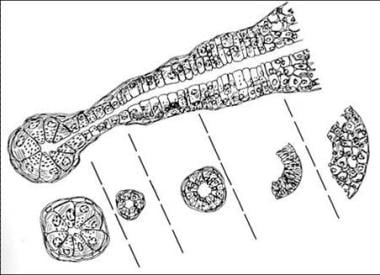
You are in: eMedicine Specialties > General Surgery > Glands Salivary Gland Tumors, Minor, BenignArticle Last Updated: Nov 10, 2005AUTHOR AND EDITOR INFORMATIONAuthor: Fadi Chahin, MD, Assistant Professor, Department of Surgery, Division of Plastic and Reconstructive Surgery, University of California at Los Angeles Medical Centers Fadi Chahin is a member of the following medical societies: American College of Surgeons and American Medical Association Coauthor(s): Matthew R Kaufman, MD, Consulting Surgeon, The Plastic Surgery Center Editors: Sanjiv S Agarwala, MD, Chief, Medical Oncology, St Luke's Hospital and Health Network; Francisco Talavera, PharmD, PhD, Senior Pharmacy Editor, eMedicine; David L Morris, MD, PhD, Professor, Department of Surgery, St George Hospital, University of New South Wales, Australia; Paolo Zamboni, MD, Professor of Surgery, Chief of Day Surgery Unit, Chair of Vascular Diseases Center, University of Ferrara, Italy; John Geibel, MD, DSc, MA, Professor, Department of Surgery, Section of Gastrointestinal Medicine and Department of Cellular and Molecular Physiology, Yale University School of Medicine; Director of Surgical Research, Department of Surgery, Yale-New Haven Hospital Author and Editor Disclosure Synonyms and related keywords: SGT, benign tumors of the minor salivary glands, benign epithelial tumors, pleomorphic adenoma, Warthin tumor, monomorphic adenoma, intraductal papilloma, oncocytoma, sebaceous neoplasms, cystadenoma lymphomatosum, cystic papillary adenoma, adenolymphoma, lymphoepithelial hyperplasia, Mikulicz disease, intraductal papilloma, papillary cystadenoma, oxyphil adenoma, oncocytoma, benign nonepithelial tumors, lipoma, hemangioma, angioma, lymphangioma, cystic hygroma, neural sheath tumors, melanoma, squamous cell carcinoma, salivary gland neoplasm, minor salivary gland resection, parotidectomy, intraoral resection, mandibulotomy, submandibular gland surgery INTRODUCTIONTumors of the salivary glands are uncommon and represent 2-4% of head and neck neoplasms. They may be broadly categorized into benign neoplasms, tumorlike conditions, and malignant neoplasms. The glands are divided into major and minor salivary gland categories. The major salivary glands are the parotid, the submandibular, and the sublingual glands. The minor glands are dispersed throughout the upper aerodigestive submucosa (ie, palate, lip, pharynx, nasopharynx, larynx, parapharyngeal space). Most (70%) salivary gland tumors (SGTs) originate in the parotid gland. The remaining tumors arise in the submandibular gland (8%) and minor salivary glands (22%). Although 75% of parotid gland tumors are benign, slightly more than 50% of tumors of the submandibular gland and 60-80% of minor SGTs are found to be malignant. Pleomorphic adenomas (benign mixed tumors) are the most common benign SGTs, comprising 85% of all salivary gland neoplasms. The ubiquitous deposition of the minor salivary glands complicates the diagnosis and management of SGTs. The approach for a suspected tumor of the minor salivary glands begins with a thorough history and a physical examination. Radiographic imaging (CT with or without MRI) and a histopathologic diagnosis (obtained based on fine needle aspiration biopsy [FNAB]) often provide useful information prior to definitive surgical therapy. History of the ProcedureSalivary gland surgery dates back to the 16th century. The anatomy of the parotid gland and the role of the main ducts were described in the mid-17th century. The earliest references to "para-auricular swellings," as the Greeks called them, described the findings associated with calculi and inflammation. Between 1650 and 1750, salivary gland surgery was limited to the treatment of ranulas and oral calculi. The concept of surgical excision of a parotid tumor has been attributed to Bertrandi in 1802. The initial applications of this surgery included an extensive approach, causing serious disfiguration and disability. In about the 1850s, the focus shifted toward dissection and the intimate relationship between the facial nerve and the parotid gland. Attempts were made to perform the surgery with nerve preservation. John C. Warren, MD, was the first to use ether inhalation anesthesia during his resection of a parotid tumor in Boston in 1846. In 1892, Codreanu (a Romanian native) performed the first total parotidectomy with facial nerve preservation. Grafting of the facial nerve after resection was attempted in the early 1950s. Beahrs and Adson (1958) eloquently described the relevant anatomy and surgical technique of current parotid gland surgery. They stressed surgical landmarks for avoiding injury to the facial nerve and advocated complete removal of the superficial portion of the parotid gland for noninvasive lesions confined to that portion of the gland. ProblemSGTs usually manifest as an enlargement of the salivary glands. Investigate weight loss, underlying infectious processes (eg, chest pain, cough, lymphadenopathy), and clinical indications of lymphoma–type B symptoms (eg, night sweats, fever). FrequencyTumors of the parotid gland are the most common SGTs and are 5 times more common than tumors of the minor salivary glands. The latter are almost twice as common as neoplasms that develop in the submandibular gland. The incidence of salivary gland neoplasms peaks in the fifth decade of life. The most common benign tumor is the benign mixed tumor, or pleomorphic adenoma. Sixty to eighty percent of all minor SGTs are malignant. Overall, adenoid cystic carcinoma is the most common malignant tumor of all minor salivary glands. The submandibular gland has a high incidence of malignant tumors (65% malignant vs 35% benign). EtiologyAlthough the etiology of SGTs is unknown, the involvement of environmental or genetic factors has been suggested. Radiation exposure has been linked to the development of the benign Warthin tumor and to the malignant mucoepidermoid carcinoma. Epstein-Barr virus may be a factor in the development of lymphoepithelial tumors of the salivary glands. Genetic alterations, such as allelic loss, monosomy and polysomy, and structural rearrangement, have all been studied as factors in the development of SGTs. PathophysiologyThe histogenesis of SGTs is based on the salivary gland unit (see Media file 1). According to the multicellular theory of SGTs, pleomorphic adenomas originate from the intercalated duct cells and myoepithelial cells; oncocytic tumors originate from the striated duct cells; acinic cell tumors originate from the acinar cells; and mucoepidermoid and squamous cell tumors originate from the excretory duct cells. ClinicalThe classic presentation of a benign SGT is a painless, slow-growing mass on the face (parotid), angle of the jaw (parotid tail, submandibular), or neck (submandibular) or a swelling at the floor of the mouth (sublingual). A sudden increase in size may be indicative of infection, cystic degeneration, hemorrhage inside the mass, or malignant degeneration. Benign SGTs are almost always freely mobile, and for masses that arise in the parotid gland, facial nerve function should be normal. Because of the multiple and varied sites of minor salivary glands, the presentation of benign tumors in these sites may be less specific. For example, bleeding and airway compromise may be the first signs of minor SGTs of the nasal septum, whereas tumors of the base of tongue may present with dysphagia and a globus sensation. The authors have each observed one patient treated for a pleomorphic adenoma of the nasal septum and the base of the tongue. Benign tumors of the parapharyngeal space may present as trismus. Differentiating a benign, space occupying lesion from one that is truly invading the masseter and pterygoid musculature is important (see Media file 2). Rule out signs of a malignant lesion, such as new onset of pain, facial nerve weakness, rapid growth, paresthesias, hoarseness, skin involvement, a fixed lesion, and cervical lymphadenopathy. Tumors of the salivary glands are classified based on their cytological, architectural, and biological characteristics. The World Health Organization classification of 1992 groups both benign and malignant tumors into epithelial and nonepithelial categories. Benign epithelial tumors include pleomorphic adenoma, Warthin tumor, monomorphic adenoma, intraductal papilloma (IDP), oncocytoma, and sebaceous neoplasms. Benign nonepithelial tumors (mesenchymal origin) include hemangioma, angioma, lymphangioma (cystic hygroma), lipoma, and neural sheath tumors. An additional category of tumorlike lesions includes necrotizing sialometaplasia, benign lymphoepithelial lesions, cystic lymphoid hyperplasia (in persons with AIDS), and salivary gland cysts. Benign epithelial tumorsPleomorphic adenoma Pleomorphic adenomas (benign mixed tumors) are the most common tumors of the salivary gland and are most often located in the tail of the parotid gland. When found in the minor salivary glands, the hard palate is the site most frequently involved, followed by the upper lip. These tumors were termed pleomorphic because of the epithelial and connective tissue components that compose them in varying degrees. Their gross appearance is a round, smooth mass with a thin, delicate, incomplete capsule. Of note, pleomorphic adenomas that arise in the minor salivary glands usually lack a capsule. These tumors grow slowly, although they may become larger than other SGTs. The thin, delicate capsule may have projections into the surrounding parotid tissue. This is of particular clinical significance because obtaining clean margins and avoiding spillage are mandatory to minimize recurrence. Microscopically, benign mixed tumors are characterized by variable, diverse, structural histologic patterns. Frequently, they have growth patterns of sheets, strands, or islands of spindle and stellate cells, with a myxoid configuration occasionally predominating. Treatment of benign neoplasms involves the complete surgical excision of the affected gland. If the parotid gland is involved, superficial parotidectomy with standard facial nerve dissection and preservation is the procedure of choice. Enucleation is contraindicated because of the tendency toward tumor spillage that can lead to tumor recurrence. Warthin tumor (ie, papillary cystadenoma lymphomatosum, cystic papillary adenoma, adenolymphoma) Albrecht first recognized this tumor in 1910, and Warthin later described it in 1929. In gross appearance, it is a smooth, soft, parotid mass. It is well encapsulated when located in the parotid gland and contains multiple cysts. Histologically, the Warthin tumor has a heavy lymphoid stroma and aciniform epithelial cells that line the cystic areas with papillary projections. Malignant transformation has not been observed. All patients with this tumor survive, and the recurrence rate is 5%. The Warthin tumor tends to be bilateral (10% of cases) and is usually found in the major glands, as are most other types. Intraductal papilloma IDP is a small, tan, fairly smooth lesion that is usually found in the submucosal layer. Microscopically, IDP consists of a cystically dilated duct partially lined with a cuboidal epithelium with complex anastomosing papillary fronds of variable size filling the cystic area. IDP of the minor salivary gland is a rare lesion that has been described only in various case reports. Histologically, the differential diagnosis of IDP includes papillary cystadenoma, which is commonly but erroneously diagnosed as IDP. In papillary cystadenoma, intraductal hyperplasia occurs and the dilated duct contains some papillary folds and projections. However, this occurs much less frequently than in IDP. Oxyphil adenoma (oncocytoma) Duplay first described the oncocytic tumor in 1875. Oncocytomas of the salivary glands are very uncommon. They rarely, if ever, occur in the minor salivary glands. Such neoplasms occur more often in women than in men, with a female-to-male ratio of 2:1. Patients are older than 50 years, and the superficial lobe of the parotid gland is the most commonly reported location. Oncocytomas manifest as small ( <5 cm in diameter), firm, slow-growing, spherical masses. Bilateral oncocytomas of the parotid glands have been described. Histologically, they are large and spherical and have a distinct capsule. Uniform cells are arranged in solid sheets. These tumors recur if excision is incomplete (Buxton, 1953). Benign nonepithelial tumorsHemangiomas Hemangiomas are the most common SGTs in children and usually involve the parotid gland. Less often, they may involve the submandibular gland. These vascular tumors may be distinguished from vascular malformations by their presence early in life, rapid growth phase in children aged approximately 1-6 months, and gradual involution over 1-12 years. The typical presentation is an asymptomatic, unilateral, compressible mass. Gross examination reveals a dark red, lobulated, unencapsulated mass. Microscopically, hemangiomas are composed of solid masses of cells and multiple anastomosing capillaries that replace the acinar structure of the gland. Because they lack a capsule, they tend to infiltrate neighboring structures. Treatment should initially consist of steroids administered 2-4 mg/kg/d. Although the response may be immediate, only 40-60% of hemangiomas exhibit a response to steroids. Despite the tendency toward spontaneous involution, specific conditions may warrant surgical excision. Lymphangioma (cystic hygroma) Lymphangiomas are most commonly located in the head and neck region of infants and children. They are believed to be due to lymphatic sequestration of primitive embryonic lymph ducts that undergo irregular growth and canalization. They are spongy, multiloculated masses with a yellowish or bluish surface and are formed by endothelial-lined spaces. More than 50% manifest at birth, and 80% manifest by age 2 years. Usually, they manifest as painless masses that may involve parotid glands, submandibular glands, or both. Diagnosis is made based on clinical findings. Surgical excision with preservation of the vital structures is the treatment of choice. Lymphangiomas rarely cause symptoms of airway obstruction, and excision is usually for cosmetic reasons. Lipoma Lipoma tumors are relatively uncommon in a major salivary gland. They derive from fat cells and appear grossly as smooth, well-demarcated, bright-yellow masses. Histologically, the tumor consists of mature adipose cells with uniform nuclei. These tumors manifest as soft, mobile, painful masses and peak in the fifth and sixth decades of life, with a male-to-female ratio of 10:1. They are slow-growing tumors with an average diameter of 3 cm. Treatment is surgical excision. Tumorlike lesionsNecrotizing sialometaplasia Necrotizing sialometaplasia may easily be mistaken for a malignant tumor because it presents as a single, unilateral, painless or slightly painful lesion on the hard palate. However, it is a benign, self-healing lesion of the minor salivary glands that is seen in adults older than 40 years and is 2-3 times more common in men than in women. Although the etiology is unknown, it may represent a reparative process in response to ischemic necrosis of salivary tissue. A biopsy helps to rule out a malignant process; otherwise, no treatment is indicated. Lymphoepithelial hyperplasia (Mikulicz disease, sicca complex, chronic punctate sialadenitis) This disorder can manifest as a diffuse enlargement of all or part of the parotid gland, or it may manifest as a discrete mass. Histologically, the lesion is composed of a diffused, well-organized lymphoid tissue and lymphocytic interstitial infiltrate with obliteration of the acinar pattern. Lymphoepithelial hyperplasia is more frequent in females than in males, and its peak incidence is in the fourth and fifth decades of life. Occasionally, both parotid glands are involved. The growth of this tumor is slowly progressive, and it gives rise to pain around the ear or the retromandibular area. INDICATIONSThe general consensus is that definitive surgical therapy is warranted for any benign or malignant tumor of the major or minor salivary glands. The notable exceptions to this would be certain tumorlike conditions such as lymphoepithelial cysts associated with AIDS and small, asymptomatic hemangiomas. Although, historically, physicians have advocated surgery without radiographic imaging or FNAB, current recommendations include preoperative assessment with these diagnostic tools for all SGTs, except perhaps small lesions of the superficial lobe of the parotid gland. RELEVANT ANATOMYThe parotid gland is situated in the musculoskeletal recess formed by portions of the temporal bone, atlas and mandible, and their related muscles. The gland has a superficial and deep lobe, between which runs the extratemporal portion of the facial nerve. The deep lobe is in contact with the parapharyngeal space. The deep cervical fascia surrounds the parotid gland. This fascia has an anteroinferior portion that becomes the stylomandibular ligament, separating the parotid gland from the submandibular gland. The facial nerve exits the stylomastoid foramen just posterior to the base of the styloid, gives off small branches to the postauricular and posterior belly of the digastric muscles, and then turns anterolaterally. The main trunk then becomes embedded in parotid tissue and divides into temporofacial and cervicofacial branches just superficial to the retromandibular vein and external carotid artery. Beyond this point, the nerve anatomy varies some; however, 5 general peripheral nerve branches exist: frontal, zygomatic, buccal, marginal mandibular, and cervical. Surgical landmarks for the main trunk of the facial nerve include the tragal pointer and the tympanomastoid suture line. The submandibular gland encompasses most of the submandibular or digastric triangle. Similar to the parotid gland, the submandibular gland can be divided into a superficial and deep lobe based on the relationship to the mylohyoid muscle. The marginal mandibular branch of the facial nerve courses between the deep surface of the platysma and the superficial aspect of the fascia that lies over the submandibular gland. The facial artery and vein are located just deep to this nerve, and ligation and superior traction of these vascular structures can prevent nerve injury. Along the posterior border of the mylohyoid are located the lingual nerve and submandibular duct (Wharton duct). The hypoglossal nerve courses deep to the tendon of the digastric and then lies medial to the deep cervical fascia. The sublingual gland occupies the same anatomical space as the submandibular gland, located between the mylohyoid and hyoglossus muscles. The gland can often be palpated in the floor of mouth, as it is rather superficial, covered by only a thin layer of oral mucosa. The minor salivary glands are widely dispersed throughout the upper respiratory tract, including the palate, lip, pharynx, nasopharynx, larynx, and parapharyngeal space. The greatest densities of glands are located in the hard (250 glands) and soft (150 glands) palates. CONTRAINDICATIONSThe only contraindication to surgical treatment of a benign or malignant SGT is an associated medical problem that precludes the use of a general anesthetic. WORKUPLab Studies
Imaging Studies
Diagnostic Procedures
Histologic FindingsSee Clinical. TREATMENTMedical therapyAdminister medical and supportive treatment in cases of inflammatory or infectious masses (eg, acute bacterial sialadenitis, mycobacterial disease). Importantly, salivary gland excision is sometimes indicated when symptomatic, recurrent chronic gland infection (eg, parotitis) proves refractory to conservative treatments. If lymphoma is diagnosed, administer therapy appropriate for the stage and type of lymphoma. Surgical therapyManagement of benign SGTs includes complete removal with an adequate margin of tissue to avoid recurrences. This usually implies complete removal of the gland in which the tumor has arisen. Excision is performed with the patient under general anesthesia and without paralysis. The endotracheal tube is usually positioned in the corner of the mouth opposite to the surgical field. Minor salivary glandsMinor salivary gland resection Surgical treatment of minor SGTs depends on the site of origin and the extent of disease. For tumors of the lip or palate, this may simply involve a wide local excision with primary closure. Larger tumors of the parapharyngeal space may require a more complex surgical procedure, as intraoral resection is not recommended. The options for external approaches to the parapharyngeal space include a cervical-parotid approach (parotid incision with cervical extension) or a cervical-parotid approach with mandibulotomy (see Media file 3). Often, an attempt is made to avoid a mandibulotomy when treating benign lesions that arise from the minor salivary glands. Although this procedure does not require a full facial nerve dissection, the inferior division must be located and preserved. By retracting the sternocleidomastoid muscle laterally, the surgeon can identify the internal jugular vein, external and internal carotid arteries, and cranial nerves IX-XII. In order to access the space, the posterior belly of the digastric and stylohyoid muscles must be divided, followed by the external carotid artery and stylomandibular ligament. In addition, the styloid process may be resected for delivery of larger tumors and greater visualization. Major salivary glandsParotidectomy The key to this procedure is to localize the facial nerve at the main trunk proximal to the gland safely. Include the possibility of total parotidectomy in the preoperative plan. Also discuss the potential need to sacrifice the facial nerve, with immediate grafting, cervical lymphadenectomy, and mandibulectomy. Superficial parotidectomy remains the initial procedure of choice for benign parotid gland tumors. The incision usually starts just anterior to the ear helix, extends inferiorly below the ear lobe, and then moves anteriorly to parallel the angle of the jaw within a 2 cm distance. Dissection is usually performed sharply down to the superficial parotid fascia. Then, the skin flap is sutured and retracted from the surgical field. Dissection is continued to expose the remainder of the gland anteriorly and the anterior border of the sternocleidomastoid muscle. At this location, the greater auricular nerve is identified and preserved because it carries sensation to the ear lobule and provides the best option for nerve grafting, if needed. Note that, occasionally, deeper-lobe parotid tumors may displace the facial nerve to a more superficial location, where it is easily injured. In a parotid gland that is being operated on for the first time, a facial nerve stimulator is not used to identify the facial nerve during surgery. However, testing it on the muscle and setting it at 0.5 mA before use is recommended. Its value is realized at the end of the procedure, when it is used to test and confirm the integrity of the facial nerve branches should a transient dysfunction become an issue in the postoperative period. Submandibular gland surgerySubmandibular gland surgery is performed with the patient under general anesthesia with endotracheal intubation. Head rotation is to the opposite side of the tumor. An incision is made at the mastoid process and curved along the inferior aspect of the mandible, approaching the midline. The length of the incision is approximately 4-6 cm. Take the incision down through the platysma muscle, leaving the muscle attached to the skin as a musculocutaneous flap. At this point, the marginal branch of the facial nerve is identified and preserved unless it is directly involved with the tumor. The nerve is located just below the muscle and superficial to the facial vessels. The safest technique is to divide the inferior aspect of the posterior facial vein and to raise the flap to the depth of the vessels and nerve. Start the dissection of the gland at the level of the hyoid bone and the lower aspect of the gland. Identifying the digastric muscle is important because the hypoglossal nerve with the vessels runs in between the gland and the digastric muscle. Dissection continues on the posterior aspect of the gland, superiorly to where the facial artery is located. At this level, the blood supply to the gland is ligated. The lingual nerve is visualized by anterior retraction of the mylohyoid muscle, and the pedicle of the gland is then carefully ligated, with attention to the main trunk of the lingual nerve. Next, the Warthin duct is identified and ligated to conclude the resection. To complete the procedure, ensure hemostasis, place a suction drain (with or without an outside pressure dressing), and perform a cosmetic layered closure. Follow-upCure is expected in almost all cases when a complete resection with clear margins is performed. For excellent patient education resources, visit eMedicine's Cancer and Tumors Center. Also, see eMedicine's patient education article Cancer of the Mouth and Throat. COMPLICATIONSRecurrence is usually caused by inadequate excision (spillage) or inoculation. The recurrence rate, as reported after a mean follow-up period of 11.8 years, is as high as 25%. Use proper hemostasis techniques with suction drains and compression dressing to avoid bleeding and seroma. Iatrogenic injury is usually recognized during surgery and immediately repaired. If the facial nerve is sacrificed because of direct tumor involvement, immediate grafting (using the greater auricular nerve or sural nerve) is required. Transient facial nerve paralysis (paresis) takes a few weeks to resolve spontaneously but can last as long as 6 months. Direct trauma to the nerve, devascularization, or postoperative nerve inflammation is believed to cause paresis. Frey syndrome is a known complication after parotidectomy, and manifestations range from erythema related to eating to copious gustatory sweating. The cause is believed to be an aberrant connection of the parasympathetic fibers to the sweat gland of the overlying flap of skin. To minimize the chance of the patient developing postoperative Frey syndrome, raise a thick parotid flap just above the parotid fascia. Salivary fistulae with wound healing are very uncommon. When a submandibular gland is removed, follow surgical recommendations to avoid unintentional injury to the lingual, hypoglossal, or mandibular branch of the facial nerve. OUTCOME AND PROGNOSISWith the appropriate treatment of benign SGTs (ie, complete excision, superficial parotidectomy), the outcome is excellent and the recurrence rate is very low. MULTIMEDIA
REFERENCES
Salivary Gland Tumors, Minor, Benign excerpt Article Last Updated: Nov 10, 2005 | |||||||||||||||||||||