Continually Updated Clinical Reference
 
 
  All Sources     eMedicine     Medscape     Drug Reference     MEDLINE
 
eMedicine - Subclavian Steal Syndrome : Article by

Quick Find
Authors & Editors
Introduction
Indications
Relevant Anatomy
Contraindications
Workup
Treatment
Complications
Outcome and Prognosis
Future and Controversies
Multimedia
References


Patient Education
Click here for patient education.


Author: Kenneth E McIntyre, MD, Professor of Surgery, Chief, Division of Vascular Surgery, University of Nevada School of Medicine

Kenneth E McIntyre is a member of the following medical societies: American Association for the Surgery of Trauma, American College of Surgeons, Association for Academic Surgery, Society for Clinical Vascular Surgery, Society for Vascular Surgery, Southern Association for Vascular Surgery, and Texas Medical Association

Editors: Jeffrey Lawrence Kaufman, MD, Associate Professor, Department of Surgery, Division of Vascular Surgery, Tufts University School of Medicine; Francisco Talavera, PharmD, PhD, Senior Pharmacy Editor, eMedicine; Travis J Phifer, MD, Chief, Division of Vascular Surgery, Professor, Department of Surgery and Radiology, Louisiana State University Health Sciences Center in Shreveport; Paolo Zamboni, MD, Professor of Surgery, Chief of Day Surgery Unit, Chair of Vascular Diseases Center, University of Ferrara, Italy; William H Pearce, MD, Chief, Division of Vascular Surgery, Violet and Charles Baldwin Professor of Vascular Surgery, Department of Surgery, Northwestern University School of Medicine

Author and Editor Disclosure

Synonyms and related keywords: subclavian steal syndrome, retrograde vertebral artery blood flow, proximal ipsilateral subclavian artery stenosis, proximal ipsilateral subclavian artery occlusion, atherosclerosis, atherosclerotic plaque, tobacco, nicotine, cigarette smoking, hypercholesterolemia, diabetes mellitus, hypertension, hyperhomocystinemia, Takayasu disease, temporal arteritis, Blalock-Taussig procedure, brain ischemia, cerebral ischemia, dizziness, vertigo, syncope, dysarthria, diplopia, ipsilateral arm exercise, subclavian artery transposition, percutaneous transluminal angioplasty, extrathoracic bypass procedures, endarterectomy, extrathoracic carotid-subclavian bypass, subclavian transposition procedures

The term subclavian steal has been used to describe retrograde blood flow in the vertebral artery associated with proximal ipsilateral subclavian artery stenosis or occlusion. This phenomenon may occur when the subclavian artery is occluded proximal to the origin of the vertebral artery. Although retrograde blood flow in the vertebral artery associated with ipsilateral subclavian artery occlusion is not unusual, neurological symptoms following ipsilateral arm exercise in this setting are uncommon. Most patients with significant arterial occlusive lesions in the proximal subclavian artery are asymptomatic; therefore, the term subclavian steal syndrome should really be reserved for those patients who develop neurological symptoms as a consequence of brain ischemia that occurs during or immediately following exercise of the ipsilateral arm.

History of the Procedure

In 1960, Contorni published the first report of blood flowing in a retrograde direction in the vertebral artery associated with a proximal ipsilateral subclavian artery occlusion. The following year, Reivich et al reported the first patient with symptoms and retrograde vertebral blood flow. However, in 1961, Fisher was the first to use the term subclavian steal syndrome to describe the neurologic symptoms associated with arm exercise. Surgical treatment for this syndrome was first reported in 1964, when Parrott described the technique of subclavian artery transposition. Percutaneous transluminal angioplasty for subclavian steal syndrome was first reported in 1980.

Problem

A definition of subclavian steal syndrome must include the following criteria:

  • Neurological symptoms due to cerebral ischemia that are initiated by ipsilateral arm exercise
  • Diminished blood pressure in the ipsilateral arm secondary to hemodynamically significant stenosis or occlusion of the subclavian artery proximal to the origin of the vertebral artery

Even if retrograde blood flow in the vertebral artery occurs in the presence of proximal subclavian artery stenosis or occlusion, subclavian steal syndrome is not present without symptoms and signs of cerebral ischemia initiated by ipsilateral arm exercise.

Frequency

Although peripheral arterial disease affects about 20-25% of Americans older than 70 years, the vessels of the upper extremity are affected much less often than those of the lower extremity. Since most patients do not seek medical advice unless symptoms occur, the prevalence of subclavian artery occlusive disease and subclavian steal syndrome is unknown.

The left subclavian artery is the most common aortic arch branch vessel affected by atherosclerosis; therefore, it is not surprising that the left subclavian artery is involved with subclavian steal 3 times more frequently than the right. In the Joint Study of Extracranial Arterial Occlusion, Fields and Lemak found that 17% of 6534 patients admitted to the study had arteriographic evidence of subclavian and/or innominate stenosis of greater than 30% or occlusion. However, only 168 patients had symptoms of subclavian steal syndrome. Berguer and associates found that only half of patients with significant subclavian occlusive lesions manifest reversal of blood flow in the ipsilateral vertebral artery.

Etiology

The most common cause of proximal subclavian artery occlusive lesions is atherosclerosis. The risk factors for developing atherosclerotic plaques have been recognized for some time and are categorized as nonmodifiable and modifiable. Nonmodifiable risks include age, male sex, and family history. The modifiable risk factors are cigarette smoking, hypercholesterolemia, diabetes mellitus, hypertension, and hyperhomocysteinemia.

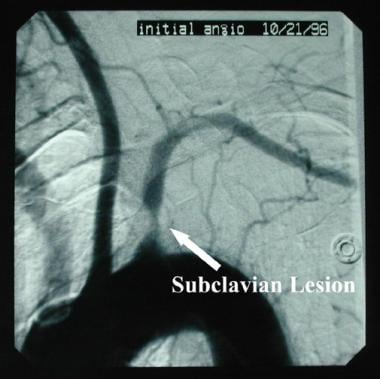
Although retrograde blood flow in the vertebral artery is usually noted angiographically in association with proximal ipsilateral subclavian artery occlusion, subclavian steal may also occur with hemodynamically significant subclavian artery stenosis (see Image 1).

Other less common causes of subclavian steal syndrome have been recognized. Arteriopathies, such as Takayasu disease, temporal arteritis, and congenital lesions of the aortic arch or subclavian artery, are unusual causes. Finally, subclavian steal syndrome has been documented following surgical sacrifice of the subclavian artery to perform the Blalock-Taussig procedure for tetralogy of Fallot.

Pathophysiology

Subclavian steal produces symptoms by flow-related phenomena rather than embolic. When an atherosclerotic lesion in the proximal subclavian artery progresses to cause hemodynamically significant stenosis, collateral vessels from the subclavian artery gradually enlarge. The upper extremity becomes dependent on these large collateral blood vessels that originate from the subclavian artery distal to the obstruction.

The collateral vessels serve as points of reentry for blood flowing retrograde into the arm from the head, shoulder, and neck, thereby providing the extremity with adequate perfusion. When the arm is exercised, the blood vessels dilate to enhance perfusion to the ischemic muscle, thus lowering the resistance in the outflow vessels. Blood is siphoned from the head, neck, and shoulder through collateral vessels to supply this low-resistance vascular bed, satisfying increased oxygen demand by the exercising muscles of the upper extremity.

When arm exercise ceases, the resistance in the outflow vessels of the arm increases, thereby reducing retrograde blood flow in the vertebral artery.

Despite retrograde flow through the vertebral artery away from the brain, symptoms are not produced unless cerebral ischemia occurs. When cerebral ischemia from retrograde vertebral blood flow occurs, occlusive lesions in the other cerebral vessels are commonly present. Arterial lesions are present in the contralateral vertebral and/or carotid arteries in up to 80% of patients with subclavian steal symptoms.

Clinical

Patients who demonstrate retrograde blood flow in a vertebral artery are usually asymptomatic. In addition, with few exceptions, proximal subclavian stenosis or occlusion usually causes no symptoms of arm ischemia. Muscle cramping due to ischemia in the upper extremity typically occurs in laborers who perform vigorous work, often with their arms elevated above their heads. If arm exercise exceeds the ability of collateral vessels to provide sufficient blood flow to meet increased oxygen demand, then cerebral ischemia may occur as more blood is siphoned from the brain through the vertebrobasilar system.

Numerous symptoms are associated with posterior circulation cerebral ischemia. Symptoms of dizziness or vertigo occur in more than half of patients, and syncope and dysarthria have been noted in 18% and 12.5%, respectively. Visual symptoms secondary to vestibular dysfunction and/or nystagmus include a sensation of objects moving or the inability to focus as well as monocular or binocular visual loss. Diplopia occurs in 19% of cases. Fortunately, these transient ischemic episodes seldom progress to cause cerebral infarction.

An invariable finding in the patient with symptoms of subclavian steal is a difference (on average, 45 mm Hg) in the upper extremity pulses and brachial systolic blood pressures between the patient's arms.


Patients with atherosclerotic occlusive plaques in the subclavian artery are usually asymptomatic and therefore require no treatment. However, if either vertebrobasilar symptoms or exercise-induced arm pain occurs, a search for subclavian artery occlusive disease should be undertaken. If the ischemic symptoms are due to retrograde vertebral artery blood flow, surgical or interventional (ie, subclavian angioplasty/stent) treatment is indicated.


True subclavian steal syndrome cannot occur without retrograde blood flow in a vertebral artery associated with proximal ipsilateral subclavian artery stenosis or occlusion. In a healthy individual, blood pressures in both arms should be similar. Without a significant difference in blood pressure between the patient's arms, proximal subclavian stenosis or occlusion cannot be present.

Therefore, with a simple physical examination, the clinician can effectively eliminate significant subclavian arterial lesions without the need for angiography or duplex ultrasonography. The internal mammary artery arises from the inferior aspect of the proximal subclavian artery, opposing the origin of the vertebral artery. Recurrent symptoms of angina pectoris following otherwise successful coronary revascularization using a left internal mammary artery (LIMA) graft may also indicate a hemodynamically significant proximal left subclavian stenosis.

Atherosclerotic lesions (stenosis or occlusion) of the proximal vertebral artery may produce similar symptoms. Occlusive disease of the vertebral artery should be considered if posterior circulation symptoms occur with normal blood pressures in the affected arm.


Surgical treatment should not be offered to treat subclavian artery stenosis or occlusion in the absence of symptoms related to either cerebral or ipsilateral arm ischemia. Symptoms (eg, ataxia, dysarthria, diplopia, muscle cramping in the arm) must be associated with exercise and resolve quickly following cessation of exercise.


Lab Studies

  • Following an adequate physical examination, a routine battery of laboratory studies should be ordered to examine the risk factors for atherosclerosis. These tests should include a fasting lipid profile and blood glucose.

Imaging Studies

  • Duplex ultrasonography
    • Duplex ultrasonography is the most important test of the extracranial carotid and vertebral arteries as well as the subclavian artery.
    • Duplex ultrasonography can demonstrate retrograde blood flow in the vertebral artery and any significant occlusive lesions of the carotid arteries in the neck.
    • Searching for significant lesions in the ipsilateral carotid artery is important. If brachial artery pressures are significantly decreased (>20%) compared with the contralateral side, perform arch aortography to further define the problem and plan for operative or interventional repair.
    • The ultrasound probe is usually inadequate for satisfactorily imaging the proximal subclavian artery.
    • CT angiography
      • This test uses iodinated contrast material and gives excellent anatomical detail concerning the location of the arterial lesions.
      • No arterial puncture is required.
      • However, if endovascular treatment is considered, then conventional 4-vessel arteriography is more appropriate, since the diagnostic study as well as the treatment can be performed at the same time.
  • Four-vessel cerebral angiography
    • This test can define the problem anatomically, demonstrating retrograde blood flow in the vertebral artery and associated proximal occlusive subclavian artery lesions.
    • In addition, arteriography serves as a road map for possible repair (surgical vs endovascular) of the subclavian artery.
  • Chest radiography: Chest x-ray films are used to look for unusual causes of subclavian artery obstruction (eg, cervical rib).
  • Magnetic resonance angiography: This modality has become an alternative to conventional angiography for the assessment of subclavian steal, especially in those patients with renal dysfunction. Unfortunately, however, MRA often overestimates the degree of arterial obstruction and is associated with a higher degree of false-positive studies.

Other Tests

  • ECG: Since many of these patients have concomitant ischemic heart disease, an ECG should be performed.


Medical therapy

No medical therapy is known to effectively treat subclavian steal syndrome. However, if the cause of subclavian steal syndrome is atherosclerotic stenosis or occlusion of the proximal subclavian artery, treat patients with lifelong antiplatelet therapy to reduce the risk of associated myocardial infarction, stroke, and other vascular causes of death.

Surgical therapy

The goal of surgical therapy is to restore antegrade blood flow in the vertebral artery, thereby alleviating symptoms. This goal can be achieved by restoring adequate perfusion pressure to the affected arm so that collateral blood flow from the head and neck are not required during arm exercise.

Endarterectomy

Direct surgical approaches to the proximal subclavian artery are of only historical interest because endarterectomy has largely been replaced by less invasive extrathoracic bypass procedures. With endarterectomy, the artery is opened after obtaining vascular control, and the plaque, diseased intima, and internal elastic lamina of the vessel are removed, thus disobliterating the lumen. Since the occlusive lesions in the proximal left subclavian develop as an extension of plaque from the aortic arch, partial occlusion of the arch must be performed to ensure that the entire lesion is effectively removed. Surgical exposure must be obtained through an anterolateral thoracotomy in the left third intracostal space. On the right side, exposure can be accomplished through a transverse incision in the base of the neck without the need for thoracotomy.

Endovascular Treatment

Endovascular treatment (catheter-based procedures) of the proximal subclavian artery is the most common way that proximal subclavian lesions are treated today. The technical success rate is 86-100%, and the complication rate is low. Moreover, most can be performed as outpatient endovascular procedures. Although balloon angioplasty has been used in the past, primary stenting of the subclavian artery is the procedure of choice. Stenting improves perfusion to the arm and treats subclavian steal syndrome (see Image 3). Since plaque in the proximal subclavian is actually part of the atherosclerotic lesion in the aortic arch, the stent must traverse the entire plaque and protrude slightly into the lumen of the aortic arch.

Extrathoracic carotid-subclavian bypass

Extrathoracic carotid-subclavian bypass using a prosthetic conduit has largely replaced subclavian endarterectomy. Surgical exposure is easily obtained through a transverse incision at the base of the neck extending 5-7 cm laterally from the sternal notch parallel to the clavicle. Conventionally, 6- to 8-mm Dacron or polytetrafluoroethylene (PTFE) prosthetic grafts are used. End-to-side (graft-to-artery) anastomoses are performed without difficulty. The procedures are well tolerated, and patients do not require a prolonged hospital stay or recovery period.

Transposition

The subclavian artery can also be transposed to a new origin on the side of the common carotid artery. This operation is performed through a transverse incision at the base of the neck as well and has the advantage of not requiring prosthetic material. The required dissection is more extensive, and care must be taken to avoid injury to the thoracic duct on the left side. An end-to-side (subclavian-to-carotid) anastomosis is performed. The long-term results of subclavian transposition procedures are similar to those of carotid-subclavian bypass.

Axillary-axillary bypass

Axillary-axillary bypass offers no real advantage over carotid-subclavian bypass. This procedure is not often used because it requires a long segment of prosthetic graft material to be passed underneath the skin overlying the sternum. The position of the graft, with its proximity to the skin, adds the risk of graft infection and skin erosion. Should a sternotomy be required in the future, the graft would have to be exposed and at least temporarily divided. Consider axillary-axillary bypass only if the ipsilateral common carotid is so severely diseased that using it for inflow would be problematic. In addition, the contralateral axillary artery must be relatively free of occlusive disease.

Endovascular details

The arch aortogram can be performed through a right femoral access using a multi-sidehole catheter and a power injector. The patient needs to be placed in a 30° left anterior oblique (LAO) position to obtain a reasonable image of the aortic arch and great vessels. As with any endovascular treatment, a guidewire must first be placed across the lesion. This may be more easily accomplished using the ipsilateral brachial artery in a retrograde direction if the origin of the subclavian artery is not well defined. On the other hand, if a stump of the patent proximal subclavian artery is visible, an antegrade approach through a right femoral artery access can be attempted.

When performing these procedures, both access sites (brachial and femoral) should be made available by proper preparation. If stenting is planned, the patient is given 5000 U of intravenous heparin. In general, balloon-expandable stents perform well in this location. They offer precise placement and have greater radial strength than self-expanding stents. Ensure that the subclavian stent does not compress the lumen of the ipsilateral vertebral artery or internal mammary artery. After stent placement, a selective subclavian arteriogram is taken to confirm the technical success of the procedure.

Post endovascular details

Most of these procedures are performed as outpatients. Patients should be monitored for 3-4 hours in a recovery area to insure that no bleeding or hematoma has occurred in the access site. If a closure device has been used on the access site, patients can be discharged as soon as any sedative medication has worn off. Neurological status should also be monitored and the blood pressure should be recorded in both arms.

Preoperative details

Arch aortography must be performed to ensure that the proximal common carotid and distal subclavian arteries are relatively free of disease. During this procedure, also visualize the carotid and vertebral arteries because these vessels often contain other hemodynamically significant lesions that can contribute to the symptoms of subclavian steal.

Intraoperative details

The incision used for either carotid-subclavian bypass or subclavian transposition is made approximately 2 cm cephalad to the clavicle, extending lateral from the sternal notch. The attachments of the clavicular head of the sternocleidomastoid muscle are incised. The scalene fat pad is identified, and care is taken to preserve the phrenic nerve that traverses the anterior aspect of the scalenus anticus muscle. The muscle is divided, exposing the subclavian artery. The common carotid artery is easily exposed through the medial aspect of the same incision.

On the left side, the thoracic duct must be avoided. This structure is visualized near its junction with the proximal internal jugular vein. Following systemic heparinization, a bypass is performed using an 8-mm PTFE or Dacron prosthetic graft. End-to-side anastomoses are performed to the common carotid and subclavian arteries. Subclavian transposition requires more proximal dissection of the subclavian artery to ensure that enough length of artery is available to perform the anastomosis without undue tension. A partial occluding clamp on the common carotid is not necessary.

Complete carotid occlusion with a proximal and distal clamp affords a better view of the intima, and the short period of ischemia is generally well tolerated. Shunting of the common carotid artery during occlusion is usually unnecessary. However, if the contralateral common or internal carotid arteries are occluded, it may be reasonable to use an intraluminal shunt during the carotid anastomosis. Following completion of the anastomoses, protamine is administered to reverse the heparin.

Postoperative details

Patients require observation for 24 hours in a monitored unit. Head elevation helps reduce swelling in the surgical incision. Brachial blood pressures are taken in both arms and are expected to be remarkably similar following the procedure. Patients are sent home with instructions to take 325 mg of aspirin daily as an antiplatelet agent.

Follow-up

Patients are seen at 3- to 6-month intervals for the first year and yearly thereafter. Always check blood pressures in both arms. A decline in pressure on the operated side may be the first sign that recurrent stenosis may be developing. Follow-up duplex scans of the reconstruction should be obtained at 6-month and 1-year intervals. Patients who have had subclavian stents should be treated with both aspirin and clopidogrel for a period of 6-12 months. Thereafter, a single antiplatelet agent is appropriate.


Complications related to surgical treatment may be classified as local or cerebral. Local complications are related to injury to adjacent structures that may be encountered during the course of the operation (eg, thoracic duct injury, phrenic nerve injury) and are quite uncommon. Cerebral complications are related to brain ischemic symptoms and can be caused either by thrombosis of the repair or by embolism up the carotid and/or vertebral arteries during the course of the procedure. Cerebral ischemia during common carotid occlusion is most unusual; therefore, a shunt is not used for the procedure.

Complications related to endovascular treatment can occur at the access site (femoral or brachial artery) or at the target vessel (subclavian or vertebral artery). Access site bleeding or hematoma is very uncommon but can occur. Target vessel thrombosis, dissection, or distal embolization have also been reported. These complications occur less than 4% of the time.


Patients with asymptomatic flow reversal in a vertebral artery have a benign natural history, and no specific treatment is required. With proximal subclavian artery occlusive disease, patients may first seek medical treatment for symptoms of exercise-induced arm pain rather than for neurologic symptoms associated with arm exercise Furthermore, if a patient has undergone coronary revascularization using a left internal mammary artery (LIMA) graft, new onset angina may herald proximal left subclavian stenosis. With subclavian steal syndrome, if neurologic symptoms do occur, they tend to be transient (ie, transient ischemic attack) and seldom lead to stroke.

The outcome for patients who have antegrade vertebral blood flow reestablished by either surgical revascularization or endovascular stenting of the diseased subclavian artery is highly favorable. The stroke risk from the procedure is low, and the long-term durability is excellent.

The operative mortality rate from transthoracic subclavian artery revascularization is substantially higher than for extrathoracic repair, mainly because of the morbidity associated with thoracotomy. Recognizing this problem, surgeons have virtually abandoned this approach in favor of extrathoracic revascularization, either carotid-subclavian bypass or subclavian transposition. The operative mortality rate for either of these extrathoracic procedures approaches zero. Moreover, the morbidity rate is very low.

The results of percutaneous subclavian angioplasty and/or stent placement are also excellent. Most authors document initial success rates of 91-100%, and the complication rate is reasonably low (3-17%). After successful stenting of the subclavian artery, the restenosis rate is 0-16% after 12-48 months follow-up. The technical success rate of subclavian angioplasty varies from 86-100%. The restenosis rate following subclavian angioplasty is 5-22% with follow-up from 28-60 months.


With recent improvements in angioplasty and stent placement techniques, surgery will probably have a smaller role for the treatment of subclavian steal syndrome in the future. Since the results of treatment for subclavian stenosis with angioplasty or stent placement are so good, surgery will likely be reserved for those patients who have had prior unsuccessful attempts at endovascular treatment. These unsuccessful cases usually involve a chronic subclavian occlusion of considerable length. In these cases, traversing the lesion with a guidewire is difficult, thus inducing a higher failure rate.


Media file 1:  Irregular proximal subclavian stenosis.
Click to see larger pictureClick to see detailView Full Size Image
Media type:  X-RAY

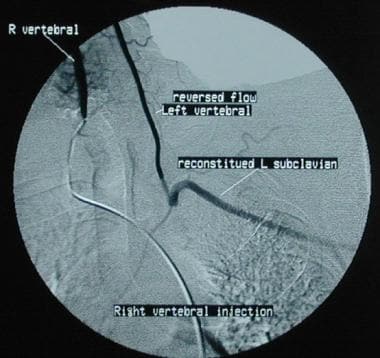
Media file 2:  Retrograde blood flow from the left vertebral artery into the left subclavian artery in a patient with subclavian steal syndrome.
Click to see larger pictureClick to see detailView Full Size Image
Media type:  X-RAY

Media file 3:  Successful stent treatment of subclavian stenosis seen in Picture 1 with restored antegrade flow into the vertebral artery.
Click to see larger pictureClick to see detailView Full Size Image
Media type:  X-RAY


  • Bachman DM, Kim RM. Transluminal dilatation for subclavian steal syndrome. AJR Am J Roentgenol. Nov 1980;135(5):995-6. [Medline].
  • Baker R, Rosenbaum A, Caplan L. Subclavian steal syndrome. Contemporary Surgery. 1974;4:96.
  • Berguer R, Higgins R, Nelson R. Noninvasive diagnosis of reversal of vertebral-artery blood flow. N Engl J Med. Jun 12 1980;302(24):1349-51. [Medline].
  • Bornstein NM, Norris JW. Subclavian steal: a harmless haemodynamic phenomenon?. Lancet. Aug 9 1986;2(8502):303-5. [Medline].
  • Caplan LR, Wityk RJ. Transient Ischemic Attacks and Stroke in the Distribution of the Vertebrobasilar System: Clinical Manifestations. Surgery for Cerebrovascular Disease. 1996;85-86.
  • Caplan LR. Vertebrobasilar occlusive disease. Stroke: Pathophysiology, Diagnosis and Management. 1986;549.
  • Cherry KJ Jr. Arteriosclerotic Occlusive Disease of Brachiocephalic Arteries. Rutherford RB (ed) Vascular Surgery. 2000;2:1154-60.
  • Contorni L. Il circolo collaterale vertebro-vertebrale obliterazione dell'arteria succlavia alla origine. Minerva-Chir. 1960;15:268-71.
  • Crawford ES, Stowe CL, Powers RW Jr. Occlusion of the innominate, common carotid, and subclavian arteries: long-term results of surgical treatment. Surgery. Nov 1983;94(5):781-91. [Medline].
  • Deriu GP, Milite D, Verlato F. Surgical treatment of atherosclerotic lesions of subclavian artery: carotid-subclavian bypass versus subclavian-carotid transposition. J Cardiovasc Surg (Torino). Dec 1998;39(6):729-34. [Medline].
  • Erbstein RA, Wholey MH, Smoot S. Subclavian artery steal syndrome: treatment by percutaneous transluminal angioplasty. AJR Am J Roentgenol. Aug 1988;151(2):291-4. [Medline].
  • Farina C, Mingoli A, Schultz RD. Percutaneous transluminal angioplasty versus surgery for subclavian artery occlusive disease. Am J Surg. Dec 1989;158(6):511-4. [Medline].
  • Fields WS, Lemak NA. Joint Study of extracranial arterial occlusion. VII. Subclavian steal-- a review of 168 cases. JAMA. Nov 27 1972;222(9):1139-43. [Medline].
  • Fisher CM. A new vascular syndrome: "The Subclavian Steal". N Engl J Med. 1961;265:912-13.
  • Graor RA, Gray BH. Interventional treatment of peripheral vascular disease. In Young JR, Graor RA, Olin JW et al (eds): Peripheral Vascular Disease. 1991;Mosby Year Book:111-33.
  • Hebrang A, Maskovic J, Tomac B. Percutaneous transluminal angioplasty of the subclavian arteries: long- term results in 52 patients. AJR Am J Roentgenol. May 1991;156(5):1091-4. [Medline].
  • Hennerici M, Klemm C, Rautenberg W. The subclavian steal phenomenon: a common vascular disorder with rare neurologic deficits. Neurology. May 1988;38(5):669-73. [Medline].
  • Henry M, Amor M, Henry I, et al. Percutaneous transluminal angioplasty of the subclavian arteries. J Endovasc Surg. Feb 1999;6(1):33-41. [Medline].
  • Lochaya S, Kaplan B, Shaffer AB. Pseudocoarctation of the aorta with bicuspid aortic valve and kinked left subclavian artery: a possible cause of subclavian steal. Am Heart J. Mar 1967;73(3):369-74. [Medline].
  • Mehigan JT, Buch WS, Pipkin RD. Subclavian-carotid transposition for the subclavian steal syndrome. Am J Surg. Jul 1978;136(1):15-20. [Medline].
  • Moran KT, Zide RS, Persson AV. Natural history of subclavian steal syndrome. Am Surg. Nov 1988;54(11):643-4. [Medline].
  • Motarjeme A, Keifer JW, Zuska AJ. Percutaneous transluminal angioplasty for treatment of subclavian steal. Radiology. Jun 1985;155(3):611-3. [Medline].
  • Olin JW, Young JR, Graor RA. Role of the cardiologist in peripheral vascular disease. J Am Coll Cardiol. Jan 1992;19(1):235-6. [Medline].
  • Parrot JD. The subclavian steal syndrome. Arch Surg. 1969;88:661-5.
  • Perler BA, Williams GM. Carotid-subclavian bypass--a decade of experience. J Vasc Surg. Dec 1990;12(6):716-22; discussion 722-3. [Medline].
  • Piccone VA, LeVeen HH. The subclavian steal syndrome. Ann Thorac Surg. Jan 1970;9(1):51-75. [Medline].
  • Pollock M, Blennerhassett JB, Clarke AM. Giant cell arteritis and the subclavian steal syndrome. Neurology. Jun 1973;23(6):653-7. [Medline].
  • Reivich M, Holling E, Roberts B et al. Reversal of blood flow through the vertebral artery and its effect on cerebral circulation. N Engl J Med. 1961;265:878-85.
  • Riles TS, Imparato AM. Indications for repair of the brachiocephalic trunks. In: Surgery for Cerebrovascular Disease. 2nd ed. WB Saunders Co;1996:590-594.
  • Solti F, Iskum M, Papp S. The regulation of cerebral blood circulation in subclavian steal syndrome. Circulation. Dec 1970;42(6):1185-91. [Medline].
  • Sueoka BL. Percutaneous transluminal stent placement to treat subclavian steal syndrome. J Vasc Interv Radiol. May-Jun 1996;7(3):351-6.
  • Sullivan TM, Gray BH, Bacharach JM, et al. Angioplasty and primary stenting of the subclavian, innominate, and common carotid arteries in 83 patients. J Vasc Surg. Dec 1998;28(6):1059-65.
  • Vitti MJ, Thompson BW, Read RC. Carotid-subclavian bypass: A twenty-two-year experience. J Vasc Surg. Sep 1994;20(3):411-7; discussion 417-8. [Medline].
  • Walker PM, Paley D, Harris KA. What determines the symptoms associated with subclavian artery occlusive disease?. J Vasc Surg. Jan 1985;2(1):154-7. [Medline].
  • Wholey MH, Postoak D, Suri R, et al. Tools of the subclavian trade. Endovascular Today. 2006;April 5(4):24-33.

Subclavian Steal Syndrome excerpt

Article Last Updated: Aug 18, 2006