| Patient Education |
|
Click here for patient education.
|
|
You are in: eMedicine Specialties >
General Surgery > Head and Neck
Perilymph Fistula
Article Last Updated: Apr 29, 2008
AUTHOR AND EDITOR INFORMATION
Section 1 of 11
Author: Howard L Kaufman, MD, Chief, Division of Surgical Oncology, Columbia University
Howard L Kaufman is a member of the following medical societies: American Association for Cancer Research, American Association for the Advancement of Science, American College of Surgeons, American Medical Association, American Society of Clinical Oncology, Association for Academic Surgery, Illinois State Medical Society, Massachusetts Medical Society, New York Academy of Sciences, and Society of Surgical Oncology
Coauthor(s):
Joshua N Honeyman, BA, Brown Medical School;
Nicholas J Gargiulo III, MD, Staff Physician, Department of Surgery, Albert Einstein College of Medicine;
Frank J Veith, MD, The William J von Liebig Chair in Vascular Surgery, Vice Chairman, Department of Surgery, Montefiore Medical Center; Clinical Visiting Professor, Department of Surgery, Uniformed Services University of the Health Sciences
Editors: Alex Jacocks, MD, Program Director, Professor, Department of Surgery, University of Oklahoma School of Medicine; Francisco Talavera, PharmD, PhD, Senior Pharmacy Editor, eMedicine; Amy L Friedman, MD, Professor of Surgery, Director of Transplantation, State University of New York Upstate Medical University College of Medicine, Syracuse; Michael E Zevitz, MD, Assistant Professor of Medicine, Finch University of the Health Sciences, The Chicago Medical School; Consulting Staff, Private Practice; John Geibel, MD, DSc, MA, Vice Chairman, Professor, Department of Surgery, Section of Gastrointestinal Medicine and Department of Cellular and Molecular Physiology, Yale University School of Medicine; Director of Surgical Research, Department of Surgery, Yale-New Haven Hospital
Author and Editor Disclosure
Synonyms and related keywords:
lymphatic fistula, lymphocele, thoracic duct fistula, chylous ascites, chylothorax, abdominal aortic reconstruction, laparotomy, total parenteral nutrition, TPN, lymphoscintigraphy, vascular reconstruction, lymphatic system
Vascular reconstruction inevitably results in lymphatic injury because the lymphatics are intricately associated with the arteries and veins and significant lymph node groups are found near major vessels. The lymphatic system, however, has a remarkable ability to regenerate and reestablish continuity after transection or ligation. Thus, most injuries to the lymphatic system are trivial and rarely contribute to surgical morbidity. A small proportion of lymphatic injuries can result in significant morbidity, requiring further medical or surgical management. An injury to the infrainguinal lymphatic vessels during vascular reconstruction may result in lymphatic fistula or lymphocele. Chylous ascites might develop after injury to the paraaortic or mesenteric lymphatics during abdominal aortic reconstruction. Thoracic duct injuries during thoracoabdominal aortic reconstruction may result in chylothorax. This myriad of lymphatic injuries during vascular reconstruction constitutes a rare but complex situation for both the patient and the surgeon.
History of the Procedure
- Lymphatic fistula after infrainguinal reconstruction: The advent of infrainguinal reconstruction for lower limb salvage introduced this complication. In 1991, Kalman et al described the most comprehensive series of patients with postoperative lymphatic fistulae after infrainguinal reconstruction.1 Other case reports and smaller collected series were described prior to this comprehensive review.
- Chylous ascites: Several case reports and much smaller clinical series (beginning in 1970) describe the development of chylous ascites after abdominal aortic reconstruction.
- Chylothorax: A few case reports describing chylothorax following thoracoabdominal aortic reconstruction were submitted beginning in 1979. A more extensive review began in 1996 with the advent of congenital aortic coarctation repair.
Problem
- Lymphatic fistula is an epithelialized tract that develops between the lymphatic system and the epidermis after lymphatic injury during infrainguinal reconstruction.
- Chylous ascites is an effusion of chyle into the intra-abdominal cavity after lymphatic injury to the paraaortic or mesenteric lymphatics (eg, the cisterna chyli).
- Chylothorax is an effusion of chyle into the pleural cavity, usually after a thoracic duct injury.
Frequency
- Lymphatic fistula: In the most comprehensive review of lymphatic fistulae after infrainguinal reconstruction, Kalman et al reported an incidence of 1.1%.1 Smaller series report an incidence of 0.8-6.4% after reconstructive procedures.
- Chylous ascites: A review of the world literature from 1969-2001 reveals approximately 25 case reports of chylous ascites developing after abdominal aortic reconstruction.
- Chylothorax: Chylothorax after cardiothoracic surgery has an incidence of 0.2-1%. Scattered case reports describe chylothorax after thoracoabdominal and abdominal aortic reconstruction.
Etiology
- Lymphatic fistula: Etiologic factors contributing to lymphatic fistulae after infrainguinal reconstruction include failure to ligate injured lymphatic vessels and failure to meticulously approximate tissue layers at closure. Other risk factors for the development of lymphatic fistulae include diabetes mellitus, wound infections, reoperation, use of prosthetic grafts for vascular conduits, and excessive postoperative ambulation.
- Chylous ascites: Failure to meticulously dissect around the abdominal aorta and failure to ligate the larger lumbar, paraaortic, and mesenteric lymphatic vessels may result in postoperative chylous ascites. Other causes of chylous ascites include neoplasms (eg, lymphoma), cirrhosis, trauma, congenital lymphatic abnormalities, infections (eg, peritoneal tuberculosis), and inflammatory disorders.
- Chylothorax: Inadvertent transection of the thoracic duct results in this complication. Like chylous ascites, many nontraumatic etiologies exist for chylothorax, including malignancy, congenital disorders, and various infectious and inflammatory processes.
Pathophysiology
- Lymphatic fistula: Transection of the infrainguinal lymphatic vessels results in lymphatic leakage. Collection of lymphatic fluid in the groin may result in wound infection, prosthetic graft infection, and lymphocele, which may have a negative effect on progressive postoperative rehabilitation.
- Chylous ascites: Lymphatic leakage from the paraaortic or mesenteric lymphatic vessels into a closed compartment, such as the intra-abdominal cavity, has much greater implications for postoperative morbidity. When lymphatic leakage outstrips reabsorption, progressive abdominal distention occurs and can subsequently lead to pulmonary compromise. Malnourishment and infectious complications may result from the loss of proteins, fats, and vital immunologic complexes.
- Chylothorax: Lymphatic leakage from the thoracic duct into a closed compartment, such as the thoracic cavity, inevitably results in respiratory difficulty. Malnourishment and infectious complications may also result from such a substantial lymphatic leak.
Clinical
- Lymphatic fistula: The diagnosis may be established by the leakage of clear yellow fluid from an infrainguinal incision that occurs days to months after infrainguinal vascular reconstruction. A lymphocele may be diagnosed by the presence of lymphatic drainage in a soft, fluid-filled cyst.
- Chylous ascites: Patients usually develop progressive abdominal distention and pain accompanied by nausea and vomiting several days to weeks following abdominal aortic reconstruction. The presence of a fluid wave indicating ascites may be appreciated on abdominal examination. Lymphopenia and anemia may also develop.
- Chylothorax: The presence of decreased breath sounds at the lung bases and dullness to percussion may suggest the presence of an effusion and chylothorax. Pulmonary compromise ensues several days after thoracoabdominal aortic reconstruction or repair of aortic coarctation. Hematologic depression, such as lymphopenia and anemia, may also develop.
- Lymphatic fistula: Indications for operative repair of lymphatic fistulae include a failure to respond to conservative management, a persistently draining high-volume fistula, and an enlarging or symptomatic lymphocele. Conservative treatment includes bed rest with leg elevation, local wound care, and administration of intravenous antibiotics.
- Chylous ascites: Exploratory laparotomy for chylous ascites after previous abdominal aortic reconstruction is indicated if the patient does not improve with complete bowel rest, total parenteral nutrition (TPN), and repeated paracentesis.
- Chylothorax: Thoracotomy for chylothorax after prior thoracoabdominal or abdominal aortic reconstruction is indicated if the patient does not improve with conservative therapy consisting of closed drainage via a thoracostomy tube and TPN.
- Lymphatic fistula: The demonstration of isosulfan blue (Lymphazurin dye) leakage within the reexplored infrainguinal incision aids in the repair of lymphatic fistulae. Blue droplets appear from the site of lymphatic injury, which may then be suture ligated, cauterized, or fibrin glued.
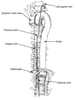
- Chylous ascites: Several large mesenteric lymphatics are located on the anteroinferior aspect of the left renal vein. These mesenteric lymphatics, along with the right and left lumbar lymphatics, form the cisterna chyli. The cisterna chyli lies between the inferior vena cava and the abdominal aorta at the level of the second lumbar vertebra.
- Chylothorax: The thoracic duct lies to the right of the aorta and to the left of the azygos vein. It begins at the cisterna chyli and enters the posterior mediastinum through the aortic hiatus. In the superior mediastinum, the thoracic duct lies behind the aortic arch and subclavian artery, to the left of the esophagus, and enters the left brachiocephalic vein.
The only contraindication to operative repair of lymphatic fistulae, chylous ascites, and chylothorax includes standard preoperative comorbidities that require continuance of conservative therapy (eg, recent myocardial infarction). As with any surgical therapy, the risk-benefit ratio must be assessed.
Lab Studies
- The presence of chyle may be confirmed in the laboratory by measuring fat and protein content, pH, and specific gravity. Chyle has a fat content of 0.4-4.0 g/dL, a protein content of approximately 3 g/dL, a pH of greater than 7.5, and a specific gravity of greater than 1.010 g/dL.
- Lymphopenia and anemia may occur.
Imaging Studies
- Lymphatic fistula
- Lymphoscintigraphy may be used to confirm that clear yellow drainage from an infrainguinal incision is of lymphatic origin. Lymphangiography was used for diagnostic purposes before the development of lymphoscintigraphy, but it carried a much higher complication rate.
- CT scans may be used to exclude underlying prosthetic graft infections following infrainguinal reconstruction.
- Fistulography and white blood cell scanning are other diagnostic tools that may be used to help diagnose lymphatic fistulae.
- Chylous ascites: Abdominal ultrasonography and/or abdominal CT scans may confirm the presence of significant amounts of free fluid consistent with chylous ascites.
- Chylothorax: Chest x-ray films and/or chest CT scans confirm the presence of an effusion.
Other Tests
- Infrainguinal wound drainage may be sent for laboratory confirmation of chyle. The demonstration of chyle within infrainguinal wound drainage confirms that the drainage is of lymphatic origin.
Diagnostic Procedures
- Traditional, ultrasonographic, or CT scan–directed paracentesis may be performed to confirm the presence of chylous ascites.
- Chylothorax may be demonstrated by diagnostic/therapeutic thoracentesis.
- Tube thoracostomy may be used for diagnosis and conservative treatment of chylothorax.
Histologic Findings
No major histologic findings exist for chyle or for the diagnosis of lymphatic fistulae, chylous ascites, or chylothorax.
Staging
No formal clinical staging system currently exists for lymphatic fistulae, chylous ascites, or chylothorax.
Medical therapy
- Lymphatic fistula: Medical management of lymphatic fistulae after infrainguinal reconstruction consists of bed rest and leg elevation, local wound care, and administration of intravenous antibiotics.
- Chylous ascites: Administration of a low-fat, high-protein, medium-chain triglyceride diet may be implemented in mild-to-moderate cases of chylous ascites. Severe cases may require complete bowel rest, TPN, and paracentesis. Somatostatin has also been used successfully in the treatment of chylous ascites.2
- Chylothorax: Therapeutic thoracentesis and/or tube thoracostomy and administration of a low-fat, high-protein, medium-chain triglyceride diet are used in the management of chylothorax. Complete bowel rest and TPN may be used to further reduce lymphatic output. As with chylous ascites, somatostatin has also been effective in reducing chyle accumulation.3 In refractory cases not amenable to surgical intervention, pleurodesis, pleurovenous/pleuroperitoneal shunting, and percutaneous embolization of the lymphatic vessels have been effective.
Surgical therapy
Suture ligation of the injured lymphatic (infrainguinal, lumbar, mesenteric, or paraaortic) is the treatment of choice for these lymphatic injuries when conservative therapy fails. For injured infrainguinal lymphatic vessels not visualized, fibrin glue may be used as a substitute for suture ligation. Injuries to the cisterna chyli or thoracic duct should have lateral closure with a 6-0 to 8-0 Prolene suture. If unsuccessful, proximal suture ligation of the cisterna chyli and thoracic duct may be implemented.
Preoperative details
Implement standard preoperative care for the surgical treatment of patients with lymphatic fistulae, chylous ascites, and chylothorax. Careful attention to the nutritional and metabolic status of the patient is important before operative intervention. Specify nothing by mouth (NPO) for patients starting 6-8 hours before surgery. Order an intravenous dose of antibiotics to be administered half an hour before surgery. Have a highly qualified team of anesthesiologists experienced in the physiology of infrainguinal, abdominal, and thoracoabdominal aortic surgery present throughout the operation. The concerns and fears of both the patient and the family must be addressed by the surgeon because this is a reoperative procedure for a surgical complication.
Intraoperative details
Meticulous sterile technique must be used because this is reoperative surgery, often in the presence of prosthetic vascular grafts, which are at risk for infection.
- Lymphatic fistula: Infrainguinal, intra-abdominal, and intrathoracic lymphatic injury may be better defined by the interdigital injection of 5 mL of isosulfan blue (Lymphazurin dye) into the first and third web spaces of the foot. Upon infrainguinal reexploration, blue fluid droplets are emitted from the site of lymphatic injury. Infrainguinal sites of lymphatic injury should then be suture ligated if clearly visualized (use fibrin glue if not clearly visualized), then closed meticulously in multiple layers. A Jackson-Pratt drain may be left near the site of lymphatic injury for 24 hours.
- Chylous ascites: Lumbar, mesenteric, and paraaortic lymphatic vessels may also be suture ligated or oversewn after identification with the isosulfan blue technique. However, injuries involving the cisterna chyli should have lateral closure with a 6-0 to 8-0 Prolene suture. A Jackson-Pratt drain may be left intra-abdominally near the site of injury.
- Chylothorax: Thoracic duct injuries may be repaired primarily by lateral closure using 6-0 to 8-0 Prolene. If unsuccessful, complete ligation of the thoracic duct may be performed. Leave a chest tube in place for any further drainage.
Postoperative details
Postoperatively, close surveillance must be initiated, preferably in an intensive care unit, to optimize patient outcome after reoperative surgery. Qualified staff familiar with reoperative infrainguinal, abdominal, and thoracoabdominal aortic surgery must be available. Special attention to drain output, chest tube output, and wound care is essential. An attentive staff to allay patient and family concerns is also helpful.
- Lymphatic fistula: Remove the Jackson-Pratt drain after 24 hours unless evidence of further lymphatic leakage is found. Have patients begin immediate incentive spirometry and early rehabilitation for ambulation 24-48 hours after surgery. Continue antibiotics for 24 hours postoperatively unless other indications for their continuance exist.
- Chylous ascites: Incentive spirometry and early ambulation are the mainstays of postoperative care after exploratory laparotomy. Drains may be removed once drainage decreases to 30 mL/d and no further evidence of lymphatic leakage is seen. Antibiotics may be discontinued after drain removal. Deep vein thrombosis prophylaxis, consisting of systemic compression devices and low molecular weight heparin, is warranted unless contraindications exist. A regular diet may be resumed once bowel function returns to normal.
- Chylothorax: Aggressive incentive spirometry must be instituted following thoracotomy for thoracic duct injury. The chest tube may be removed once drainage diminishes to 75 mL/d and no further evidence of lymphatic injury exists. Antibiotics may be discontinued with chest tube removal, and a regular diet may be resumed once chylous drainage has ceased.
Follow-up
Implement standard surgical follow-up care after repair of lymphatic fistulae and lymphatic injuries that result in chylous ascites and chylothorax. Lymphoscintigraphy may be performed before discharge to confirm successful operative closure of these lymphatic injuries. After discharge from the hospital, follow patients bi-weekly for the first 1-2 months and then monthly for the following 6 months. Three-month intervals may be used for surveillance once the surgeon and the patient are satisfied with the outcome.
Lymphatic fistulae and lymphatic injuries resulting in chylous ascites and chylothorax are complications of infrainguinal, abdominal, and thoracoabdominal aortic reconstruction. Nonoperative or conservative management of these complications reduces morbidity and mortality rates. Operative intervention implemented to treat lymphatic injuries requires reoperation, which is both physically and mentally challenging for the patient and the surgeon. Reoperative surgery results in further systemic and procedural complications. Systemic complications include pneumonia, myocardial infarction, pulmonary embolus, cerebrovascular accident, sepsis, multiorgan failure, and death. Procedural complications include bleeding, wound and graft infections, and graft failure. Prevention of lymphatic injuries is essential after vascular reconstruction in order to avoid further reoperation.
Both operative and nonoperative management of lymphatic injuries may worsen surgical outcome and prognosis after vascular reconstruction. The operative repair of lymphatic fistulae after infrainguinal reconstruction carries a better outcome and prognosis than the operative repair of lymphatic injuries that result in chylous ascites and chylothorax. Repair of the latter two complications requires reoperative exploratory laparotomy and/or thoracotomy.
In general, chylous ascites and chylothorax secondary to traumatic injury during vascular reconstruction carry a better prognosis than that occurring secondary to underlying neoplasia. A mortality rate of approximately 18% has been reported for chylous ascites developing after aortic surgery. Mortality rates ranging from 44-83% have been reported for chylous ascites developing secondary to an underlying neoplasm. A survey of several case reports revealed 1 patient of 6 who died after conservative treatment of chylothorax.
Few controversies exist in the management of lymphatic complications after vascular reconstruction. Use good clinical judgment to determine the patients who might benefit from more conservative medical management. Reserve operative intervention only for patients who can tolerate the physiologic stress of reoperation. Lymphatic complications after infrainguinal vascular reconstruction occur more frequently in diabetic patients and in those requiring reoperation.
The advent of endovascular reconstruction has limited tissue handling and dissection and has reduced the incidence of lymphatic complications. Further advancements in endovascular techniques will enable more complex procedures to be performed with a consequent reduction in operative morbidity and mortality rates.
- Kalman PG, Walker PM, Johnston KW. Consequences of groin lymphatic fistulae after vascular reconstruction. Vasc Surg. 1991;25:210-213.
- Huang Q, Jiang ZW, Jiang J, Li N, Li JS. Chylous ascites: treated with total parenteral nutrition and somatostatin. World J Gastroenterol. Sep 1 2004;10(17):2588-91. [Medline].
- Kelly RF, Shumway SJ. Conservative management of postoperative chylothorax using somatostatin. Ann Thorac Surg. Jun 2000;69(6):1944-5. [Medline].
- Cope C, Kaiser LR. Management of unremitting chylothorax by percutaneous embolization and blockage of retroperitoneal lymphatic vessels in 42 patients. J Vasc Interv Radiol. Nov 2002;13(11):1139-48. [Medline].
- Fairfax AJ, McNabb WR, Spiro SG. Chylothorax: a review of 18 cases. Thorax. Nov 1986;41(11):880-5. [Medline].
- Gloviczki P, Lowell RC. Lymphatic complications of vascular surgery. In: Rutherford RB, ed. Vascular Surgery. Philadelphia: WB Saunders Co; 2001:781-789.
- McKenna R, Stevick CA. Chylous ascites following aortic reconstruction. Vasc Surg. 1983;17:143-149.
- Pabst TS 3rd, McIntyre KE Jr, Schilling JD, Hunter GC, Bernhard VM. Management of chyloperitoneum after abdominal aortic surgery. Am J Surg. Aug 1993;166(2):194-8; discussion 198-9. [Medline].
- Roberts JR, Walters GK, Zenilman ME, Jones CE. Groin lymphorrhea complicating revascularization involving the femoral vessels. Am J Surg. Mar 1993;165(3):341-4. [Medline].
- Savrin RA, High R. Chylous ascites after abdominal aortic surgery. Surgery. Nov 1985;98(5):866-9. [Medline].
- Shermak MA, Yee K, Wong L, Jones CE, Wong J. Surgical management of groin lymphatic complications after arterial bypass surgery. Plast Reconstr Surg. Jun 2005;115(7):1954-62. [Medline].
- Tyndall SH, Shepard AD, Wilczewski JM, Reddy DJ, Elliott JP Jr, Ernst CB. Groin lymphatic complications after arterial reconstruction. J Vasc Surg. May 1994;19(5):858-63; discussion 863-4. [Medline].
- Vargas FS, Milanez JR, Filomeno LT, Fernandez A, Jatene A, Light RW. Intrapleural talc for the prevention of recurrence in benign or undiagnosed pleural effusions. Chest. Dec 1994;106(6):1771-5. [Medline].
Perilymph Fistula excerpt Article Last Updated: Apr 29, 2008
|