You are in: eMedicine Specialties > Medicine, Ob/Gyn, Psychiatry, and Surgery > Gastroenterology
|
Budd-Chiari Syndrome Last Updated: December 8, 2006 |
|
| Synonyms and related keywords: thrombotic hepatic vein obstruction, nonthrombotic hepatic vein obstruction, non-thrombotic hepatic vein obstruction, hepatic vein obstruction, obliterating hepatic vein endophlebitis, liver obstruction, liver disease, hepatic disease, hepatic obstruction, hepatomegaly, ascites, thrombotic diathesis, congestive hepatopathy, hepatic congestion, liver congestion, membranous webs, acute liver disease, subacute liver disease, fulminant liver disease, liver failure
|
|   |
AUTHOR INFORMATION
| Section 1 of 10  |
|
| Author: Praveen K Roy, MD, Assistant Professor of Medicine, Associate Director of Research, Division of Gastroenterology, Department of Internal Medicine, University of Missouri at Columbia; Chief of Gastroenterology, Harry Truman Veteran Affairs Memorial Hospital Coauthor(s): Jehad Barakat, MD, Assistant Professor of Medicine, Gastroenterology and Hepatology, University of New Mexico School of Medicine; Consulting Staff, Department of Medicine, Albuquerque Veterans Affairs Medical Center; Victor Nwakakwa, MD, MRCP (UK), Clinical Instructor, Department of Internal Medicine, Division of Gastroenterology, University of Virginia Health System; Homayoun Shojamanesh, MD, Former Fellow, Digestive Diseases Branch, National Institutes of Health; Vikas Khurana, MD, FACP, FACG, Assistant Professor, Department of Medicine, Division of Gastroenterology and Hepatology, Graduate Hospital, Gastroenterology Associates, PC |
| Praveen K Roy, MD, is a member of the following medical societies:
American College of Gastroenterology,
American Gastroenterological Association, and
Canadian Association of Gastroenterology |
| Editor(s): Robert J Fingerote, MD, MSc, BSc, FRCPC, Consultant, Clinical Evaluation Division, Biologic and Gene Therapies, Directorate Health Canada; Consulting Staff, Department of Medicine, Division of Gastroenterology, York Central Hospital, Richmond Hill, Ontario; Francisco Talavera, PharmD, PhD, Senior Pharmacy Editor, eMedicine;
James L Achord, MD, Professor Emeritus, Department of Medicine, Division of Digestive Diseases, University of Mississippi School of Medicine;
Alex J Mechaber, MD, FACP, Assistant Dean for Medical Curriculum, Associate Professor of Medicine, Division of General Internal Medicine, University of Miami Miller School of Medicine;
and Julian Katz, MD, Clinical Professor of Medicine, Drexel University College of Medicine; Consulting Staff, Department of Medicine, Section of Gastroenterology and Hepatology, Hospital of the Medical College of Pennsylvania |
Disclosure
|   |
INTRODUCTION
| Section 2 of 10  |
|
Background: Budd-Chiari syndrome is an uncommon condition induced by thrombotic or nonthrombotic obstruction to hepatic venous outflow. Budd described it in 1845, and Chiari added the first pathologic description of a liver with "obliterating endophlebitis of the hepatic veins" in 1899. Hepatomegaly, ascites, and abdominal pain characterize Budd-Chiari syndrome.
The syndrome most often occurs in patients with underlying thrombotic diathesis, including myeloproliferative disorders, such as polycythemia vera and paroxysmal nocturnal hemoglobinuria, pregnancy, tumors, chronic inflammatory diseases, clotting disorders, and infections. Pathophysiology: Obstruction of intrahepatic veins leads to congestive hepatopathy. This results from obstruction of either large- or small-caliber veins, which leads to hepatic congestion as blood flows into, but not out of, the liver. Hepatocellular injury results from microvascular ischemia due to congestion. Portal hypertension and liver insufficiency result. Frequency:
- In the US: Budd-Chiari syndrome is rare, but the exact frequency is unknown.
- Internationally: Internationally, Budd-Chiari syndrome is also rare, but the exact frequency is unknown. Membranous webs are a common cause of Budd-Chiari syndrome in Asian countries.
Mortality/Morbidity: Budd-Chiari syndrome is a potentially fatal disorder, if untreated.
Race: The syndrome occurs in persons of all races.
Sex: The syndrome is equally present in both sexes. Emergent presentation is more common in women than in men.
Age: Age at presentation is usually the third or fourth decade of life, although the condition may also occur in children or elderly persons.
|   |
CLINICAL
| Section 3 of 10  |
|
History: The classic triad of abdominal pain, ascites, and hepatomegaly is observed in the vast majority of patients but is nonspecific. A high index of suspicion is needed to make the diagnosis. Four main clinical variants have been described: acute liver disease, subacute liver disease, fulminant liver disease, and liver failure. The most common presentation is subacute liver disease complicated by portal hypertension and varying degrees of liver decompensation. - Acute and subacute form: These are characterized by rapid development of abdominal pain, ascites, hepatomegaly, jaundice, and renal failure.
- Chronic form: This is the most common form of presentation. Patients present with progressive ascites. Jaundice is absent, and approximately 50% of patients also have renal impairment.
- Fulminant form: This form of presentation is uncommon. Fulminant or subfulminant hepatic failure is present along with ascites, tender hepatomegaly, jaundice, and renal failure.
Physical: Physical examination may reveal the following findings: - Prominence of collateral veins
Causes: Most patients have an underlying thrombotic diathesis. In approximately a third of patients, an underlying cause is not evident. Causes of Budd-Chiari syndrome are as follows: - Paroxysmal nocturnal hemoglobinuria
- Unspecified myeloproliferative disorder
- Antiphospholipid antibody syndrome
- Inherited thrombotic diathesis
- Antithrombin III deficiency
- Factor V Leiden deficiency
- Pregnancy and postpartum
- Membranous webs
- Oral contraceptives
- Chronic infections
- Hydatid cysts
- Aspergillosis
- Amebic abscess
- Syphilis
- Tuberculosis
- Chronic inflammatory diseases
- Behçet disease
- Inflammatory bowel disease
- Sarcoidosis
- Systemic lupus erythematosus
- Sjögren syndrome
- Mixed connective-tissue disease
- Hepatocellular carcinoma
- Renal cell carcinoma
- Leiomyosarcoma
- Adrenal carcinoma
- Wilms tumor
- Right atrial myxoma
- Alpha1-antitrypsin deficiency
- Trauma
- Dacarbazine
- Urethane
|   |
DIFFERENTIALS
| Section 4 of 10  |
|
Pericarditis, Constrictive
Other Problems to be Considered:
Right-sided heart failure
Metastatic liver disease
Alcoholic liver disease
Granulomatous liver disease |
|
Patient Education
|
|
Click here for patient education.
|
|
|
|
|
|   |
WORKUP
| Section 5 of 10  |
|
Lab Studies:
- Examination of ascitic fluid provides useful clues to the diagnosis.
- Patients usually have high protein concentrations (>2 g/dL). This may not be present in persons with the acute form of Budd-Chiari syndrome.
- The WBC count is usually less than 500/mL.
- The serum ascites–albumin gradient is usually less than 1.1 (except in the acute forms of the disease).
- Routine biochemical test results are usually nonspecific. Mild elevations in serum aminotransferase and alkaline phosphatase levels are present in 25-50% of patients.
Imaging Studies:
- Thrombi can be visualized.
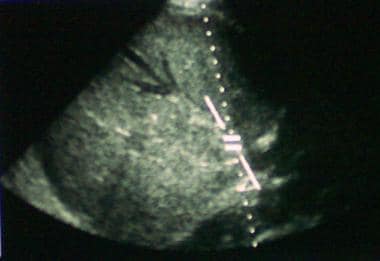
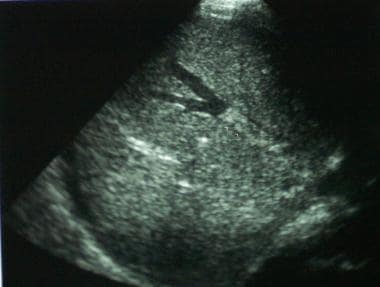
- Color-flow Doppler ultrasound is the preferred mode. Sensitivity and specificity are 85-90%.
- Magnetic resonance imaging (MRI) scanning with pulsed sequencing
- MRI images help in the assessment of hepatic venous blood flow.
- Sensitivity and specificity are 90%.
- Thrombi are observed in hepatic veins.
- With venography, hepatic vein orifices cannot be cannulated.
Procedures:
Histologic Findings: Pathological findings after liver biopsy are (1) high-grade venous congestion and centrilobular liver cell atrophy and, possibly, (2) thrombi within the terminal hepatic venules. The extent of fibrosis can be determined based on biopsy findings.
|   |
TREATMENT
| Section 6 of 10  |
|
Medical Care: Medical therapy can be instituted for short-term, symptomatic benefit. Medical therapy alone is associated with a high 2-year mortality rate (80-85%). - Management of ascites: See Ascites for more information.
- Antithrombolytic therapy: This has been used in a few cases. Agents include streptokinase, urokinase, recombinant tissue plasminogen activator, and other modalities.
- Angioplasty: This can help relieve obstruction caused by membranous webs.
Surgical Care: Offer decompression of the hepatic vasculature if portal hypertension is the cause of the symptoms. Either surgery or a transjugular intrahepatic portosystemic shunt procedure can be performed.
Offer liver transplantation if decompensated liver cirrhosis is present (see Liver Transplantation). Consultations: Diet: Recommend a low-sodium diet for the control of ascites.
|   |
MEDICATION
| Section 7 of 10  |
|
Anticoagulation is needed in some patients, especially those with underlying hematological disorders as the cause of the syndrome.
Drug Category: Anticoagulants -- Prevent recurrent or ongoing thromboembolic occlusion. Drug Name
| Warfarin (Coumadin) -- Interferes with hepatic synthesis of vitamin K–dependent coagulation factors. Used for prophylaxis and treatment of venous thrombosis, pulmonary embolism, and thromboembolic disorders. Tailor dose to maintain an INR in the range of 2-3. |
|---|
| Adult Dose | 5-15 mg/d PO qd for 2-5 d; adjust dose according to desired INR |
|---|
| Pediatric Dose | 0.05-0.34 mg/kg/d PO; adjust dose according to desired INR |
|---|
| Contraindications | Documented hypersensitivity; severe liver or kidney disease; open wounds; GI ulcers |
|---|
| Interactions | Drugs that may decrease anticoagulant effects include griseofulvin, carbamazepine, glutethimide, estrogens, nafcillin, phenytoin, rifampin, barbiturates, cholestyramine, colestipol, vitamin K, spironolactone, oral contraceptives, and sucralfate
Medications that may increase anticoagulant effects include oral antibiotics, phenylbutazone, salicylates, sulfonamides, chloral hydrate, clofibrate, diazoxide, anabolic steroids, ketoconazole, ethacrynic acid, miconazole, nalidixic acid, sulfonylureas, allopurinol, chloramphenicol, cimetidine, disulfiram, metronidazole, phenylbutazone, phenytoin, propoxyphene, sulfonamides, gemfibrozil, acetaminophen, and sulindac| Pregnancy |
X - Contraindicated in pregnancy |
|---|
| Precautions | Do not switch brands after achieving therapeutic response; caution in active tuberculosis or diabetes; patients who have protein C or S deficiency are at risk of developing skin necrosis |
|---|
|
|---|
Drug Category: Fibrinolytic agents -- Used to dissolve a pathologic intraluminal thrombus or embolus that has not been dissolved by the endogenous fibrinolytic system. Also used for the prevention of recurrent thrombus formation and for the rapid restoration of hemodynamic disturbances.Drug Name
| Streptokinase (Kabikinase, Streptase) -- Acts with plasminogen to convert plasminogen to plasmin. Plasmin degrades fibrin clots, fibrinogen, and other plasma proteins. Increase in fibrinolytic activity that degrades fibrinogen levels for 24-36 h occurs with intravenous infusion. |
|---|
| Adult Dose | Not established; can be administered locally via catheter or IV
Local: 7500 U/h
IV: 100,000 U/h after loading dose of 250,000 U bolus| Pediatric Dose | Administer as in adults |
|---|
| Contraindications | Documented hypersensitivity; active internal bleeding, intracranial neoplasm, aneurysm, diathesis, or severe uncontrolled arterial hypertension |
|---|
| Interactions | Antifibrinolytic agents may decrease effects; heparin, warfarin, and aspirin may increase risk of bleeding |
|---|
| Pregnancy |
B - Usually safe but benefits must outweigh the risks.
|
|---|
| Precautions | Caution in severe hypertension, IM administration of medications, or trauma or surgery in the previous 10 d; measure hematocrit, platelet count, aPTT, TT, PT, or fibrinogen levels before therapy is implemented; either TT or aPTT should be less than twice the normal control value following infusion of streptokinase and before instituting or reinstituting heparin; do not take blood pressure in lower extremities because may dislodge possible deep vein thrombi; PT, aPTT, TT, or fibrinogen should be monitored 4 h after initiation of therapy |
|---|
|
|---|
Drug Name
| Urokinase (Abbokinase) -- Direct plasminogen activator that acts on the endogenous fibrinolytic system and converts plasminogen to the enzyme plasmin, which, in turn, degrades fibrin clots, fibrinogen, and other plasma proteins. Most often used for local fibrinolysis of thrombosed catheters and superficial vessels. Advantage is that agent is nonantigenic. However, more expensive than streptokinase and thus limits use. When used for local fibrinolysis, urokinase is given as local infusion directly into area of thrombus and with no bolus given. Dose should be adjusted to achieve clot lysis or patency of affected vessel. |
|---|
| Adult Dose | Can be given locally or systemically
Loading dose: 4400 U/kg IV over 10 min and increase to 6000 U/kg/h
Maintenance dose: 4400-6000 U/kg/h IV| Pediatric Dose | Administer as in adults |
|---|
| Contraindications | Documented hypersensitivity; internal bleeding, recent trauma, history of intracranial or intraspinal surgery or trauma, cerebrovascular accident, and intracranial neoplasm |
|---|
| Interactions | Thrombolytic enzymes, alone or in combination with anticoagulants and antiplatelets, may increase risk of bleeding complications |
|---|
| Pregnancy |
B - Usually safe but benefits must outweigh the risks.
|
|---|
| Precautions | Caution in patients receiving IM administration of medications, severe hypertension, and trauma or surgery in previous 10 d; to avoid dislodging possible deep vein thrombi, do not measure blood pressure in lower extremities; monitor therapy by measuring PT, aPTT, TT, or fibrinogen level approximately 4 h after initiation of therapy |
|---|
|
|---|
Drug Name
| Alteplase (Activase) -- Tissue plasminogen activator used in management of acute myocardial infarction, acute ischemic stroke, and pulmonary embolism. Safety and efficacy with concomitant administration of heparin or aspirin during first 24 h after symptom onset have not been investigated. |
|---|
| Adult Dose | 0.25-0.50 mg/kg IV over 60 min |
|---|
| Pediatric Dose | Administer as in adults |
|---|
| Contraindications | Documented hypersensitivity; active internal bleeding, cerebrovascular accident or stroke within last 2 mo, intracranial or intraspinal surgery or trauma, intracranial hemorrhage upon pretreatment evaluation, possible subarachnoid hemorrhage, intracranial neoplasm, arteriovenous malformation or aneurysm, bleeding diathesis, or severe uncontrolled hypertension |
|---|
| Interactions | Anticoagulants and antiplatelets may increase risk of bleeding; may give heparin with and after alteplase infusions to reduce risk of rethrombosis; either heparin or alteplase may cause bleeding complications |
|---|
| Pregnancy |
C - Safety for use during pregnancy has not been established.
|
|---|
| Precautions | Monitor for bleeding, especially at arterial puncture sites, with coadministration of vitamin K antagonists; control and monitor blood pressure frequently during and following administration (when managing acute ischemic stroke); do not use >0.9 mg/kg to manage acute ischemic stroke; doses >0.9 mg/kg may cause ICH |
|---|
|   |
FOLLOW-UP
| Section 8 of 10  |
|
Further Inpatient Care:
- Gastroscopy should be performed to help rule out the presence of esophageal and gastric varices. If present, these may be obliterated with banding or sclerotherapy. Nonselective beta-blockers (eg, propranolol, nadolol) can be administered for primary prophylaxis against variceal bleeding.
- Electrolyte levels should be monitored closely because diuretics and other factors can cause electrolyte imbalances.
- Monitor prothrombin time and activated partial thromboplastin time once anticoagulation is started. These should be maintained within the therapeutic range.
Further Outpatient Care:
- Long-term anticoagulation is often needed, and it may also be needed after liver transplantation.
Transfer:
- Once a patient is determined to be a transplant candidate, transfer to a liver transplant unit.
Complications:
- Complications secondary to hepatic decompensation
- Complications secondary to hypercoagulable state
Prognosis:
- The natural history is not well known. The following factors have been associated with a good prognosis:
- Absence of ascites or easily controlled ascites
- Low serum creatinine level
- A formula to calculate the prognostic index has been proposed. A score less than 5.4 is associated with a good prognosis. The formula to calculate the prognostic index is as follows:
Prognostic index = (ascites score X 0.75) + (Pugh score X 0.28) + (age X 0.037) + (creatinine level X 0.0036)
- Prognosis is poor in patients with Budd-Chiari syndrome who remain untreated. Death results from progressive liver failure in 3 months to 3 years from the time of diagnosis.
- The 5-year survival rate is 38-87% following portosystemic shunting. The actuarial 5-year survival rate following liver transplantation is 70%.
|   |
MISCELLANEOUS
| Section 9 of 10  |
|
Medical/Legal Pitfalls:
- Failure to perform hematological studies to evaluate for a hypercoagulable state
- Failure to offer long-term anticoagulation if indicated
- Failure to offer liver transplantation if indicated
- Failure to decompress the hepatic vasculature if portal hypertension is the cause of symptoms
|   |
BIBLIOGRAPHY
| Section 10 of 10 |
|
-
Abujudeh H, Contractor D, Delatorre A: Rescue TIPS in acute Budd-Chiari syndrome. AJR Am J Roentgenol 2005 Jul; 185(1): 89-91[Medline].
-
Asherson RA, Khamashta MA, Hughes GR: The hepatic complications of the antiphospholipid antibodies. Clin Exp Rheumatol 1991 Jul-Aug; 9(4): 341-4[Medline].
-
Avenhaus W, Ullerich H, Menzel J, et al: Budd-Chiari syndrome in a patient with factor V Leiden--successful treatment by TIPSS placement followed by liver transplantation. Z Gastroenterol 1999 Apr; 37(4): 277-81[Medline].
-
Bahar K, Karayalcin S, Kaya M: Percutaneous transhepatic venoplasty: an alternative treatment for Budd-Chiari syndrome. Turk J Gastroenterol 2002 Jun; 13(2): 83-88[Medline].
-
Blokzijl H, de Knegt RJ: Long-term effect of treatment of acute Budd-Chiari syndrome with a transjugular intrahepatic portosystemic shunt. Hepatology 2002 Jun; 35(6): 1551-2[Medline].
-
Bogin V, Marcos A, Shaw-Stiffel T: Budd-Chiari syndrome: in evolution. Eur J Gastroenterol Hepatol 2005 Jan; 17(1): 33-5[Medline].
-
De BK, De KK, Sen S, et al: Etiology based prevalence of Budd-Chiari syndrome in eastern India. J Assoc Physicians India 2000 Aug; 48(8): 800-3[Medline].
-
De BK, Biswas PK, Sen S, et al: Management of the Budd-Chiari syndrome by balloon cavoplasty. Indian J Gastroenterol 2001 Jul-Aug; 20(4): 151-4[Medline].
-
Denninger MH, Chait Y, Casadevall N, et al: Cause of portal or hepatic venous thrombosis in adults: the role of multiple concurrent factors. Hepatology 2000 Mar; 31(3): 587-91[Medline].
-
Dilawari JB, Bambery P, Chawla Y, et al: Hepatic outflow obstruction (Budd-Chiari syndrome). Experience with 177 patients and a review of the literature. Medicine (Baltimore) 1994 Jan; 73(1): 21-36[Medline].
-
Eckstein F, Bruns W, Parmeggiani A: Synthesis of guanosine 5'-di- and -triphosphate derivatives with modified terminal phosphates: effect on ribosome-elongation factor G- dependent reactions. Biochemistry 1975 Nov 18; 14(23): 5225-32[Medline].
-
Espinosa G, Font J, Garcia-Pagan JC, et al: Budd-Chiari syndrome secondary to antiphospholipid syndrome: clinical and immunologic characteristics of 43 patients. Medicine (Baltimore) 2001 Nov; 80(6): 345-54[Medline].
-
Faust TW: Budd-Chiari Syndrome. Curr Treat Options Gastroenterol 1999 Dec; 2(6): 491-504[Medline].
-
Fickert P, Trauner M, Hausegger K, et al: Intra-hepatic haematoma complicating transjugular intra-hepatic portosystemic shunt for Budd-Chiari syndrome associated with anti- phospholipid antibodies, aplastic anaemia and chronic hepatitis C. Eur J Gastroenterol Hepatol 2000 Jul; 12(7): 813-6[Medline].
-
Fisher NC, McCafferty I, Dolapci M, et al: Managing Budd-Chiari syndrome: a retrospective review of percutaneous hepatic vein angioplasty and surgical shunting. Gut 1999 Apr; 44(4): 568-74[Medline].
-
Ganger DR, Klapman JB, McDonald V, et al: Transjugular intrahepatic portosystemic shunt (TIPS) for Budd-Chiari syndrome or portal vein thrombosis: review of indications and problems. Am J Gastroenterol 1999 Mar; 94(3): 603-8[Medline].
-
Guntupalli SR, Steingrub J: Hepatic disease and pregnancy: an overview of diagnosis and management. Crit Care Med 2005 Oct; 33(10 Suppl): S332-9[Medline].
-
Hadengue A, Poliquin M, Vilgrain V, et al: The changing scene of hepatic vein thrombosis: recognition of asymptomatic cases. Gastroenterology 1994 Apr; 106(4): 1042-7[Medline].
-
Hernandez-Guerra M, Lopez E, Bellot P: Systemic hemodynamics, vasoactive systems, and plasma volume in patients with severe Budd-Chiari syndrome. Hepatology 2006 Jan; 43(1): 27-33[Medline].
-
Janssen HL, Garcia-Pagan JC, Elias E: Budd-Chiari syndrome: a review by an expert panel. J Hepatol 2003 Mar; 38: 364-71[Medline].
-
Karadag O, Akinci D, Aksoy DY: Acute Budd-Chiari syndrome resulting from a pyogenic liver abscess. Hepatogastroenterology 2005 Sep-Oct; 52(65): 1554-6[Medline].
-
Khuroo MS, Al-Suhabani H, Al-Sebayel M: Budd-Chiari syndrome: long-term effect on outcome with transjugular intrahepatic portosystemic shunt. J Gastroenterol Hepatol 2005 Oct; 20(10): 1494-502[Medline].
-
Klein AS, Sitzmann JV, Coleman J, et al: Current management of the Budd-Chiari syndrome. Ann Surg 1990 Aug; 212(2): 144-9[Medline].
-
Klein AS, Molmenti EP: Surgical treatment of Budd-Chiari syndrome. Liver Transpl 2003 Sep; 9: 891-6[Medline].
-
Knoop M, Lemmens HP, Bechstein WO, et al: Treatment of the Budd-Chiari syndrome with orthotopic liver transplantation and long-term anticoagulation. Clin Transplant 1994 Feb; 8(1): 67-72[Medline].
-
Kohli V, Pande GK, Dev V, et al: Management of hepatic venous outflow obstruction. Lancet 1993 Sep 18; 342(8873): 718-22[Medline].
-
Kwasniewska-Rutczynska A, Bakon L, Januszewicz M: Budd-Chiari syndrome: current options in interventional radiology treatment exemplified by three selected cases. Med Sci Monit 2005 Dec 19; 12(1): CS4-12[Medline].
-
Langlet P, Escolano S, Valla D: Clinicopathological forms and prognostic index in Budd-Chiari syndrome. J Hepatol 2003 Oct; 39: 496-501[Medline].
-
Lin GL, Xu PQ, Qi H: Relations of Budd-Chiari syndrome to prothrombin gene mutation. Hepatobiliary Pancreat Dis Int 2004 May; 3(2): 214-8[Medline].
-
Lin J, Chen XH, Zhou KR: Budd-Chiari syndrome: Diagnosis with three-dimensional contrast-enhanced
magnetic resonance angiography. World J Gastroenterol 2003 Oct; 9: 2317-21[Medline].
-
Mahmoud AE, Mendoza A, Meshikhes AN, et al: Clinical spectrum, investigations and treatment of Budd-Chiari syndrome. QJM 1996 Jan; 89(1): 37-43[Medline].
-
Malkowski P, Pawlak J, Michalowicz B: Thrombolytic treatment of portal thrombosis. Hepatogastroenterology 2003 Nov-Dec; 50(54): 2098-100[Medline].
-
Malkowski P, Michalowicz B, Pawlak J: Surgical and interventional radiological treatment of Budd-Chiari syndrome: report of nine cases. Hepatogastroenterology 2003 Nov-Dec; 50(54): 2049-51[Medline].
-
Mancuso A, Fung K, Mela M: TIPS for acute and chronic Budd-Chiari syndrome: a single-centre
experience. J Hepatol 2003 Jun; 38: 751-4[Medline].
-
McKusick MA: Imaging findings in Budd-Chiari syndrome. Liver Transpl 2001 Aug; 7(8): 743-4[Medline].
-
Mendez-Sanchez N, Chavez-Tapia NC, Lopez-Mendez E: Budd-Chiari syndrome. Ann Hepatol 2005 Jul-Sep; 4(3): 204[Medline].
-
Menon KV, Shah V, Kamath PS: The Budd-Chiari syndrome. N Engl J Med 2004 Feb 5; 350(6): 578-85[Medline].
-
Minnema MC, Janssen HL, Niermeijer P, de Man RA: Budd-Chiari syndrome: combination of genetic defects and the use of oral contraceptives leading to hypercoagulability. J Hepatol 2000 Sep; 33(3): 509-12[Medline].
-
Mitchell MC, Boitnott JK, Kaufman S, et al: Budd-Chiari syndrome: etiology, diagnosis and management. Medicine (Baltimore) 1982 Jul; 61(4): 199-218[Medline].
-
Molmenti EP, Segev DL, Arepally A: The utility of TIPS in the management of Budd-Chiari syndrome. Ann Surg 2005 Jun; 241(6): 978-81; discussion 982-3[Medline].
-
Orloff MJ, Daily PO, Orloff SL, et al: Surgical treatment of Budd-Chiari syndrome--when is liver transplant indicated? Transplant Proc 2001 Feb-Mar; 33(1-2): 1435[Medline].
-
Panis Y, Belghiti J, Valla D, et al: Portosystemic shunt in Budd-Chiari syndrome: long-term survival and factors affecting shunt patency in 25 patients in Western countries. Surgery 1994 Mar; 115(3): 276-81[Medline].
-
Paradis V, Bieche I, Dargere D: Quantitative gene expression in Budd-Chiari syndrome: a molecular approach to the pathogenesis of the disease. Gut 2005 Dec; 54(12): 1776-81[Medline].
-
Pati HP, Dayal S, Srivastava A: Spectrum of hemostatic derangements, in Budd-Chiari syndrome. Indian J Gastroenterol 2003 Mar-Apr; 22(2): 59-60[Medline].
-
Perello A, Garcia-Pagan JC, Gilabert R, et al: TIPS is a useful long-term derivative therapy for patients with Budd- Chiari syndrome uncontrolled by medical therapy. Hepatology 2002 Jan; 35(1): 132-9[Medline].
-
Qiao T, Liu CJ, Liu C: Interventional endovascular treatment for Budd-Chiari syndrome with long-term follow-up. Swiss Med Wkly 2005 May 28; 135(21-22): 318-26[Medline].
-
Rao AR, Chui AK, Gurkhan A, et al: Orthotopic liver transplantation for treatment of patients with Budd- Chiari syndrome: a Singe-center experience. Transplant Proc 2000 Nov; 32(7): 2206-7[Medline].
-
Ruh J, Malago M, Busch Y: Management of Budd-Chiari syndrome. Dig Dis Sci 2005 Mar; 50(3): 540-6[Medline].
-
Senzolo M, Cholongitas EC, Patch D: Update on the classification, assessment of prognosis and therapy of Budd-Chiari syndrome. Nat Clin Pract Gastroenterol Hepatol 2005 Apr; 2(4): 182-90[Medline].
-
Shah SR, Narayanan TS, Nagral SS, Mathur SK: Surgical management of the Budd-Chiari syndrome: early experience. Indian J Gastroenterol 1999 Apr-Jun; 18(2): 60-2[Medline].
-
Shrestha R, Durham JD, Wachs M, et al: Use of transjugular intrahepatic portosystemic shunt as a bridge to transplantation in fulminant hepatic failure due to Budd-Chiari syndrome. Am J Gastroenterol 1997 Dec; 92(12): 2304-6[Medline].
-
Simsek S, Verheesen RV, Haagsma EB, Lourens J: Subacute Budd-Chiari syndrome associated with polycythemia vera and factor V Leiden mutation. Neth J Med 2000 Aug; 57(2): 62-7[Medline].
-
Singh V, Sinha SK, Nain CK, et al: Budd-Chiari syndrome: our experience of 71 patients. J Gastroenterol Hepatol 2000 May; 15(5): 550-4[Medline].
-
Slakey DP, Klein AS, Venbrux AC, Cameron JL: Budd-Chiari syndrome: current management options. Ann Surg 2001 Apr; 233(4): 522-7[Medline].
-
Smith LH, Dixon JD, Stringham JR: Pivotal role of PAI-1 in a murine model of hepatic vein thrombosis. Blood 2006 Jan 1; 107(1): 132-4[Medline].
-
Tan HP, Markowitz JS, Maley WR, et al: Successful liver transplantation in a patient with Budd-Chiari syndrome caused by homozygous factor V Leiden. Liver Transpl 2000 Sep; 6(5): 654-6[Medline].
-
Valla DC: The diagnosis and management of the Budd-Chiari syndrome: consensus and controversies. Hepatology 2003 Oct; 38(4): 793-803[Medline].
-
Wadhawan M, Kumar N: Budd-Chiari syndrome. Trop Gastroenterol 2003 Jan-Mar; 24: 3-7[Medline].
-
Watanabe H, Shinzawa H, Saito T, et al: Successful emergency treatment with a transjugular intrahepatic portosystemic shunt for life-threatening Budd-Chiari syndrome with portal thrombotic obstruction. Hepatogastroenterology 2000 May-Jun; 47(33): 839-41[Medline].
-
Xu PQ, Dang XW: Treatment of membranous Budd-Chiari syndrome: analysis of 480 cases. Hepatobiliary Pancreat Dis Int 2004 Feb; 3(1): 73-6[Medline].
-
Zeitoun G, Escolano S, Hadengue A, et al: Outcome of Budd-Chiari syndrome: a multivariate analysis of factors related to survival including surgical portosystemic shunting. Hepatology 1999 Jul; 30(1): 84-9[Medline].
Budd-Chiari Syndrome excerpt |