Continually Updated Clinical Reference
 
 
  All Sources     eMedicine     Medscape     Drug Reference     MEDLINE
 
eMedicine - Thrombotic Thrombocytopenic Purpura : Article by

Quick Find
Authors & Editors
Introduction
Clinical
Differentials
Workup
Treatment
Medication
Follow-up
Miscellaneous
Multimedia
References

Related Articles
Disseminated Intravascular Coagulation

Hypertension

Hypertension, Malignant

Immune Thrombocytopenic Purpura


Patient Education
Click here for patient education.


Author: Theodore Wun, MD, Professor of Medicine, Pathology and Laboratory Medicine, University of California at Davis School of Medicine; Program Director, Chief of Hematology and Oncology, Veterans Affairs Northern California Health Care System

Theodore Wun is a member of the following medical societies: American Association of Blood Banks, American College of Physicians, American Federation for Medical Research, American Society for Blood and Marrow Transplantation, American Society of Clinical Oncology, American Society of Hematology, and Southwestern Oncology Group

Coauthor(s): Wadie F Bahou, MD, Chief, Division of Hematology, Hematology/Oncology Fellowship Director, Professor, Department of Internal Medicine, State University of New York at Stony Brook

Editors: Wadie F Bahou, MD, Chief, Division of Hematology, Hematology/Oncology Fellowship Director, Professor, Department of Internal Medicine, State University of New York at Stony Brook; Francisco Talavera, PharmD, PhD, Senior Pharmacy Editor, eMedicine; Marcel E Conrad, MD, BS, (Retired) Distinguished Professor of Medicine, University of South Alabama; Rajalaxmi McKenna, MD, FACP, Consulting Staff, Department of Medicine, Southwest Medical Consultants, SC, Good Samaritan Hospital, Advocate Health Systems; Emmanuel C Besa, MD, Professor, Department of Medicine, Division of Hematologic Malignancies, Kimmel Cancer Center, Thomas Jefferson University

Author and Editor Disclosure

Synonyms and related keywords: Moschowitz syndrome, thrombotic thrombocytopenic purpura, TTP, hemolytic-uremic syndrome, HUS, microangiopathic hemolytic anemia, von Willebrand factor, vWF, bland thrombi, petechiae, paralysis, coma

Background

In 1924, Eli Moschowitz, MD, described a girl who presented with an abrupt onset of petechiae and pallor followed rapidly by paralysis, coma, and death. Upon pathologic examination, the small arterioles and capillaries of the patient were found to have thrombi consisting mostly of platelets. Dr. Moschowitz hypothesized a "powerful poison which had both agglutinative and hemolytic properties" as the cause of the disease. The syndrome described by Moschowitz is now known as thrombotic thrombocytopenic purpura (TTP).

In its full-blown form, the disease consists of the pentad of microangiopathic hemolytic anemia, thrombocytopenic purpura, neurologic abnormalities, fever, and renal disease. A closely related disorder, hemolytic-uremic syndrome (HUS), shares many clinical characteristics of TTP but is more common in children. Renal abnormalities tend to be more severe in HUS. Although once considered variants of a single syndrome, recent evidence suggests differing pathogenic mechanisms of TTP and HUS. The mortality of TTP is greatly reduced with the routine use of aggressive high-volume total plasma exchange (TPE). The effect of TPE on the outcome of patients with HUS is more controversial.

Pathophysiology

TTP can affect any organ system, but involvement of the peripheral blood, the central nervous system, and the kidneys causes the clinical manifestations. The classic histologic lesion is one of bland thrombi in the microvasculature of affected organs. These thrombi consist predominantly of platelets with little fibrin and red cells compared to thrombi that occur secondary to intravascular coagulation. The ultimate cause of TTP is unknown; however, recent research has uncovered some clues about the pathophysiology.

Patients with TTP have unusually large multimers of von Willebrand factor (vWF) in their plasma. Patients with TTP lack a plasma protease that is responsible for the breakdown of these ultralarge vWF multimers. In the congenital form of TTP, mutations in the gene encoding this protease have been described. In the more common sporadic form, an antibody inhibitor can be isolated in most patients. This protease has been isolated and cloned and is designated ADAMTS13 (a disintegrinlike and metalloprotease with thrombospondin type 1 motif 13). The activity of this protease is normal in most patients with classic HUS suggesting differing pathogenesis of these closely related entities.

Frequency

United States

Exact incidence figures are not available, although TTP is thought to be a rare disease. One series showed the frequency was 1 in approximately 50,000 hospital admissions. In a 25-year period in the Sacramento, California region (population at risk 1.2 million), at least 176 documented cases of TTP were reported. In another 1-year study, 20 institutions reported 115 patients with TTP.

International

International incidence figures are not available.

Mortality/Morbidity

  • Untreated, TTP has a mortality rate of as high as 90%. With plasma exchange, the mortality rate is reduced to 10-20%.
  • Acute morbidities include ischemic events such as stroke, transient-ischemic attacks, myocardial infarction and arrhythmia, bleeding, and azotemia.
  • In general, survivors have no long-term sequelae, with the exception of residual neurologic deficits in a minority of patients. However, relapses are not uncommon, occurring in 13-36% of patients.

Race

  • An ethnic predisposition to TTP is not established.

Sex

  • In the larger series reported, a female predominance of approximately 2:1 was noted.

Age

  • In several large studies, the median age at diagnosis is approximately 40 years. However, in the authors' series of 126 consecutive patients, the median age was 52 years.
  • In general, HUS is diagnosed in children and TTP is diagnosed in adults. Ninety percent of cases of HUS occur in children.


History

  • Patients with thrombotic thrombocytopenic purpura (TTP) typically report an acute or subacute onset of symptoms related to neurologic dysfunction, anemia, or thrombocytopenia.
    • Neurologic manifestations include alteration in mental status, seizures, hemiplegia, paresthesias, visual disturbance, and aphasia.
    • Fatigue may accompany the anemia.
    • Severe bleeding from thrombocytopenia is unusual, although petechiae are common.
  • Fever occurs in approximately 50% of patients.
  • Patients also may notice dark urine from hemoglobinuria.
  • Clinical differentiation of HUS and TTP can be problematic and differentiation is often based on the presence of CNS involvement in TTP and the more severe renal involvement in HUS. In HUS, an antecedent history of diarrheal illness is more often present. In fact, some investigators are suggesting a clinical classification of HUS based on the presence or absence of diarrhea.
  • In children, the distinction between HUS and TTP may be of more importance as general supportive measures, with dialysis as needed, is the standard therapy versus plasma exchange. However, albeit somewhat controversial, plasma exchange is performed in adults with HUS so the differentiation has less therapeutic implications at present.

Physical

  • Patients with TTP or HUS have no characteristic physical findings. Findings upon examination depend on the severity of involvement of the target organ systems.
  • Hemolytic anemia and thrombocytopenia cause pallor, jaundice, and petechiae.
  • Abnormal findings upon neurologic examination consist of mental status changes and/or focal neurologic deficits. These defects can be evanescent and, thus, present as transient ischemic attacks.
  • Organomegaly is not typical.

Causes

  • The exact etiology of HUS and TTP is not clear, although much recent data are available on the role of bacterial Shiga toxin in HUS and of a deficiency in a protease designated ADAMTS13.
  • HUS, and to some extent TTP, commonly occur following a diarrheal illness with enterohemorrhagic Escherichia coli O 157:H7 and Shigella dysenteriae serotype I.
    • These bacteria, besides causing bloody diarrhea, are able to secrete an exotoxin called Shiga toxin (in the case of Shigella) or Shigalike toxin (in the case of E coli).
    • These toxins can bind to certain cell membrane globotriaosylceramide receptors, and, depending on the cell in question, can lead to chemokine or cytokine secretion (colonic and renal epithelial cells), cellular activation (monocytes and platelets), or secretion of unusually large von Willebrand multimers (glomerular endothelial cells). Evidence for activation of the coagulation cascade in HUS also exists.
    • The relative specificity of the toxin for renal endothelial cells versus other types of endothelial cells is unknown.
  • Drugs such as mitomycin, cyclosporin A, cisplatin, bleomycin, quinine, and ticlopidine have been associated with HUS and TTP. Whether the drugs and/or their metabolites have a direct effect on the vascular endothelium or whether alteration of the endothelial cells results in a neoantigen that leads to autoantibody formation remains unknown.
  • Formation of endothelial cell autoantibodies may underlie the association of thrombotic microangiopathies and pregnancy.
  • Most sporadic cases of TTP appear to be associated with severe deficiency of ADAMTS13 activity due to autoantibodies against this protease. Normally, ADAMTS13 cleaves the large multimers of von Willebrand factor when they are secreted from endothelial cells. In most patients with active TTP, unusually large von Willebrand multimers are found in plasma. These multimers can bind to platelets in the absence of physiologic stimulus, and this mechanism might underlie the white clot seen in pathologic specimens from patients with TTP. Congenital TTP results from mutations in the gene for ADAMTS13. Why such patients do not always have clinically apparent TTP remains unknown.


Disseminated Intravascular Coagulation
Hypertension
Hypertension, Malignant
Immune Thrombocytopenic Purpura


Lab Studies

  • Complete blood count with platelets and differential
    • CBC usually reveals a normal or slightly elevated total white blood cell count.
    • Hemoglobin is moderately depressed at 8-9 g/dL.
    • Platelet count generally ranges from 20,000-50,000 per microliter.
  • Review of peripheral smears (see Image 2)
    • Review reveals moderate-to-severe schistocytosis.
    • Early in the course of illness, schistocytes may not be seen, but, eventually, they will be present.
    • Some consider schistocytosis the sine qua non for diagnosis.
  • Prothrombin time (International Normalized Ratio) and activated partial thromboplastin time: The coagulation studies typically are normal in patients with HUS and TTP, although some series report patients with slight elevations of both.
  • D-dimers and fibrinogen
    • D-dimers are indicative of fibrinolysis and thus, thrombin activation, which usually is normal or mildly elevated in patients with TTP.
    • Fibrinogen typically is in the high to high-normal range.
    • These tests are useful in differentiating TTP/HUS from disseminated intravascular coagulation (DIC), in which most of these coagulation parameters are abnormal.
  • BUN and creatinine
    • Evaluation of renal function with a BUN and creatinine level is necessary to establish the presence and severity of renal impairment.
    • This also aids in differentiating HUS from TTP, but patients who are classified as TTP in some studies have an elevated creatinine level and those with HUS have had neurologic abnormalities, again emphasizing that these are clinical diagnoses.
  • Lactic dehydrogenase and bilirubin, direct and total
    • Lactic dehydrogenase (LDH) and bilirubin are indirect measures of the degree of hemolysis.
    • LDH level being in the 1000 IU/L range (normal <200 IU/L) is not unusual.
    • Generally, a moderate degree of hyperbilirubinemia (2.5-4 mg/dL) is present, with the indirect form predominating.
  • Direct Coombs test determines the presence of antibodies on red cells; antibodies, if present, are more consistent with autoimmune hemolytic anemia.
  • Because of the association of TTP/HUS with HIV, serologic evaluation for HIV infection should be obtained in all newly presenting patients.
  • von Willebrand factor-cleaving protease activity
    • Although not routinely available, measurement of vWF-cleaving protease (ADAMTS13) activity holds the promise of helping diagnose TTP with greater certainty. Ideally, patients with TTP have either an inherited or an acquired lack of this protease activity, whereas those with HUS do not have an abnormality of the enzyme. However, to date, studies with different variations of the activity assay have not clearly distinguished between patients thought to have TTP from patients thought to have HUS. In addition, patients with other causes of thrombocytopenia as well as liver disease, pregnancy, and sepsis may have moderately depressed levels of ADAMTS13 activity. Thus, the clinical utility of the assays has yet to be demonstrated.

Imaging Studies

  • Imaging studies generally are not required in the evaluation of patients for TTP or HUS.
  • In patients where stroke is suspected, CT scan or MRI may be performed to rule out infarct and/or hemorrhage.

Histologic Findings

Biopsy is not required for the diagnosis of HUS or TTP. When biopsies have been performed, they generally have revealed thrombi that are relatively platelet-rich and fibrin-poor in the microcirculation (white clot). These lesions are most prominent in the kidneys and the CNS.


Medical Care

Therapy should be initiated if the diagnosis of thrombotic thrombocytopenic purpura (TTP) is seriously considered. Only the minority of patients (20-30%) present with the classic pentad. The presence of microangiopathic hemolytic anemia (schistocytes, elevated LDH, and indirect hyperbilirubinemia) and thrombocytopenia in the absence of other obvious causes (DIC, malignant hypertension) is justification to begin total plasma exchange.

  • The therapy of choice for TTP is plasma exchange with fresh frozen plasma. Replacement with normal saline and albumin is not adequate. When immediate plasma exchange is not available, simple plasma infusion can be performed until transfer to a facility that performs plasma exchange.
    • Patients with HUS (usually children) often require dialysis. Plasma exchange is reserved for refractory cases.
    • Some large series have reported resolution of HUS with dialysis alone or with steroid therapy.
  • Usually, at least 5 plasma exchanges are performed in the first 10 days. The authors' routine is to exchange 1.5 plasma volumes with each exchange for 5 consecutive days, although some physicians exchange 1 predicted plasma volume. If no response to exchange is observed, a second course of 5 exchanges can be performed. Others have used a course of at least 7 exchanges during the first 9 days of therapy. In the author's cohort, the vast majority of responses were seen within the first 10 plasma exchanges. However, a few patients took up to 15 exchanges to respond.
    • Plasma exchange generally is well tolerated, although some patients do have intravenous access problems, hypotension, and reactions to plasma.
    • Hypotension can result from the necessary extracorporeal volume in the apheresis device. If the person is small, then this may represent a considerable fraction of the total blood volume.
    • Using a smaller bowl and/or priming the machine with colloid can circumvent this problem. In addition, the patient can be given a small colloid bolus prior to beginning the procedure.
  • Complete response criteria differ depending on the investigator, but they generally include the following:
    • Disappearance of neurologic symptoms
    • Normalization of hemoglobin, platelet count, LDH, and bilirubin
    • Normalization of creatinine
  • Adequate initial response is fulfilled if neurologic signs and symptoms disappear, the platelet count climbs to greater than 50,000/microliter, and the LDH declines.
  • In patients who respond to plasma exchange, the mean time to resolution of neurologic changes is approximately 3 days, to a normal LDH is 5 days, to a normal platelet count is 10 days, and to normal renal function is 15 days.
  • The total number of exchanges necessary for sustained response is not established. Anecdotally, the rate of relapse is increased if plasma exchange is stopped abruptly, although no prospective, or even retrospective, study has shown this to be true. Regardless, many apheresis services taper the exchanges from 3 per week to 1 per week before stopping therapy. In the author's experience, a direct correlation existed between the number of exchanges required to reach a platelet count of 150,000 per microliter and the risk of relapse.
  • In those patients refractory to plasma exchange, using cryopoor plasma (or cryosupernatant) has sometimes led to a response. This is fresh frozen plasma that has had the cryoprecipitate removed and is thus depleted of high-molecular weight von Willebrand multimers, which have a pathogenic role in TTP. Whether cryosupernatant is superior to regular fresh frozen plasma is unknown and currently is the subject of a randomized trial.
  • Corticosteroids are commonly given to patients with TTP, and responses to this alone have been documented. The use of aspirin and dipyridamole, although part of standard therapy in the past, has fallen out of favor. Vincristine, a vinca alkaloid generally used as chemotherapy, also has been shown to be useful in refractory patients. Complete response has been reported in one patient with TTP treated with vincristine alone. Finally, reports have shown patients improving with therapy using a staphylococcal protein A column (Prosorba), which presumably acts by removing immune complexes.
  • Platelet transfusions should be avoided unless life-threatening (usually CNS) bleeding is present. Anecdotal reports have documented myocardial infarction and stroke following platelet transfusion in patients with TTP.

Surgical Care

  • Surgical colleagues may be consulted for placement of a central venous access device adequate for apheresis and splenectomy, which has been used in refractory cases of TTP.

Consultations

  • Hematologist
  • Apheresis service, if different from the hematologist
  • Nephrologist, if renal impairment warrants dialysis

Diet

  • Other than a renal diet if the patient is azotemic or uremic, no diet is indicated for this condition.

Activity

  • Activity should be restricted if the patient has altered mental status or bleeding.


Generally, drug therapy is reserved for refractory patients. Some hematologists routinely treat patients with steroids, and given the data that acquired TTP may be an autoimmune disorder with an inhibitory antibody to vWF-cleaving protease, this practice has appeal. The chemotherapeutic agent vincristine has been used as an adjunct to plasma exchange in patients with refractory disease, but its routine use has not been validated. Recent case reports have suggested that cyclosporin may be beneficial in patients with refractory disease even though this drug has been incriminated as a potential etiology of TTP. Although used in the past, aspirin and dipyridamole are no longer used in treating TTP. The anti-CD20 monoclonal antibody rituximab has also been reported to have activity in patients' refractory to plasma exchange.

Drug Category: Chemotherapy agents

These agents are used as an adjunct to plasma exchange.

Drug NameVincristine (Oncovin, Vincasar)
DescriptionMechanism of action uncertain. May involve a decrease in reticuloendothelial cell function or increase in platelet production. However, neither of these mechanisms fully explains the effect in TTP and HUS.
Adult Dose2 mg IV push
Pediatric Dose1.4 mg/m2 IV push; not to exceed 2 mg
ContraindicationsDocumented hypersensitivity
InteractionsAcute pulmonary reaction may occur when taken concurrently with mitomycin-C
PregnancyB - Usually safe but benefits must outweigh the risks.
PrecautionsCaution in patients diagnosed with severe cardiopulmonary or hepatic impairment and patients with preexisting neuromuscular disease
Care should be given to avoid extravasation, which can result in tissue necrosis

Drug Category: Corticosteroids

These agents are used to treat idiopathic and acquired autoimmune disorders. They are also used as an adjunct to plasma exchange.

Drug NamePrednisone (Deltasone, Orasone, Sterapred)
DescriptionMay work by decreasing activity of reticuloendothelial system. In light of the evidence that patients with acquired TTP have an inhibitor to vWF-cleaving protease, steroids may decrease production of autoantibody.
Adult Dose1 mg/kg PO/IV
Pediatric DoseAdminister as in adults
ContraindicationsDocumented hypersensitivity; viral infection, peptic ulcer disease, hepatic dysfunction, connective tissue infections, and fungal or tubercular skin infections; GI disease
InteractionsCoadministration with estrogens may decrease prednisone clearance; concurrent use with digoxin may cause digitalis toxicity secondary to hypokalemia; phenobarbital, phenytoin, and rifampin may increase metabolism of glucocorticoids (consider increasing maintenance dose); monitor for hypokalemia with coadministration of diuretics
PregnancyB - Usually safe but benefits must outweigh the risks.
PrecautionsAbrupt discontinuation of glucocorticoids may cause adrenal crisis; hyperglycemia, edema, osteonecrosis, myopathy, peptic ulcer disease, hypokalemia, osteoporosis, euphoria, psychosis, myasthenia gravis, growth suppression, and infections may occur with glucocorticoid use

Drug Category: Monoclonal antibody

These agents have shown efficacy in the treatment of autoimmune disorders.

Drug NameRituximab (Rituxan)
DescriptionAnti-CD20 chimeric monoclonal antibody initially approved for therapy of follicular lymphoma. Has been shown to have activity in several autoimmune disorders such as immune thrombocytopenia, systemic lupus erythematosus, autoimmune hemolytic anemia, and rheumatoid arthritis.
Adult Dose375 mg/m2 slow IV infusion qwk for 4 wk
Pediatric DoseNot established
ContraindicationsDocumented hypersensitivity
InteractionsNone reported
PregnancyC - Safety for use during pregnancy has not been established.
PrecautionsHypotension, bronchospasm, and angioedema may occur; discontinue treatment if life-threatening cardiac arrhythmias occur


Further Inpatient Care

  • Patients with thrombotic thrombocytopenic purpura (TTP) should remain hospitalized until at least a partial response, such as resolution of altered mental status, improved platelet count, and reduced LDH with stable hemoglobin, is achieved.
  • In some patients, intravenous access will become a concern.
    • Large-bore dual-lumen apheresis catheters are now readily available and many are now placed by interventional radiology services.
    • Patients and/or a caregiver can be instructed in the proper care of these catheters.

Further Outpatient Care

  • The necessary outpatient follow-up for patients with TTP and HUS who have entered a complete or partial response is not well defined.
    • Anecdotal reports of increased relapse rates upon abrupt cessation of plasma exchange have resulted in many apheresis services tapering off plasma exchange over the course of 2-3 weeks.
    • However, this practice has not been validated in any prospective or retrospective analysis.
  • Recommendations are that the patient be seen every week for 2 weeks and, if stable, every 2 weeks for a month.
    • During this time, weekly determination of a complete blood count and LDH are performed.
    • If the platelet count drops or the LDH starts to rise, another course of 5 plasma exchanges is reinstituted.
    • If the patient remains stable for a month, the frequency of the follow-up is decreased.
  • The relapse rate is 13-36%, and recurrences as many as 9 years later have been reported.

Transfer

  • Transfer to a facility able to perform apheresis therapy is part of the initial management of these patients.

Complications

  • If patients recover from the acute episode of TTP or HUS, generally, no long-term complications occur.
  • Complications can be divided into disease-related and treatment-related.
    • Disease-related complications are rare. Persistent neurologic abnormalities can occur after otherwise successful treatment of TTP. Abnormalities may result from actual stroke. Persistent renal impairment to the point of requiring dialysis is rare, although mild renal impairment may persist for weeks to months.
    • Treatment-related complications include fluid overload or allergic reactions from plasma infusion. Apheresis catheters can become thrombosed or infected. During the apheresis, hypotension can occur. Paresthesias are related to hypocalcemia from the anticoagulant acid-citrate dextrose (ACD) most commonly used in apheresis procedures; however, this is transient. Long-term complications include the small risk of a blood-borne infection.

Prognosis

  • The overall response rate to plasma exchange is 75-90%.
  • The early mortality rate is 10-20%.
  • Long-term survival is largely dependent on the presence or absence of serious underlying comorbidities such as cancer, HIV infection, or solid organ transplantation. In the authors' series of 126 patients, the estimated 10-year survival rate of patients without comorbid conditions was 82%, compared to a survival rate of 50% if comorbid conditions were present.
  • A clinical severity score, incorporating the presence or absence of neurologic symptoms, creatinine, platelet count, and hemoglobin, was shown to be predictive of 30-day mortality in the authors' retrospective analysis. The absence of fever and a higher creatinine level was associated with a higher rate of relapse. However, upon further analysis of a larger cohort of patients (as yet unpublished), these factors are no longer predictive.


Medical/Legal Pitfalls

  • To make an accurate diagnosis, the similarity between TTP and HUS must be recognized.
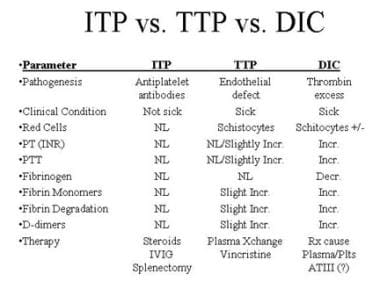
  • The differential diagnosis includes idiopathic thrombocytopenic purpura (ITP) and DIC, 2 entities with very different modes of therapy (see Image 1).
  • Diagnosis must be considered early and, if entertained, plasma infusion and exchange instituted as soon as possible. Most successful suits are due to failure to consider the diagnosis and delays in appropriate initiation of plasma infusion and exchange.

Special Concerns

  • Diagnosing TTP and HUS during pregnancy can be very difficult because the differential includes not only DIC but also preeclampsia/eclampsia and the HELLP syndrome (hemolysis, elevated liver enzymes, and low platelets). In general, TTP is more common in the first 2 trimesters, HELLP is more common during the last trimester, and HUS is more common postpartum.


Media file 1:  Differential diagnosis of thrombotic thrombocytopenic purpura/hemolytic-uremic syndrome.
Click to see larger pictureClick to see detailView Full Size Image
Media type:  Graph

Media file 2:  Peripheral smear from a patient with thrombotic thrombocytopenic purpura: Red blood cells are fragmented and appear as schistocytes. Certain schistocytes have the appearance of helmet cells (H). Spheroidal cells often are present (S). Occasional nucleated erythroid precursors may be present.
Click to see larger pictureClick to see detailView Full Size Image
Media type:  Photo


  • Bell WR, Braine HG, Ness PM, Kickler TS. Improved survival in thrombotic thrombocytopenic purpura-hemolytic uremic syndrome. Clinical experience in 108 patients. N Engl J Med. Aug 8 1991;325(6):398-403. [Medline].
  • Fakhouri F, Vernant JP, Veyradier A, et al. Efficiency of curative and prophylactic treatment with rituximab in ADAMTS13-deficient thrombotic thrombocytopenic purpura: a study of 11 cases. Blood. Sep 15 2005;106(6):1932-7. [Medline].
  • Furlan M, Robles R, Galbusera M, et al. von Willebrand factor-cleaving protease in thrombotic thrombocytopenic purpura and the hemolytic-uremic syndrome. N Engl J Med. Nov 26 1998;339(22):1578-84. [Medline].
  • Lara PN, Coe TL, Zhou H, et al. Improved survival with plasma exchange in patients with thrombotic thrombocytopenic purpura-hemolytic uremic syndrome. Am J Med. Dec 1999;107(6):573-9. [Medline].
  • Lau DH, Wun T. Early manifestation of thrombotic thrombocytopenic purpura. Am J Med. Nov 1993;95(5):544-5. [Medline].
  • Moake JL. Haemolytic-uraemic syndrome: basic science. Lancet. Feb 12 1994;343(8894):393-7. [Medline].
  • Neild GH. Haemolytic-uraemic syndrome in practice. [published erratum appears in Lancet 1994 Feb 26;343(8896):552]. Lancet. Feb 12 1994;343(8894):398-401. [Medline].
  • Rock GA, Shumak KH, Buskard NA, et al. Comparison of plasma exchange with plasma infusion in the treatment of thrombotic thrombocytopenic purpura. Canadian Apheresis Study Group. N Engl J Med. Aug 8 1991;325(6):393-7. [Medline].
  • Shumak KH, Rock GA, Nair RC. Late relapses in patients successfully treated for thrombotic thrombocytopenic purpura. Canadian Apheresis Group. Ann Intern Med. Apr 15 1995;122(8):569-72. [Medline].
  • Tsai HM, Lian EC. Antibodies to von Willebrand factor-cleaving protease in acute thrombotic thrombocytopenic purpura. N Engl J Med. Nov 26 1998;339(22):1585-94. [Medline].
  • Vesely SK, George JN, Lammle B, et al. ADAMTS13 activity in thrombotic thrombocytopenic purpura-hemolytic uremic syndrome: relation to presenting features and clinical outcomes in a prospective cohort of 142 patients. Blood. Jul 1 2003;102(1):60-8. [Medline].

Thrombotic Thrombocytopenic Purpura excerpt

Article Last Updated: Jul 5, 2006