Practice Essentials
Serum sickness is a type III hypersensitivity reaction that results from the injection of heterologous or foreign protein or serum. Reactions to nonprotein drugs are clinically similar to serum sickness reactions.
Historically, the term serum sickness connotes a self-limited syndrome caused by deposition of immune complexes resulting from exposure to foreign proteins or haptens. Von Pirquet and Schick first described the syndrome in 1905, reporting fever, skin eruptions (mainly consisting of urticaria), joint pain, and lymphadenopathy in regions draining the site of injection after patients were given antitoxin in the form of horse serum. [1] Later, physicians reported a similar clinical picture after the injection of other equine-based antitoxins and antivenins. [2] Identifying serum sickness was a landmark observation in understanding immune complex diseases.
Certain medications (eg, penicillin, nonsteroidal anti-inflammatory drugs [NSAIDs]) have also been associated with serum sickness–like reactions. These reactions typically occur 1 to 3 weeks after exposure to the drug, but may occur as early as 1 to 24 hours afterward. Accelerated reactions are T-cell mediated, although an IgE mechanism cannot always be ruled out. [3]
Withdrawal of the offending agent is the mainstay of treatment in serum sickness. Anti-inflammatory drugs and antihistamines provide symptomatic relief. Severe cases (multisystem involvement with significant symptoms) may warrant a 7- to 10-day course of corticosteroids (0.5 - 2 mg/kg). [4] In some cases, plasmapheresis can attenuate serum sickness. [5]

Pathophysiology
Serum sickness is an example of the type III, or immune complex–mediated, hypersensitivity disease. The molecular size, charge, structure, amount, and valence of the antigen involved influence the type of immune complexes formed. [2]
After the initial exposure to a foreign antigen in the absence of a preexisting antibody, serum sickness can develop within 1-2 weeks. Upon subsequent exposure, however, serum sickness develops sooner. The disease appears as the antibody formation begins, and the pathogenesis of serum sickness is related to protracted interaction between antigen and antibody in the circulation, with antigen-antibody complex formation in an environment of antigen excess.
The immunologic interactions observed in serum sickness occur when antigens capable of remaining in the circulation for long periods incite antibody formation. [6] Typically, serum protein molecules are removed from the circulation by nonimmune processes that are not yet completely understood.
Immune complex formation is a common event and does not typically cause symptoms. [7] Small complexes usually circulate without triggering inflammation, and large complexes are cleared by the reticuloendothelial system. However, intermediate-sized complexes that develop in the context of slight antigen excess may deposit in blood vessel walls and tissues, where they induce vascular and tissue damage resulting from activation of complement and granulocytes. [8]
Endothelial cells increase the expression of adhesion molecules, and monocytes and macrophages release proinflammatory cytokines. Subsequently, additional inflammatory cells are recruited, and necrosis of the small vessels develops. Complement activation promotes chemotaxis and adherence of neutrophils to the site of immune complex deposition. This may be facilitated by increased vascular permeability due to release of vasoactive amines from tissue mast cells. [8]
At this point, complement levels fall to half their levels prior to the antibody response. [6] This clinicopathological syndrome usually develops within 1-2 weeks of antigen injection.
Free antigen continues to clear from the blood, leading to antibody excess and the formation of large immune complexes, which are quickly removed by circulating macrophages. Finally, the antigen is no longer detectable, and the level of circulating antibodies continues to rise. Clinical recovery is usually apparent after 7-28 days, as intermediate-sized immune complexes are cleared by the reticuloendothelial system.
Secondary serum sickness is the result of antigen recognition by presensitized cells of the immune system. It is characterized by a shorter latent period, exaggerated symptoms, and a brief clinical course.
Why immune complex disease occurs under certain circumstances is not known. Possible factors may include high levels of immune complexes and a relative deficiency of some complement components leading to a decreased ability to eliminate immune complexes. [7]
In an epidemiological study of 37 cases of rituximab-induced serum sickness, Bayer and colleagues reported that 54% of cases occurred after the first injection, mainly in individuals treated for an autoimmune disease (78%), particularly systemic lupus erythematosus (SLE). The investigators concluded this may be due to B-cell lysis, leading to the release of intracellular antigens into the serum and subsequent antigen-antibody complex formation, particularly in patients with elevated autoantibodies. [9]
Not all substances that are recognized as foreign by the immune system elicit an immune response. The antigen must be of characteristic size or have specific antigenic determinants and physiological properties to be an effective stimulator of the immune system.
After an appropriate antigen is introduced, an individual's immune system responds by synthesizing antibodies after 4-10 days. The antibody reacts with the antigen, forming soluble circulating immune complexes that may diffuse into the vascular walls, where they may initiate fixation and activation of complement.
Complement-containing immune complexes generate an influx of polymorphonuclear leukocytes into the vessel wall, where proteolytic enzymes that can mediate tissue damage are released. Immune complex deposition and the subsequent inflammatory response are responsible for the widespread vasculitic lesions seen in serum sickness.
Etiology
Currently, the most common cause of serum sickness and serum sickness–like is hypersensitivity reaction to drugs. [5] Drugs containing proteins of other species include the following:
-
Antitoxins
-
Antivenins [10]
-
Hormones from other species
-
Streptokinase
-
Vaccines
Polyclonal and monoclonal antibodies prepared from horse, rabbit, or mouse serum (eg, antithymocyte globulin, OKT-3) have also been found to cause serum sickness. [11]
Antibiotics and other antimicrobials that can cause serum sickness include the following:
-
Cephalosporins
-
Ciprofloxacin
-
Griseofulvin
-
Lincomycin
-
Metronidazole
-
Para-aminosalicylic acid
-
Penicillins
-
Streptomycin
-
Sulfonamides
-
Tetracyclines
Other drugs associated with serum sickness include the following:
-
Allopurinol
-
Barbiturates
-
Captopril
-
Carbamazepine
-
Fluoxetine
-
Gold salts
-
Halothane
-
Hydantoins (eg, phenytoin)
-
Hydralazine
-
Indomethacin
-
Iodides
-
Iron dextran
-
Methimazole
-
Methyldopa
-
Mirabegron [14]
-
Penicillamine
-
Procainamide
-
Procarbazine
-
Propranolol
-
Thiouracil
Monoclonal antibodies have been reported to cause a serum sickness–like syndrome. These include infliximab, which is used to treat disorders including rheumatoid arthritis, psoriatic arthritis, Crohn disease, ulcerative colitis, and akylosing spondylitis [15, 16] ; omalizumab, which is used to treat allergy-related asthma and chronic idiopathic urticaria [17, 18, 19, 20] ; and rituximab, which is used to treat various rheumatologic and neoplastic disorders. [18, 21, 22, 23]
A possible case of serum sickness after a third infusion of ocrelizumab for treatment of relapsing remitting multiple sclerosis (MS) has been reported. [24] Although the patient in this case did not have the classic presentation of fever, rash, and arthralgia, serum sickness could not be ruled out; a case commentary recommends considering serum sickness in patients with delayed hypersensitivity reactions to anti-CD20 monoclonal therapies. [25]
Stings from insects in the order Hymenoptera (eg, bees, wasps), mosquitoes, and tick bites may cause serum sickness. [26]
Infectious diseases involving circulating immune complexes (eg, hepatitis B, infective endocarditis) may cause serum sickness–like reactions. These conditions are often associated with circulating cryoglobulins.
Epidemiology
The annual incidence of serum sickness is decreasing as the administration of foreign antigens in medical therapeutics is refined. [4] The likelihood of developing serum sickness is dose-related. In one study, 10% of patients who received 10 mL of tetanus antitoxin developed serum sickness; the administration of 80 mL or more produced the disease in almost all patients. [4]
The likelihood also varies by antigen type. Antirabies serum is associated with a higher likelihood (16.3%) of serum sickness than tetanus antitoxin (2.5%-5%). [4] The reported rate of serum sickness–like reaction per course of cefaclor in United States children is 0.2%. [27]
In one study, serum sickness was more common in patients older than 15 years who were given antirabies serum. [28] Antibiotic-associated serum sickness–like disease, however, is more frequently described in children younger than 5 years.
In a prospective cohort study of 109 patients who received snake antivenom in Australia, serum sickness occurred in 29% of the patients. [10]
Prognosis
Serum sickness is typically self-limited and resolves within days. [5] The prognosis of serum sickness in patients without internal organ involvement is good. [7] Although occasional reports show mortality resulting from progressive glomerulonephritis or severe neurological complications.
Complications of serum sickness may include the following:
-
Vasculitis
-
Neuropathy
-
Acute kidney injury
-
Glomerulonephritis (rare)
-
Anaphylaxis
-
Shock
-
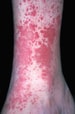
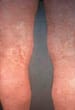
A 29-year-old woman with RA presented with fever, a diffuse skin rash, and arthralgia approximately 10 days after receiving intravenous rituximab. Diagnosis was rituximab-associated serum sickness. Image courtesy of Jason Kolfenbach, MD, and Kevin Deane, MD, Division of Rheumatology, University of Colorado Denver School of Medicine.