Continually Updated Clinical Reference
 
 
  All Sources     eMedicine     Medscape     Drug Reference     MEDLINE
 
eMedicine - Rickettsialpox : Article by

Quick Find
Authors & Editors
Introduction
Clinical
Differentials
Workup
Treatment
Medication
Follow-up
Miscellaneous
References

Related Articles
Varicella-Zoster Virus


Patient Education
Click here for patient education.


Author: Julie A Ake, MD, Fellow, Infectious Disease Service, Walter Reed Army Medical Center

Coauthor(s): Richard J Scarfone, MD, Associate Professor, Department of Pediatrics, University of Pennsylvania School of Medicine; Attending Physician and Director of Emergency Preparedness, Division of Emergency Medicine, The Children's Hospital of Philadelphia; Timothy J Whitman, DO, Consulting Staff, Department of Infectious Disease, National Naval Medical Center; Chi Hiong U Go, MD, Assistant Professor, Department of Internal Medicine, Texas Tech University Health Science Center at Odessa

Editors: Fred A Lopez, MD, Vice-Chair, Department of Internal Medicine, Division of Infectious Diseases, Assistant Professor, Louisiana State University School of Medicine; Francisco Talavera, PharmD, PhD, Senior Pharmacy Editor, eMedicine; Charles V Sanders, MD, Edgar Hull Professor and Chairman, Department of Internal Medicine, Professor of Microbiology, Immunology and Parasitology, Louisiana State University School of Medicine at New Orleans; Medical Director, Medicine Hospital Center, Charity Hospital and Medical Center of Louisiana at New Orleans; Consulting Staff, Ochsner Medical Center; Eleftherios Mylonakis, MD, Clinical and Research Fellow, Department of Internal Medicine, Division of Infectious Diseases, Massachusetts General Hospital; Burke A Cunha, MD, Professor of Medicine, State University of New York School of Medicine at Stony Brook; Chief, Infectious Disease Division, Winthrop-University Hospital

Author and Editor Disclosure

Synonyms and related keywords: rickettsialpox, gamasid rickettsiosis, vesicular rickettsiosis, Rickettsia akari, R akari, Allodermanyssus sanguineus, A sanguineus, Liponyssoides sanguineus, L sanguineus, Mus musculus, M musculus, spotted-fever group of rickettsiae, papule, maculopapulovesicular exanthema, leukocytosis, leukopenia, lymphadenopathy, chickenpox, boutonneuse fever, hand-foot-and-mouth disease, scrub typhus


Background

Rickettsialpox is a mild, self-limited, zoonotic febrile illness characterized by eschar formation at the location of a mite bite, followed by the onset of systemic symptoms and a more generalized papulovesicular rash. The causative agent is Rickettsia akari, a member of the spotted-fever group of rickettsiae.

Pathophysiology

R akari is an obligate intracellular gram-negative coccobacillus. Its vector is the colorless mite Liponyssoides sanguineus (formerly Allodermanyssus sanguineus), which is found on mice (most commonly the house mouse [Mus musculus]) and other rodents. These hosts serve as the reservoir for the disease. A sanguineus will bite humans when murine hosts are scarce. About 7-10 days after the painless bite, a papular skin lesion appears at the bite location and becomes vesicular with a surrounding area of erythema. An eschar forms and slowly heals. About 3-7 days after the initial skin lesion develops, patients may suddenly develop high-grade fever, chills, headaches, and myalgias with subsequent development of a sparse generalized papulovesicular rash.

The disease is mild and self-limited and usually persists for about a week.

Frequency

United States

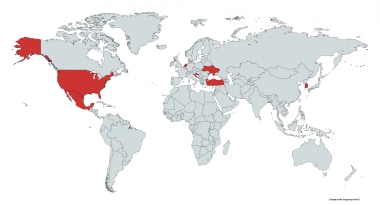
Rickettsialpox occurs primarily in urban areas, where the density of mites, mice, and humans is high. Huebner et al first isolated and named rickettsialpox in 1946 in New York City.1

Rickettsialpox has been reported primarily in the northeastern and midwest United States (Boston, Mass; West Hartford, Conn; Philadelphia, Pa; Pittsburgh, Pa; and Cleveland, Ohio). Cases have also been reported in North Carolina, Arkansas, and Utah.

Although the prevalence of confirmed cases is very low, several reports suggest the disease is more common than previously thought. Serologic evidence of rickettsialpox exposure was found in 16% of 631 intravenous drug users in inner-city Baltimore, Md, and in 9% of 204 intravenous drug users in Harlem, NY.2, 3 In addition, between 2001 and 2003, the number of clinical samples submitted to the Centers for Disease Control and Prevention (CDC) increased following the anthrax bioterror attack, reflecting an increased awareness of eschar-associated febrile illness.4 Prior to this, these clinical syndromes may have been misdiagnosed, or perhaps the infected persons did not seek medical attention. Consequently, rickettsialpox is widely believed to be an underrecognized and underreported clinical entity.

International

Internationally, the disease has been described in South Africa, Costa Rica, France, Italy, Turkey, Croatia, the UkraineRussia, and Korea.

Mortality/Morbidity

Rickettsialpox is a benign, self-limited disease. No fatalities have been reported. The incubation period varies from 10-21 days. Rickettsialpox usually resolves within 14-21 days; however, headache and lassitude may persist for another 1-2 weeks.

Sex

Rickettsialpox has no sexual predilection.

Age

Rickettsialpox has no age predilection. It has been reported in patients aged 6 months to 72 years.


History

  • Following a mite bite, R akari proliferates locally in the skin. After 7-10 days, a firm, red papule 1-1.5 cm in diameter appears; in a few days, it vesiculates with a surrounding area of erythema. The lesion then ulcerates, forms an eschar, and slowly heals.
  • About 3-7 days after the appearance of the skin lesion, rickettsialpox may manifest as a sudden onset of high fever, chills, sore throat, rigor and profuse sweating, myalgias (especially backache), anorexia, and photophobia. Untreated, fever may last a week. Vertigo, conjunctival injection, cough, rhinorrhea, nausea, and vomiting sometimes occur. Headaches and neck stiffness may be severe. Regional lymphadenopathy at the draining site of the eschar is common, and generalized lymphadenopathy has also been reported. Lymphangitis is not a feature of rickettsialpox.
  • Approximately 2-3 days after the onset of systemic symptoms, the generalized papulovesicular rash of rickettsialpox erupts. This can involves palms and soles and is occasionally accompanied by an oropharyngeal enanthem. This rash typically lasts a week.

Physical

  • Patients may have high fever fluctuating between 101-104ºF.
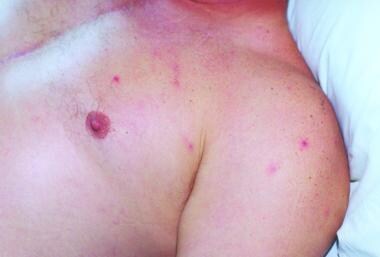
  • The maculopapulovesicular exanthema is usually comprised of 20-40 lesions but may range from 5-100.  
    • The lesions typically begin as papules with subsequent vesiculation, but may remain avesicular.
    • Lesions are usually scattered on the face, trunk, and extremities with no particular sequence of involvement. Patients may present with lesions on the tongue, buccal mucosa, and pharynx.
    • Lesions may also be present on palms and soles.
    • The lesions are typically asymptomatic but can be pruritic.
    • Rashes last a week. Scabs form but do not leave scars.
  • At the time of presentation, an eschar is present in at least 95% of affected individuals. The mite bite is painless and begins as an erythematous papule, which develops into a tense vesicle that ruptures to form a dark crust with surrounding induration. More than one eschar may be present.  
    • Mite bites can occur on any part of the body, including the hands, feet, face, and angle of the mouth (labial commissure). They do occur in covered areas.
    • Regional adenopathy may be present and is usually tender.

Causes

  • Rickettsialpox is caused by R akari and was first described in 1946.
  • Rickettsialpox is sporadically observed in many urban centers of the United States. The bloodsucking mite L sanguineus is the vector, and mice (typically M musculus) and other rodents are the reservoir.
  • When murine hosts are scarce, A sanguineus will bite humans.
  • No human-to-human transmission occurs.


Varicella-Zoster Virus

Other Problems to be Considered

Human spotted fever secondary to Rickettsia parkeri infection
African tick bite fever secondary to Rickettsia africae infection
Mediterranean Spotted Fever
Scrub Typhus
Anthrax
Smallpox

Characteristics of Similar Conditions

 Disease
Rash/Eschar
Generalized Rash
Clinical Features
Geography
Rickettsialpox secondary to R akari infection
A red papule with a vesicle in the center dries and forms a black eschar with surrounding induration. Multiple eschars are possible.
The papulovesicular rash is usually on the trunk and extremities; the palms, soles, and oral mucosa may also be involved.
The papule precedes the febrile illness and mild systemic symptoms. Regional lymphadenopathy may develop.
See Frequency
Chickenpox secondary to varicella zoster infection
The papule turns into a vesicle on an erythematous base and resembles a "dew drop on a rose petal."
The rash begins on the head and progresses to the trunk, arms, and then legs; vesicles are present in all stages.
It is common in children. No black eschar is present.
Worldwide
Mediterranean spotted fever secondary to Rickettsia conorii infection
At the site of a tick bite, a single eschar with a red halo forms.
The rash is generalized, involves the palms and soles, and is often maculopapular, occasionally petechial.
Fever, headache, myalgias may develop. The onset is abrupt. The disease may be severe in context of comorbidity.
North Africa, Middle East, Southern Europe
African tick bite fever secondary to R africae infection
Single or multiple eschars with regional lymphadenopathy
A scant generalized rash, vesicular or maculopapular, may be present. Conversely, the rash may be absent.
Fever, headache, myalgias, regional lymphadenopathy; associated with reports of subacute neuropathy
Sub-Saharan Africa, Caribbean
Human spotted fever secondary to R parkeri infection
Single or multiple eschars develop from erythematous papules.
Scant nonpruritic papules
Fever, headache, myalgias, arthralgias
United States
Scrub typhus secondary to Orientia tsutsugamushi infection
A vesicle or black scab appears on an erythematous base at the bite site.
Vesicles are usually on the trunk or extremities.
The rash fades within a few days; pneumonitis is common.
Asia-Pacific rim


Lab Studies

  • Routine laboratory test results are nonspecific for rickettsialpox, but leukopenia with relative lymphocytosis and mild proteinuria are common. Thrombocytopenia is also a frequently reported finding.
  • A diagnosis of rickettsialpox is usually confirmed with a combination of clinical, epidemiological, and serological testing. In the presence of compatible illness in the context of mite exposure, perform serologic tests for antibodies to the spotted-fever group of rickettsiae. If possible, send a biopsy specimen for direct fluorescent antibody (DFA) testing, culture, and polymerase chain reaction (PCR). Sensitivity of the DFA is better for the eschar site than for secondary papulovesicular lesions.
  • Weil-Felix test findings are negative.
  • If acute titer results are negative, obtain convalescent sera after 6-8 weeks.

Other Tests

  • Organism culture, immunohistochemical staining, protein gel electrophoresis, and molecular analysis via PCR may be performed, usually at the reference laboratory level.
  • Giemsa stains of tissue specimens may reveal extremely small coccobacillary intracellular bacteria.

Histologic Findings

Skin biopsies are not routinely obtained to confirm a diagnosis of rickettsialpox. If collected, biopsy samples show epidermal infiltration by mononuclear cells and necrosis of the dermis and epidermis. Inflammation around blood vessels with thrombi and extravasation of red blood cells may also be observed. Vacuolar degeneration of basal cell layers is consistently present.


Medical Care

Rickettsialpox is a self-limited disease; however, antibiotics hasten defervescence and provide relief of other systemic symptoms. A presumptive diagnosis of rickettsialpox can be made based on high clinical suspicion in the correct geographic context, and empiric antimicrobial therapy can be appropriately prescribed. The treatment of choice is doxycycline 100 mg administered orally twice daily until the patient has clinically recovered for approximately 48 hours. Usually, 5-7 days is sufficient. Supportive and symptomatic therapy may also be provided. 

Consultations

If antibiotics cause no response within 48 hours, seek an alternate diagnosis.


A brief course of a tetracycline antibiotic is recommended. Quinolones may also be considered. Chloramphenicol is an alternate treatment but is not usually recommended because of substantial toxicity.

Drug Category: Antibiotics

Empiric antimicrobial therapy must be comprehensive and should cover all likely pathogens in the context of the clinical setting.

Drug NameDoxycycline (Bio-Tab, Doryx, Vibramycin, Doxy)
DescriptionInhibits protein synthesis and, thus, bacterial growth by binding to 30S and possibly 50S ribosomal subunits of susceptible bacteria.
Adult Dose100-mg PO q12h
Pediatric Dose<8 years: Not recommended
>8 years: 2-5 mg/kg/d in 1-2 divided doses for 2-5 d; not to exceed 200 mg/d
ContraindicationsDocumented hypersensitivity; severe hepatic dysfunction
InteractionsBioavailability decreases with antacids containing aluminum, calcium, magnesium, iron, or bismuth subsalicylate; tetracyclines can increase hypoprothrombinemic effects of anticoagulants; tetracyclines can decrease effects of oral contraceptives, causing breakthrough bleeding and increased risk of pregnancy
PregnancyD - Fetal risk shown in humans; use only if benefits outweigh risk to fetus
PrecautionsPhotosensitivity may occur with prolonged exposure to sunlight or tanning equipment; reduce dose in renal impairment; consider serum level determinations in prolonged therapy; tetracycline use during tooth development (last half of pregnancy through age 8 y) can cause permanent discoloration of teeth; Fanconi-like syndrome may occur with outdated tetracyclines


Deterrence/Prevention

  • Measures aimed at controlling rodent population and their mite ectoparasites should be instituted.
  • No human-to-human transmission occurs.
  • No vaccine is available.

Prognosis

  • Prognosis is excellent.
  • Rickettsialpox is usually a self-limited disease.
  • No fatalities have been reported.
  • Despite cross-reactivity with other members of the spotted-fever group, cross-immunity to other agents is not conferred upon recovery from rickettsialpox.


Medical/Legal Pitfalls

  • Rickettsialpox is commonly confused with chickenpox, which usually occurs in childhood, is associated with more severe constitutional symptoms, and has a different vesicular rash distribution.


  1. Huebner RJ, Stamps P, Armstrong C. Rickettsialpox. A newly recognized rickettsial disease. 1. isolation of the etiological agent. Public Health Report. 1946;61:1605.
  2. Comer JA, Tzianabos T, Flynn C, Vlahov D, Childs JE. Serologic evidence of rickettsialpox (Rickettsia akari) infection among intravenous drug users in inner-city Baltimore, Maryland. Am J Trop Med Hyg. Jun 1999;60(6):894-8. [Medline].
  3. Comer JA, Diaz T, Vlahov D, Monterroso E, Childs JE. Evidence of rodent-associated Bartonella and Rickettsia infections among intravenous drug users from Central and East Harlem, New York City. Am J Trop Med Hyg. Dec 2001;65(6):855-60. [Medline].
  4. Paddock CD, Zaki SR, Koss T, Singleton J Jr, Sumner JW, Comer JA, et al. Rickettsialpox in New York City: a persistent urban zoonosis. Ann N Y Acad Sci. Jun 2003;990:36-44. [Medline].
  5. Anderson GW Jr, Osterman JV. Host defenses in experimental rickettsialpox: resistance of C3H mouse sublines. Acta Virol. Jun 1980;24(4):294-6. [Medline].
  6. Angeloni VL, Keller RA, Walker DH. Rickettsialpox-like illness in a traveler. Mil Med. Sep 1997;162(9):636-9. [Medline].
  7. Boyd AS. Rickettsialpox. Dermatol Clin. Apr 1997;15(2):313-8. [Medline].
  8. Brettman LR, Lewin S, Holzman RS, Goldman WD, Marr JS, Kechijian P, et al. Rickettsialpox: report of an outbreak and a contemporary review. Medicine (Baltimore). Sep 1981;60(5):363-72. [Medline].
  9. Heymann WR. Rickettsialpox. Clin Dermatol. May-Jun 1996;14(3):279-82. [Medline].
  10. Kass EM, Szaniawski WK, Levy H, Leach J, Srinivasan K, Rives C. Rickettsialpox in a New York City hospital, 1980 to 1989. N Engl J Med. Dec 15 1994;331(24):1612-7. [Medline].
  11. Kass EM, Szaniawski WK, Levy H, Leach J, Srinivasan K, Rives C. Rickettsialpox in a New York City hospital, 1980 to 1989. N Engl J Med. Dec 15 1994;331(24):1612-7. [Medline].
  12. Kemper CA, Spivack AP, Deresinski SC. Atypical papulovesicular rash due to infection with Rickettsia conorii. Clin Infect Dis. Oct 1992;15(4):591-4. [Medline].
  13. Kenyon RH, Pedersen CE Jr. Immune responses to Rickettsia akari infection in congenitally athymic nude mice. Infect Immun. May 1980;28(2):310-3. [Medline].
  14. Krinsky WL. Does epizootic lymphocytic choriomeningitis prime the pump for epidemic rickettsialpox?. Rev Infect Dis. Nov-Dec 1983;5(6):1118-9. [Medline].
  15. Krusell A, Comer JA, Sexton DJ. Rickettsialpox in North Carolina: a case report. Emerg Infect Dis. Jul 2002;8(7):727-8. [Medline].
  16. McDade JE, Black CM, Roumillat LF, Redus MA, Spruill CL. Addition of monoclonal antibodies specific for Rickettsia akari to the rickettsial diagnostic panel. J Clin Microbiol. Oct 1988;26(10):2221-3. [Medline].
  17. Myers SA, Sexton DJ. Dermatologic manifestations of arthropod-borne diseases. Infect Dis Clin North Am. Sep 1994;8(3):689-712. [Medline].
  18. Ozturk MK, Gunes T, Kose M, Coker C, Radulovic S. Rickettsialpox in Turkey. Emerg Infect Dis. Nov 2003;9(11):1498-9. [Medline].
  19. Paddock CD, Koss T, Eremeeva ME, Dasch GA, Zaki SR, Sumner JW. Isolation of Rickettsia akari from eschars of patients with rickettsialpox. Am J Trop Med Hyg. Oct 2006;75(4):732-8. [Medline].
  20. Paddock CD, Sumner JW, Comer JA, Zaki SR, Goldsmith CS, Goddard J, et al. Rickettsia parkeri: a newly recognized cause of spotted fever rickettsiosis in the United States. Clin Infect Dis. Mar 15 2004;38(6):805-11. [Medline].
  21. Paterson PY, Taylor W. Rickettsialpox. Bull N Y Acad Med. Jul 1966;42(7):579-87. [Medline].
  22. Radulovic S, Feng HM, Morovic M, Djelalija B, Popov V, Crocquet-Valdes P, et al. Isolation of Rickettsia akari from a patient in a region where Mediterranean spotted fever is endemic. Clin Infect Dis. Feb 1996;22(2):216-20. [Medline].
  23. Rickettsialpox. Lancet. Jan 16 1982;1(8264):148. [Medline].
  24. Saini R, Pui JC, Burgin S. Rickettsialpox: report of three cases and a review. J Am Acad Dermatol. Nov 2004;51(5 Suppl):S137-42. [Medline].
  25. Walker DH. Rickettsioses of the spotted fever group around the world. J Dermatol. Jun 1989;16(3):169-77. [Medline].
  26. Walker DH, Hudnall SD, Szaniawski WK, Feng HM. Monoclonal antibody-based immunohistochemical diagnosis of rickettsialpox: the macrophage is the principal target. Mod Pathol. May 1999;12(5):529-33. [Medline].
  27. Wong B, Singer C, Armstrong D, Millian SJ. Rickettsialpox. Case report and epidemiologic review. JAMA. Nov 2 1979;242(18):1998-9. [Medline].

Rickettsialpox excerpt

Article Last Updated: Apr 11, 2008