Continually Updated Clinical Reference
 
 
  All Sources     eMedicine     Medscape     Drug Reference     MEDLINE
 
eMedicine - Balantidiasis : Article by

Quick Find
Authors & Editors
Introduction
Clinical
Differentials
Workup
Treatment
Medication
Follow-up
Miscellaneous
Multimedia
References

Related Articles
Pneumonia, Fungal


Patient Education
Click here for patient education.


Author: Valda M Chijide, MD, Clinical Professor, Department of Medicine, University of Saskatchewan, Consultant in Infectious Diseases, Regina, Saskatchewan, Canada

Valda M Chijide is a member of the following medical societies: American College of Chest Physicians and Infectious Diseases Society of America

Editors: Jeffrey D Band, MD, Clinical Professor of Medicine, Wayne State University School of Medicine; Director, Division of Infectious Diseases and International Medicine, William Beaumont Hospital Corporation; Francisco Talavera, PharmD, PhD, Senior Pharmacy Editor, eMedicine; Ronald A Greenfield, MD, Professor, Chief, Department of Internal Medicine, Section of Infectious Diseases, University of Oklahoma College of Medicine; Eleftherios Mylonakis, MD, Clinical and Research Fellow, Department of Internal Medicine, Division of Infectious Diseases, Massachusetts General Hospital; Burke A Cunha, MD, Professor of Medicine, State University of New York School of Medicine at Stony Brook; Chief, Infectious Disease Division, Winthrop-University Hospital

Author and Editor Disclosure

Synonyms and related keywords: balantidiasis, balantidiosis, Balantidium coli, B coli, hyaluronidase, colon cyst, diarrhea, gastrointestinal infection, GI infection, infection associated with pig contact

Background

Balantidium coli is a ciliated protozoan, and it is also the largest human protozoan. It is known to parasitize the colon, and pigs may be its primary reservoir.
Pathophysiology

B coli occurs as a trophozoite and a cyst in the colon. The trophozoites replicate by binary fission and conjugation, and they subsist on bacteria. Humans ingest infective cysts, which then migrate to the large intestine, cecum, and terminal ileum. The organisms primarily dwell in the lumen, but they also can penetrate the mucosa and cause ulcers. Hyaluronidase is produced by this organism, which may enhance its ability to invade the mucosa.

Frequency

United States

B coli has a worldwide distribution with an estimated prevalence of 1%. Epidemics have occurred in psychiatric hospitals in the United States.

International

Infection tends to be more common among humans who handle pigs. It is reported most commonly in Latin America; Southeast Asia; and Papua, New Guinea. In 1971, an outbreak involving 100 people occurred in Truk following a typhoon.

Mortality/Morbidity

Most infections in immunocompetent individuals are asymptomatic. The mortality rate for the acute and fulminating types was reportedly as high as 30% in untreated patients prior to the introduction of antibiotics. Pneumonia has been described in patients with cancer-related immunosuppression and has not always been associated with direct contact with pigs.


History

Some patients may develop the following symptoms:

  • Diarrhea (watery, bloody, mucoid)
  • Nausea
  • Vomiting
  • Abdominal pain
  • Anorexia
  • Weight loss
  • Headache
  • Mild colitis
  • More severe and marked fluid loss (resembling amebic dysentery)

Physical

Patients may present with abdominal tenderness and, in cases with prolonged diarrhea, signs of dehydration.

Causes

The risk of balantidiasis increases when the patient has contact with pigs, handles fertilizer contaminated with pig excrement, or lives in areas where the water supply may be contaminated by the excrement of infected animals. Poor nutrition, achlorhydria, and immunosuppression can be contributing factors.


Pneumonia, Fungal

Other Problems to be Considered

Peritonitis


Lab Studies

  • Wet smear stool specimens
    • B coli does not stain well on permanent stained smears, making diagnosis more difficult; however, diagnosis can be made by examining wet smears of stool specimens or scrapings from the periphery of ulcers during an endoscopic examination.
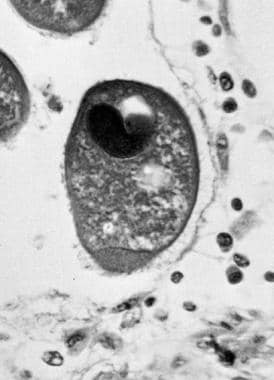
    • On unstained specimens, the trophozoite is recognized by its large size (approximately 50-100 µm in length and 40-70 µm in width), a short ciliary covering, and its spiraling motility. It frequently is observed under low power. On stained preparations, the trophozoite characteristically shows 2 nuclei: the macronucleus, which is kidney-shaped, and the micronucleus, which is spherical and lies close to the macronucleus.
    • Cysts may be spherical or ellipsoid and range from about 50-70 µm long. Newly encysted organisms observed on unstained specimens may still have cilia, but cilia disappear after a longer period of encystment. Observation of a macronucleus and a micronucleus is diagnostic if observed in a cyst on a stained specimen.

Imaging Studies

  • Chest radiography: This study can show pulmonary parenchymal involvement.
  • Computed tomography (CT) scan: Pulmonary parenchymal and lymph node involvement, as well as involvement of other organ systems, may be seen on this study.

Procedures

  • Colonoscopy: Perform an endoscopic examination of the colon to obtain a biopsy of ulcers, thereby aiding in the diagnosis. Obtain the specimens from the periphery of ulcers.
  • Bronchoalveolar lavage (BAL) can identify organisms on wet mount of bronchial secretions.

Histologic Findings

Organisms can invade the mucosa and submucosa, causing ulceration and infiltration with polymorphonuclear cells, lymphocytes, and eosinophils. Trophozoites can be observed at the invading edge of ulcers or at the periphery of submucosal abscesses.


Medical Care

Pay special attention to volume replacement and electrolyte repletion in patients with severe diarrhea.

Surgical Care

The disease rarely manifests as acute appendicitis, which requires an appendectomy.

Consultations

  • Consult a surgeon for management of acute abdomen problems (eg, appendectomy, laparotomy).
  • Consult a gastroenterologist for patients requiring a colonoscopy.
  • Therapy in intensive care may be required for patients who show signs of clinical deterioration despite receipt of appropriate antibiotics.


The goals of pharmacotherapy are to reduce morbidity and to prevent complications. Prolonged courses of therapy may be required for cure in patients who are infected with HIV or otherwise immunosuppressed.

Drug Category: Antibiotics

Empiric antimicrobial therapy must be comprehensive and should cover all likely pathogens in the context of the clinical setting. Tetracycline is the treatment of choice, with metronidazole being the primary alternative. Iodoquinol, puromycin, and nitazoxanide are also effective.

Drug NameTetracycline (Sumycin)
DescriptionIsolated from a strain of Streptomyces aureofaciens. Exerts a bacteriostatic effect by reversibly binding to 30S and 50S ribosomal subunits of susceptible organisms, thereby inhibiting protein synthesis.
Adult Dose500 mg PO qid for 10 d
Pediatric Dose<8 years: Not recommended
>8 years: 40 mg/kg/d PO divided qid for 10 d; not to exceed 2 g/d PO
ContraindicationsDocumented hypersensitivity; breastfeeding; children <8 y; renal or hepatic impairment
InteractionsDecreases effect of penicillin; colestipol, divalent/trivalent cation–containing antacids, food, dairy products, and supplements decrease absorption; increases anticoagulant effect of warfarin; decreases efficacy of oral contraceptives; increases serum levels of digoxin and lithium; concurrent use of retinoids can increase risk of pseudotumor cerebri; tetracyclines may reduce insulin requirements
PregnancyD - Unsafe in pregnancy
PrecautionsPhotosensitivity may occur with prolonged exposure to sunlight or tanning equipment; reduce dose in renal impairment; consider drug serum level determinations in prolonged therapy; tetracycline use during tooth development (last half of pregnancy through age 8 y) can cause permanent discoloration of teeth; Fanconi-like syndrome may occur with outdated tetracycline; some patients experience headache, light-headedness, dizziness, or vertigo

Drug NameMetronidazole (Flagyl)
DescriptionSynthetic drug with antiprotozoal and antibacterial action used to treat symptomatic patients with diarrhea.
Adult Dose500 mg PO tid for 5 d
Pediatric Dose35-50 mg/kg/d PO divided tid for 5 d
ContraindicationsDocumented hypersensitivity to metronidazole or other nitroimidazole derivatives; first trimester of pregnancy; history of blood dyscrasias
InteractionsAlcohol intake during and for 3 d after therapy induces disulfiramlike reaction; microsomal enzyme inducers (eg, phenytoin, phenobarbital) decrease serum levels; microsomal enzyme inhibitors (eg, cimetidine) prolong half-life; increases serum lithium levels and/or lithium toxicity
PregnancyB - Usually safe but benefits must outweigh the risks.
PrecautionsAdjust dose in hepatic disease; monitor for seizures and development of peripheral neuropathy

Drug NameIodoquinol (Yodoxin)
DescriptionContact amebicide works in the lumen of intestine.
Adult Dose650 mg PO tid for 20 d
Pediatric Dose40 mg/kg/d PO divided tid for 20 d
ContraindicationsDocumented sensitivity; hepatic insufficiency; iodine intolerance
InteractionsIncreases protein-bound serum iodine concentration
PregnancyC - Safety for use during pregnancy has not been established.
PrecautionsGI distress, acneform and bullous eruptions, optic neuritis, optic atrophy, peripheral neuropathy, and thyroid dysfunction may occur; avoid long-term therapy


Further Outpatient Care

  • Ensure that the patient has a follow-up visit after treatment to document the resolution of symptoms. Also, obtain a stool specimen and a wet smear to check for organisms.

Deterrence/Prevention

  • A clean water supply and hygienic living conditions can prevent this disorder.
  • Avoiding contact with pigs and fertilizer that is contaminated with pig excrement can decrease the risk.

Complications

  • Intestinal perforation and extraintestinal spread to liver and mesenteric lymph nodes are rare.
  • Pulmonary involvement has been reported and appears to be more common in patients with underlying illnesses such as diabetes, cancer, or impaired lymphocyte function.

Prognosis

  • In the antibiotic era, prognosis is improved for those with severe forms of the illness, and most affected patients now recover.

Patient Education

  • Patients should be counseled on the importance of good handwashing, particularly after being exposed to environments where likelihood of infection is high.


Special Concerns

  • Immediately examine a stool sample because the trophozoites do not survive long outside of the colon.
  • Patients infected with HIV may require up to 30 days of therapy for a cure.


Media file 1:  Trophozoite of Balantidium coli in colon. This photograph shows the large macronucleus and the thin cell membrane covered with cilia (X820). Courtesy of Armed Forces Institute of Pathology (AFIP 75-9300).
Click to see larger pictureClick to see detailView Full Size Image
Media type:  Photo

Media file 2:  Cyst of Balantidium coli in feces. This photograph demonstrates a thick cyst wall and a large macronucleus (X820). Courtesy Armed Forces Institute of Pathology (AFIP 75-9301).

Click to see larger pictureClick to see detailView Full Size Image
Media type:  Photo


  • Anargyrou K, Petrikkos GL, Suller MT, et al. Pulmonary Balantidium coli infection in a leukemic patient. Am J Hematol. Jul 2003;73(3):180-3. [Medline].
  • Arean VM, Koppisch E. Balantidiasis; a review and report of cases. Am J Pathol. Nov-Dec 1956;32(6):1089-115. [Medline].
  • Aucott JN, Ravdin JI. Amebiasis and "nonpathogenic" intestinal protozoa. Infect Dis Clin North Am. Sep 1993;7(3):467-85. [Medline].
  • Canadian Pharmacists Association. Compendium of Pharmaceuticals and Specialties (CPS). 2006;2182-2183.
  • Dodd LG. Balantidium coli infestation as a cause of acute appendicitis. J Infect Dis. Jun 1991;163(6):1392. [Medline].
  • Esteban JG, Aguirre C, Angles R, et al. Balantidiasis in Aymara children from the northern Bolivian Altiplano. Am J Trop Med Hyg. Dec 1998;59(6):922-7. [Medline].
  • Fisk T, Keystone J, Kozarsky P. Cyclospora cayetanensis, Isospora belli, Sarcocystis Species, Balantidium coli, and Blastocystis hominis. In: Mandell GL, Bennet JE, Dolin R, eds. Principles and Practice of Infectious Diseases. 6th ed. Philadelphia, Pa: Elsevier Churchill Livingstone;. 2005;2:3228-37.
  • Garcia L, Bruckner D. Intestinal Protozoa: Flagellates and Ciliates. In: Diagnostic Medical Parasitology. 3rd ed. Washington, DC: ASM Press;. 1997:34-53.
  • Markell E. Lumen-Dwelling Protozoa. In: Markell and Voge's Medical Parasitology. 8th ed. Philadelphia, Pa: WB Saunders Co;. 1999:24-89.
  • Micromedex. Tetracycline. Drugdex Drug Evaluations. 2000. Available at: http://www.micromedex.com:Accessed 2000. [Medline].
  • Neafie R. Balantidiasis. In: Pathology of Tropical and Extraordinary Diseases. Vol 1. Washington, DC:. Armed Forces Institute of Pathology;1976:325-7.
  • PDR. Physicians' Desk Reference. Montvale, NJ: Medical Economics Company, Inc;. 2000.
  • Rosenblatt JE. Antiparasitic agents. Mayo Clin Proc. Nov 1999;74(11):1161-75. [Medline].
  • The Medical letter on drugs and therapeutics. Drugs for parasitic infections. Med Lett Drugs Ther. Jan 2 1998;40(1017):1-12. [Medline].
  • Vasilakopoulou A, Dimarongona K, Samakovli A, et al. Balantidium coli pneumonia in an immunocompromised patient. Scand J Infect Dis. 2003;35(2):144-6. [Medline].
  • Walzer PD, Judson FN, Murphy KB, et al. Balantidiasis outbreak in Truk. Am J Trop Med Hyg. Jan 1973;22(1):33-41. [Medline].
  • Yazar S, Altuntas F, Sahin I, Atambay M. Dysentery caused by Balantidium coli in a patient with non-Hodgkin's lymphoma from Turkey. World J Gastroenterol. Feb 1 2004;10(3):458-9. [Medline].
  • Young MD. Attempts to transmit human Balantidium coli. Am J Trop Med Hyg. Jan 1950;30(1):71. [Medline].

Balantidiasis excerpt

Article Last Updated: Feb 5, 2007