| Patient Education |
|
Click here for patient education.
|
|
You are in: eMedicine Specialties >
Infectious Diseases > MEDICAL TOPICS
Mycobacterium Marinum
Article Last Updated: Feb 28, 2006
AUTHOR AND EDITOR INFORMATION
Section 1 of 10
Author: Raphael J Kiel, MD, Associate Professor of Medicine, Wayne State University School of Medicine; Associate Program Director, Head of Infectious Disease Section, Department of Internal Medicine, Oakwood Hospital
Raphael J Kiel is a member of the following medical societies: American College of Physicians-American Society of Internal Medicine, American Geriatrics Society, American Medical Association, and American Medical Informatics Association
Editors: Klaus-Dieter Lessnau, MD, FCCP, Clinical Assistant Professor of Medicine, New York University School of Medicine; Medical Director, Pulmonary Physiology Laboratory, Director of Research in Pulmonary Medicine, Department of Medicine, Section of Pulmonary Medicine, Lenox Hill Hospital; Francisco Talavera, PharmD, PhD, Senior Pharmacy Editor, eMedicine; Aaron Glatt, MD, Professor of Clinical Medicine, New York Medical College; Chief Medical Officer, Departments of Medicine and Infectious Diseases, New Island Hospital; Eleftherios Mylonakis, MD, Clinical and Research Fellow, Department of Internal Medicine, Division of Infectious Diseases, Massachusetts General Hospital; Burke A Cunha, MD, Professor of Medicine, State University of New York School of Medicine at Stony Brook; Chief, Infectious Disease Division, Winthrop-University Hospital
Author and Editor Disclosure
Synonyms and related keywords:
Mycobacterium marinum, M marinum, fish tank granuloma, swimming pool granuloma, fish fancier's finger
Background
Mycobacterium marinum is an atypical Mycobacterium found in salt and fresh water. M marinum infection occurs following skin trauma in fresh or salt water and usually presents as a localized granuloma or sporotrichotic lymphangitis. This pathogen is classified in Runyon group 1 and is a photochromogen, which means it produces pigment when cultured and exposed to light. Culture growth occurs over 7-14 days and is optimal at 32°C.
Pathophysiology
M marinum infection occurs following trauma to an extremity that is in contact with an aquarium, salt water, or marine animals. Exposure to M marinum via swimming pools is rare because most pools are chlorinated. The organism grows better at 32°C; therefore, cooler extremities are affected more often than central sites. M marinum rarely disseminates, except in the setting of a severely immunosuppressed patient.
Frequency
United States
Infections caused by M marinum are rare but well described in the literature. Estimated annual incidence is 0.27 cases per 100,000 adult patients. Of the approximately 150 cases described, most are case reports of cutaneous infection; however, some describe osteomyelitis, tenosynovitis, arthritis, and disseminated infection. M marinum is ubiquitous and is found more often in salt water than in fresh water. Individuals who fish or work with aquariums have an increased risk of exposure. Nosocomial infection has never been described.
International
International incidence and prevalence are unknown due to lack of surveillance.
Mortality/Morbidity
- Infection with M marinum responds slowly to appropriate antibiotic therapy. Patients may require treatment for 2 weeks to as long as 18 months.
- Infection may result in persistent ulceration, draining sinuses, or septic arthritis. Aggressive M marinum infection may cause extensive osteomyelitis and amputation of the involved digit.
- Reports describe dissemination to the bone marrow and visceral involvement; however, the reports do not include deaths directly related to M marinum infection.Patients with acquired immunodeficiency syndrome have been reported to have disseminated M marinum infection.
Race
No known racial predilection exists.
Sex
No known sex predilection exists, and infection in men is linked to occupational exposures.
Age
No known age predilection exists.
History
- Infection often follows abrasions to an extremity occurring in nonchlorinated water. Fishermen, oyster workers, swimmers, and aquarium workers are predisposed.
- A papule or nodule initially appears at the site of trauma. This nodule subsequently may ulcerate and involve the local joint or tendons.
- Localized pain and induration are common. Fever, localized lymphadenopathy, and systemic infection rarely are observed, with the exception of immunosuppressed patients.
- The incubation period of M marinum is about 2-3 weeks.
- The localized lesion can increase slowly over several months.
Physical
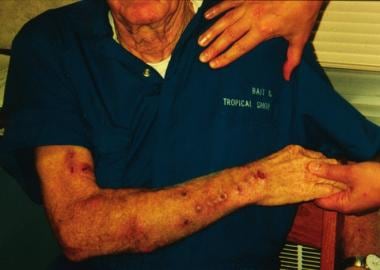
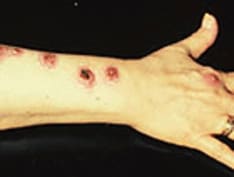
- A papule or bluish nodule develops at the inoculation site. Ulceration can occur later, and subsequent lesions may be present along the path of lymphatic drainage of the extremity.
- In 25-50% of patients, the nodules proliferate along the path of lymphatic drainage in a sporotrichotic type of distribution.
- Patients may have deeper involvement, with tenosynovitis, septic arthritis, and osteomyelitis of the underlying bone. Dissemination to the bone marrow and abdominal viscera rarely develops.
- An upper extremity is affected in nearly 90% of cases. Patients also can present with an erythematous plaque on their hands.
- Most patients have a tuberculin skin test of less than 10 mm of induration.
- The presentation can be similar to that of interstitial granuloma annulare.
Causes
Infection is caused by inoculation with M marinum. Individuals who are at increased risk for infection are as follows:
- Fishermen and workers who process saltwater fish
- Workers who clean saltwater aquariums
- Immunocompromised patients (increased risk of disseminated infection)
- Home aquarium owners
Mycobacterium Chelonae
Mycobacterium Fortuitum
Mycobacterium Gordonae
Sporotrichosis
Lab Studies
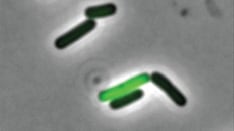
- Cultures may grow nonmotile acid-fast bacilli in 7-14 days, with optimum growth at 32°C.
- The organisms are photochromogen (Runyon group 1), producing pigment only when exposed to light.
- No niacin or nitrate production occurs; urease is produced, but the organism is a weak producer of catalase at 25°C.
- Even on repeat cultures results may remain negative.
- Polymerase chain reaction (PCR) amplification techniques using Mycobacterium genus-specific primers can be used to diagnose M marinum infection directly in the biopsy sample.
Imaging Studies
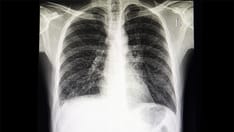
- Obtain radiographs of the infected area to evaluate for evidence of osteomyelitis.
- Consider a CT scan or MRI of the infected area if tenosynovitis or deeper infection is suspected.
Procedures
- Surgical drainage of skin lesions often is unnecessary; however, if diagnosing deeper infection, drainage is indicated.
Histologic Findings
Younger lesions show epidermal hyperkeratosis, mixed inflammatory response, or, possibly, frank suppuration. Older lesions may present as organized granulomas; however, caseation is uncommon. Organisms are acid fast and may have a transverse banding pattern.
Medical Care
Treatment usually is medical with bacteriocidal agents. Duration of therapy is empiric, with recommendations to continue therapy for 4-6 weeks following clinical resolution of lesions. Treatment of some infections may last 18 months or longer. Spontaneous resolution has been reported.
Surgical Care
Surgical drainage of skin lesions often is unnecessary. For deeper infection, drainage is indicated.
Consultations
An infectious disease physician can establish the diagnosis and suggest management.
Strains of M marinum are resistant to the antituberculosis medications isoniazid, streptomycin, and para-aminosalicylic acid. This organism is sensitive to rifampin, ethambutol, tetracyclines, trimethoprim-sulfamethoxazole (TMP-SMX), clarithromycin, and levofloxacin.
Use clarithromycin (bacteriocidal for M marinum) for initial therapy. Use ethambutol and rifampin together as empiric therapy, particularly in patients older than 6 years. Other clinically effective agents are minocycline, TMP-SMX, and levofloxacin. Duration of therapy is empiric, with recommendations to continue therapy for 4-6 weeks following clinical resolution of lesions. Treatment of some infections may last 18 months or longer. Spontaneous resolution has been reported.
Drug Category: Antimycobacterials
Empiric antimycobacterial therapy must be comprehensive and should cover all likely pathogens in the context of the clinical setting.
| Drug Name | Rifampin (Rifadin) |
| Description | Inhibits bacterial RNA synthesis by binding to DNA-dependent RNA polymerase, blocking RNA transcription. Effective for treating tuberculosis and atypical mycobacterial infections and for eliminating meningococci carriage states. Also useful for prophylaxis of Haemophilus influenzae type b infection. Used in combination with other antibiotics for prophylaxis and to treat staphylococcal infections. |
| Adult Dose | 10 mg/kg/d PO/IV usually as a single dose; not to exceed 600 mg/d |
| Pediatric Dose | 10-20 mg/kg/d PO/IV usually as a single dose; not to exceed 600 mg/d |
| Contraindications | Documented hypersensitivity |
| Interactions | Induces microsomal enzymes, which may decrease effects of acetaminophen, oral anticoagulants, barbiturates, benzodiazepines, beta-blockers, chloramphenicol, oral contraceptives, corticosteroids, mexiletine, cyclosporine, digitoxin, disopyramide, estrogens, hydantoins, methadone, clofibrate, quinidine, dapsone, tazobactam, sulfonylureas, theophyllines, tocainide, and digoxin; blood pressure may increase with coadministration of enalapril; coadministration with isoniazid may result in higher rate of hepatotoxicity than with either agent alone (discontinue 1 or both agents if alterations in LFTs occur) |
| Pregnancy | C - Safety for use during pregnancy has not been established.
|
| Precautions | Use with caution in patients with liver impairment; observe for hyperbilirubinemia; urine, feces, saliva, sweat, tears, and CSF may be discolored to red/orange; remove contact lenses while on treatment; obtain CBCs and baseline clinical chemistries prior to and throughout therapy; interruption of therapy and high-dose intermittent therapy are associated with thrombocytopenia that is reversible if therapy is discontinued as soon as purpura occurs; if treatment is continued or resumed after appearance of purpura, cerebral hemorrhage or death may occur |
| Drug Name | Ethambutol (Myambutol) |
| Description | Suppresses mycobacteria multiplication by interfering with RNA synthesis. Bacteriostatic against tubercle bacilli. |
| Adult Dose | No previous antituberculous therapy: 15 mg/kg (7 mg/lb) PO qd as a single dose Previous antituberculous therapy: 25 mg/kg (11 mg/lb) PO qd |
| Pediatric Dose | Not generally used in children > 6 y who are not able to take visual acuity and color perception tests reliably <13 years: Not recommended >13 years: Administer as in adults |
| Contraindications | Documented hypersensitivity; presence of optic neuritis (unless clinically indicated) |
| Interactions | Decreased absorption with aluminum salts (administer several h before or after ethambutol dose) |
| Pregnancy | B - Usually safe but benefits must outweigh the risks.
|
| Precautions | Major toxicity of ethambutol is retrobulbar neuritis and peripheral neuropathy; visual field constriction or impairment of acuity or color vision may develop, perform visual acuity and color perception testing q4-6wk while on therapy; reduce dose in impaired renal function |
Drug Category: Antimicrobials
Empiric antimicrobial therapy must be comprehensive and should cover all likely pathogens in the context of the clinical setting.
| Drug Name | Doxycycline (Vibramycin) |
| Description | Used to treat infections caused by Rickettsia, Chlamydia, and Mycoplasma. Used for community-acquired pneumonia and other common infections due to susceptible organisms. Has activity against M marinum, Mycobacterium fortuitum, and Mycobacterium chelonae. Inhibits protein synthesis and thus bacterial growth by binding to 30S, and possibly 50S, ribosomal subunits of susceptible bacteria. |
| Adult Dose | 100 mg PO/IV bid |
| Pediatric Dose | <8 years: Not recommended >8 years: 100-200 mg/d PO/IV in 1-2 divided doses; not to exceed 200 mg/d |
| Contraindications | Documented hypersensitivity; children <8 y; severe hepatic dysfunction |
| Interactions | Bioavailability decreases minimally with antacids containing aluminum, calcium, magnesium, iron, or bismuth subsalicylate |
| Pregnancy | D - Unsafe in pregnancy
|
| Precautions | Use of tetracyclines during tooth development may cause permanent discoloration of the teeth, do not administer in last one-half of pregnancy through age 8 y; photosensitivity reactions are rare |
| Drug Name | Clarithromycin (Biaxin) |
| Description | Effective against most strains on nontuberculous mycobacterium species, including M marinum, Mycobacterium avium-intracellulare, M fortuitum, M chelonae, and Mycobacterium abscessus. Exerts antibacterial action by binding to 50S ribosomal subunit, resulting in inhibition of protein synthesis. |
| Adult Dose | 500 mg PO q12h |
| Pediatric Dose | <6 months: Not established >6 months: 15 mg/kg/d PO divided q12h |
| Contraindications | Documented hypersensitivity; concurrent use with pimozide |
| Interactions | Toxicity increases with coadministration of fluconazole and pimozide; clarithromycin effects decrease and GI adverse effects may increase with coadministration of rifabutin or rifampin; may increase toxicity of anticoagulants, cyclosporine, tacrolimus, digoxin, omeprazole, carbamazepine, ergot alkaloids, triazolam, and HMG CoA-reductase inhibitors; plasma levels of certain benzodiazepines may increase, prolonging CNS depression; arrhythmias and increase in QTc intervals occur with disopyramide; coadministration with omeprazole may increase plasma levels of both agents |
| Pregnancy | C - Safety for use during pregnancy has not been established.
|
| Precautions | Coadministration with ranitidine or bismuth citrate is not recommended with CrCl <25 mL/min; administer half dose or increase dosing interval if CrCl <30 mL/min; diarrhea may be sign of pseudomembranous colitis; superinfections may occur with prolonged or repeated antibiotic therapies |
| Drug Name | Levofloxacin (Levaquin) |
| Description | For treatment of tuberculosis and some atypical mycobacterial infections in combination with rifampin and other antituberculosis agents. |
| Adult Dose | 500-1000 mg PO qd or divided bid |
| Pediatric Dose | <18 years: Not recommended >18 years: Administer as in adults |
| Contraindications | Documented hypersensitivity |
| Interactions | Antacids, iron salts, and zinc salts may reduce serum levels; administer antacids 1-2 h before or after taking fluoroquinolones |
| Pregnancy | C - Safety for use during pregnancy has not been established.
|
| Precautions | Adjust dose in renal function impairment; superinfections may occur with prolonged or repeated antibiotic therapy |
| Drug Name | Azithromycin (Zithromax) |
| Description | Treats mild-to-moderate microbial infections. |
| Adult Dose | 1 g PO once Day 1: 500 mg PO Days 2-5: 250 mg PO qd |
| Pediatric Dose | <6 months: Not established >6 months: Day 1: 10 mg/kg PO once; not to exceed 500 mg/d Days 2-5: 5 mg/kg PO qd; not to exceed 250 mg/d |
| Contraindications | Documented hypersensitivity; hepatic impairment; do not administer with pimozide |
| Interactions | May increase toxicity of theophylline, warfarin, and digoxin; effects are reduced with coadministration of aluminum and/or magnesium antacids; nephrotoxicity and neurotoxicity may occur when coadministered with cyclosporine |
| Pregnancy | B - Usually safe but benefits must outweigh the risks.
|
| Precautions | Site reactions can occur with IV route; bacterial or fungal overgrowth may result with prolonged antibiotic use; may increase hepatic enzymes and cholestatic jaundice; caution in patients with impaired hepatic function, prolonged QT intervals, or pneumonia; caution in hospitalized, geriatric, or debilitated patients |
| Drug Name | Rifabutin (Mycobutin) |
| Description | Indicated for the treatment of tuberculosis and several atypical mycobacterial infections. If GI upset occurs, administer dose bid with food. |
| Adult Dose | 300-600 mg PO qd; alternatively, 10-20 mg/kg/d; not to exceed 600 mg/d |
| Pediatric Dose | Not established; suggested dose is 5 mg/kg/d PO |
| Contraindications | Documented hypersensitivity |
| Interactions | Steady-state zidovudine plasma levels may decrease after repeated rifabutin dosing but does not affect inhibition of HIV by zidovudine |
| Pregnancy | C - Safety for use during pregnancy has not been established.
|
| Precautions | Do not administer to patients with active tuberculosis; no evidence exists that rifabutin is effective in prophylaxis against Mycobacterium tuberculosis; may administer isoniazid and rifabutin concurrently in patients requiring prophylaxis against both M tuberculosis and M avium complex; perform hematologic studies periodically in patients receiving prophylaxis due to association with neutropenia and, more rarely, thrombocytopenia |
Further Outpatient Care
- Treat patients in an outpatient setting.
- See patients weekly until they begin to respond to therapy, and then biweekly until their infection is fully cured.
In/Out Patient Meds
- Continue clarithromycin or the combination ethambutol plus rifampin until the infection resolves.
Transfer
- Transfer to other facilities is not necessary.
- Refer patients to an infectious diseases physician in an outpatient clinical setting.
Deterrence/Prevention
- People who work near salt water should take precautions to avoid abrasions, trauma, or bites from fish and marine animals.
- People who work in aquariums should wear gloves if they are cleaning tanks or expect to encounter trauma to their hands or feet.
- If abrasions or bites occur, cleanse the skin with an antibacterial preparation and dress with an appropriate bandage.
Complications
- Persistent ulceration
- Osteomyelitis
- Tenosynovitis
- Arthritis
- Disseminated infection
- Amputation of involved digit
Prognosis
- With treatment, prognosis is excellent.
Patient Education
- Patients are not infectious and will be cured with proper treatment.
- Educate people who work near salt water to cleanse the skin with an antibacterial preparation and dress with an appropriate bandage if abrasions or bites occur.
Medical/Legal Pitfalls
- Failure to accurately identify M marinum as the causative agent - Infection may be mistaken for sporotrichosis
- Failure to obtain appropriate biopsy samples and skin lesion cultures to determine appropriate therapy
Special Concerns
- Infection in patients with the acquired immunodeficiency syndrome may result in dissemination to the bone marrow, liver, spleen, and lung. This infection may be hard to detect in this setting and further may be confused with M tuberculosis. M marinum will not respond to conventional antituberculosis agents, such as isoniazid and para-aminosalicylic acid.
- Aubry A, Chosidow O, Caumes E, et al. Sixty-three cases of Mycobacterium marinum infection: clinical features, treatment, and antibiotic susceptibility of causative isolates. Arch Intern Med. Aug 12-26 2002;162(15):1746-52. [Medline].
- Barr KL, Lowe L, Su LD. Mycobacterium marinum infection simulating interstitial granuloma annulare: a report of two cases. Am J Dermatopathol. Apr 2003;25(2):148-51. [Medline].
- Barton A, Bernstein RM, Struthers JK, O''Neill TW. Mycobacterium marinum infection causing septic arthritis and osteomyelitis. Br J Rheumatol. Nov 1997;36(11):1207-9. [Medline].
- Bartralot R, Garcia-Patos V, Sitjas D, et al. Clinical patterns of cutaneous nontuberculous mycobacterial infections. Br J Dermatol. Apr 2005;152(4):727-34. [Medline].
- Braback M, Riesbeck K, Forsgren A. Susceptibilities of Mycobacterium marinum to gatifloxacin, gemifloxacin, levofloxacin, linezolid, moxifloxacin, telithromycin, and quinupristin-dalfopristin (Synercid) compared to its susceptibilities to reference macrolides and quinolones. Antimicrob Agents Chemother. Apr 2002;46(4):1114-6. [Medline].
- Edelstein H. Mycobacterium marinum skin infections. Report of 31 cases and review of the literature. Arch Intern Med. Jun 27 1994;154(12):1359-64. [Medline].
- El-Etr SH, Subbian S, Cirillo SL, Cirillo JD. Identification of two Mycobacterium marinum loci that affect interactions with macrophages. Infect Immun. Dec 2004;72(12):6902-13. [Medline].
- Ena P, Sechi LA, Saccabusi S, et al. Rapid identification of cutaneous infections by nontubercular mycobacteria by polymerase chain reaction-restriction analysis length polymorphism of the hsp65 gene. Int J Dermatol. Aug 2001;40(8):495-9. [Medline].
- Enzensberger R, Hunfeld KP, Elshorst-Schmidt T, et al. Disseminated cutaneous Mycobacterium marinum infection in a patient with non-Hodgkin''s lymphoma. Infection. Dec 2002;30(6):393-5. [Medline].
- Farooqui MA, Berenson C, Lohr JW. Mycobacterium marinum infection in a renal transplant recipient. Transplantation. Jun 15 1999;67(11):1495-6. [Medline].
- Forsgren A. Antibiotic susceptibility of Mycobacterium marinum. Scand J Infect Dis. 1993;25(6):779-82. [Medline].
- Galdiero M, Finamore E, Galdiero E, et al. A case of granulomatous skin lesions caused by Mycobacterium marinum in the Campania region. New Microbiol. Jan 2005;28(1):89-92. [Medline].
- Harth M, Ralph ED, Faraawi R. Septic arthritis due to Mycobacterium marinum. J Rheumatol. May 1994;21(5):957-60. [Medline].
- Horowitz EA, Sanders WE. Other Mycobacterium Species. In: Mandell G, Bennett J, Dolin R, eds. Principles and Practice of Infectious Diseases. 4th ed. New York, NY: Churchill Livingstone;. 1995:2264-73.
- Iijima S, Saito J, Otsuka F. Mycobacterium marinum skin infection successfully treated with levofloxacin. Arch Dermatol. Aug 1997;133(8):947-9. [Medline].
- Johnston JM, Izumi AK. Cutaneous Mycobacterium marinum infection ("swimming pool granuloma"). Clin Dermatol. Jul-Sep 1987;5(3):68-75. [Medline].
- Kishihara Y, Nakashima K, Nukina H, et al. [Two cases of acquired immunodeficiency syndrome with disseminated non-tuberculous mycobacterial infection]. Kansenshogaku Zasshi. Dec 1993;67(12):1223-7. [Medline].
- Lewis FM, Marsh BJ, von Reyn CF. Fish tank exposure and cutaneous infections due to Mycobacterium marinum: tuberculin skin testing, treatment, and prevention. Clin Infect Dis. Aug 1 2003;37(3):390-7. [Medline].
- Ramakrishnan L. Images in clinical medicine. Mycobacterium marinum infection of the hand. N Engl J Med. Aug 28 1997;337(9):612. [Medline].
- Rhomberg PR, Jones RN. In vitro activity of 11 antimicrobial agents, including gatifloxacin and GAR936, tested against clinical isolates of Mycobacterium marinum. Diagn Microbiol Infect Dis. Feb 2002;42(2):145-7. [Medline].
- Ryan JM, Bryant GD. Fish tank granuloma--a frequently misdiagnosed infection of the upper limb. J Accid Emerg Med. Nov 1997;14(6):398-400. [Medline].
- Saadatmand B, Poulton JK, Kauffman CL. Mycobacterium marinum with associated bursitis. J Cutan Med Surg. Apr 1999;3(4):218-20. [Medline].
- Shih JY, Hsueh PR, Chang YL, et al. Osteomyelitis and tenosynovitis due to Mycobacterium marinum in a fish dealer. J Formos Med Assoc. Nov 1997;96(11):913-6. [Medline].
- Sokol DK, Azzarelli B, Smith RR, et al. Primary intravascular lymphomatosis associated with Mycobacterium marinum. J Neuroimaging. Jan 1998;8(1):47-9. [Medline].
- Tan HH, Chan RK. Atypical mycobacterium infection with sporotrichoid spread in a patient with human immunodeficiency virus. Ann Acad Med Singapore. Nov 1999;28(6):846-8. [Medline].
- Vazquez JA, Sobel JD. A case of disseminated Mycobacterium marinum infection in an immunocompetent patient. Eur J Clin Microbiol Infect Dis. Oct 1992;11(10):908-11. [Medline].
- Weitzul S, Eichhorn PJ, Pandya AG. Nontuberculous mycobacterial infections of the skin. Dermatol Clin. Apr 2000;18(2):359-77, xi-xii. [Medline].
- Wendt JR, Lamm RC, Altman DI, et al. An unusually aggressive Mycobacterium marinum hand infection. J Hand Surg [Am]. Sep 1986;11(5):753-5. [Medline].
Mycobacterium Marinum excerpt Article Last Updated: Feb 28, 2006
|