Practice Essentials
Bacillary angiomatosis is a vascular, proliferative form of Bartonella infection that primarily occurs in immunocompromised persons. Although the disorder is treatable and curable, it may be life threatening if untreated. Bacillary angiomatosis is the second-most-common cause of angiomatous skin lesions in persons infected with the human immunodeficiency virus (HIV). Multiple lesions often demonstrate more than 1 morphologic appearance. Black patients, in particular, may bear the plaque form.
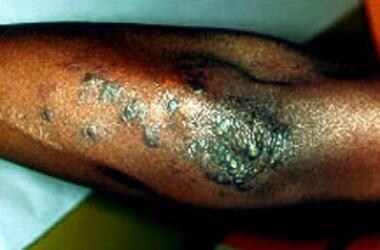 A 40-year-old HIV-positive homosexual man with lichenoid cutaneous plaques on his upper extremities.
Signs and symptoms
Patients with bacillary angiomatosis commonly have a history of HIV infection, organ transplantation, leukemia, or chemotherapy. [1] Inoculation bartonellosis may be evident in immunocompetent individuals as a pyogenic granuloma–like nodule at the site of a cat scratch or at a burn site. [2, 3]
Cutaneous lesions due to bacillary angiomatosis may take one of the following forms:
-
Solitary or multiple red, purple, flesh-colored, or colorless papules (hemangiomalike lesions) varying in size from 1 mm to several centimeters
-
Nodules, often covered with a fine, tightly adherent scale
-
Large, friable, pedunculated, or polypoid exophytic masses
-
Hyperpigmented, hyperkeratotic, indurated plaques, typically on the extremities and often overlying osseous defects
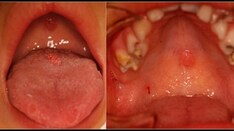
Lesions can also occur in the oral mucosa, tongue, oropharynx, nose, penis, and anus. Bone pain, frequently in the forearms or legs, can also occur.
Visceral involvement associated with bacillary angiomatosis may be asymptomatic or may cause the following symptoms:
-
Fever, chills, malaise, night sweats, anorexia, and weight loss
-
Symptoms of peliosis hepatis: Abdominal pain, nausea, and vomiting
-
Jaundice secondary to biliary obstruction caused by external compression of periportal lymph nodes
-
Intra-abdominal mass and gastrointestinal bleeding
-
Symptoms of colonic bacillary angiomatosis: Abdominal cramps, tenesmus, and bloody diarrhea
-
Symptoms of CNS bacillary angiomatosis: Psychiatric symptoms, such as exacerbation of depression or new-onset psychosis; personality changes, including anxiety and irritability; headache; trigeminal neuralgia; seizures; and back pain
-
Difficulty breathing secondary to laryngeal obstruction
Diagnosis
Lab studies
The diagnosis of cutaneous bacillary angiomatosis and extracutaneous disease is most often based on clinical features coupled with biopsies of lesions. Histology reveals vascular proliferation with the presence of neutrophils adjacent to the blood vessels and masses of bacteria, which can be demonstrated by modified silver staining (Warthin-Starry silver stain). Detection of Bartonella DNA in tissue specimens by polymerase chain reaction (PCR) assay or of Bartonella antigens by immunohistochemical methods is diagnostic. [4]
Imaging studies
Radiography can be used to find bone lesions; chest radiography can reveal pulmonary parenchymal nodules.
Computed tomography (CT) scanning of the brain can detect intracerebral bacillary angiomatosis. CT scanning and magnetic resonance imaging (MRI) can be used in the diagnosis of peliosis hepatis, while chest and abdominal CT scans may reveal mediastinal, retroperitoneal, or mesenteric lymph node enlargement.
Procedures
-
Biopsy: Specimens of skin, subcutaneous or mucosal lesions, or, in cases of peliosis hepatis, the liver are diagnostic
-
Endoscopy: With gastrointestinal involvement, may reveal ulcerated nodules of the mucosa of the stomach, small intestine, or large intestine
-
Bronchoscopy: With lung involvement, may reveal polypoid lesions
Management
Bacillary angiomatosis can be cured in most patients with antibiotics. Clinical experience strongly favors the use of erythromycin or a tetracycline derivative in this disorder.
Cryotherapy, electrodesiccation and curettage, and surgical excision of solitary cutaneous lesions can be useful as adjunctive therapy.
The reader is referred to the 2014 guidelines published by the Infectious Diseases Society of America (IDSA) for the treatment of bacillary angiomatosis (see Practice Guidelines for the Diagnosis and Management of Skin and Soft Tissue Infections: 2014 Update by the Infectious Diseases Society of America). [5]

Background
Bacillary angiomatosis is a vascular, proliferative form of Bartonella infection that occurs primarily in immunocompromised persons. It was first described in 1983 in a patient infected with the human immunodeficiency virus (HIV). [6] The disease has since been described in patients following organ transplantation [1, 7, 8] and in other individuals with a weakened immune system, although it occasionally is reported in immunocompetent patients. [9, 10, 11, 12] Initially, bacillary angiomatosis was called epithelioid angiomatosis, because of its histologic appearance. (See Pathophysiology and Etiology.)
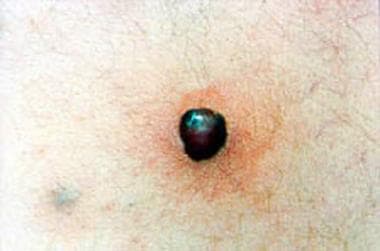 A 35-year-old retrovirus-negative Mexican immigrant who had undergone recent splenectomy for idiopathic thrombocytopenic purpura, with multiple violaceous nodules on his trunk.
In 1990, Relman et al identified a visible but uncultivable bacillus from affected tissues of patients with bacillary angiomatosis. [13] The gram-negative organism was later named Bartonella (formerly Rochalimaea) henselae. A similar bacterium, B quintana, has also been detected in and cultured from lesions caused by bacillary angiomatosis. Bacillary angiomatosis due to Bartonella elizabethae in an individual with HIV infection has been reported in Mexico. [14]
The systemic nature of the disease became evident when postmortem examinations showed nodules in the larynx, gastrointestinal tract, peritoneum, and diaphragm.
Bacillary angiomatosis often responds to therapy with oral erythromycin, although other oral antibiotics and antituberculosis medications, including tetracycline, other macrolides, trimethoprim-sulfamethoxazole, ciprofloxacin, and rifampin, also may be effective. While the disorder is treatable and curable, it may be life threatening if untreated. The disease is the second-most-common cause of angiomatous skin lesions in persons infected with HIV. (See Treatment and Medication.)
Patient education
Immunocompromised patients and their caregivers should be advised to avoid cat contact and to control flea infestations in cats.
Pathophysiology
B henselae and B quintana are small gram-negative rods in the family Bartonellaceae. Bartonella, Rickettsia, Ehrlichia, and Afipia species all are part of the alpha-2 subgroup of the Alphaproteobacteria.
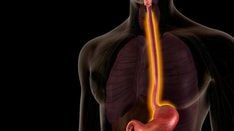
Bacillary angiomatosis can affect almost any organ system, although most commonly it affects skin and subcutaneous tissue. Subcutaneous lesions may erode into underlying bones (ie, osseous bacillary angiomatosis), especially the tibia, fibula, and radius. Involvement of ribs and vertebrae has been described. Rarely, skeletal muscles may be involved, resulting in pyomyositis. Mucous membranes of the conjunctiva, upper airway, and perineum (anus and penis) may also be affected. Bacillary angiomatosis may be accompanied by disseminated visceral disease (peliosis), mainly in the liver (peliosis hepatis), spleen, and lymph nodes.
Other internal organs that may be involved include the following:
-
Brain
-
Bone marrow
-
Heart
-
Lungs
-
Pleura
-
Larynx
-
Oropharynx
-
Tongue
-
Esophagus
-
Stomach
-
Duodenum
-
Colon
-
Peritoneum
-
Diaphragm
-
Kidneys
-
Adrenal glands
-
Pancreas
-
Uterine cervix
-
Vulva [15]
Extrinsic compression of the common bile duct by enlarged peripancreatic, celiac, and portohepatic nodes has been reported.
The pathogenesis of bacillary angiomatosis includes early blood-borne dissemination of organisms. Bartonella organisms readily attach to and may enter erythrocytes. [16] They avoid opsonization and host phagocytosis by unknown mechanisms and become persistent within the intravascular compartment.
An angiogenic factor may be responsible for the vascular proliferation observed in patients with bacillary angiomatosis, because a similar factor mediates vasoproliferation in verruca peruana, the second stage of Bartonella bacilliformis infection. Moreover, deoxyribonucleic acid (DNA) hybridization, 16S ribosomal ribonucleic acid (rRNA) sequence homology, cellular fatty acid profiles, and cytosine and guanine content studies have shown that B henselae and B quintana are closely related to Bartonella bacilliformis. [17]
Infection sites
The specific Bartonella species, B henselae or B quintana, can affect the location of bacillary angiomatosis, as follows:
-
Cutaneous lesions: Result almost equally from B henselae and B quintana infections
-
Subcutaneous lesions: Usually caused by B quintana infection
-
Osseous lesions: Usually caused by B quintana infection
-
Visceral involvement: Almost exclusively caused by B henselae infection
-
Neurologic disorders: Associated more frequently with B quintana infection than with B henselae
Disease reservoirs
Domestic cats (Felis domesticus) are the reservoirs of B henselae, which may be transmitted via cat bites or scratches or, potentially, by bites from cat fleas (Ctenocephalides felis). Kittens are more frequently associated with transmission of B henselae than are older cats. Humans appear to be the only reservoir of B quintana; the human body louse, Pediculus humanus, is the transmission vector.
Etiology
Risk factors for bacillary angiomatosis include the following:
-
Chronic lymphocytic leukemia
-
Cytotoxic chemotherapy
Additional risk factors for bacillary angiomatosis associated with B henselae infection include the following:
-
Cat ownership
-
Cat bites
-
Cat scratches
Additional risk factors for bacillary angiomatosis associated with B quintana infection include the following:
-
Homelessness
-
Low socioeconomic status
-
Exposure to body and hair lice
Other considerations
Bacillary angiomatosis was reported in a patient who was HIV-seronegative but had idiopathic thrombocytopenic purpura, had undergone splenectomy, and had been administered long-term systemic prednisone. [20] Although not taken from the same patient, see the image below.
A 35-year-old retrovirus-negative Mexican immigrant who had undergone recent splenectomy for idiopathic thrombocytopenic purpura, with multiple violaceous nodules on his trunk.
Another report described an immunocompetent child with infected facial wound, in the vicinity of which bacillary angiomatosis lesions had developed. Similar lesions also appeared at the donor site of the skin graft, which was grafted on the facial wound. [9] A case of bacillary angiomatosis presenting as a pyogenic granuloma of the hand in an otherwise apparently healthy man recently was reported from Saudi Arabia. [21]
Multiple leg ulcers caused by bacillary angiomatosis without a history of direct contact with cats in an adult immunocompetent man has also been reported. [22]
A case of bacillary angiomatosis in an HIV-negative patient who had chronic hepatitis B but no other immunosuppressive status was reported from Turkey, suggesting that immunologic differences secondary to chronic hepatitis B could have led to an increased risk for the disease. [23] Bacillary angiomatosis may be triggered by trauma and skin burns immunocompetent individuals. [24, 25]
Epidemiology
Occurrence in the United States
The exact incidence of bacillary angiomatosis is not known, but the disease has been reported in almost all states. Reports have been especially high in Florida, Texas, New York, and northern California (San Francisco area), each of which has a high frequency of HIV infection.
International occurrence
Bacillary angiomatosis is less commonly reported in Europe than in North America, which may imply that diagnoses are missed or that Europe has a minimal reservoir of bacilli. Cases also have been reported in Africa, Peru, Argentina, Brazil, [26, 27] Turkey, [23] Saudi Arabia, [21] and Australia. [28] In 2008, Thailand reported its first case of bacillary angiomatosis associated with B henselae. [29]
An analysis of 605 healthy people in southern Spain found 13.55% IgG seropositive to B. henselae and to 11.07% B. quintana, delineating an elevated prevalence of both in this region. [30]
Race-, sex-, and age-related demographics
Approximately 40% of US patients with bacillary angiomatosis are white, 40% are Black, and 20% are of Hispanic origin.
Approximately 90% of US patients with bacillary angiomatosis are men, probably because a disproportionate number of patients infected with HIV also are men.
A wide age range exists among patients with bacillary angiomatosis, from infancy to old age. The age range was 26-52 years in one early series of patients with acquired immunodeficiency syndrome (AIDS). Although bacillary angiomatosis is extremely rare in children, it was reported in a boy aged 12 years with acute leukemia who was undergoing chemotherapy and in a 6-year-old immunocompetent girl.
Prognosis
The prognosis of bacillary angiomatosis is excellent; antibiotics are curative in most patients, with lesions resolving completely after treatment. Hyperpigmentation or slight induration at the site of a lesion may persist indefinitely. Relapses can occur after cessation of therapy and are common in immunocompromised hosts.
Overall prognosis depends on early detection and treatment and on the degree of immunosuppression. Treatment may be more difficult and requires a longer duration of therapy if the diagnosis is delayed. Untreated bacillary angiomatosis may be progressive and life threatening.
Complications
Bacillary angiomatosis may cause disease of many different organs, including the heart, brain, liver, and spleen, if not treated promptly. Complications include the following:
-
Disfigurement
-
Biliary obstruction and jaundice
-
Gastrointestinal bleeding
-
Encephalopathy
-
Laryngeal obstruction and asphyxiation
-
A 35-year-old retrovirus-negative Mexican immigrant who had undergone recent splenectomy for idiopathic thrombocytopenic purpura, with multiple violaceous nodules on his trunk.
-
Many blood vessels of varying dimensions lined by swollen endothelial cells that contain bacilli. An infiltrate of acute and chronic inflammatory cells as well as fibrin deposition is noted in places (hematoxylin and eosin, X80).
-
A 40-year-old HIV-positive homosexual man with lichenoid cutaneous plaques on his upper extremities.
-
Lesion showing large masses of blood vessels of markedly varying dimensions lined by swollen endothelial cells. The tissue is friable with evident fragmentation during processing (hematoxylin and eosin, X23).