Continually Updated Clinical Reference
 
 
  All Sources     eMedicine     Medscape     Drug Reference     MEDLINE
 
eMedicine - Testicular Seminoma : Article by

Quick Find
Authors & Editors
Introduction
Clinical
Differentials
Workup
Treatment
Medication
Follow-up
Miscellaneous
Multimedia
References

Related Articles
Epididymitis

Hydrocele

Testicular Choriocarcinoma

Testicular Trauma

Testicular Tumors: Nonseminomatous


Patient Education
Men's Health Center

Cancer and Tumors Center

Cancer of the Testicle Overview

Cancer of the Testicle Causes

Cancer of the Testicle Symptoms

Cancer of the Testicle Treatment

Testicular Self-Exam Introduction


Author: John W Davis, MD, Associate Program Director, Department of Urology, Assistant Professor, Virginia Prostate Center, Eastern Virginia Medical School, Sentara Healt

John W Davis is a member of the following medical societies: American College of Surgeons and American Urological Association

Coauthor(s): Paul Schellhammer, MD, Chairman, Program Director, Professor, Department of Urology, Eastern Virginia Medical School

Editors: Gamal Mostafa Ghoniem, MD, FACS, Fellowship Program Director, Clinical Professor of Surgery, Head, Section of Voiding Dysfunction, Female Urology and Reconstruction, Cleveland Clinic Florida; Francisco Talavera, PharmD, PhD, Senior Pharmacy Editor, eMedicine; Dan Theodorescu, MD, PhD, Paul Mellon Professor of Urologic Oncology, Department of Urology, University of Virginia Health Sciences Center; J Stuart Wolf, Jr, MD, FACS, David A Bloom Professor of Urology, Director, Division of Minimally Invasive Urology, Department of Urology, University of Michigan Medical Center; Stephen W Leslie, MD, FACS, Founder and Medical Director of the Lorain Kidney Stone Research Center, Clinical Assistant Professor, Department of Urology, Medical College of Ohio

Author and Editor Disclosure

Synonyms and related keywords: testis cancer, cancer of the testes, testis germ cell carcinoma, testicular cancer, seminoma, germ cell tumor, GCT, radical orchiectomy, germ cell carcinoma in situ, germ cell CIS

Background

The study of germ cell tumors (GCTs) of the testicle is a unique area of urologic oncology because treatment algorithms have benefited from numerous randomized prospective clinical trials (unlike prostate cancer) and because metastatic disease is highly responsive to multimodal treatment (unlike renal cell carcinoma). Seminoma is a histologic subtype of GCTs, which are discussed separately as nonseminomas in Germ Cell Tumors.

Interest in GCTs is out of proportion to its incidence because of its fascinating pathologic subtypes, success of multimodal therapy (even for metastatic disease), and almost universal incidence in otherwise healthy males aged 15-35 years. Testicular GCTs have a variety of pathologic subtypes, including seminoma, embryonal, yolk sac, teratoma, and choriocarcinoma. The most important clinical distinction is between seminoma and nonseminoma, 2 broad categories with different treatment algorithms: (1) seminoma as a classification refers to pure seminoma upon histopathologic review, and (2) any nonseminomatous elements (even if seminoma is prevalent) change the classification to nonseminoma.

Pathophysiology

After a radical orchiectomy, testicular seminoma is a pathologic diagnosis in which only seminomatous elements are observed upon histopathologic review and in which serum alpha-fetoprotein (AFP) is within the reference range. Any elevation of AFP or nonseminomatous elements in the testis specimen mandates diagnosis of nonseminomatous GCT (NSGCT) and an appropriate change in treatment.

GCTs have the following subtypes and frequencies: seminoma (40%), embryonal (25%), teratocarcinoma (25%), teratoma (5%), and choriocarcinoma (pure) (1%).

Germ cell carcinoma in situ (CIS) is a premalignant condition with a natural history of progression to seminoma or embryonal cancer. Patients with infertility, intersex disorders, cryptorchidism, prior contralateral GCTs, or atrophic testes more commonly have CIS. Histologically, it demonstrates intratubular atypical germ cells within seminiferous tubules. Most patients with seminomas (except spermatocytic seminoma) and NSGCTs have CIS or severe atypia associated with the primary tumor. In patients with GCTs, 5% of those with contralateral testes harbor CIS. Testicular microcalcifications observed on scrotal ultrasonographic studies may suggest CIS.

Frequency

United States

Testicular GCTs are rare, occurring in only 1-2% of all male malignancies and occurring in 1 of 250 men by age 65 years; however, GCT is the most common malignancy in men aged 15-35 years. Incidence rates are 3.7 and 0.9 cases per 100,000 persons per year for whites and blacks, respectively.

International

Incidence of testis cancer has increased from the early 1960s to the mid 1980s. Nonwhite populations have a lower incidence than white populations. The highest rates are in Denmark (8.4 cases per 100,000 persons per y) and Switzerland (6.2-8.8 cases per 100,000 persons per y), and rates vary across Europe.

Race

Established data sets have consistently demonstrated a higher incidence of GCTs among whites compared with African Americans—as high as a 5:1 ratio. Recently, McGlynn et al published an analysis of 9 registries of the Surveillance, Epidemiology, and End Results (SEER) database from 1973-2001. They found an increasing incidence among African Americans starting in the 1990s. The increased incidence was 100% for GCTs overall—124% for seminoma and 64% for nonseminoma. The reasons for this increase are unclear, and the author's review of the data suggests environmental or nonperinatal factors (occupation, physical activity, diet) rather than early screening as the predominant cause.


History

  • Common presentation
    • Typically, a male aged 15-35 years presents with a painless lump he has had on his testicle for several days to months.
    • Delay in diagnosis is common because of (1) a patient's failure to perform self-examinations, (2) a patient's failure to alert the physician about the mass, or (3) a physician's delay while treating the patient for presumed epididymoorchitis or testicular trauma.
    • Patients commonly have abnormal findings on semen analysis at presentation, and they may be subfertile.
    • Patients may present with a hydrocele, and scrotal ultrasonography may identify a nonpalpable testis tumor. The presence of a hydrocele complicates manual examination and identification of a testicular lump, nodule, or mass.
    • Overall, in approximately 75% of patients, the seminomas are localized (stage I) at diagnosis. However, 15% have metastatic disease to the regional lymph nodes, and 5-10% have involvement of juxtaregional nodes or visceral metastases.
  • Uncommon presentation
    • Testicular pain, possibly with an acute onset, especially when associated with a hydrocele, prevents adequate physical examination.
    • A testis tumor may become metastatic and manifest with large retroperitoneal and/or chest lesions, while the primary tumor is nonpalpable. Scrotal ultrasonography may locate the primary tumor. Histopathology of the primary testis often shows a focus of tumor surrounded by fibrous scar, termed burned-out testis cancer.
    • In 1996, Miller and associates reported a series of patients with previous nonpalpable testes that were explored and incorrectly diagnosed as vanished testes. A subsequent seminoma was diagnosed intra-abdominally.

Causes

  • Patients with history of cryptorchidism have a 10- to 40-times increased risk of testis cancer; 10% of patients with GCTs have a history of cryptorchidism (see Image 1).
    • Risk is greater for the abdominal versus inguinal location of undescended testis.
    • An abdominal testis is more likely to be seminoma, while a testis surgically brought to the scrotum by orchiopexy is more likely to be NSGCT.
  • Orchiopexy allows for earlier detection by physical examination but does not alter the risk of GCT.
  • Genetic changes in the form of amplifications and deletions are observed mainly in the 12p11.2-p12.1 chromosomal regions.
    • A gain of 12p sequences is associated with invasive growth of both seminomas and NSGCTs.
    • In contrast, spermatocytic seminoma shows a gain of chromosome 9, while most infantile yolk sac tumors and teratomas show no chromosomal changes.
  • Other risks include trauma, mumps, and maternal estrogen exposure.


Epididymitis
Hydrocele
Testicular Choriocarcinoma
Testicular Trauma
Testicular Tumors: Nonseminomatous

Other Problems to be Considered

Testicular teratocarcinoma


Lab Studies

  • Yolk sac elements secrete AFP; an elevated level rules out pure seminoma, despite possible contrary histopathologic findings at orchiectomy.
  • Lactate dehydrogenase (LDH) is a less-specific marker for GCTs, but levels can correlate with overall tumor burden.
  • Measure beta-human chorionic gonadotropin (bhCG).
    • bHCG is a glycoprotein with the same alpha unit as thyroid-stimulating hormone, follicle-stimulating hormone, and luteinizing hormone.
    • It has a 24-hour half-life and is secreted by syncytiotrophoblast cells within GCTs.
    • In 5-10% of patients with seminomas, bHCG is elevated. Its elevation may correlate with metastatic disease but not with overall survival.
    • If bHCG levels do not normalize after orchiectomy, Richie suggests in a 1998 publication to treat patients as if they have NSGCT, citing a study where one third of patients dying of metastatic seminoma were found to have nonseminomatous elements at autopsy. With the 10% incidence of pure seminomas producing bHCG, NSGCT chemotherapy regimens may better serve these patients.
  • Placentalike alkaline phosphatase levels can be elevated in patients with seminoma, especially as the tumor burden increases; it may also increase with smoking.

Imaging Studies

  • Scrotal ultrasonography
    • Consider this study for any male with a suspicious or questionable testicular mass that is palpable upon physical examination (see Image 2).
    • Other indications may include acute scrotal pain (especially when associated with a hydrocele), nonspecific scrotal pain, swelling, or the presence of a mass.
    • If an asymptomatic hydrocele obscures physical examination of the testicle, this study may be appropriate prior to surgical intervention. It may also be appropriate for males who are at the peak age range for testicular cancer (ie, 15-35 y).
    • Scrotal ultrasonography commonly shows a homogeneous hypoechoic intratesticular mass. Larger lesions may be more inhomogeneous.
    • Calcifications and cystic areas are less common in seminomas than in nonseminomatous tumors.
  • CT scanning of the abdomen and pelvis with IV and oral contrast can be used to identify metastatic disease to the retroperitoneal lymph nodes; however, CT scanning results in understaging in approximately 15-20% of patients thought to be at stage I.
  • Chest CT scanning is indicated only when abnormal findings are observed on a chest radiograph.

Histologic Findings

Seminomas can have 3 histologic variants.

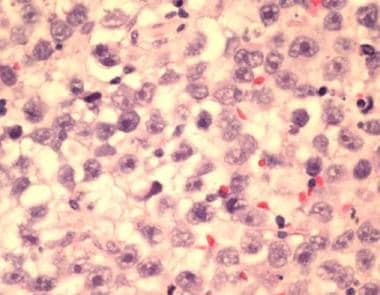
The first is classic seminoma, and it has a uniform population of large cells that form sheets and nests separated by delicate connective tissue (see Images 3-4). Leukocytic infiltration (20%), multinucleated cells, syncytiotrophoblasts (7-35%), and microcalcifications (60%) may be present. Upon gross examination, the tumor has a uniform yellow color and bulges from the cut surface. Classic seminoma is the most common histologic type.

The second is anaplastic seminoma, and it is observed in 5-15% of patients with seminomas. Histopathology is as described for classic seminoma but with increased mitotic figures. Patients tend to present at more advanced stages than those with classic seminoma, but stage prognosis is similar.

The third is spermatocytic seminoma, and it is a rare variant that occurs in older adults. Histopathology shows tumor cells arranged in solid sheets, containing poorly developed inconspicuous septae without leukocytic infiltrate. No glycogen is present. Small, medium, and large cell types are observed. Orchiectomy alone is sufficient treatment; metastases are rare.

Staging

American Joint Committee on Cancer and the International Union Against Cancer: Testicular Cancer Staging System

Table 1. Primary Tumor (T)

pTx Primary tumor cannot be assessed
p0 No evidence of primary tumor
pTis Intratubular germ cell neoplasia
pT1 Tumor limited to the testis and epididymis
No vascular/lymphatic invasion
May invade the tunica albuginea
No invasion of the tunica vaginalis
pT2 Tumor limited to the testis and epididymis
Vascular/lymphatic invasion or tumor extending through the tunica albuginea with involvement of the tunica vaginalis
Invades beyond the tunica albuginea or into the epididymis
pT3 Tumor invades the spermatic cord with or without vascular/lymphatic invasion
pT4 Tumor invades the scrotum with or without vascular/lymphatic invasion

Table 2A. Regional Lymph Nodes (N): Clinical

Nx Nodes not assessed
N0 No regional lymph node metastasis
N1 Lymph node mass or multiple lymph node masses £2 cm in greatest dimension
N2 Lymph node mass or multiple lymph node masses > 2 cm but £5 cm in greatest dimension
N3 Lymph node mass > 5 cm in greatest dimension

Table 2B. Regional Lymph Nodes (N): Pathologic

pN0 No evidence of tumor in lymph nodes
pN1 Lymph node mass £2 cm in greatest dimension
£5 nodes positive
pN2 Lymph node mass > 2 cm but <5 cm in greatest dimension
>5 nodes positive
Evidence of extranodal extension of tumor
pN3 Lymph node mass > 5 cm in greatest dimension

Table 3. Distant Metastases (M)

M0 No evidence of distant metastases
M1a Nonregional nodal or pulmonary metastases
M2b Nonpulmonary visceral metastases

Table 4. Serum Tumor Markers (S)

S LDH hCG† (mIU/mL) AFP (ng/mL)
Sx Not assessed Not assessed Not assessed
S0 £N and Normal and Normal
S1 <1.5 x N and <5,000 and <1,000
S2 1.5-10 x N or 5,000-50,000 or 1,000-10,000
S3 >10 x N or >50,000 or >10,000

N = upper limit of normal for the LDH assay

†HCG = human chorionic gonadotropin

Table 5. Stage Grouping

Stage grouping T N M S
Stage 0 pTis N0 M0 S0
Stage I T1-T4 N0 M0 Sx
Stage IA T1 N0 M0 S0
Stage IB T2-4 N0 M0 S0
Stage IS Any T N0 M0 S1-S3
Stage II Any T Any N M0 Sx
Stage IIA Any T N1 M0 S0-S1
Stage IIB Any T N2 M0 S0-S1
Stage IIC Any T N3 M0 S0-S1
Stage III Any T Any N M1 Sx
Stage IIIA Any T Any N M1a S0-S1
Stage IIIB Any T Any N M0-M1a S2
Stage IIIC Any T Any N M0-M1a S3
Any T Any N M1b Any S

Additional staging systems are well discussed by Prow in a 1998 publication.


Medical Care

  • External beam radiation therapy for stage I and nonbulky stage II disease
    • Refer patients with stage I and nonbulky stage II seminomas for external beam radiation therapy. Over a 3-week period, administer 2500 cGy in a hockey-stick field, including the para-aortic, paracaval, bilateral common iliac, and external iliac nodal regions. Recent protocols are reducing the radiation field to the para-aortic area only.
    • A 2005 randomized trial from the Medical Research Council compared adjuvant radiotherapy at 30 Gy versus 20 Gy for stage I seminoma. The lower dose had equivalent associated relapse rates and reduced morbidity, especially regarding fatigue. Further follow-up was recommended to determine if associated long-term secondary malignancies develop (Jones, 2005).
    • Mediastinal radiation was commonly administered but is currently avoided because chemotherapy is more effective. Mediastinal radiation may also diminish the ability to provide salvage chemotherapy later, if needed.
    • Only 3% of patients relapse after radiation therapy. Relapses are usually located outside the radiation therapy field.
    • Short-term adverse effects include fatigue, nausea, vomiting, and GI upset.
    • Long-term adverse effects are debatable; for example, in 1994, van Rooy and Sagerman reported 104 patients with no late complications, but in 1998, Bauman reported 6% developing late toxicity.
    • Secondary malignancies are rarely reported. Observation protocols help avoid these uncommon malignancies.
    • As an alternative to radiotherapy, single-agent carboplatin protocols are being studied. The Medical Research Council compared adjuvant carboplatin with radiotherapy and found equivalent relapse rates after a median follow-up period of 4 years. Long-term success of carboplatin therapy is unknown so should be considered experimental at this time (Oliver, 2005).
  • Chemotherapy for stage II bulky or stage III disease
    • After radical orchiectomy (see Surgical Care) and metastatic workup, administer 4 cycles of chemotherapy without radiation therapy in those patients with advanced seminoma (stage IIB bulky or stage III).
    • Clinical trials have evaluated numerous chemotherapeutic regimens. While the optimal regimen is debatable, 4 cycles of bleomycin, etoposide, and cisplatin (BEP) is standard.
    • Ongoing clinical trials are evaluating the omission of the fourth cycle, or bleomycin, in good-risk patients.
    • For poor-risk and salvage cases, physicians may use alternative regimens using ifosfamide and vinblastine with dose escalation.

Surgical Care

  • Relevant anatomy
    • Seminoma arises from abnormal germ cells in the seminiferous tubules. The TNM staging system (see Staging) stages the tumor by its local, regional, and distant invasion.
    • Testicular lymphatics relate to the embryonic origin of the testis. The male gonad initially forms near the kidney and descends through the inguinal canal to the scrotal sac. The right gonadal vein derives from the inferior cava, while the left gonadal vein derives from the left renal vein. Additional blood supply derives from the artery of the vas and the cremasteric arteries. Testicular lymphatics follow the vessels of the spermatic cord through the inguinal canal and into the retroperitoneum. Testicular cancer spreads predominantly and initially through lymphatic routes. On the right, the cancer landing zone is between the aorta and the inferior vena cava; on the left, it is on top of and lateral to the aorta.
    • Scrotal skin lymphatics are different from testicular lymphatics and drain into the inguinal nodes. Perform all orchiectomies for solid masses through an inguinal route to avoid tumor spill into the inguinal drainage basin. If a patient undergoes scrotal exploration, subsequent therapy may necessitate hemiscrotectomy and radiation treatment of the inguinal nodes.
    • In patients with prior herniorrhaphy, orchiopexy, or other alteration in lymphatic drainage, extend their radiation field to include the contralateral inguinal region with contralateral testis shielding.
  • Radical inguinal orchiectomy
    • Preoperative details
      • Draw serum tumor markers preoperatively because values fall rapidly after orchiectomy. Other staging tests can be performed preoperatively or postoperatively.
      • Because of the rapid doubling time of a potential choriocarcinoma, schedule surgery for testis tumors rapidly to avoid upstaging.
      • Most patients with seminoma are young and healthy and require only routine preoperative preparation.
      • Discuss semen donation for subsequent fertility if the contralateral testis function is in question; however, many patients have poor semen quality that improves after orchiectomy.
      • Cosmetic testicular prostheses are not widely available because of the recent problems with silicone implants used primarily in breast augmentation; however, Mentor Urology is conducting trials for saline testis implants.
      • If a patient presents with symptomatic metastatic lesions from a testis tumor, proceed with platinum-based chemotherapy and delay radical orchiectomy. Radical orchiectomy is not a morbid procedure, but it may potentially delay initiation of chemotherapy.
      • Differentiation of seminoma versus NSGCT for advanced disease is not important at the outset of treatment because both groups receive the same regimen.
      • Although chemotherapy may result in disappearance of the testicular mass, orchiectomy is always indicated.
    • Intraoperative details
      • Patients may be administered spinal, general, or (uncommonly) local anesthesia. Shave the inguinal area, and prep in a standard fashion.
      • Create an inguinal incision to allow exposure of the external and internal iliac canal.
      • Open the external iliac fascia, exposing the spermatic cord and internal iliac canal. Control the spermatic cord with a Penrose drain in a tourniquet fashion to stop retroperitoneal lymphatic and venous drainage of tumor cells.
      • Then, deliver the testis from the scrotum and ligate separately the vas deferens and spermatic arteries.
      • Leave a long nonabsorbable tie on the patient side of the spermatic cord. This is to facilitate identification if retroperitoneal lymph node dissection (RPLND) becomes necessary and the patient requires dissection of the remaining spermatic cord structures from the abdominal exposure.
      • Reapproximate the external oblique fascia and close the skin in standard fashion.
    • Postoperative details
      • Radical orchiectomy is usually performed on an outpatient or 23-hour admission basis, often accompanied by the staging workup.
      • Conduct a follow-up study on the patient by staging and referring him for appropriate adjuvant therapies.
    • Complications rarely are a problem but may include wound infection, inguinal skin numbness from injury to the genitofemoral nerve, hematoma, and standard anesthetic risks.

Consultations

  • Low-stage disease - Radiation oncologist for external beam radiation therapy
  • Advanced disease - Medical oncologist for platinum-based chemotherapy


BEP is the most common chemotherapy regimen administered for GCTs. It is usually administered in 4 cycles. Additional agents involved in primary, high-risk, and salvage protocols may include ifosfamide and vinblastine.

Drug Category: Antineoplastic agents

These agents inhibit deregulated growth of cells.

Drug NameBleomycin (Blenoxane)
DescriptionComposed of cytotoxic glycopeptide antibiotics, which appear to inhibit DNA synthesis with some evidence of RNA and protein synthesis inhibition to a lesser degree; used in the management of several neoplasms as a palliative measure.
Adult Dose30 U (0.25-0.5 U/kg) IV on days 1, 9, and 16
Pediatric DoseNot established
ContraindicationsDocumented hypersensitivity; significant renal function impairment; compromised pulmonary function
InteractionsMay decrease plasma levels of digoxin and phenytoin; cisplatin may increase toxicity
PregnancyD - Unsafe in pregnancy
PrecautionsCaution in renal impairment; possibly secreted in breast milk; may cause mutagenesis and pulmonary toxicity (10%); idiosyncratic reactions similar to anaphylaxis (1%) may occur; monitor for adverse effects during and after treatment

Drug NameEtoposide (VP-16)
DescriptionArrests cells in the G2 portion of the cell cycle and induces DNA strand breaks by interacting with DNA topoisomerase II and forming free radicals.
Adult Dose100 mg/m2 IV on days 1-5
Pediatric DoseNot established
ContraindicationsDocumented hypersensitivity; IT administration, may cause death
InteractionsMay prolong effects of warfarin and increase clearance of methotrexate; cyclosporine and etoposide have additive effects in cytotoxicity of tumor cells
PregnancyD - Unsafe in pregnancy
PrecautionsBleeding and severe myelosuppression may occur

Drug NameCisplatin (Platinol, Platinol-AQ)
DescriptionInorganic metal complex thought to act analogously to alkylating agents; inhibits DNA synthesis and thus cell proliferation by causing DNA crosslinks and denaturation of double helix.
Adult Dose20 mg/m2 IV on days 1-5 and repeat q3-4wk
Pediatric DoseNot established
ContraindicationsDocumented hypersensitivity; preexisting renal insufficiency; myelosuppression; hearing impairment
InteractionsIncreases toxicity of bleomycin and ethacrynic acid
PregnancyD - Unsafe in pregnancy
PrecautionsAdminister adequate hydration before and 24 h after dosing to reduce risk of nephrotoxicity; myelosuppression, ototoxicity, nausea, and vomiting may occur

Drug NameIfosfamide (Ifex)
DescriptionRelated to nitrogen mustards and is a synthetic analog of cyclophosphamide; inhibits DNA and protein synthesis and thus cell proliferation by causing DNA cross-linking and denaturation of double helix.
Adult Dose1.2 g/m2/d IV on days 1-5
Pediatric DoseNot established
ContraindicationsDocumented hypersensitivity; depressed bone marrow function
InteractionsPhenobarbital, phenytoin, chloral hydrate, and other drugs that interfere with cytochrome P450 activity may alter effects
PregnancyD - Unsafe in pregnancy
PrecautionsMay cause hemorrhagic cystitis and severe myelosuppression; caution in renal function impairment or compromised bone marrow reserve

Drug NameVinblastine (Alkaban-AQ, Velban)
DescriptionInhibits microtubule formation, which in turn, disrupts the formation of mitotic spindle, causing cell proliferation to arrest at metaphase.
Adult Dose4-20 mg/m2 (0.1-0.5 mg/kg) IV q7-10d or 5 d continuous infusion of 1.4-1.8 mg/m2/d or 0.1-0.5 mg/kg/wk
Pediatric DoseNot established
ContraindicationsDocumented hypersensitivity; severe bone marrow suppression; granulocytopenia; bacterial infections
InteractionsPhenytoin plasma levels may be reduced when coadministered; toxicity may significantly increase with mitomycin
PregnancyD - Unsafe in pregnancy
PrecautionsCaution in patients diagnosed with impaired liver function and neurotoxicity; when patient is receiving mitomycin C, monitor closely for shortness of breath and bronchospasm


Prognosis

  • Mortality rates increased until the 1970s but have since declined greatly as a result of advances in treatment.
  • All stages have at least a 90% cure rate.
    • Stage I is 98-100%.
    • Stage II (B1/B2 nonbulky) is 98-100%.
    • Stage II (B3 bulky) and stage III have a 90% complete response to chemotherapy and an 86% durable response rate to chemotherapy.
  • Second cancers and cardiac disease among long-term survivors
    • Secondary cancers among patients testicular cancer are increased as a result of their young age at diagnosis, high cure rate, and exposure to radiation, chemotherapy, or both. Travis et al reported on a cohort of 14 population-based tumor registries in Europe and North America totaling 40,576 patients. A plethora of statistics is provided. Their key findings were that survivors of testicular cancer are at a significantly increased risk of solid tumors for at least 35 years after treatment. Tumors included malignant mesothelioma and those of the lung, colon, bladder, pancreas, and stomach. The relative risk increases were the same for seminoma, nonseminoma, and treatment with radiation, chemotherapy, or both. For patients diagnosed with seminoma at age 35 years, the cumulative risk 40 years later was 36%, compared with 23% for the general population.
    • Zagars et al reported on long-term follow-up involving 477 men with lowp-stage seminoma treated with orchiectomy and adjuvant radiation at a single institution. They compared long-term cancer-specific survival with cardiac-specific survival and performed a risk analysis in relation to standard US data for males. No differences were seen in the first 15 years, but, after 15 years, the relative risks of cardiac and secondary cancer deaths were increased.
    • In summary, these two long-term follow-up studies demonstrate that, although many men with seminoma are cured, they require counseling and long-term follow-up to minimize the risk of excess mortality from secondary cancers and cardiac disease.

Patient Education


Medical/Legal Pitfalls

  • Failure to select patients well and to ensure patient compliance with the protocol for follow-up CT scanning and tumor marker assessment for those patients with low-stage disease who elect the observation protocol instead of adjuvant radiation therapy
  • Losing patients to follow-up studies and undetected recurrent disease
  • Failure to consider the issue of fertility in patients with advanced disease who need chemotherapy
  • Failure to carefully discuss the effects of chemotherapy on future fertility and to discuss options for banking healthy sperm before chemotherapy

Special Concerns

  • Contralateral testis biopsy
    • In a 1996 publication, Daugaard and associates argued that a biopsy should be obtained from the contralateral testis at the time of orchiectomy. Because 5% of contralateral testes in men with GCT harbor CIS, nearly all of which eventually progress to invasive GCT, early diagnosis and treatment with surgery or radiation is recommended.
    • In their 1997 report, however, Herr and Sheinfeld argue that biopsy is unnecessary because 95% of patients have a normal contralateral testis and the 5% who have an abnormal contralateral testis can be effectively treated at a later time. They recommend patient education and close follow-up studies, which is the common practice in the United States.
  • Surveillance for stage I seminoma
    • Because cure rates are excellent for advanced disease and because only 25% of patients with stage I disease harbor occult metastatic disease, some interest lies in observing patients with stage I disease. Surveillance is appropriate only for well-motivated and compliant patients who adhere to strict follow-up imaging studies. Restricting surveillance to clinical trials may be reasonable until more outcome evidence is available.
    • Problems with surveillance in seminoma include (1) the fact that no chemical markers are available to monitor (in contrast to NSGCT) and (2) the need for a longer follow-up time (compared to NSGCT); radiation treatment failures are observed 2-10 years later.
    • The following are 2 prominent reports on outcomes of surveillance.
      • In 1997, Warde and associates reported on 201 patients with stage I seminoma placed on surveillance. The 5-year actuarial relapse-free survival rate was 85%, the actuarial survival rate was 97%, and the cause-specific survival rate was 99.5%.
      • In 1994, Miki and associates reported a group of 27 patients who underwent radiation therapy, and one had failure in the lung. In a study of patients who did not receive radiation therapy, 5 of 41 had recurrence. However, all 5 patients with relapses were alive and had no disease following chemotherapy.
  • Recurrent mass after chemotherapy for seminoma
    • Chemotherapy for seminoma causes a fibrotic reaction in the retroperitoneum that is similar to retroperitoneal fibrosis; thus, postchemotherapy RPLND for seminoma is a difficult and potentially morbid procedure compared to the excellent results of postchemotherapy RPLND for NSGCT.
    • In 1987, Motzer and associates showed that residual masses larger than 3 cm had a 50% chance of harboring a tumor and recommended this cutoff for RPLND. Because this procedure is very difficult, they recommended referral to centers with experienced personnel.
    • In a 1997 report on a series of patients with residual masses treated with radiation therapy, Duchesne and associates reported that only 2.3% benefited from treatment.
    • Positron emission tomography (PET) scan using fluorine-18 2-fluoro-2-deoxy-D-glucose (FDG-PET) has emerged as a diagnostic tool to evaluate recurrent retroperitoneal masses after chemotherapy. In a study by De Santis et al, FDG-PET scans correctly predicted residual tumor in 19 of 19 cases residual masses larger than 3 cm. In cases of residual masses smaller than 3 cm, 35 of 37 cases were correctly predicted. Overall performance was specificity, 100%; sensitivity, 80%; positive predictive value, 100%; and negative predictive value, 96%. The results of this study support using PET rather than the 3-cm rule for deciding between subsequent salvage therapy and surveillance.
  • Follow-up protocols are available on the National Comprehensive Cancer Network Web site. Surveillance is lifelong and includes the following:
    • Stage I
      • Orchiectomy plus adjuvant radiation
      • History and physical examination and serum tumor markers (bhCG, LDH, AFP) every 3-4 months the first year, every 6 months the second year, then annually thereafter
      • Imaging: Chest radiography each visit; CT scan of the pelvis annually for 3 years if status post para-aortic radiotherapy
    • Stage II
      • Orchiectomy plus surveillance
      • History and physical examination and serum tumor markers every 3-4 months years 1-3, every 6 months years 4-7, and then annually thereafter
      • Imaging: Radiotherapy at alternate visits for up to 10 years; CT scan of the abdomen and pelvis each visit
    • Stage IIa/b
      • Orchiectomy plus radiotherapy
      • History and physical examination and serum tumor markers every 3-4 months years 1-3, every 6 months year 4, and then annually thereafter
      • Imaging: radiotherapy each visit; CT scan of the abdomen and pelvis during month 4 of the first year
    • Stage IIc, III
      • Orchiectomy plus chemotherapy
      • History and physical examination and serum tumor markers every 2 months the first year, every 3 months the second year, every 4 months the third year, every 6 months the fourth year, and then annually thereafter
      • Imaging: Chest radiography each visit; CT scan of the abdomen and pelvis during month 4 of the first year status post surgery (otherwise, every 3 mo until stable); PET scan as clinically indicated


Media file 1:  Testicular seminoma. A 57-year-old man presents with abdominal pain of slow onset. CT scanning shows a large 25-cm retroperitoneal lesion encompassing the aorta and renal vasculature and displacing the right kidney laterally. The patient had a history of cryptorchidism repaired at age 8 years. Testes were normal and descended; however, ultrasonography showed a small 5-mm lesion on the right testis, which proved to be pure seminoma at orchiectomy. Beta-human chorionic gonadotropin was 70 (reference range <5), and alpha-fetoprotein was within the reference range; no metastatic lesions were observed above the diaphragm, indicating stage IIb (bulky), T1N3M0. The patient was referred for 4 cycles of cisplatin-based chemotherapy.
Click to see larger pictureClick to see detailView Full Size Image
Media type:  CT

Media file 2:  Testicular seminoma. This scrotal ultrasound of a 37-year-old man with a painless mass in his right testis shows a right testis with hypoechoic solid masses compared to the homogeneous, more hyperechoic, healthy left testis. Serum beta-human chorionic gonadotropin and alpha-fetoprotein were within the reference range, and the metastatic workup was negative. Histopathology showed a pure seminoma. Metastatic workup showed no nodal or distant spread, T1N0M0 stage I. After orchiectomy, the patient underwent adjuvant external beam radiation therapy to the para-aortic nodes. At a 3-year follow-up study, the patient is disease free and has a greater than 95% chance of remaining disease free.
Click to see larger pictureClick to see detailView Full Size Image
Media type:  Image

Media file 3:  Testicular seminoma. This is a classic seminoma at low power. Uniform tumor cells are observed with mild inflammatory response (lymphocytes). Other seminoma findings not seen could include a fibrovascular stroma, syncytiotrophoblastic cells, and multinucleated histiocytes.
Click to see larger pictureClick to see detailView Full Size Image
Media type:  Photo

Media file 4:  This is a classic testicular seminoma, high-power view, from a 37-year-old man with a painless mass in his right testis. Serum beta-human chorionic gonadotropin and alpha-fetoprotein were within the reference range, and the metastatic workup was negative. Histopathology showed a pure seminoma. Metastatic workup showed no nodal or distant spread, T1N0M0 stage I. After orchiectomy, the patient underwent adjuvant external beam radiation therapy to the para-aortic nodes. At a 3-year follow-up study, the patient is disease free and has a greater than 95% chance of remaining disease free. See Image 2 for a scrotal ultrasound of this patient. Note here that tumor cells are uniform, have abundant clear cytoplasm, a large centrally located nucleus, and a variable mitotic pattern.
Click to see larger pictureClick to see detailView Full Size Image
Media type:  Photo


  • Bauman GS, Venkatesan VM, Ago CT. Postoperative radiotherapy for Stage I/II seminoma: results for 212 patients. Int J Radiat Oncol Biol Phys. Sep 1 1998;42(2):313-7. [Medline].
  • Beahrs O, Henson D, Hutter R. Handbook for staging of cancer. In: Manual of Staging of Cancer. 4th ed. Philadelphia, Pa: JB Lippincott;1993:195-7.
  • Bredael JJ, Vugrin D, Whitmore WF Jr. Autopsy findings in 154 patients with germ cell tumors of the testis. Cancer. Aug 1 1982;50(3):548-51. [Medline].
  • Coleman JM, Coleman RE, Turner AR. The management and clinical course of testicular seminoma: 15 years'' experience at a single institution. Clin Oncol (R Coll Radiol). 1998;10(4):237-41. [Medline].
  • Daugaard G, Giwercman A, Skakkebaek NE. Should the other testis be biopsied?. Semin Urol Oncol. Feb 1996;14(1):8-12. [Medline].
  • De Santis M, Becherer A, Bokemeyer C, et al. 2-18fluoro-deoxy-D-glucose positron emission tomography is a reliable predictor for viable tumor in postchemotherapy seminoma: an update of the prospective multicentric SEMPET trial. J Clin Oncol. Mar 15 2004;22(6):1034-9.
  • Dreicer R, Ritter MA. Management of stage III-IV (C) seminoma. In: Raghavan D, Scher H, Leibel S, Lange P, eds. Principles and Practice of Genitourinary Oncology. New York, NY:. Lippincott-Raven;1997.
  • Duchesne GM, Stenning SP, Aass N. Radiotherapy after chemotherapy for metastatic seminoma--a diminishing role. MRC Testicular Tumour Working Party. Eur J Cancer. May 1997;33(6):829-35. [Medline].
  • Fleming ID, Cooper JS, Henson DE, et al. AJCC cancer staging manual. 5th ed. New York, NY: Lippincott-Raven; 1997.
  • Herr HW, Sheinfeld J. Is biopsy of the contralateral testis necessary in patients with germ cell tumors?. J Urol. Oct 1997;158(4):1331-4. [Medline].
  • Horstman WG. Scrotal imaging. Urol Clin North Am. Aug 1997;24(3):653-71. [Medline].
  • Jones WG, Fossa SD, Mead GM, et al. Randomized trial of 30 versus 20 Gy in the adjuvant treatment of stage I Testicular Seminoma: a report on Medical Research Council Trial TE18, European Organisation for the Research and Treatment of Cancer Trial 30942 (ISRCTN18525328). J Clin Oncol. Feb 20 2005;23(6):1200-8.
  • Klein FA, Melamed MR, Whitmore WF Jr. Intratubular malignant germ cells (carcinoma in situ) accompanying invasive testicular germ cell tumors. J Urol. Mar 1985;133(3):413-5. [Medline].
  • Kodama M, Murakami M, Kodama T. Chronological transition of the age-adjusted incidence rates (AAIRs) of 20 major neoplasias from early 1960s to mid-1980s. Anticancer Res. Jan-Feb 1999;19(1B):779-87. [Medline].
  • Looijenga LH, Oosterhuis JW. Pathogenesis of testicular germ cell tumours. Rev Reprod. May 1999;4(2):90-100. [Medline].
  • McGlynn KA, Devesa SS, Graubard BI. Increasing incidence of testicular germ cell tumors among black men in the United States. J Clin Oncol. Aug 20 2005;23(24):5757-61.
  • Miki T, Saki S, Kotake T. [The role of salvage surgery following chemotherapy in advanced testicular cancer]. Hinyokika Kiyo. Oct 1994;40(10):951-5. [Medline].
  • Miller FH, Whitney WS, Fitzgerald SW. Seminomas complicating undescended intraabdominal testes in patients with prior negative findings from surgical exploration. AJR Am J Roentgenol. Feb 1999;172(2):425-8. [Medline].
  • Motzer R, Bosl G, Heelan R. Residual mass: an indication for further therapy in patients with advanced seminoma following systemic chemotherapy. J Clin Oncol. Jul 1987;5(7):1064-70. [Medline].
  • Oliver RT, Mason MD, Mead GM. Radiotherapy versus single-dose carboplatin in adjuvant treatment of stageI seminoma: a randomised trial. Lancet. Jul 23-29 2005;366(9482):293-300.
  • Panidis D, Rousso D, Stergiopoulos K. The effect of testicular seminoma in semen quality. Eur J Obstet Gynecol Reprod Biol. Apr 1999;83(2):219-22. [Medline].
  • Parkin DM, Muir CS. Cancer Incidence in Five Continents. Comparability and quality of data. IARC Sci Publ. 1992;(120):45-173. [Medline].
  • Prow DM. Germ cell tumors: staging, prognosis, and outcome. Semin Urol Oncol. May 1998;16(2):82-93. [Medline].
  • Richie JP. Neoplasms of the Testis. In: Walsh PC,Retik AB, Vaughan ED Jr, Wein AJ, eds. Campbell's Urology. 7th ed. Philadelphia, Pa: WB Saunders; 1998.
  • Schwerk WB, Schwerk WN, Rodeck G. Testicular tumors: prospective analysis of real-time US patterns and abdominal staging. Radiology. Aug 1987;164(2):369-74. [Medline].
  • Swerdlow AJ. Epidemiology of Testicular Cancer. In: Raghavan D, Scher H, Leibel S, Lange P, eds. Principles and Practice of Genitourinary Oncology. Philadelphia, Pa: Lippincott-Raven; 1997.
  • Travis LB, Fossa SD, Schonfeld SJ. Second cancers among 40,576 testicular cancer patients: focus on long-term survivors. J Natl Cancer Inst. Sep 21 2005;97(18):1354-65.
  • Warde P, Gospodarowicz MK, Banerjee D. Prognostic factors for relapse in stage I testicular seminoma treated with surveillance. J Urol. May 1997;157(5):1705-9; discussion 1709-10. [Medline].
  • Zagars GK, Ballo MT, Lee AK. Mortality after cure of testicular seminoma. J Clin Oncol. Feb 15 2004;22(4):640-7.
  • van Rooy EM, Sagerman RH. Long-term evaluation of postorchiectomy irradiation for stage I seminoma. Radiology. Jun 1994;191(3):857-61. [Medline].
  • von der Maase H, Rorth M, Walbom-Jorgensen S. Carcinoma in situ of contralateral testis in patients with testicular germ cell cancer: study of 27 cases in 500 patients. Br Med J (Clin Res Ed). Nov 29 1986;293(6559):1398-401. [Medline].

Testicular Seminoma excerpt

Article Last Updated: Sep 13, 2006