Background
Mediterranean spotted fever (MSF), also known as boutonneuse fever (BF), is caused by Rickettsia conorii subspecies conorii (R conorii). R conorii is an organism that is endemic in the Mediterranean region. It was first described in Tunisia in 1910; Tunisia was a French protectorate at the time MSF was first described clinically. The illness derives its name from the French word boutonneux which translates as spotty or pimpled.
R conorii is transmitted by the dog tick Rhipicephalus sanguineus. The illness causes a characteristic diffuse maculopapular rash and frequently a distinct black eschar, tache noire (black spot), at the site of the tick bite. More than 95% will have a diffuse maculopapular rash and approximately 70% of patients will have a single eschar. [1]
R. conorii is also found in southern Europe, Africa, and India. [2] Depending on where the infection is acquired, and which subspecies is the causative agent, it may go by a different name:
-
Marseilles fever ( Rickettsia conorii subspecies conorii)
-
Kenya tick typhus ( Rickettsia conorii subspecies conorii)
-
South African tick bite fever ( Rickettsia conorii subspecies conorii)
-
Astrakhan fever ( Rickettsia conorii subspecies caspia)
-
Israeli tick typhus ( Rickettsia conorii subspecies israelensis)
-
Indian tick typhus ( Rickettsia conorii subspecies indica)
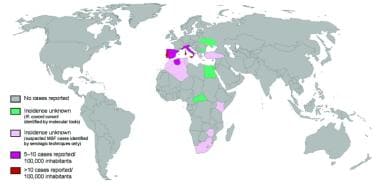 Distribution and incidence of Mediterranean spotted fever (boutonneuse fever). Courtesy of Professor Didier Raoult, Unité des Rickettsies, Marseille, France [Rovery C, Brouqui P, Raoult D. Questions on Mediterranean spotted fever a century after its discovery. Emerg Infect Dis. 2008 Sep; 14(9): 1360–1367. Online at: https://wwwnc.cdc.gov/eid/article/14/9/07-1133_article.].
The major clinical features of MSF are as follows:
-
Fever
-
Exanthem (maculopapular rash)
-
Eschar (tache noire) at site of tick bite
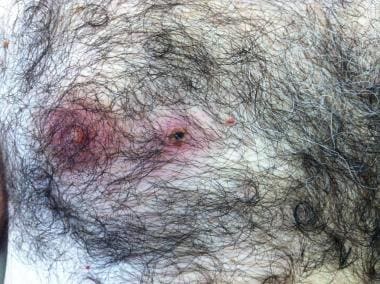 Eschar (tache noire) at site of tick bite on chest. Courtesy of José A Oteo, MD, Centro de Rickettsiosis y Enfermedades Transmitidas por Artrópodos Vectores, Hospital Universitario San Pedro - Centro de Investigación Biomédica de La Rioja (CIBIR).
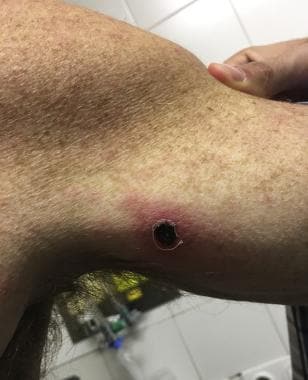 Black spot or “tache noire” in Mediterranean spotted fever. Courtesy of Elsevier [Garcia-Fernandez-Bravo I, Demelo-Rodriguez P, Alejandre de Ona A, Del Toro Cervera J. Black spot or “tache noire” in Mediterranean spotted fever. Medicina Clinica (Barc). 2018 Aug 10;151(3):130. Online at: https://www.elsevier.es/en-revista-medicina-clinica-english-edition--462-articulo-black-spot-or-tache-noire-S2387020618302328.].
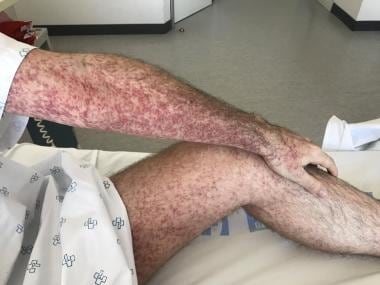 Maculopapular purpuric rash in Mediterranean spotted fever involving extremities. Courtesy of José A Oteo, MD, Centro de Rickettsiosis y Enfermedades Transmitidas por Artrópodos Vectores, Hospital Universitario San Pedro - Centro de Investigación Biomédica de La Rioja (CIBIR).
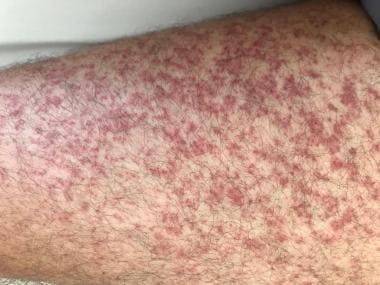 Maculopapular purpuric rash in Mediterranean spotted fever (close up). Courtesy of José A Oteo, MD, Centro de Rickettsiosis y Enfermedades Transmitidas por Artrópodos Vectores, Hospital Universitario San Pedro - Centro de Investigación Biomédica de La Rioja (CIBIR).
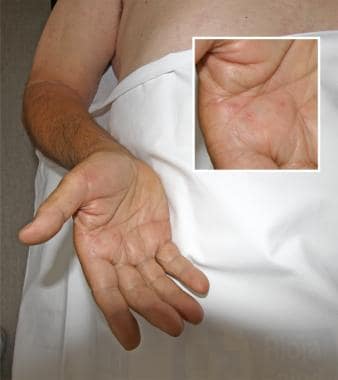 Maculopapular rash in Mediterranean spotted fever involving palms. Courtesy of José A Oteo, MD, Centro de Rickettsiosis y Enfermedades Transmitidas por Artrópodos Vectores, Hospital Universitario San Pedro - Centro de Investigación Biomédica de La Rioja (CIBIR).
The exanthem is typically maculopapular and involves the entire body including the palms and soles. The exanthem may be papulovesicular in some patients; this form is more common in adults in Africa. It may be challenging to differential this form from viral exanthems, particularly chickenpox.
In a minority of patients, isolated lymphadenopathy is the only symptom. R conorii infection should be considered in patients with isolated lymphadenopathy who live in or have traveled to an endemic area, even when other more specific features are not present. In this setting, care should be taken to examine the area distal to the lymphadenopathy for an inoculation eschar, which, if present, can help support the diagnosis.
Although MSF is usually a mild disease, severe complications including neurologic involvement does occur in 6-10% of cases. Neurologic manifestations can result in a delayed diagnosis and appropriate therapy for MSF due to workup and empiric therapy for bacterial meningitis. Complications of MSF are more common in patients with underlying disease or in elderly persons (the so-called malignant form of MSF). Mild forms of the disease are usually observed in children.
Treatment relies on early and appropriate antibiotic therapy. Prevention is important. Patients should be educated about avoiding tick bites and minimizing contact with dogs in areas that are endemic with MSF. For patient education resources, see the First Aid and Injuries Center, as well as Ticks.

Pathophysiology
Once introduced through a tick bite, R conorii invades and proliferates in the endothelial cells of small vessels, causing endothelial injury and tissue necrosis. This necrosis is what results in the eschar (tach noire) at the site of the tick bite. Activation of the acute-phase response with changes in the coagulation state follows. Thrombosis is not an important pathogenic mechanism in this infection, but deep venous thrombosis can occur late in the course of illness.
MSF patients have an alteration in cell-mediated immunity, together with a reduction in CD4 cells and a considerable alteration in the cytokine profile. [3] The incubation time of MSF is typically 5 to 7 days but can be longer (reportedly, up to 28 days in German travelers).
Fractalkine (CX3CL1) is a chemokine expressed mainly by endothelial cells. Its peak of expression on day 3 of infection reportedly coincides with the time of infiltration of macrophages into infected tissues and precedes the peak of rickettsial content in tissues. [4]
Induction of the endothelial cyclooxygenase (COX)-2 system and the ensuing release of vasoactive prostaglandins may contribute to the regulation of inflammatory responses and vascular permeability changes. [5] Expression of type I cytokines may correlate with milder disease expression. [6, 7]
The course of the illness may be divided into stages as follows:
-
The first day of fever is recognized as the first day of the disease
-
The acute stage extends from day 2 to day 14
-
Week 3 (days 15-21) is the borderline period between the acute stage and the convalescent stage
-
The convalescent stage starts after day 21
Etiology
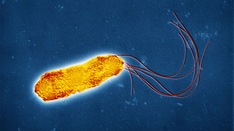
Rickettsiae are obligate, intracellular gram-negative coccobacilli that measure 0.3 to 2.0 µm. They are found within the cytoplasm and occasionally the nucleus of eukaryotic cells. A member of this genus, R conorii, is the organism responsible for MSF.
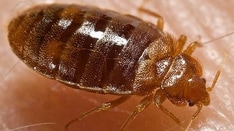
R sanguineus (the brown dog tick) is the most common vector for R conorii. In Cyprus, 3.8% of ticks are infected with R conorii. In Crimea (Ukraine), 8% of ticks are infected with R conorii. In Cyprus, 8.16% of Hyalomma ticks are infected with R conorii.
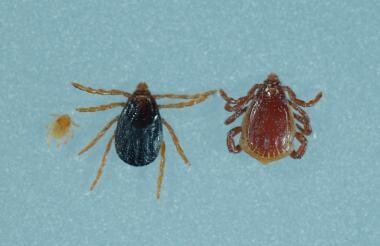 Rhipicephalus sanguineus (brown dog tick), found worldwide. Courtesy of Jim Occi Photography (https://jimocci.photoshelter.com/).
Ticks are the only confirmed reservoir for R conorii. It has been postulated, but never proven, that dogs are a reservoir for R conorii.
Additionally, the following 6 species or subspecies within the spotted fever group in the genus Rickettsia have been described as emerging pathogens [8] :
-
Rickettsia slovaca
-
Rickettsia sibirica subsp mongolitimonae
-
Rickettsia massiliae
-
R conorii subsp israelensis
-
R conorii subsp caspia
-
Rickettsia aeschlimannii
Epidemiology
United States statistics
MSF is uncommon in the United States. About 50 imported cases of MSF have been reported and confirmed by the US Centers for Disease Control and Prevention (CDC). [9] A rickettsial illness similar to MSF with an eschar is found in the southeastern United States. The causative organism is Rickettsia parkeri and the vector is the Gulf Coast tick (Amblyomma maculatum). Rocky Mountain spotted fever (RMSF) is also found in the United States. Rocky Mountain spotted fever is caused by Rickettsia rickettsii, for which the ixodid tick is the vector. RMSF is typically more severe than MSF. RMSF does not cause an eschar.
International statistics
MSF is known to be prevalent in southern Europe, Israel, Africa, and central Asia, including India. The frequency of travel-associated MSF has increased worldwide because of increased travel to endemic areas, including ecotourism. However, the true incidence of MSF is unknown. In many endemic areas, mild infection is common, underdiagnosed, and underreported.
In the Mediterranean region, the incidence of MSF is estimated to be about 50 cases per 100,000 inhabitants per year. In the Leon province of Spain, antibodies to R conorii were discovered in 1% of humans and in 14% of dogs. [10] In the Valles Occidental in Spain, a population without a previous history of MSF, antibodies to R. conorii were detected in 4.6-13.5% (mean, 8%) of humans and in 26.1% of dogs. [11] In southern Portugal, 7.6% of the population have antibodies to R conorii; nationally as many as 20,000 cases are estimated to occur each year, but only about 5% are reported. [12] In Sicily, almost 400 cases are reported every year (mainly from June to September). [13] In Croatia, 51.6% of a studied population with a recent history of a tick bite had antibodies to R conorii. On the Mediterranean coast of Turkey, immunoglobulin G (IgG) antibodies against R conorii were detected in 13.3% of the healthy population. [14] A seroprevalence study of kenneled dogs in southern Italy revealed an R conorii seroprevalence of 72%. [15]
In Zambia, the seroprevalence of antibodies against R. conorii is estimated to be 16.7% in the human population and higher in cattle-breeding areas.
In Germany, Norway, and the Netherlands, sporadic cases of so-called imported MSF (eg, disease acquired via infected dogs or as a holiday souvenir) are described. MSF and other rickettsial infections are reported from Korea. [16] In the United Kingdom, spotted fever group rickettsial species were detected in 9.7% of Ixodes ricinus ticks and 27% of Dermacentor reticularis ticks. [17]
Age-, sex-, and race-related demographics
People of all ages are susceptible to R. conorii infection. In published reports, most MSF patients present at the mean age of about 50 years if a cohort of adult patients is examined. The male-to-female ratio for BF is 1.7:1. This condition affects people of all races.
Prognosis
Traditionally, MSF was characterized as a benign rickettsiosis. However, severe sequala have been reported and include Guillain-Barré syndrome, polyneuropathy, altered mental status, hepatomegaly, acute renal failure, thrombocytopenia, hypoxemia, hemophagocytic lymphohistiocytosis, and death have been reported. [18, 19, 20, 21, 22, 23] Factors associated with more severe disease include older age, alcoholism, immune compromise, and glucose-6-phosphatase dehydrogenase (G6PD) deficiency.
Such complications notwithstanding, MSF is still a benign condition in most cases, carrying a low mortality (in the range of 2-5%). The prognosis is especially good in cases of mild disease; the main concern is malignant (severe) MSF developing in patients who are immunocompromised, elderly, or both. [24]
In one series, 2.5% of MSF patients died of the malignant form. In another series, 33% of MSF patients with underlying disease (eg, chronic liver disease, alcoholism, diabetes mellitus, G6PD deficiency, end-stage renal disease, or cardiac disease) died of malignant MSF. Death from malignant MSF has been associated with delays in diagnosis (>5 days) and treatment (>10 days).
-
Distribution and incidence of Mediterranean spotted fever (boutonneuse fever). Courtesy of Professor Didier Raoult, Unité des Rickettsies, Marseille, France [Rovery C, Brouqui P, Raoult D. Questions on Mediterranean spotted fever a century after its discovery. Emerg Infect Dis. 2008 Sep; 14(9): 1360–1367. Online at: https://wwwnc.cdc.gov/eid/article/14/9/07-1133_article.].
-
Rhipicephalus sanguineus (brown dog tick), found worldwide. Courtesy of Jim Occi Photography (https://jimocci.photoshelter.com/).
-
Eschar (tache noire) at site of tick bite on chest. Courtesy of José A Oteo, MD, Centro de Rickettsiosis y Enfermedades Transmitidas por Artrópodos Vectores, Hospital Universitario San Pedro - Centro de Investigación Biomédica de La Rioja (CIBIR).
-
Maculopapular purpuric rash in Mediterranean spotted fever involving extremities. Courtesy of José A Oteo, MD, Centro de Rickettsiosis y Enfermedades Transmitidas por Artrópodos Vectores, Hospital Universitario San Pedro - Centro de Investigación Biomédica de La Rioja (CIBIR).
-
Maculopapular purpuric rash in Mediterranean spotted fever (close up). Courtesy of José A Oteo, MD, Centro de Rickettsiosis y Enfermedades Transmitidas por Artrópodos Vectores, Hospital Universitario San Pedro - Centro de Investigación Biomédica de La Rioja (CIBIR).
-
Maculopapular rash in Mediterranean spotted fever involving palms. Courtesy of José A Oteo, MD, Centro de Rickettsiosis y Enfermedades Transmitidas por Artrópodos Vectores, Hospital Universitario San Pedro - Centro de Investigación Biomédica de La Rioja (CIBIR).
-
Black spot or “tache noire” in Mediterranean spotted fever. Courtesy of Elsevier [Garcia-Fernandez-Bravo I, Demelo-Rodriguez P, Alejandre de Ona A, Del Toro Cervera J. Black spot or “tache noire” in Mediterranean spotted fever. Medicina Clinica (Barc). 2018 Aug 10;151(3):130. Online at: https://www.elsevier.es/en-revista-medicina-clinica-english-edition--462-articulo-black-spot-or-tache-noire-S2387020618302328.].