Product
The wound adhesive 2-octyl cyanoacrylate (Dermabond) is approved by the US Food and Drug Administration (FDA) for the closure of incised skin. [1] In addition to its surgical adhesive indication, 2-octyl cyanoacrylate was approved by the FDA in January 2001 for use as a barrier against common bacterial microbes, including certain staphylococci, pseudomonads, and Escherichia coli.
In 1997, Quinn et al published a study comparing the cosmetic outcome of suture closure versus octylcyanoacrylate closure. [2, 3] Photographs of nonmucosal facial wounds; selected limb wounds not involving the hands, feet, or joints; and select torso wounds were analyzed by a plastic surgeon at a 3-month postprocedural follow-up. Photographs were assigned a cosmesis score based on a previously validated 100-mm visual analog cosmesis scale. The plastic surgeon was unaware of the method of wound closure. At the end of the study, there was no difference between the mean visual analog scores of the two closure methods.
Category
Wound adhesive, tissue glue

Design Features
The cyanoacrylates were first synthesized in 1949 by Airdis. [4, 5] Coover et al described their adhesive properties and suggested their possible use for surgical adhesives. [5, 6, 7] In the early 1960s, various surgical applications were investigated for these adhesives.
Cyanoacrylates can be synthesized by reacting formaldehyde with alkyl cyanoacetate to obtain a prepolymer that, by heating, is depolymerized into a liquid monomer. The monomer can then be modified by altering the alkoxycarbonyl (-COOR) group of the molecule to obtain compounds of different chain lengths. Upon application to living tissues (water or base), the monomer undergoes an exothermic hydroxylation reaction that results in polymerization of the adhesive. The shorter-chain derivatives tend to have a higher degree of tissue toxicity than do the longer-chain derivatives.
Butyl-2-cyanoacrylate
Previously, butyl-2-cyanoacrylate was the only commercially available cyanoacrylate tissue adhesive. [8, 9, 10] There are several available brands of this product, including Vetbond and Liquiband. However, although butyl-2-cyanoacrylate is effective in closing superficial lacerations under low tension, it has several limitations. Several studies have shown wound-breaking strength in wounds repaired with butyl-2-cyanoacrylate to be equal to that in wounds repaired with sutures at 5-7 days; however, on day 1, breaking strength with the tissue adhesive is only approximately 10-15% of that in a wound sutured with a 5-0 monofilament. [11]
After polymerizing, the adhesive becomes brittle and is subject to fracturing when used in skin creases or long incisions. This restricts the use of adhesives to areas of low tension, thus limiting their use for incision repair. Butyl-2-cyanoacrylate has been used widely with good cosmetic outcomes for various plastic surgical procedures (eg, upper lid blepharoplasty, facial skin closure, scalp wound closure). [9]
2-Octyl cyanoacrylate
The polymer 2-octyl cyanoacrylate (Dermabond) was formulated to correct some of the deficiencies of the shorter-chain cyanoacrylate derivatives. It was first approved by the FDA for closure of superficial skin lacerations in 1998. Since that time, its uses have expanded beyond simple wound closure; in 2002, it was FDA approved for barrier protection against common microbes. As an 8-carbon alkyl derivative, this polymer should be less reactive than the shorter-chain derivatives. The slower degradation of the octyl derivatives may result in lower concentrations of the cyanoacrylate polymer byproducts in surrounding tissues, resulting in less inflammation.
Additionally, plasticizers are added to produce a more pliable and tissue-compatible product that flexes with the skin and remains inherent for longer periods. The three-dimensional (3-D) breaking strength of 2-octyl cyanoacrylate is three times that of butyl-2-cyanoacrylate and is closer to that of a 5-0 monofilament suture. This stronger, flexible bond may allow its use on longer incisions.
Indications
Laceration repair/superficial incision closure
The FDA approved 2-octyl cyanoacrylate (Dermabond) for topical application in the closure of incised skin and for use as a barrier against common bacterial microbes, such as certain staphylococci, pseudomonads, and Escherichia coli. [12, 13, 14, 15, 16] 2-Octyl cyanoacrylate use is often correlated with laceration repair, which is certainly a popular application. However, it is also widely used for operative incision repair. Sutureless pediatric circumcisions, [17, 18] cleft lip repair, [19] upper eyelid blepharoplasties, [20] and total joint arthroplasties [21, 22, 23] are a few innovative surgical incision closures that have been facilitated by the use of 2-octyl cyanoacrylate.
Partial-thickness facial lacerations are well suited for the use of 2-octyl cyanoacrylate. However, use of 2-octyl cyanoacrylate does not exclude the possibility of this type of injury requiring deep sutures. The use of cyanoacrylates as wound adhesives may obviate the need for local anesthetics during laceration repair; however, local anesthesia may be required for wound exploration, debridement, and placement of deep sutures.
Good technique for the application of 2-octyl cyanoacrylate includes the following:
-
Maintaining everted skin apposition with fingers or forceps during application; this provides the best apposition and corrects for the scar flattening associated with scar remodeling
-
Using multiple thin applications
-
Allowing the adhesive to dry between applications
-
Advising the patient not to scrub the site where the adhesive has been applied
Using 2-octyl cyanoacrylate to close dead volume in a skin wound is not considered good technique, as it results in an inflammatory reaction that impairs wound healing.
The following are contraindications for the use of 2-octyl cyanoacrylate [24] :
-
Mammalian bite wounds
-
Stellate crush injuries
-
Partial-thickness facial lacerations in patients with diabetes mellitus
-
Patients with a history of allergy to cyanoacrylates
-
Decubitus ulcers
-
Nonsurgical puncture wounds
In addition, 2-octyl cyanoacrylate should be used carefully on the oral mucosa, hands, feet, or joints, where repetitive movement and washing may cause the adhesives to slough prematurely, which could increase the risk of inflammation and areas of wound separation. [25]
Implementation
Cost analysis has found that the use of tissue adhesives can significantly decrease healthcare costs and is preferred by patients. [26, 27, 28, 29] Additional evidence suggests that 2-octyl cyanoacrylate may reduce the need for unnecessary follow-up required for suture removal postoperatively. [30] Adhesives also provide a needle-free method of wound closure, an important consideration given blood-borne viruses. [31] In addition, adhesives do not require the administration of local anesthetics. 2-Octyl cyanoacrylate has also demonstrated shorter healing times compared with more traditional wound closure techniques. [32, 33]
The cyanoacrylates function as waterproof occlusive dressings, have antimicrobial properties against gram-positive organisms, and may decrease the risk of infection. [34] They have been demonstrated to decrease histologic and clinical infection rates in contaminated wounds when compared with suture closure. [31] If the adhesives are used improperly and are implanted into the wound, they can cause a foreign-body reaction and actually may increase infection rates.
The following discussion is limited to 2-octyl cyanoacrylate (Dermabond). Moreover, this text is designed to be only a guideline; as always, physicians should use their own discretion in the use of these materials. Although tissue adhesives have many advantages, their successful incorporation into the physician's practice depends on understanding the indications, contraindications, and proper method of application. Without understanding these concepts, results are more likely to be unsatisfactory, and advantages of adhesives are more likely to be lost.
See also Incision Placement, Wound Healing and Repair, and Wound Closure Technique.
2-Octyl cyanoacrylate
The 2-octyl cyanoacrylate adhesive can be used topically to close skin incisions and lacerations alone, or it can be used in conjunction with deep sutures. Generally, the octyl products can be used in place of nonabsorbable sutures for primary closure of skin incisions and lacerations on the face. For facial incisions and lacerations that are under tension and when closing incisions and lacerations on the extremities and torso, deep (subcutaneous) sutures are recommended.
The adhesive should not be used on the oral mucosa, hands, and feet, where repetitive movement and washing may cause the adhesives to slough prematurely. Other types of wounds that are not optimal for cyanoacrylate adhesives include decubitus ulcers, stellate lacerations, animal or human bites, and nonsurgical puncture wounds. The adhesive does not replace the requirement for good quality wound care. Wounds still need careful examination and exploration with irrigation and debridement when appropriate. These types of wound preparations still may require administration of local anesthetic.
Topical application
In learning to apply tissue adhesives, the most important concept is that they are for topical closure only. Give special care to ensure the adhesive will not leak between the wound edges. If used properly, the adhesive acts as a strong bridge to hold the well-opposed wound edges together. If placed in the wound, it acts as a barrier to proper epithelialization and may impair healing. Once in the wound, the adhesive also has the potential to cause a foreign-body reaction and to increase the risk of infection.
Toriumi et al published an article on the use of 2-octyl cyanoacrylate in which they underscore two other important principles: the need to reduce skin tension at the site of the laceration and the need to ensure no dead space is present before sealing with the tissue adhesive. [35] Singer et al also published an excellent literature review on these adhesives. [36]
Deep dermal sutures (vertical mattress stitches) are used to bring the skin edges into everted apposition. The everted edges are extremely important to successful closure with tissue adhesives, because they prevent scar broadening and improve the cosmetic result. The everted skin apposition should be maintained with forceps or fingers during the application of the 2-octyl cyanoacrylate. For best results, a thin layer of the adhesive should be applied over the epidermis and allowed to dry for approximately 20-30 seconds. This method prevents pooling and running of the tissue adhesive, and it also provides a layer of protection from the heat generated by the exothermic polymerization. Subsequent layers of cyanoacrylate are then applied over the top of this initial layer. The images below demonstrate the application of this product.
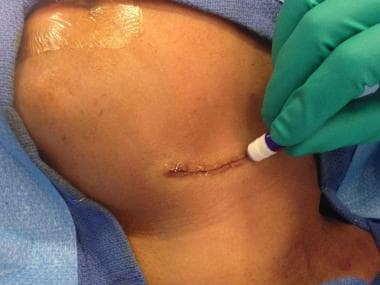 Application of 2-octyl cyanoacrylate to neck incision after closure with deep dermal absorbable sutures. Courtesy of Daniel Deschler, MD.
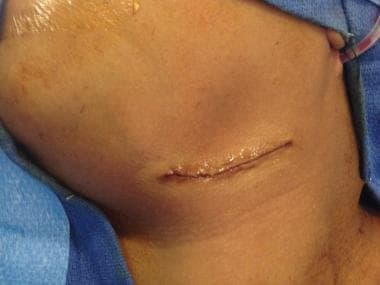 Appearance of incision immediately after application and drying of 2-octyl cyanoacrylate. Courtesy of Daniel Deschler, MD.
Cosmetic results
Several clinical studies have shown that 2-octyl cyanoacrylate provides cosmetic results equal to those of sutures. [2, 19, 22, 37, 38] Additionally, studies do show a difference in overall operative time between surgical adhesives versus traditional suture technique. [39, 40] Therefore, given the speed and efficacy of this new tissue adhesive, it should firmly establish itself in the treatment repertoire for skin closure.
Use as bonding material
More recently, 2-octyl cyanoacrylate has been used as a material for securing catheters and newly placed shunts and in splinting broken teeth. [41, 42, 43]
Future uses
Future investigations with this product no doubt will expand its use.
While the FDA has only approved the use of 2-octyl cyanoacrylate in superficial closures, many clinical trials have been conducted illustrating the effectiveness of 2-octyl cyanoacrylate in other applications. The following is a list of uses of 2-octyl cyanoacrylate that have proven successful:
-
Type I tympanoplasty [44] - Twenty-one of 23 patients were successfully grafted in a Turkish study; after temporal fascia was inserted underneath the eardrum remnant, 2-octyl cyanoacrylate was dripped over the temporal fascia; the mean air-bone gap (at 400, 1000, 2000, and 4000 Hz) of the 23 patients who underwent the study was 8.2 postoperatively, as opposed to 19.3 preoperatively.
-
Femoral fracture closure [47] : A prospective cohort study comparing femoral fracture wound closure with staples versus sutures and 2-octyl cyanoacrylate application demonstrated that closure with staples had the highest rate of prolonged wound drainage and length of stay and sutures in combination with 2-octyl cyanoacrylate had the lowest incidence of prolonged wound drainage.
-
Implanting pacemakers [50]
-
Direct application to visceral pleura to control air leaks [51]
-
As a wound barrier in clear corneal cataract surgery [54]
-
For patch fixation in a tension-free inguinal herniorrhaphy [55]
-
Abdominoplasty closure in combination with self-adhering mesh [56] : A randomized controlled trial evaluated the use of 2-octyl cyanoacrylate along with self-adhering mesh for closure after abdominoplasty as compared with traditional techniques and found cost-savings; a more favorable cosmetic outcome at 6- and 12-month follow-up; and decreased pain, irregularity, and thickness at 12 months.
-
Sutureless circumcision [57]
-
Gastric and duodenal varices in patients who are not candidates for transjugular intrahepatic portosystemic shunts [58]
-
Hemostasis of distal fingertip pad dermal avulsion injuries [59]
-
Pediatric nail bed injuries [60]
-
Extraocular muscle fixation to porous orbital implants [61]
-
Friction blisters of the hands [62]
-
Refractory gastrointestinal fistulae [63]
-
Cartilage interposition in ossiculoplasty [64] : Seventy-one patients underwent ossiculoplasty with or without tympanoplasty using 2-octyl cyanoacrylate to bond the prosthesis and cartilage interposition graft. A single drop of 2-octyl cyanoacrylate was placed in the center of the cartilage; the prosthesis was then firmly placed on top of the cartilage and allowed 30 seconds for adhesion. There were two cases of prosthesis extrusions (2.8%), one of which was secondary to a recurrent cholesteatoma. Mean follow-up was 10 months (range, 0-48 months), with no accounts of either foreign body reaction or local surgical-site infection.
-
Preoperative localization of small pulmonary nodules [65] : One hundred and one patients had small pulmonary nodules successfully located with 2-octyl cyanoacrylate guided by CT. The time interval between localization and operative repair was significantly shorter for 2-ocyl cyanoacrylate compared with conventional hookwire localization (P < .001), and complication rates were similar between the two approaches.
-
Postoperative hemorrhage after Mohs micrographic surgery [66]
-
Prevention of bacterial infection in extracorporeal membrane oxygenation (ECMO) cannulae [67]
-
Depilation of scalp spilt-thickness skin grafts [68]
Follow-up/Monitoring
Physicians should be mindful of the anatomic location where 2-octyl cyanoacrylate (Dermabond) is being applied. Close attention should be paid when closing wounds near surrounding structures that could become encased in or stuck to the adhesive. Case reports have described eyelashes and lips having to be pried free from dried 2-octyl cyanoacrylate. In such a case, petroleum jelly or acetone can be used, which weakens the polymerization. Using water and alcohol, which speed up the exothermic reaction that polymerizes 2-octyl cyanoacrylate, is discouraged. [69]
Patients who have had 2-octyl cyanoacrylate applied to their wounds should be monitored for allergic-type reactions. Such reactions are rare but can occur. Specifically, several case reports have described contact dermatitis after 2-octyl cyanoacrylate application. [70, 71, 72, 73] Such reactions tend to show within the first 2 weeks after application, although they have been reported as late as 4 weeks afterwards. [74] Reactions commonly occurring sooner after a second exposure to the adhesive as compared with the first exposure due to sensitization are reported. [71] Suggestions have been made to reduce the likelihood of developing such a reaction by ensuring that the 2-octyl cyanoacrylate has completely sloughed at 2 weeks. [74] Generally, it takes 7-14 days for 2-octylcyanoacrylate to flake off, and prolonged retention, either on the surface or within the edges of the wound, could lead to allergic reactions [72, 73] Additionally, implementation of skin patch testing has been suggested to decrease risk of allergic-type reactions. [75]
Complications
Inflammation, tissue necrosis, granulation formation, and wound breakdown can occur when cyanoacrylates are implanted subcutaneously. The process causing the histologic toxicity is thought to be related to the byproducts of degradation, cyanoacetate and formaldehyde. [76, 77] The local concentrations of these breakdown products are proportional to the rate of degradation (an aqueous degradation process) of the parent compound. Therefore, slower degradation rates result in less toxicity to the tissues. This is explained by the hypothetical possibility that slowly degrading compounds release degradation products more gradually, thereby permitting more effective clearance and invoking a less intense inflammatory response. The longer-chain compounds break down much more slowly than the shorter-chain compounds, hence the lower reactivity of the longer-chain compounds.
There are reports in the literature demonstrating allergic contact dermatitis in response to 2-octyl-cyanoacrylate application. [71, 72, 73] Case reports from 2020 indicate full-thickness injury caused by 2-octyl-cyanoacrylate, requiring debridement and secondary closure. [70, 78]
Similarly, there are also case reports describing local inflammation and foreign body reaction with subsequent granuloma formation in the setting of intraabdominal 2-octyl-cyanoacrylate application. [79, 80] In the setting of definitive oncologic resection for a primary malignancy, its use should be cautioned given concerns for the known development of false-positive PET/CT findings during routine surveillance, which confounds the presence of a true locoregional recurrence and the subsequent need for revision surgery; [79] however, evidence from 2020 highlights the potential value of 2-octyl-cyanoacrylate for localization of pulmonary nodules prior to surgical resection. [65]
With regard to other cyanoacrylate products, reports describe occupational asthma and occupational rhinitis in those applying cyanoacrylate-based cosmetics (eyelash extensions, artificial fingernails), as well as pulmonary obstruction in adhesive production facilities. [81, 82, 83, 84] Again, no similar reports have been identified with the use of 2-octyl-cyanoacrylate.
-
Application of 2-octyl cyanoacrylate to neck incision after closure with deep dermal absorbable sutures. Courtesy of Daniel Deschler, MD.
-
Appearance of incision immediately after application and drying of 2-octyl cyanoacrylate. Courtesy of Daniel Deschler, MD.