Continually Updated Clinical Reference
 
 
  All Sources     eMedicine     Medscape     Drug Reference     MEDLINE
 
eMedicine - Inner Ear, Presbycusis : Article by

Quick Find
Authors & Editors
Introduction
Clinical
Differentials
Workup
Treatment
Medication
Follow-up
Miscellaneous
References

Related Articles
Inner Ear, Autoimmune Disease

Inner Ear, Genetic Sensorineural Hearing Loss

Inner Ear, Noise-Induced Hearing Loss

Inner Ear, Ototoxicity

Inner Ear, Perilymphatic Fistula

Inner Ear, Presbycusis

Inner Ear, Sudden Hearing Loss

Inner Ear, Syndromic Sensorineural Hearing Loss

Middle Ear, Acute Otitis Media, Medical Treatment

Middle Ear, Benign Tumors

Middle Ear, Cholesteatoma

Middle Ear, Chronic Suppurative Otitis, Medical Treatment

Middle Ear, Granulomatous Diseases

Middle Ear, Inflammatory Diseases

Middle Ear, Otosclerosis

Skull Base, Acoustic Neuroma (Vestibular Schwannoma)

Skull Base, Petrous Apex, Infection

Skull Base, Petrous Apex, Tumors

Temporal Bone Fractures


Patient Education
Ear, Nose, and Throat Center

Senior Health Center

Hearing Loss Overview

Hearing Loss Causes

Hearing Loss Symptoms

Hearing Loss Treatment


Author: Peter S Roland, MD, Professor, Department of Neurological Surgery, Professor and Chairman, Department of Otolaryngology-Head and Neck Surgery, Director of Clinical Center for Auditory, Vestibular and Facial Nerve Disorders, Chief of Pediatric Otology, University of Texas Southwestern Medical Center; Adjunct Professor of Communicative Disorders, School of Human Development

Peter S Roland is a member of the following medical societies: Alpha Omega Alpha, American Academy of Otolaryngic Allergy, American Academy of Otolaryngology-Head and Neck Surgery, American Auditory Society, American Laryngological Rhinological and Otological Society, American Neurotology Society, American Otological Society, North American Skull Base Society, and Society of University Otolaryngologists-Head and Neck Surgeons

Coauthor(s): Joe Walter Kutz Jr, MD, Assistant Professor, Department of Otolaryngology-Head and Neck Surgery, University of Texas Southwestern Medical Center; Michelle C Marcincuk, MD, Clinical Assistant Professor of Otolaryngology, University of Texas Southwestern Medical Center; Consulting Staff, Department of Surgery, Division of Otolaryngology, Texas Health Care, PLLC

Editors: Jack A Shohet, MD, Chairman of Otolaryngology, Hoag Hospital; Francisco Talavera, PharmD, PhD, Senior Pharmacy Editor, eMedicine; Gerard J Gianoli, MD, Clinical Associate Professor, Department of Otolaryngology-Head and Neck Surgery, Tulane University School of Medicine; Vice President, The Ear and Balance Institute; Chief Executive Officer, Ponchartrain Surgery Center; Christopher L Slack, MD, Otolaryngology-Facial Plastic Surgery, Private Practice, Associated Coastal ENT; Medical Director, Treasure Coast Sleep Disorders; Arlen D Meyers, MD, MBA, Professor, Department of Otolaryngology-Head and Neck Surgery, University of Colorado School of Medicine

Author and Editor Disclosure

Synonyms and related keywords: presbycusis, age-induced hearing loss, hearing loss, inner ear, sensorineural hearing impairment, sensory presbycusis, neural presbycusis, metabolic presbycusis, strial presbycusis, mechanical presbycusis, cochlear conductive presbycusis


Background

The term presbycusis refers to sensorineural hearing impairment in elderly individuals. Characteristically, presbycusis involves bilateral high-frequency hearing loss associated with difficulty in speech discrimination and central auditory processing of information. However, other patterns of presbycusis exist. The association between advanced age and high-tone deafness was first described by Zwaardemaker in 1899. Since then, extensive research has attempted to determine the pathologic changes of presbycusis, but the exact mechanisms remain unknown.

Presbycusis is an important problem in society. It occurs in an elderly population that relies on special senses to compensate for other age-associated disabilities. Elderly individuals may rely on their hearing to overcome limitations of impaired vision and slowed reaction time. In addition, age-associated decline in concentration and memory contribute to difficulty understanding speech, especially in noisy situations. Arthritis and impaired dexterity may limit their ability to take advantage of the amplification devices used in rehabilitation of age-associated hearing loss. Finally, hearing loss may contribute to the isolation of some elderly people by restricting their use of the phone, causing them to forfeit social opportunities such as concerts and social gatherings, and amplifying their sense of disability.

Pathophysiology

Histologic changes associated with aging occur throughout the auditory system from the hair cells of the cochlea to the auditory cortex in the temporal lobe of the brain. These changes may correlate with different clinical findings and auditory test results, depending on the severity of the changes and the anatomic level at which they occur. Over the past 50 years some brilliant research in the field of presbycusis has been witnessed, but elucidation of the pathophysiology of presbycusis is still incomplete.

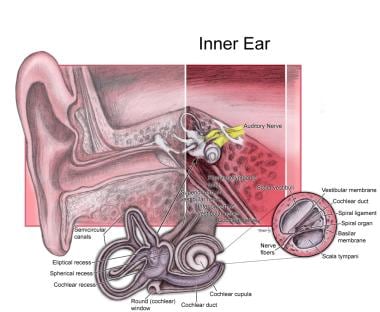
Many researchers have investigated the causes of this disease. Crowe and associates, Saxen, and Gacek and Schuknecht have studied histologic changes in the cochleae of human ears with presbycusis. Gacek and Schuknecht identified 4 sites of aging in the cochlea and divided presbycusis into 4 types based on these sites.1 The histologic changes are correlated approximately with symptoms and auditory test results.

  • Sensory presbycusis: This refers to epithelial atrophy with loss of sensory hair cells and supporting cells in the organ of Corti. This process originates in the basal turn of the cochlea and slowly progresses toward the apex. These changes correlate with a precipitous drop in the high-frequency thresholds, which begins after middle age. The abrupt downward slope of the audiogram begins above the speech frequencies; therefore, speech discrimination is often preserved. Histologically, the atrophy may be limited to only the first few millimeters of the basal end of the cochlea. The process is slowly progressive over time. One theory proposes that these changes are due to the accumulation of lipofuscin pigment granules.
  • Neural presbycusis: This refers to atrophy of nerve cells in the cochlea and central neural pathways. Schuknecht estimated that 2100 neurons are lost every decade (of 35,000 total). This loss begins early in life and may be genetically predetermined. Effects are not noticeable until old age because pure-tone average is not affected until 90% of neurons are gone. Atrophy occurs throughout the cochlea, with the basilar region only slightly more predisposed than the remainder of the cochlea. Therefore, no precipitous drop in the high-frequency thresholds on audio is observed. A disproportionately severe decrease in speech discrimination is a clinical correlate of neural presbycusis and may be observed before hearing loss is noted because fewer neurons are required to maintain speech thresholds than speech discrimination.
  • Metabolic (ie, strial) presbycusis: This condition result from atrophy of the stria vascularis. The stria vascularis normally maintains the chemical and bioelectric balance and metabolic health of the cochlea. Atrophy of the stria vascularis results in hearing loss represented by a flat hearing curve because the entire cochlea is affected. Speech discrimination is preserved. This process tends to occur in people aged 30-60 years. It progresses slowly and may be familial.
  • Mechanical (ie, cochlear conductive) presbycusis: This condition results from thickening and secondary stiffening of the basilar membrane of the cochlea. The thickening is more severe in the basal turn of the cochlea where the basilar membrane is narrow. This correlates with a gradually sloping high-frequency sensorineural hearing loss that is slowly progressive. Speech discrimination is average for the given pure-tone average.

The changes associated with presbycusis are rarely found exclusively at one site; the development of presbycusis typically involves simultaneous changes at multiple sites. This explains the difficulty of associating specific clinical symptoms or signs with specific anatomic locations, as pointed out by Suga and Lindsay and also by Nelson and Hinojosa.2, 3, 4

A large volume of current research is being conducted to determine the exact underlying cause of presbycusis. Much of the current research focuses on finding underlying genetic abnormalities that may cause, contribute to, or predispose to the development of this disease.

One of the most widely investigated potential causes is a genetic mutation in mitochondrial DNA. Reduced perfusion of the cochlea associated with age may contribute to the formation of reactive oxygen metabolites, which may adversely affect the inner ear neural structures as well as cause damage to mitochondrial DNA. Damaged mitochondrial DNA may cause reduced oxidative phosphorylation, which may lead to problems with neural functioning in the inner ear. A study by Dai et al also suggested that damaged mitochondrial DNA may lead to anatomic changes of the inner ear.5 Specifically, they found more severe narrowing of the vaso nervorum in the internal auditory meatus in temporal bones with a mitochondrial DNA deletion. Damaged mitochondrial DNA has also been linked to a greater rate of apoptosis of certain cells in the inner ear in a study by Pickles.6

Two specific mitochondrial DNA deletions, mtDNA4834 and mtDNA4977, have been linked to age-related hearing loss in rodents. Additionally, studies by Han et al and Dai et al have linked the mtDNA4977 deletion with archived human temporal bones from patients with presbycusis.7, 8

Nutritional and anatomic causes of presbycusis have also been researched. Berner et al investigated the relation between vitamin B12 and folate deficiency with age-related hearing loss but did not find a statistically significant relationship.9 Martin Villares et al did, however, find a positive relationship between high cholesterol levels and hearing loss.10 However, Olzowy et al, in a randomized controlled trial, failed to show a difference in the rate of hearing loss in patients with presbycusis with the use of atorvastatin.11 Although the degree of mastoid pneumatization did not correlate with the presence of presbycusis in a study by Pata et al, ultrastructural changes of the cuticular plate did appear to correlate with a known history of age related high-tone hearing loss in a human temporal bone study by Scholtz.12, 13

In general, the exact cause of age-related hearing loss is still not known today. However, promising research is currently underway in an effort to elucidate the etiology, whether it be genetic, anatomic, or a combination of factors.

Frequency

United States

No accurate account of the incidence of presbycusis in the United States is available. Approximately 25-30% of people aged 65-74 years are estimated to have impaired hearing. For people aged 75 years and older, this incidence is thought to rise to 40-50%.

International

The international incidence of presbycusis varies widely among societies. Westernized foreign countries and primitive civilizations have very different patterns of hearing loss. A 1962 study by Rosen and colleagues of a remote tribe of the Sudan called the Mabaans revealed significantly less hearing loss in the elderly population than in similarly aged people of urban societies. Whether this is because of the lack of chronic noise exposure or the paucity of other systemic ailments that are common in industrialized societies (eg, atherosclerosis, diabetes, reactive airway disease) is not known. In general, most of the world's population experiences some degree of decline in hearing with advancing age.

Race

No known difference exists in prevalence of presbycusis based on race.

Sex

No difference in the prevalence of presbycusis between the sexes is found.

Age

By definition, prevalence of presbycusis increases with advancing age.


History

The clinical presentation of presbycusis varies from patient to patient and is a result of the various combinations of cochlear and neural changes that have occurred. Patients typically may have more difficulty understanding rapidly spoken language, vocabulary that is less familiar or more complex, and speech within a noisy, distracting environment. In addition, localizing sound is increasingly difficult as the disease progresses.

For example, an elderly patient may be healthy and mentally alert. The patient’s only report may be a gradually progressive hearing loss with particular difficulty understanding words and conversation when a high level of ambient background noise is present. This may interfere with his effectiveness at meetings. He may have a history of noise exposure (eg, armed services, hunting, use of power tools, industrial occupation). A high-frequency sloping sensorineural hearing loss may be found. His speech discrimination score may be normal unless tested in the presence of background noise. Hearing aids with more gain in the higher frequencies to match his hearing loss may provide substantial benefit, depending on his needs and motivation. He may also be counseled to avoid excessive noise exposure.

Physical

In patients with presbycusis, no abnormalities are found on physical examination.

  • Presbycusis is a diagnosis of exclusion that should not be made until all other possible etiologies of hearing loss in elderly individuals have been evaluated and excluded.
  • Etiologies as simple as cerumen impaction and as complex as otosclerosis or cholesteatoma must not be overlooked in the elderly patient with hearing loss because these are amenable to treatment.

Causes

Although the precise etiology of presbycusis is currently not known, the cause of presbycusis is generally agreed to be multifactorial. Proposed causes include the following:

  • Arteriosclerosis: Arteriosclerosis may cause diminished perfusion and oxygenation of the cochlea. Hypoperfusion leads to the formation of reactive oxygen metabolites and free radicals, which may damage inner ear structures directly as well as damage mitochondrial DNA of the inner ear. This damage may contribute to the development of presbycusis.
  • Diet and metabolism
    • Diabetes accelerates the process of atherosclerosis, which may interfere with perfusion and oxygenation of the cochlea.
    • Diabetes causes diffuse proliferation and hypertrophy of the vascular intimal endothelium, which may also interfere with perfusion of the cochlea.
    • Le and Keithley have demonstrated diets high in antioxidants such as vitamins C and E reduce the progression of presbycusis in a mouse model.
  • Accumulated exposure to noise
  • Drug and environmental chemical exposure
  • Stress
  • Genetics
    • Genetic programming for early aging of parts of the auditory system may influence the development of presbycusis. Often, concomitant impairment of hearing, balance, sense of smell, taste, and visual acuity is associated with the aging process.
    • Likewise, genetically programmed susceptibility to environmental factors (eg, noise, ototoxic drugs and chemicals, stress) may be involved.


Inner Ear, Autoimmune Disease
Inner Ear, Genetic Sensorineural Hearing Loss
Inner Ear, Noise-Induced Hearing Loss
Inner Ear, Ototoxicity
Inner Ear, Perilymphatic Fistula
Inner Ear, Presbycusis
Inner Ear, Sudden Hearing Loss
Inner Ear, Syndromic Sensorineural Hearing Loss
Middle Ear, Acute Otitis Media, Medical Treatment
Middle Ear, Benign Tumors
Middle Ear, Cholesteatoma
Middle Ear, Chronic Suppurative Otitis, Medical Treatment
Middle Ear, Granulomatous Diseases
Middle Ear, Inflammatory Diseases
Middle Ear, Otosclerosis
Skull Base, Acoustic Neuroma (Vestibular Schwannoma)
Skull Base, Petrous Apex, Infection
Skull Base, Petrous Apex, Tumors
Temporal Bone Fractures


Lab Studies

Evaluation may entail a variety of tests, including blood tests for autoimmune-induced hearing loss.

Imaging Studies

Evaluation may entail a variety of tests, including CT scanning or MRI to exclude anatomic abnormalities or mass lesions that may cause hearing loss.

Other Tests

  • Audiometric testing with pure-tone average and speech discrimination forms the cornerstone of diagnostic testing for presbycusis.
  • The need for additional testing can usually be determined from the audiometric test results. For example, individuals with asymmetric hearing loss (ie, more than 10 dB difference at any 2 consecutive frequencies) and individuals with a conductive component require further evaluation.
  • Evaluation may entail a variety of tests, including tests of central auditory processing to exclude abnormal processing of auditory information in the central nervous system.


Medical Care

Presbycusis is not curable, but the effects of the disease on patients’ lives can be mitigated.

  • Amplification devices: Properly fitted hearing aids may contribute to the rehabilitation of a patient with presbycusis. Older patients with arthritis in their fingers and visual difficulties need extra help in learning to use hearing aids. Patients using hearing aids may still experience difficulties with speech discrimination in noisy situations.
  • Lip reading: Lip reading may help patients with diminished speech discrimination and may help hearing aid users who have difficulty in noisy environments.
  • Assistive listening devices: These range from a simple amplification of the telephone signal to a device on the television that sends a signal across the room to a headset worn by a patient with hearing loss. The patient can amplify the sound without disturbing other people with normal hearing who are in the same room.
  • Cochlear implants: Some patients with presbycusis benefit from cochlear implants. Patients with cochlear changes and relatively intact spiral ganglia and central pathways appear to be the best candidates.

These measures are aimed at rehabilitating patients who already experience presbycusis. However, efforts are underway to develop therapies that treat the potential underlying causes of presbycusis, as well as mechanisms to actually prevent the disease altogether. With new studies showing possible genetic and nutritional causes of presbycusis, researchers are proposing treatments that address these underlying causes. For example, medications that block the production of reactive oxygen metabolites may lead to a treatment of presbycusis at the molecular level. Alternatively, a study by Derin et al showed that treatment with I-carnitine resulted in improvement in the ABR results of rats experiencing age-related hearing loss.14 Unfortunately, most of these therapies are still in the investigational stages.

Consultations

Rehabilitation of a patient with presbycusis takes time and patience. Specialists in the fields of otolaryngology, audiology, neurology, and psychology may all be involved.

Diet

No well-established dietary restrictions are prescribed for patients with presbycusis. However, some researchers have recently suggested that a 30% caloric dietary restriction and the use of antioxidant dietary supplements may reduce the production of reactive oxygen metabolites that can harm the inner ear and lead to age-related hearing loss.

Activity

No activity restrictions are prescribed for patients with presbycusis. However, patients should be warned that exposure to loud sounds can exacerbate sensorineural hearing loss.


No medical therapies or drugs are indicated to improve hearing in patients with presbycusis.


Further Inpatient Care

Inpatient care is not necessary for patients with presbycusis.

Further Outpatient Care

Patients with presbycusis require routine follow-up care with an otolaryngologist and audiologist to monitor hearing thresholds, order changes in amplification device specifications as hearing thresholds change, and monitor the patient for other signs and symptoms of ear disease that individuals with impaired hearing may overlook.

Prognosis

  • Unfortunately, the prognosis for patients with presbycusis is further progression of hearing loss. The rate of hearing loss has been estimated at 0.7-1.2 dB per year and is age and frequency dependent. This disease has no cure. However, the progression of loss is slow, and patients may be able to expect many years of serviceable though diminished hearing.
  • Warn patients with presbycusis against preventable causes of hearing loss, which may exacerbate or accelerate their disease (eg, noise exposure, exposure to ototoxic drugs, failure to control diabetes and other metabolic diseases).

Patient Education

For excellent patient education resources, visit eMedicine's Ear, Nose, and Throat Center and Senior Health Center. Also, see eMedicine's patient education article Hearing Loss.


Medical/Legal Pitfalls

Failure to differentiate presbycusis from other potentially treatable forms of sensorineural hearing loss (eg, acoustic neuroma, Ménière disease)

Special Concerns

Although presbycusis is not a curable disease, with further research into its precise pathophysiology, someday it may be a preventable one. Future research will continue to look at possible genetic, nutritional, and anatomic causes that may lend themselves to effective treatments.


  1. Gacek RR, Schuknecht HF. Pathology of presbycusis. Int Audiol. 1969;8:199.
  2. Suga F, Lindsay JR. Histopathological observations of presbycusis. Ann Otol Rhinol Laryngol. Mar-Apr 1976;85(2 pt.1):169-84. [Medline].
  3. Nelson E, Hinojosa R. Presbycusis: a human temporal bone study of individuals with flat audiometric patterns of hearing loss using a new method to quantify stria vascularis volume. Laryngoscope. Oct 2003;113 (10):1672-1686. [Medline].
  4. Nelson EG, Hinojosa R. Presbycusis: a human temporal bone study of individuals with downward sloping audiometric patterns of hearing loss and review of the literature. Laryngoscope. Sep 2006;116(9 Pt 3 Suppl 112):1-12. [Medline].
  5. Dai P, Yang W, Jiang S, et al. Correlation of cochlear blood supply with mitochondrial DNA common deletion in presbyacusis. Acta Otolaryngol. Mar 2004;124(2):130-6. [Medline].
  6. Pickles JO. Mutation in mitochondrial DNA as a cause of presbyacusis. Audiol Neurootol. Jan-Feb 2004;9(1):23-33. [Medline].
  7. Han W, Han D, Jiang S. [Mitochondrial DNA4977 deletions associated with human presbycusis]. Zhonghua Er Bi Yan Hou Ke Za Zhi. Dec 2000;35(6):416-9. [Medline].
  8. Dai P, Jiang S, Gu R. [Cochlear hypoxia and mtDNA deletion: possible correlated factors to cause presbycusis]. Zhonghua Yi Xue Za Zhi. Dec 2000;80(12):897-900. [Medline].
  9. Berner B, Odum L, Parving A. Age-related hearing impairment and B vitamin status. Acta Otolaryngol. Aug 2000;120(5):633-7. [Medline].
  10. Martin Villares C, San Roman Carbajo J, et al. [Lipid profile and hearing-loss aged-related]. Nutr Hosp. Jan-Feb 2005;20(1):52-7. [Medline].
  11. Olzowy B, Canis M, Hempel JM, et al. Effect of atorvastatin on progression of sensorineural hearing loss and tinnitus in the elderly: results of a prospective, randomized, double-blind clinical trial. Otol Neurotol. Jun 2007;28(4):455-8. [Medline].
  12. Pata YS, Akbas Y, Unal M, t al. The relationship between presbycusis and mastoid pneumatization. Yonsei Med J. Feb 29 2004;45(1):68-72. [Medline].
  13. Scholtz AW, Kammen-Jolly K, Felder E, et al. Selective aspects of human pathology in high-tone hearing loss of the aging inner ear. Hearing Res. Jul 2001;157 (1-2):77-86. [Medline].
  14. Derin A, Agirdir B, Derin N, et al. The effects of L-carnitine on presbyacusis in the rat model. Clin Otolaryngol Allied Sci. Jun 2004;29(3):238-41. [Medline].
  15. Alam SA, Oshima T, Suzuki M, et al. The expression of apoptosis-related proteins in the aged cochlea of Mongolian gerbils. Laryngoscope. Mar 2001;111(3):528-34. [Medline].
  16. Arnesen AR. Presbyacusis--loss of neurons in the human cochlear nuclei. J Laryngol Otol. Jun 1982;96(6):503-11. [Medline].
  17. Bartolome MV, Lopez LM, Gil-Loyzaga P. Galectine-1 expression in cochleae of C57BL/6 mice during aging. Neuroreport. Oct 8 2001;12(14):3107-10. [Medline].
  18. Bhatt K, Liberman M, Nadol J. Morphometric analysis of age-related changes in the human basilar membrane. Ann Otol Rhinol Laryngol. Dec 2001;110 (12):1147-1153. [Medline].
  19. Christensen K, Frederiksen H, Hoffman HJ. Genetic and environmental influences on self-reported reduced hearing in the old and oldest old. J Am Geriatr Soc. Nov 2001;49 (11):1512-1517. [Medline].
  20. Crowe SJ, Guild ST, Polvogt LM. Observations on the pathology of high tonedeafness. Bull Johns Hopkins Hosp. 1934;54:315.
  21. Eavey RD, Gao YZ, Schuknecht HF, et al. Otologic features of bacterial meningitis of childhood. J Pediatr. Mar 1985;106(3):402-7. [Medline].
  22. Harris RW, Reitz ML. Effects of room reverberation and noise on speech discrimination by the elderly. Audiology. 1985;24(5):319-24. [Medline].
  23. Iwai H, Lee S, Inaba M, et al. Correlation between accelerated presbycusis and decreased immune functions. Exp Gerontol. Mar 2003;38(3):319-25. [Medline].
  24. Katsarkas A, Ayukawa H. Hearing loss due to aging (presbycusis). J Otolaryngol. Aug 1986;15(4):239-44. [Medline].
  25. Keithley EM, Canto C, Zheng QY, et al. Age-related hearing loss and the ahl locus in mice. Hear Res. Feb 2004;188(1-2):21-8. [Medline].
  26. Kirikae I, Sato T, Shitora T. Study of hearing in advanced age. Laryngoscope. 1964;74:205.
  27. Lawrence HP. A longitudinal study of the association between tooth loss and age-related hearing loss. Spec Care Dentist. Jul-Aug 2001;21(4):129-40. [Medline].
  28. Lawrence HP, Garcia RI, Essick GK, et al. A longitudinal study of the association between tooth loss and age-related hearing loss. Spec Care Dentist. Jul-Aug 2001;21 (4):129-140. [Medline].
  29. Le T, Keithley EM. Effects of antioxidants on the aging inner ear. Hear Res. Apr 2007;226(1-2):194-202. [Medline].
  30. Liu J, Kong W, Liu Z. [Mitochondrial DNA large deletions associated with presbycusis]. Lin Chuang Er Bi Yan Hou Ke Za Zhi. Nov 2003;17(11):678-80. [Medline].
  31. Makishima K. Clinicopathological studies in presbycusis. Otologia Fukuoka. 1976;13 (Suppl 3):333-66.
  32. Makishima K. Clinicopathological studies in presbycusis. Otologia Fukuoka. 1976;13 (Suppl 1):183.
  33. Nadol JB Jr. Electron microscopic findings in presbycusic degeneration of the basal turn of the human cochlea. Otolaryngol Head Neck Surg. Nov-Dec 1979;87(6):818-36. [Medline].
  34. Nemoto M, Morita Y, Mishima Y, et al. Ahl3, a third locus on mouse chromosome 17 affecting age-related hearing loss. Biochem Biophys Res Commun. Nov 26 2004;324(4):1283-8. [Medline].
  35. Nixon JC, Glorig A, High WS. Changes in air and bone conduction thresholds as a function of age. J Laryngol. 1962;76:288. [Medline].
  36. Picciotti P, Torsello A, Wolf FI, et al. Age-dependent modifications of expression level of VEGF and its receptors in the inner ear. Exp Gerontol. Aug 2004;39(8):1253-8. [Medline].
  37. Roland PS, Marple BF, Meyerhoff WL, eds. Hearing Loss. New York: Thieme Medical Publishers; 1997:206-209.
  38. Saxen A. Inner ear in presbyacusis. Acta Otolaryngol. 1952;41:213.
  39. Saxen A. Pathologie und Klinik der Altersschwerhorigkeit nach Untersuchungen von H. von Fieandt und Arno Saxen. Acta Otolaryngol. 1937;Suppl 23.
  40. Schuknecht HF. Further observations on presbycusis. Arch Otolaryngol. 1964;80:369. [Medline].
  41. Seidman MD. Effects of Dietary Restriction and Antioxidants on Presbycusis. Laryngoscope. May 2000;110(5 Pt 1):727-738. [Medline].
  42. Seidman MD. Effects of dietary restriction and antioxidants on presbycusis. Laryngoscope. May 2000;110 (5 Pt 1):727-738.
  43. Seidman MD, Bai U, Khan MJ, et al. Mitochondrial DNA deletions associated with aging and presbyacusis. Arch Otolaryngol Head Neck Surg. Oct 1997;123(10):1039-45. [Medline].
  44. Welsh LW, Welsh JJ, Healy MP. Central presbycusis. Laryngoscope. Feb 1985;95(2):128-36. [Medline].
  45. Wu H, Du B, Wang P. [Effects of mtDNA deletion associated with abnormal expression in rat cochlear with presbycusis]. Zhonghua Er Bi Yan Hou Ke Za Zhi. Jun 2002;37(3):191-3. [Medline].
  46. Wu T, Marcus DC. Age-related changes in cochlear endolymphatic potassium and potential in CD-1 and CBA/CaJ mice. J Assoc Res Otolaryngol. Sep 2003;4(3):353-62. [Medline].
  47. Zheng QY, Johnson KR. Hearing loss associated with the modifier of deaf waddler (mdfw) locus corresponds with age-related hearing loss in 12 inbred strains of mice. Hear Res. Apr 2001;154(1-2):45-53. [Medline].

Inner Ear, Presbycusis excerpt

Article Last Updated: Jul 9, 2008