Continually Updated Clinical Reference
 
 
  All Sources     eMedicine     Medscape     Drug Reference     MEDLINE
 
You are in: eMedicine Specialties > Emergency Medicine > Neurology

Torticollis

Last Updated: November 26, 2005
Email to a Colleague
Synonyms and related keywords: idiopathic spasmodic torticollis, IST, involuntary contractions of neck muscles, focal dystonia, congenital torticollis, birth trauma, intrauterine malpositioning, acquired torticollis, acute wryneck, painful neck spasms, cervical muscle spasm, tonic head deviation, clonic head movements, head torsion, spasmodic torticollis, head shaking, cervical osteomyelitis, retropharyngeal space infection, occipital condyle fracture, cervical muscle spasm following motor vehicle accident, odontoid fractures, cervical disk disease, L-dopa, neuroleptics, ocular condition, palsy of the inferior oblique muscle, essential head tremor

  AUTHOR INFORMATION Section 1 of 11    Click here to go to the next section in this topic
Author Information Introduction Clinical Differentials Workup Treatment Medication Follow-up Miscellaneous Pictures Bibliography

Author: Michael J Ross, MD, Staff Physician and Associate Director of EMS, Department of Emergency Medicine, Metrowest Medical Center

Coauthor(s): Susan Dufel, MD, FACEP, Program Director, Associate Professor, Department of Traumatology and Emergency Medicine, Division of Emergency Medicine, University of Connecticut School of Medicine

Michael J Ross, MD, is a member of the following medical societies: American College of Emergency Physicians

Editor(s): Jeffrey Glenn Bowman, MD, MS, Consulting Staff, Department of Emergency Medicine, Mercy Springfield Hospital; Francisco Talavera, PharmD, PhD, Senior Pharmacy Editor, eMedicine; J Stephen Huff, MD, Associate Professor of Emergency Medicine and Neurology, Department of Emergency Medicine, University of Virginia Health System; John Halamka, MD, Chief Information Officer, CareGroup Healthcare System, Assistant Professor of Medicine, Department of Emergency Medicine, Beth Israel Deaconess Medical Center; Assistant Professor of Medicine, Harvard Medical School; and Charles V Pollack, Jr, MD, MA, FACEP, Chairman, Professor of Emergency Medicine, Department of Emergency Medicine, Pennsylvania Hospital, University of Pennsylvania

Disclosure


  INTRODUCTION Section 2 of 11   Click here to go to the previous section in this topic Click here to go to the top of this page Click here to go to the next section in this topic
Author Information Introduction Clinical Differentials Workup Treatment Medication Follow-up Miscellaneous Pictures Bibliography

Background: Torticollis (from the Latin torti, meaning twisted and collis, meaning neck) refers to presentation of the neck in a twisted or bent position. Torticollis manifests in involuntary contractions of the neck muscles, leading to abnormal postures and movements of the head. Idiopathic spasmodic torticollis (IST) is considered a focal dystonia.

Pathophysiology: Torticollis is a symptom, as well as a disease, and it has a host of underlying pathologies. Torticollis can be divided into 2 types: congenital and acquired.

Congenital torticollis is usually not encountered in the ED, but it is worthy of mention because of its presentation. Infants born with torticollis appear healthy at delivery, but over days to weeks, they develop soft-tissue swelling over an injured sternocleidomastoid. Injury may be due to birth trauma or intrauterine malpositioning. This mass, which may be confused with a cystic hygroma or branchial cleft cyst, regresses and leaves a fibrous band in place of the sternocleidomastoid muscle, causing contracture of the neck.

Acquired torticollis has an identical presentation, but it has a host of underlying pathologies that must be excluded before diagnosis of IST can be made.

An acute form of torticollis, known as acute wryneck, is the type most frequently encountered in the ED. Acute torticollis develops overnight in young and middle-aged adults. Patients present with painful neck spasms. On examination, cervical muscle spasm is visible and palpable. Symptoms usually resolve spontaneously within 2 weeks. Treatment is symptomatic and consists of the use of heat, massage, supportive cervical collar, muscle relaxants, and analgesics.

IST is classified in a broad category of dystonic states, as a type of focal dystonia (ie, dystonic movements in a single body part). Torticollis may be associated with other forms of focal dystonia, such as blepharospasm, writer's cramp, spasmodic dysphonia, or orobuccal dystonia. Patients may present with tonic head deviation, clonic head movements, or both. Head deviation can be subdivided into lateral tilt or torsion. Patterns are not fixed and may change over time. The operational definition of IST contains the following elements:

  • Acquired, nontraumatic origin

  • Adult or childhood onset

  • Clonic and/or tonic involuntary contractions of multiple neck muscles

  • Sustained head torsion and/or tilt

  • Duration of 6 months or longer

  • Often associated with postural limb tremor

  • No history of chronic neuroleptic treatment

  • No associated ataxia, weakness, spasticity, or reflex changes

  • Normal brain CT scan

Frequency:

  • In the US: The exact incidence of IST is unknown, but it is thought to be about 3 per 10,000 individuals.

Mortality/Morbidity: Stress and emotional events may exacerbate symptoms of torticollis.

  • Persistent neck deviation occasionally elicits avoidance behaviors.
  • Considerable somatic and psychological disability may accompany chronic torticollis.

Sex: IST affects women more often than men, with a 4.5:1 ratio.

Age: IST may occur in children or adults. In 90% of cases, however, symptom onset occurs in patients aged 31-60 years.


  CLINICAL Section 3 of 11   Click here to go to the previous section in this topic Click here to go to the top of this page Click here to go to the next section in this topic
Author Information Introduction Clinical Differentials Workup Treatment Medication Follow-up Miscellaneous Pictures Bibliography

History:

  • Signs and symptoms of torticollis change as the disease progresses.
  • During later stages of the chronic disease, patients have more pain and difficulty performing motor activities.
  • One sixth of patients report head trauma that occurred several days, or even months, before symptom onset.
  • Definite spasmodic torticollis develops within 6 months of the first appearance of symptoms in 42% of patients, within 6-12 months in 20% of patients, and after 1 year in 35% of patients.
  • Head turning is the most frequent symptom (80% of cases), and the patient often notes this finding while driving or attempting to perform a bimanual task involving direct visualization.
  • One fourth of patients learn that their heads are turned only when others inform them.
  • Neck pain occurs in 50% of cases.
  • Head shaking occurs in 50% of cases.
  • Abnormal posture occurs in 25% of cases.

Physical: The physical examination should be directed at identifying underlying etiologies as well as documenting the degree of muscle involvement.

  • Limited cervical range of motion and muscle contraction of sternocleidomastoid and paracervical muscles may be present.
  • Severe muscle contraction and spasm may be present in the sternocleidomastoid, levator, splenius, and trapezius muscles.
  • Head deviation to one side, with slight neck flexion, is the presenting posture.

Causes:

  • IST has no clear etiology, although a lesion of the thalamus has been suspected.
  • In some patients, IST is seen in several generations of their families.
  • Many have relatives with other extrapyramidal disorders, usually tremor.
  • Consider other causes before establishing a diagnosis of IST.
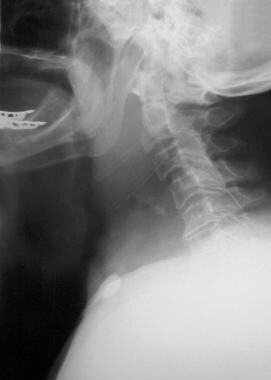
    • Infection: Cervical osteomyelitis and retropharyngeal space infection may be confused with IST.
    • Tumors: Tumors may cause IST-like symptoms by producing a mass effect on the muscle.
    • Trauma: Occipital condyle fractures, cervical muscle spasm following motor vehicle accident, and odontoid fractures may simulate torticollis.
    • Cervical disk disease: Subluxation and/or herniation can cause deviation to one side.
    • Drug-induced condition: L-dopa and neuroleptics may induce focal dystonias. Alcohol may worsen underlying torticollis.
    • Ocular condition: Patients with palsy of the inferior oblique muscle hold their heads at an angle to correct visual disturbances.
    • Essential head tremor: Tremor may precede or coexist with IST and can be stopped with intentional turning of the head. As with IST, medication lists should be reviewed.
  DIFFERENTIALS Section 4 of 11   Click here to go to the previous section in this topic Click here to go to the top of this page Click here to go to the next section in this topic
Author Information Introduction Clinical Differentials Workup Treatment Medication Follow-up Miscellaneous Pictures Bibliography

Peritonsillar Abscess
Retropharyngeal Abscess
Toxicity, Neuroleptic Agents


Other Problems to be Considered:

Conversion disorder

Quick Find
Author Information
Introduction
Clinical
Differentials
Workup
Treatment
Medication
Follow-up
Miscellaneous
Pictures
Bibliography

Click for related images.

Related Articles
Peritonsillar Abscess

Retropharyngeal Abscess

Toxicity, Neuroleptic Agents


Patient Education


  WORKUP Section 5 of 11   Click here to go to the previous section in this topic Click here to go to the top of this page Click here to go to the next section in this topic
Author Information Introduction Clinical Differentials Workup Treatment Medication Follow-up Miscellaneous Pictures Bibliography

Imaging Studies:

  • Plain cervical radiographs may be useful to exclude bony trauma or osteomyelitis.
  • MRIs of the head may help rule out brain tumor. MRIs also may help if a herniated intervertebral cervical disk is suspected.
  • CT scans are useful to identify and exclude retropharyngeal abscess or other neck mass. Brain CT scans may not equal brain MRIs, but they are more likely to be available to ED physicians.
  TREATMENT Section 6 of 11   Click here to go to the previous section in this topic Click here to go to the top of this page Click here to go to the next section in this topic
Author Information Introduction Clinical Differentials Workup Treatment Medication Follow-up Miscellaneous Pictures Bibliography

Prehospital Care: Immobilize the cervical spine for any patient with acute torticollis and a history of neck trauma.

Emergency Department Care: Patients with torticollis may present to the ED because of adverse effects of therapy for another disease. Identify and appropriately treat the cause. Review the medication list of all patients with IST or essential head tremor.

Consultations:

  • Refer most patients with symptoms suggestive of IST to a neurologist for follow-up.
  • Since IST progresses slowly and is stable, immediate consultation is unnecessary.
  • Referral to a neurologist specializing in movement disorders may hasten diagnosis and treatment.

  MEDICATION Section 7 of 11   Click here to go to the previous section in this topic Click here to go to the top of this page Click here to go to the next section in this topic
Author Information Introduction Clinical Differentials Workup Treatment Medication Follow-up Miscellaneous Pictures Bibliography

Drugs of choice for IST include benzodiazepines, anticholinergics, and local intramuscular injections of botulinum toxin (BOTOX®). Emergency physicians, as standard practice, do not administer BOTOX® injections. Tertiary referral centers perform most injections.

Drug Category: Benzodiazepines -- By binding to specific receptor sites, these agents appear to potentiate effects of gamma-aminobutyric acid (GABA), facilitate inhibitory GABA neurotransmission, and assist other inhibitory transmitters. Benzodiazepines may act in the spinal cord to induce muscle relaxation.
Drug Name
Diazepam (Valium) -- Depresses all levels of CNS, including limbic and reticular formation, possibly by increasing GABA activity.
Adult Dose2-10 mg PO bid/qid
Pediatric Dose1-2.5 mg PO tid/qid initially; increase gradually as needed or tolerated
ContraindicationsDocumented hypersensitivity; narrow-angle glaucoma
Interactions Increases toxicity of benzodiazepines in CNS with coadministration of phenothiazines, barbiturates, alcohols, and MAOIs
Pregnancy D - Unsafe in pregnancy
PrecautionsCaution with other CNS depressants, low albumin levels, or hepatic disease (may increase toxicity)
Drug Category: Presynaptic acetylcholine release inhibitors -- Block neuromuscular conduction by binding to receptor sites on motor nerve terminals, entering nerve terminals, and inhibiting release of acetylcholine.
Drug Name
Botulinum toxin type A (BOTOX®) -- Useful in reducing excessive abnormal contractions associated with torticollis. Binds to receptor sites on motor nerve terminals and inhibits release of acetylcholine, which in turn inhibits transmission of impulses in neuromuscular tissue.
Adult DoseInitial: 1.25-2.5 U (0.05-0.1 mL) IM into most active neck muscles; repeat q3-4mo; not to exceed 200 U cumulative BOTOX® type A dose in 1-mo period
Pediatric Dose<12 years: Not established
>12 years: Administer as in adults
ContraindicationsDocumented hypersensitivity
InteractionsAminoglycosides or drugs that interfere with neuromuscular transmission may potentiate effects
Pregnancy C - Safety for use during pregnancy has not been established.
PrecautionsDo not exceed recommended dosages and frequencies of administration; therapy effectiveness reduced with presence of BOTOX® type A antibodies; complications may include dysphagia, headache, malaise, and generalized motor weakness
Drug Name
Botulinum toxin type B (Myobloc) -- Paralyses muscle by blocking neurotransmitter release. Cleaves synaptic vesicle association membrane protein (VAMP, synaptobrevin), which is component of protein complex responsible for docking and fusion of synaptic vesicle to presynaptic membrane.
Adult Dose2500-5000 U IM divided among affected muscles in patients treated previously with any type of botulinum toxin; use lower dose in untreated patients
Pediatric DoseNot established
ContraindicationsDocumented hypersensitivity; coadministration of neuromuscular blockers; diseases of neuromuscular transmission; coagulopathy; uncooperative patient
InteractionsAminoglycosides or drugs that interfere with neuromuscular transmission may potentiate effects of botulinum toxin
Pregnancy C - Safety for use during pregnancy has not been established.
PrecautionsCaution if inflammation, excessive weakness, or atrophy occurs at proposed injection site; may increase risk of dysphagia and respiratory complications; concurrent use with botulinum toxin type A or within 4 mo of type B administration not recommended; presence of antibodies to botulinum toxin type B may reduce effects of therapy (avoid higher doses or frequent administration)
Drug Category: Anticholinergics -- Anticholinergics are thought to work centrally by suppressing conduction in vestibular cerebellar pathways; these agents may have an inhibitory effect on the parasympathetic nervous system.
Drug Name
Trihexyphenidyl (Artane) -- Centrally acting anticholinergic that tends to diminish muscle spasms.
Adult Dose1-2 mg on day 1; increase by 2 mg PO q3-5d to 6-10 mg/d
Pediatric DoseNot established
ContraindicationsDocumented hypersensitivity; glaucoma, peptic ulcers, pyloric or duodenal obstruction, stenotic prostatic hypertrophy or bladder neck obstructions, achalasia, and toxic megacolon
InteractionsAmantadine and anticholinergic coadministration may increase anticholinergic adverse effects that disappear when dose is reduced; haloperidol and anticholinergic coadministration may result in worsening of schizophrenic symptoms and decreased haloperidol serum concentrations; pharmacologic-therapeutic actions of phenothiazines may be reduced by concurrent administration of anticholinergics
Pregnancy C - Safety for use during pregnancy has not been established.
PrecautionsDose adjustment may be required in geriatric patients; caution in tachycardia, cardiac hypotension, prostatic hypertrophy, arrhythmias, hypertension, or tendency for urinary retention, liver or kidney disorders, and obstructive disease of GI or GU tract; if dry mouth severe and impairs swallowing or speaking or if loss of appetite and weight occurs, reduce dosage or discontinue medication temporarily
  FOLLOW-UP Section 8 of 11   Click here to go to the previous section in this topic Click here to go to the top of this page Click here to go to the next section in this topic
Author Information Introduction Clinical Differentials Workup Treatment Medication Follow-up Miscellaneous Pictures Bibliography

Prognosis:

Patient Education:

  MISCELLANEOUS Section 9 of 11   Click here to go to the previous section in this topic Click here to go to the top of this page Click here to go to the next section in this topic
Author Information Introduction Clinical Differentials Workup Treatment Medication Follow-up Miscellaneous Pictures Bibliography

Medical/Legal Pitfalls:

  • ED physicians should not diagnose IST if the patient has acute torticollis. Consider other causes.
  • Unusual cervical disk herniation or bony subluxation, on occasion, causes acute wryneck or torticollis.
  PICTURES Section 10 of 11   Click here to go to the previous section in this topic Click here to go to the top of this page Click here to go to the next section in this topic
Author Information Introduction Clinical Differentials Workup Treatment Medication Follow-up Miscellaneous Pictures Bibliography

Caption: Picture 1. A 69-year-old woman presents with torticollis and a fever.

Click to see larger pictureClick to see detailView Full Size Image
Picture Type: Image
Caption: Picture 2. Soft-tissue neck radiograph demonstrates retropharyngeal abscess appearing as torticollis.
Click to see larger pictureClick to see detailView Full Size Image
Picture Type: X-RAY
  BIBLIOGRAPHY Section 11 of 11   Click here to go to the previous section in this topic Click here to go to the top of this page
Author Information Introduction Clinical Differentials Workup Treatment Medication Follow-up Miscellaneous Pictures Bibliography

  • Bittar RG, Yianni J, Wang S, et al: Deep brain stimulation for generalised dystonia and spasmodic torticollis. J Clin Neurosci 2005 Jan; 12(1): 12-6[Medline].
  • Claypool DW, Duane DD, Ilstrup DM, Melton LJ III: Epidemiology and outcome of cervical dystonia (spasmodic torticollis) in Rochester, Minnesota. Mov Disord 1995 Sep; 10(5): 608-14[Medline].
  • Costa J, Espirito-Santo C, Borges A, et al: Botulinum toxin type B for cervical dystonia. Cochrane Database Syst Rev 2005; CD004315[Medline].
  • Denislic M, Pirtosek Z, Vodusek DB, et al: Botulinum toxin in the treatment of neurological disorders. Ann N Y Acad Sci 1994 Mar 9; 710: 76-87[Medline].
  • Duane DD: Spasmodic torticollis. Adv Neurol 1988; 49: 135-50[Medline].
  • Gauthier S: Idiopathic spasmodic torticollis: pathophysiology and treatment. Can J Neurol Sci 1986 May; 13(2): 88-90[Medline].
  • Hakkinen A, Ylinen J, Rinta-Keturi M, et al: Decreased neck muscle strength is highly associated with pain in cervical dystonia patients treated with botulinum toxin injections. Arch Phys Med Rehabil 2004 Oct; 85(10): 1684-8[Medline].
  • Havaki-Kontaxaki BJ, Kontaxakis VP, Margariti MM, et al: Treatment of severe neuroleptic-induced tardive torticollis. Ann Gen Hosp Psychiatry 2003 Oct 17; 2(1): 9[Medline].
  • Joyce MB, de Chalain TM: Treatment of recalcitrant idiopathic muscular torticollis in infants with botulinum toxin type a. J Craniofac Surg 2005 Mar; 16(2): 321-7[Medline].
  • Lee LH, Chang WN, Chang CS: The finding and evaluation of EMG-guided BOTOX injection in cervical dystonia. Acta Neurol Taiwan 2004 Jun; 13(2): 71-6[Medline].
  • Sa DS, Mailis-Gagnon A, Nicholson K, Lang AE: Posttraumatic painful torticollis. Mov Disord 2003 Dec; 18(12): 1482-91[Medline].
  • Singh S, Goyal V, Prasad K, Behari M: Cervical dystonia responsive to levodopa. Neurol India 2004 Jun; 52(2): 276-8[Medline].
  • Takeuchi N, Chuma T, Mano Y: Phenol block for cervical dystonia: effects and side effects. Arch Phys Med Rehabil 2004 Jul; 85(7): 1117-20[Medline].
  • Truong D, Duane DD, Jankovic J, et al: Efficacy and safety of botulinum type A toxin (Dysport) in cervical dystonia: results of the first US randomized, double-blind, placebo-controlled study. Mov Disord 2005 Jul; 20(7): 783-91[Medline].
  • van Herwaarden GM, Anten HW, Hoogduin CA, et al: Idiopathic spasmodic torticollis: a survey of the clinical syndromes and patients' experiences. Clin Neurol Neurosurg 1994 Aug; 96(3): 222-5[Medline].

Torticollis excerpt