Continually Updated Clinical Reference
 
 
  All Sources     eMedicine     Medscape     Drug Reference     MEDLINE
 
eMedicine - Spider Envenomations, Tarantula : Article by

Quick Find
Authors & Editors
Introduction
Clinical
Differentials
Workup
Treatment
Medication
Follow-up
Multimedia
References

Related Articles
Anaphylaxis

Bee and Hymenoptera Stings

Bites, Insects

Caterpillar Envenomations

Centipede Envenomations

Conjunctivitis

Corneal Abrasion

Dermatitis, Contact

Iritis and Uveitis

Spider Envenomations, Brown Recluse

Spider Envenomations, Funnel Web

Spider Envenomations, Redback

Spider Envenomations, Widow


Patient Education
Bites and Stings Center

Black Widow Spider Bite Overview

Black Widow Spider Bite Symptoms

Black Widow Spider Bite Treatment


Author: Scott D Fell, DO, FAAEM, Medical Director, Emergency Care Center, Venice Regional Medical Center

Scott D Fell is a member of the following medical societies: American Academy of Emergency Medicine

Coauthor(s): Christina L Kukula, DO, Consulting Staff, Walk-in-Care Center, Bon Secours Venice Hospital

Editors: Robert Norris, MD, Chief, Associate Professor, Department of Surgery, Division of Emergency Medicine, Stanford University Medical Center; John T VanDeVoort, PharmD, ABAT, Director of Pharmacy, Sacred Heart Hospital; Matthew M Rice, MD, JD, Vice President, Chief Medical Officer, Northwest Emergency Physicians, Assistant Clinical Professor of Medicine, University of Washington at Seattle; Assistant Clinical Professor, Uniformed Services University of Health Sciences; John D Halamka, MD, MS, Associate Professor of Medicine, Harvard Medical School, Beth Israel Deaconess Medical Center; Chief Information Officer, CareGroup Healthcare System and Harvard Medical School; Attending Physician, Division of Emergency Medicine, Beth Israel Deaconess Medical Center; Jonathan Adler, MD, Attending Physician, Department of Emergency Medicine, Massachusetts General Hospital; Division of Emergency Medicine, Harvard Medical School

Author and Editor Disclosure

Synonyms and related keywords: spider bite, hairy spider, poisonous spider, Theraphosidae, Orthognatha, Theraphosa blondi, Aphonopelma, Grammastola, arachnophobia, tarantula envenomation, spider envenomation

Background

Tarantulas are among the largest spiders in the world and likely the most feared. Emergency physicians are increasingly likely to encounter patients who have had tarantula contact as the popularity of tarantulas as pets is increasing.

Tarantulas belong to the suborder Orthognatha and the family Theraphosidae. These large (2.5-7.5 cm) arachnids are slow moving. Females can live as long as 35 years, while the male life span is generally 5-7 years. They have poor eyesight and sense their prey through vibrations. The largest species, Theraphosa blondi, which is found in South America, can have fangs 1 inch long and a leg span up to 12 inches.

Tarantulas generally can be found in tropical and subtropical areas of the world. The largest tarantulas are found in South America. In the United States, great numbers are found in the southwestern states. Most tarantulas sold in pet stores in the United States are imported species of Aphonopelma.

Although tarantulas often evoke panic and anxiety on sight, these hairy long-legged spiders generally are nonaggressive and rarely bite. Tarantulas usually retreat as their main line of defense.

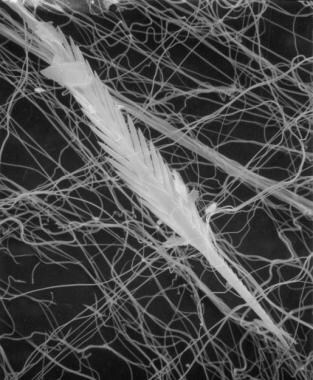
If forced to defend itself, the arachnid may flick very fine, fiberglasslike, sharp, barbed hairs from its abdomen at its enemy (see Images 1-2). These may stimulate ocular, dermatologic, and respiratory tract irritation. Density of hairs on the abdomen is approximately 10,000 per mm2.
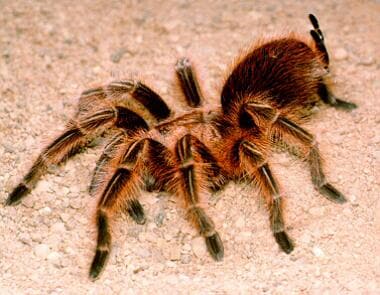
A tarantula may bite, but first assumes a strike position by raising its front pair of legs and rearing back on its abdomen.

Of historical interest is a piece of 14th-century folklore that arose from the Lycosa tarentula (actually a wolf spider) of southern Italy. Certain individuals who thought they had been bitten by this spider would attempt to exhaust themselves by dancing wildly. This condition came to be referred to as tarantism. It has been suggested that the arachnids responsible for these episodes were actually widow spiders of the genus Latrodectus.

Also from the Middle Ages are reports of a dancing mania known as Tanzwuth that was attributed to spider bites. So-called victims would seek out minstrels who would play instruments with shrill tones; this music caused the victims to dance until they fainted. Seizures, demonic possession, and tarantula bites all have been proposed as causes of this behavior. However, no true etiology has been identified, and dancing mania still remains a mystery.

Pathophysiology

Because of the tarantula's forms of defense, human injury is limited mainly to skin and ocular involvement, with occasional respiratory symptoms.

Tarantula venom is rarely toxic to humans; bites from tarantula species in the United States can be painful but are not considered dangerous. The typical effects are no more serious than those of Hymenoptera stings. The most common reaction is a low-grade histamine response.

Envenomations from the funnel web spider of southern and eastern Australia can be dangerous, even fatal (see Spider Envenomations, Funnel Web).

Hairs discharged from the tarantula can penetrate several layers of skin or ocular tissue and cause mechanical irritation. Urticating hair morphology ranges from type I to type IV. Only type I hairs are found in US tarantulas, and these do not penetrate the skin as deeply as other types. Type III hairs can penetrate up to 2 mm, causing inflammation and local reaction. Although not common, inhalation of urticating hairs may cause significant allergic rhinitis. Exposure to hairs of certain species in South America (Grammastola) can suffocate small mammals within 2 hours.

Frequency

United States

Approximately 40 species of tarantulas live in the United States. The incidence of tarantula-inflicted injuries is not known.

International

More than 1500 species of tarantulas live throughout the world. Outside the United States, tarantulas can be found in Mexico, Central America, South America, the Caribbean Islands, Africa, areas of Europe bordering the Mediterranean Sea, and Australia.

Mortality/Morbidity

While all North American species are relatively harmless, a few species in South America, Africa, and Australia may be dangerous to humans (see Spider Envenomations, Funnel Web).


History

  • Bites
    • Unprovoked bites are uncommon because tarantulas are usually docile; patients usually are able to tell what has inflicted their injury.
    • Most patients bitten by tarantulas complain of mild pain similar to a pinprick. Some tarantula bites can cause severe pain, local swelling, and numbness.
    • Some patients have reported arthritic stiffness lasting for weeks following bites near joints. No permanent deficits have been reported.
  • Skin
    • Symptoms at the site of hair penetration include irritation, severe pruritus, edema, and erythema.
    • Rarely, anaphylaxis may follow such exposure.
  • Eye
    • Ocular exposure to tarantula hairs may lead to redness and an itchy or gritty sensation.
    • A careful history may be necessary to identify this cause of ocular symptoms because patients may not relate the symptoms directly to tarantula exposure.
  • Respiratory: Significant allergic rhinitis may be present in patients who have inhaled hairs.

Physical

The findings following a tarantula bite closely resemble those of Hymenoptera stings (ie, local swelling and erythema). As noted above, the exception is the bite of the funnel web spider, which is found outside the United States.

  • Skin
    • Like insect bites, tarantula bites cause local erythema and edema.
    • Erythema and pruritic papules may be observed in skin exposed to urticating abdominal hairs. This exposure also may lead to an allergic reaction and, rarely, precipitates anaphylaxis.
    • The risk of serious reactions is much higher outside the United States, where spiders with type III and type IV hairs are found.
  • Eye
    • Several cases of ocular injuries from discharged hairs have been described in the literature.
    • Patients may have a red eye and associated keratoconjunctivitis. Depending on the depth of hair penetration, patients also may have conjunctival injection or anterior chamber inflammation.
    • Ophthalmia nodosa has been diagnosed in several individuals with resulting panuveitis that still was clinically active up to 72 months following the initial diagnosis.
    • Multiple fine intracorneal hairs may be observed on slit-lamp examination; however, they may be elusive because of their small size and location.
    • The right eye is affected more commonly than the left eye in patients who are right-hand dominant and handle tarantulas.
  • Respiratory: Allergic rhinitis signs and symptoms may be present if a patient has inhaled urticating hairs.


Anaphylaxis
Bee and Hymenoptera Stings
Bites, Insects
Caterpillar Envenomations
Centipede Envenomations
Conjunctivitis
Corneal Abrasion
Dermatitis, Contact
Iritis and Uveitis
Spider Envenomations, Brown Recluse
Spider Envenomations, Funnel Web
Spider Envenomations, Redback
Spider Envenomations, Widow


Lab Studies

  • No specific diagnostic studies, laboratory tests, or imaging studies are helpful in the evaluation and treatment of patients with injuries inflicted by tarantulas.

Procedures

  • Careful slit-lamp biomicroscopic examination is indicated for a patient presenting with ocular concerns. Examination with fluorescein is then also indicated.


Prehospital Care

  • Capture the offending arachnid for identification if it is possible to do so safely.
  • Begin supportive therapy for patients who are having a rare allergic reaction or anaphylaxis.
  • Following ocular exposure, place a protective shield over the eyes to prevent the patient from rubbing the eyes and possibly driving hairs deeper.

Emergency Department Care

A patient with anaphylaxis or allergic reaction requires prompt supportive care and attention to the ABCs.

In patients with severe reaction, establish an intravenous line, provide supplemental oxygen, and place them on a cardiac monitor.

  • Skin
    • Protect areas of localized dermatitis and allergic reactions with appropriate local wound care, including wound cleansing and ice to decrease inflammation.
    • Determine tetanus immunization status and provide prophylaxis as needed.
    • Treat pruritus and erythema with antihistamines and corticosteroids.
    • Administer parenteral or enteral analgesics to relieve severe pain.
  • Eye
    • Ocular injury caused by tarantula hairs can be complicated and requires ophthalmologic consultation.
    • After initial evaluation, patients should be treated with a topical broad-spectrum antibiotic.
    • Topical steroids are required for patients with panuveitis or keratoconjunctivitis; they should be prescribed only after consultation with an ophthalmologist.
    • As with skin contact, tetanus prophylaxis is indicated when the eye is involved.

Consultations

Patients can develop long-term inflammatory changes in the eye exposed to tarantula hairs, and definitive diagnosis of retained hairs cannot always be made by routine ED slit-lamp examination. Consulting an ophthalmologist is mandatory in such exposures.


No existing medications are specific to treat tarantula injuries occurring in the United States. Medical therapy is directed mainly at symptom relief.

One species of the funnel web spider (Atrax robustus) of Australia produces highly toxic venom that is neurotoxic and potentially fatal. Antivenom specific to Atrax has been developed and is used in Australia.

Drug Category: Antihistamines

Prevent but do not reverse histamine-mediated responses, particularly in smooth muscle of the bronchi, GI tract, uterus, and blood vessels. Prevent histamine responses in sensory nerve endings. Commonly used for temporary relief of symptoms caused by allergic conditions.

Drug NameDiphenhydramine (Benadryl)
DescriptionCompetes with histamine for cell receptor sites on effector cells; has anticholinergic (drying) and sedative adverse effects.
Adult Dose25-50 mg PO/IV/IM q6-8h; not to exceed 400 mg/d
Pediatric Dose5 mg/kg PO/IV/IM divided qid; not to exceed 300 mg/d
ContraindicationsDocumented hypersensitivity; syrup form only contraindicated with medications that cause disulfiramlike reaction
InteractionsPotentiates effects of CNS depressants
PregnancyB - Usually safe but benefits must outweigh the risks.
PrecautionsCaution in patients with exacerbation of urinary tract obstruction, angle-closure glaucoma, peptic ulcer, and hyperthyroidism

Drug NameCetirizine (Zyrtec)
DescriptionForms a complex with histamine to block H1-receptor sites on target cells in blood vessels, GI tract, and respiratory tract.
Adult Dose5-10 mg PO qd
Pediatric DoseNeonates: Not recommended
<2 years: Not established
2-5 years: 2.5 mg PO qd
>6 years: Administer as in adults
ContraindicationsDocumented hypersensitivity, neonates, premature infants, nursing mothers
InteractionsPotentiates effects of CNS depressants
PregnancyB - Usually safe but benefits must outweigh the risks.
PrecautionsHepatic or renal dysfunction; doses >10 mg/d may cause drowsiness

Drug Category: Corticosteroids

Modify the body's immune response to diverse stimuli. Suppress the migration of polymorphonuclear (PMN) leukocytes and reverse increased capillary permeability, reducing inflammatory processes. Can cause profound and varied metabolic effects.

Drug NamePrednisone (Deltasone, Sterapred, Orasone)
DescriptionHas potent antiinflammatory effects in disorders of many organ systems.
Adult Dose5-60 mg/d PO; usual dose is 40 mg/d PO for 5 d
Pediatric Dose0.1-2 mg/kg/d PO or divided tid; usual dose is 2 mg/kg PO in one dose on day 1, then 1 mg/kg/d PO or divided tid for 5 d
ContraindicationsDocumented hypersensitivity; viral, fungal, or tubercular skin lesions
InteractionsDecreases effects of salicylates and toxoids (for immunizations) when administered concomitantly; effects decreased by phenytoin, carbamazepine, barbiturates, and rifampin
PregnancyC - Safety for use during pregnancy has not been established.
PrecautionsHyperthyroidism, osteoporosis, cirrhosis, nonspecific ulcerative colitis, peptic ulcer, diabetes, myasthenia gravis

Drug Category: Ophthalmic agents

Used for inflammatory conditions in which corticosteroids are indicated and risk of infection exists.

Drug NameNeomycin, polymyxin B and hydrocortisone (Cortisporin)
DescriptionHydrocortisone suppresses inflammatory response. Because it also may inhibit body's defense mechanism against infection, a concomitant antimicrobial drug may be used, giving rationale for combination. Anti-infective components are included to provide action against specific susceptible organisms.
Adult DoseOintment: Apply thin layer to cover lesion qd/qid
Solution: 1-3 gtt in affected eye q1-2h while awake
Pediatric DoseAdminister as in adults
ContraindicationsDocumented hypersensitivity; viral infections
InteractionsNone reported
PregnancyC - Safety for use during pregnancy has not been established.
PrecautionsExtended use can lead to resistant infections and thinning or atrophy of the skin


Further Inpatient Care

  • Except for cases of significant anaphylaxis, inpatient care is not indicated.

Further Outpatient Care

  • Patients with local dermatitis caused by urticating hairs should be discharged from the ED with a course of oral corticosteroids (eg, prednisone) and an antihistamine such as cetirizine (Zyrtec) or diphenhydramine (Benadryl).
  • Cetirizine may be preferred because of its lower incidence of anticholinergic adverse effects and the convenience of once-a-day dosing. The drawback of cetirizine is its higher cost.
  • A prescription for oral analgesics also should be provided.
  • Local skin wounds from tarantula bites or urticating hairs should be re-examined in 48 hours; patients should be educated regarding the signs and symptoms of infection.
  • Patients with ocular involvement should be seen by an ophthalmologist as soon as possible (<24 h).

Deterrence/Prevention

  • Tarantula bites can be avoided almost completely by not attempting to handle or harass these arachnids. Wearing gloves when gardening and being cautious about hand placement can prevent accidental bites.

Complications

  • Ophthalmia nodosa and panuveitis can complicate ocular exposure to tarantula hairs.

Prognosis

  • Experience with ocular injuries is somewhat limited, and more information is necessary for accurate conclusions regarding long-term prognosis.
  • Recovery from eye injuries may be prompt but has been delayed up to 72 months.
  • No cases of infection from tarantula bites or skin exposure to urticarial hairs have been reported; therefore, prophylactic antibiotics are not recommended.

Patient Education

  • As tarantulas become increasingly popular as pets, owners need to be aware of the potential injuries that can occur.
  • Discourage frequent and routine handling of tarantulas. Handlers should wear gloves, avoid tarantula contact with their face and eyes, and wash their hands after working with tarantulas.
  • For excellent patient education resources, visit eMedicine's Bites and Stings Center. Also, see eMedicine's patient education articles, Black Widow Spider Bite and Brown Recluse Spider Bite.


Media file 1:  The Chilean rose tarantula. The urticating hairs are clearly visible. Courtesy of Mike Dembinsky.
Click to see larger pictureClick to see detailView Full Size Image
Media type:  Photo

Media file 2:  Enlargement of tarantula hairs. Courtesy of Cara Shillington.
Click to see larger pictureClick to see detailView Full Size Image
Media type:  Photo

Media file 3:  Slit-lamp photograph showing 2 central infiltrates caused by urticating tarantula hairs (arrows). Courtesy of Southern Medical Journal and David A. Belyea, MD.

Click to see larger pictureClick to see detailView Full Size Image
Media type:  Photo


  • Allen C. Arachnid envenomations. Emerg Med Clin North Am. May 1992;10(2):269-98. [Medline].
  • American Tarantula Society. American Tarantula Society Web site. [Full Text].
  • Auerbach PS, ed. Wilderness Medicine: Management of Wilderness and Environmental Emergencies. 3rd ed. St. Louis: Mosby-Year Book;1995:769-86.
  • Belyea DA, Tuman DC, Ward TP, Babonis TR. The red eye revisited: ophthalmia nodosa due to tarantula hairs. South Med J. Jun 1998;91(6):565-7. [Medline].
  • Blaikie AJ, Ellis J, Sanders R, MacEwen CJ. Eye disease associated with handling pet tarantulas: three case reports. BMJ. May 24 1997;314(7093):1524-5. [Medline].
  • Diekema DS, Reuter DG. Environmental Emergencies: Arthropod Bites and Stings. Clinical Pediatric Emergency Medicine. 2001;2.
  • Donaldson LJ, Cavanagh J, Rankin J. The dancing plague: a public health conundrum. Public Health. Jul 1997;111(4):201-4. [Medline].
  • Kelley TD 3rd, Wasserman G. The dangers of pet tarantulas: experience of the Marseilles Poison Centre. J Toxicol Clin Toxicol. 1998;36(1-2):55-6. [Medline].
  • Morens DM. Mass fainting at medieval rock concerts. N Engl J Med. Nov 16 1995;333(20):1361. [Medline].
  • National Geographic Society. National Geographic Web site. [Full Text].
  • Sandboe FD. Spider keratouveitis. A Case Report. Acta Ophthalmologica Scandinavica. 2001;79(5):531-2. [Medline].
  • Saucier JR. Arachnid envenomation. Emerg Med Clin North Am. May 2004;22(2):405-22. [Medline].
  • Shrum KR, Robertson DM, Baratz KH, et al. Keratitis and retinitis secondary to tarantula hair. Arch Ophthalmol. Aug 1999;117(8):1096-7. [Medline].
  • Thorpe SJ, Salkovskis PM. Selective attention to real phobic and safety stimuli. Behav Res Ther. May 1998;36(5):471-81. [Medline].
  • Waggoner TL, Nishimoto JH, Eng J. Eye injury from tarantula. J Am Optom Assoc. Mar 1997;68(3):188-90. [Medline].
  • Watts P, Mcpherson R, Hawksworth NR. Tarantula keratouveitis. Cornea. May 2000;19(3):393-4. [Medline].

Spider Envenomations, Tarantula excerpt

Article Last Updated: Aug 29, 2006