Lisboa C, Ferreira A, Resende C, Rodrigues AG. Infectious balanoposthitis: management, clinical and laboratory features. Int J Dermatol. 2009 Feb. 48(2):121-4. [QxMD MEDLINE Link].
Kuehhas FE, Miernik A, Weibl P, Schoenthaler M, Sevcenco S, Schauer I, et al. Incidence of Balanitis Xerotica Obliterans in Boys Younger than 10 Years Presenting with Phimosis. Urol Int. 2012 Dec 29. [QxMD MEDLINE Link].
Mohammed A, Shegil IS, Christou D, Khan A, Barua JM. Paediatric balanitis xerotica obliterans: an 8-year experience. Arch Ital Urol Androl. 2012 Mar. 84(1):12-6. [QxMD MEDLINE Link].
Boksh K, Patwardhan N. Balanitis xerotica obliterans: has its diagnostic accuracy improved with time?. JRSM Open. 2017 Jun. 8 (6):2054270417692731. [QxMD MEDLINE Link].
[Guideline] Edwards S, Bunker C, Ziller F, van der Meijden WI. 2013 European guideline for the management of balanoposthitis. Int J STD AIDS. 2014 May 14. 25 (9):615-626. [QxMD MEDLINE Link].
Kiss A, Király L, Kutasy B, Merksz M. High incidence of balanitis xerotica obliterans in boys with phimosis: prospective 10-year study. Pediatr Dermatol. 2005 Jul-Aug. 22(4):305-8. [QxMD MEDLINE Link].
Kizer WS, Prarie T, Morey AF. Balanitis xerotica obliterans: epidemiologic distribution in an equal access health care system. South Med J. 2003 Jan. 96(1):9-11. [QxMD MEDLINE Link].
Pugliese JM, Morey AF, Peterson AC. Lichen sclerosus: review of the literature and current recommendations for management. J Urol. 2007 Dec. 178(6):2268-76. [QxMD MEDLINE Link].
Pradhan A, Patel R, Said AJ, Upadhyaya M. 10 Years' Experience in Balanitis Xerotica Obliterans: A Single-Institution Study. Eur J Pediatr Surg. 2018 Aug 21. [QxMD MEDLINE Link].
Charlton OA, Smith SD. Balanitis xerotica obliterans: a review of diagnosis and management. Int J Dermatol. 2018 Oct 12. [QxMD MEDLINE Link].
Kalra S, Chawla A. Diabetes and balanoposthitis. J Pak Med Assoc. 2016 Aug. 66 (8):1039-41. [QxMD MEDLINE Link].
Snodgrass W, Blanquel JS, Bush NC. Recurrence after management of meatal balanitis xerotica obliterans. J Pediatr Urol. 2017 Apr. 13 (2):204.e1-204.e6. [QxMD MEDLINE Link].
Plasma Cell Balanitis (Zoon's Balanitis). American Urological Association. Available at http://www.auanet.org/education/auauniversity/education-products-and-resources/pathology-for-urologists/penis/inflammatory-and-tumor-like-lesions/plasma-cell-balanitis-(zoons-balanitis). Accessed: September 24, 2018.
Johnsson KM, Ptaszynska A, Schmitz B, Sugg J, Parikh SJ, List JF. Vulvovaginitis and balanitis in patients with diabetes treated with dapagliflozin. J Diabetes Complications. 2013 Sep-Oct. 27(5):479-84. [QxMD MEDLINE Link].
Njomnang Soh P, Vidal F, Huyghe E, Gourdy P, Halimi JM, Bouhanick B. Urinary and genital infections in patients with diabetes: How to diagnose and how to treat. Diabetes Metab. 2015 Aug 28. [QxMD MEDLINE Link].
Borelli S, Lautenschlager S. [Differential diagnosis and management of balanitis]. Hautarzt. 2015 Jan. 66 (1):6-11. [QxMD MEDLINE Link].
Celis S, Reed F, Murphy F, Adams S, Gillick J, Abdelhafeez AH, et al. Balanitis xerotica obliterans in children and adolescents: a literature review and clinical series. J Pediatr Urol. 2014 Feb. 10 (1):34-9. [QxMD MEDLINE Link].
Hugh JM, Lesiak K, Greene LA, Pierson JC. Zoon's balanitis. J Drugs Dermatol. 2014 Oct. 13 (10):1290-1. [QxMD MEDLINE Link].
Torchia D, Cappugi P. Photodynamic therapy for Zoon balanitis. Eur J Dermatol. 2014 Nov-Dec. 24 (6):707. [QxMD MEDLINE Link].
Bakkour W, Chularojanamontri L, Motta L, Chalmers RJ. Successful use of dapsone for the management of circinate balanitis. Clin Exp Dermatol. 2014 Apr. 39 (3):333-5. [QxMD MEDLINE Link].
Dayal S, Sahu P. Zoon balanitis: A comprehensive review. Indian J Sex Transm Dis. 2016 Jul-Dec. 37 (2):129-138. [QxMD MEDLINE Link].
Homer L, Buchanan KJ, Nasr B, Losty PD, Corbett HJ. Meatal Stenosis in Boys following Circumcision for Lichen Sclerosus (Balanitis Xerotica Obliterans). J Urol. 2014 Jun 30. [QxMD MEDLINE Link].
[Guideline] Pandya I, Shinojia M, Vadukul D, Marfatia YS. Approach to balanitis/balanoposthitis: Current guidelines. Indian J Sex Transm Dis. 2014 Jul-Dec. 35 (2):155-7. [QxMD MEDLINE Link].
Georgala S, Gregoriou S, Georgala C, et al. Pimecrolimus 1% cream in non-specific inflammatory recurrent balanitis. Dermatology. 2007. 215(3):209-12. [QxMD MEDLINE Link].
Zavras N, Christianakis E, Mpourikas D, Ereikat K. Conservative treatment of phimosis with fluticasone proprionate 0.05%: a clinical study in 1185 boys. J Pediatr Urol. 2009 Jun. 5(3):181-5. [QxMD MEDLINE Link].
Ashfield JE, Nickel KR, Siemens DR, MacNeily AE, Nickel JC. Treatment of phimosis with topical steroids in 194 children. J Urol. 2003 Mar. 169(3):1106-8. [QxMD MEDLINE Link].
Marques TC, Sampaio FJ, Favorito LA. Treatment of phimosis with topical steroids and foreskin anatomy. Int Braz J Urol. 2005 Jul-Aug. 31(4):370-4; discussion 374. [QxMD MEDLINE Link].
Steadman B, Ellsworth P. To circ or not to circ: indications, risks, and alternatives to circumcision in the pediatric population with phimosis. Urol Nurs. 2006 Jun. 26(3):181-94. [QxMD MEDLINE Link].
Van Howe RS. Neonatal circumcision and penile inflammation in young boys. Clin Pediatr (Phila). 2007 May. 46(4):329-33. [QxMD MEDLINE Link].
Philippou P, Shabbir M, Ralph DJ, Malone P, Nigam R, Freeman A, et al. Genital lichen sclerosus/balanitis xerotica obliterans in men with penile carcinoma: a critical analysis. BJU Int. 2013 May. 111(6):970-6. [QxMD MEDLINE Link].
Buechner SA. Common skin disorders of the penis. BJU Int. 2002 Sep. 90(5):498-506. [QxMD MEDLINE Link].
[Guideline] Edwards SK. European guideline for the management of balanoposthitis. Int J STD AIDS. 2001 Oct. 12 Suppl 3:68-72. [QxMD MEDLINE Link].
Huntley JS, Bourne MC, Munro FD, Wilson-Storey D. Troubles with the foreskin: one hundred consecutive referrals to paediatric surgeons. J R Soc Med. 2003 Sep. 96(9):449-51. [QxMD MEDLINE Link]. [Full Text].
McGregor TB, Pike JG, Leonard MP. Pathologic and physiologic phimosis: approach to the phimotic foreskin. Can Fam Physician. 2007 Mar. 53(3):445-8. [QxMD MEDLINE Link].
Muratov ID. [Bacteriological pattern of acute purulent balanoposthitis in children]. Zh Mikrobiol Epidemiol Immunobiol. 2004 Mar-Apr. 83-5. [QxMD MEDLINE Link].
O'Farrell N, Quigley M, Fox P. Association between the intact foreskin and inferior standards of male genital hygiene behaviour: a cross-sectional study. Int J STD AIDS. 2005 Aug. 16(8):556-9. [QxMD MEDLINE Link].

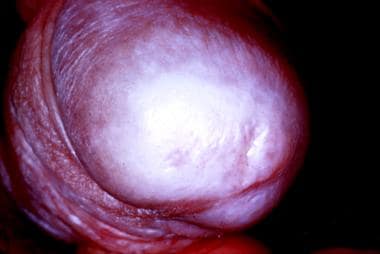 Balanitis xerotica obliterans (lichen sclerosus). Courtesy of Wilford Hall Medical Center Slide collection.




