You are in: eMedicine Specialties >
Emergency Medicine > GASTROINTESTINAL
Anal Fistulas and Fissures
Article Last Updated: Sep 27, 2007
AUTHOR AND EDITOR INFORMATION
Section 1 of 11
Author: Ingrid Legall, MD, Assistant Professor, Department of Emergency Medicine, Florida Hospital-Flagler
Ingrid Legall is a member of the following medical societies: American Academy of Emergency Medicine and American Medical Association
Editors: Michael S Beeson, MD, MBA, FACEP, Professor of Emergency Medicine, Northeastern Ohio Universities College of Medicine; Program Director, Emergency Medicine Residency, Summa Health System; Francisco Talavera, PharmD, PhD, Senior Pharmacy Editor, eMedicine; Eugene Hardin, FAAEM, FACEP, Former Chair and Associate Professor, Department of Emergency Medicine, Charles R Drew University of Medicine and Science; Former Chair, Department of Emergency Medicine, Martin Luther King, Jr/Drew Medical Center; John D Halamka, MD, MS, Associate Professor of Medicine, Harvard Medical School, Beth Israel Deaconess Medical Center; Chief Information Officer, CareGroup Healthcare System and Harvard Medical School; Attending Physician, Division of Emergency Medicine, Beth Israel Deaconess Medical Center; Robert E O'Connor, MD, MPH, Professor and Chair, Department of Emergency Medicine, University of Virginia Health System
Author and Editor Disclosure
Synonyms and related keywords:
fissure-in-ano, anal tear, anorectal disorder, intersphincteric fistula, transsphincteric fistula, suprasphincteric fistula, extrasphincteric fistula, anorectal abscess, rectal bleeding, rectal pain, bloody stools, pruritus, malodorous perianal drainage, perianal pain, sentinel pile, enlarged anal papillae, skin tag, acute fistulous abscess, chronic diarrhea, habitual use of cathartics, perianal abscesses, ischiorectal abscesses, syphilis, sexually transmitted diseases, tuberculosis, leukemia, inflammatory bowel disease, Crohn disease, diverticulitis, actinomycosis, chlamydia, lymphogranuloma venereum, LGV, radiation exposure, HIV, anorectal fistula
Background
An anal fissure is a superficial linear tear in the anoderm most commonly caused by passage of a large, hard stool. This tear is distal to the dentate line. Anal fissures are among the most common anorectal disorders in the pediatric population; however, adults also are affected. An anal fistula is an inflammatory tract between the anal canal and skin. The 4 categories of fistulas, based on the relationship of fistula to sphincter muscles, are intersphincteric, transsphincteric, suprasphincteric, and extrasphincteric.
Fissures are defined as acute if present for less than 6 weeks, and they are defined as chronic if present for more than 6 weeks.
Pathophysiology
In anal fissures, anus distal to dentate line is involved. About 90% of anal fissures occur in the posterior midline where skeletal muscle fibers that circle the anus are weakest. The remaining 10% are found in the anterior midline. Most anal fistulas originate in anal crypts, which become infected with abscess formation. When the abscess is opened or ruptures, a fistula is formed.
Sex
Anal fissures affect both sexes equally; however, an anterior fissure is more likely to develop in women (25%) than in men (8%).
- Anal fistulas are a complication of anorectal abscesses, which are more common in men than in women (male-to-female ratio of 2:1 to 3:1).
- Only 8% of anal fissures are anterior in men; 75-90% of fissures in women are posteriorly located.
- For reasons of intrinsic anatomy, rectovaginal fistulas are found only in women.
Age
Although anal fissures are the most common cause of rectal bleeding in infants, they are primarily seen in young adults.
- Eighty-seven percent of people with a chronic anal fissure are between the ages of 20 and 60 years old.
- Anal fissures in children may indicate sexual abuse.
History
- Rectal pain, usually described as burning, cutting, or tearing
- Pain with bowel movements; spasm of the anus is very suspicious for an anal fissure.
- Bloody stools
- Typically, bright-red blood appears on the surface of stools. Blood usually is not mixed into stool.
- Occasionally, blood is found on toilet paper after wiping.
- Patient may report no bleeding.
- Mucoid discharge
- Pruritus
- A patient with an anal fistula may complain of recurrent malodorous perianal drainage, pruritus, recurrent abscesses, fever, or perianal pain due to an occluded tract.
- Pain occasionally resolves spontaneously with reopening of a tract or formation of a new outflow tract.
- Pain occurs with sitting, moving, defecating, and even coughing.
- Pain usually is throbbing in quality and is constant throughout the day.
Physical
- Start by optimizing patient placement; place the patient in the left lateral decubitus position with knees drawn up toward the chest.
- Examine the patient carefully to avoid infliction of further pain or sphincter spasm. Examination may be facilitated by application of a topical anesthetic, such as Lidocaine jelly, prior to digital rectal examination.
- Most fissures are visible externally when the patient bears down as if having a bowel movement.
- Note the depth of the fissure and its orientation to the midline, often described using clock orientation of the hour hand.
- Most tears are found in the posterior midline.
- Rectal examination is generally difficult to tolerate because of sphincter spasm and pain.
- Acute fissures are erythematous and bleed easily.
- With chronic fissures, classic fissure triad may be seen.
- Deep ulcer
- Sentinel pile, which forms when the base of the fissure becomes edematous and hypertrophic (a resolving sentinel pile can result in a permanent skin tag or may become associated with a fistulous tract)
- Enlarged anal papillae
- Bidigital rectal examination in a patient with a fistula-in-ano may reveal an indurated tract or cord.
- Fistula can be identified by small circles of granulation tissue, which exude pus when compressed if tissue is patent.
- A fistulous tract that opens internally can be visualized with aid of an anoscope.
- Inguinal lymph nodes may be enlarged and painful.
- In an acute fistulous abscess, cardinal signs of inflammation, rubor, dolor, calor, and tumor (eg, erythema, pain, increased temperature, edema) may be found.
- Examination of the anus reveals a linear tear in fissure-in-ano.
Causes
- Passage of hard stool
- Chronic diarrhea
- Ten percent of chronic anal fissures are caused by childbirth.
- Habitual use of cathartics
- Anal trauma (can occur with anal intercourse or a rectal examination using a speculum or digit)
- Causes of anal fistula include opened perianal or ischiorectal abscesses, which drain spontaneously through these fistulous tracts.
- Anal fissures can be observed in patients with syphilis and other sexually transmitted diseases, tuberculosis, leukemia, inflammatory bowel disease such as Crohn disease, previous anal surgery, HIV, and other conditions or diseases.
- Incidence of anal fissures in patients with leukemia is approximately 24%.
- Fistulas are also found in patients with inflammatory bowel disease, particularly Crohn disease. The incidence of fissures in Crohn disease is 30-50%. Perianal activity often parallels abdominal disease activity, but it may occasionally be the primary site of active disease.
- Anal fistulas also are associated with diverticulitis, foreign body reactions, actinomycosis, chlamydia, lymphogranuloma venereum (LGV), syphilis, tuberculosis, radiation exposure, and HIV.
- Approximately 30% of patients with HIV develop anorectal abscesses and fistulas.
Diverticular Disease
Foreign Bodies, Rectum
Herpes Simplex
Hidradenitis Suppurativa
HIV Infection and AIDS
Inflammatory Bowel Disease
Pediatrics, Child Sexual Abuse
Pediatrics, Gastrointestinal Bleeding
Pilonidal Cyst and Sinus
Proctitis
Syphilis
Other Problems to be Considered
Anal abrasion Anal pruritus Rectal or anal carcinoma
Lab Studies
- Diagnosis of an anal fissure primarily is based on history and physical examination.
- Evaluation of an anal fistula involves at least a complete blood count (CBC) and a blood culture.
- Look at number of white blood cells (WBCs) in anyone with a significant infection.
- Depending on the condition of the patient, the possibility of bacteremia or sepsis must be considered. Blood cultures will better identify the offending organism, making it possible to treat infection more effectively.
- If syphilis or chlamydial infection is in the differential diagnosis, wound cultures may be necessary.
Imaging Studies
- If the extent of the underlying abscess is not known, a CT scan may be necessary to delineate its boundaries.
Emergency Department Care
- Use the WASH regimen in treatment of anal fissures.
- Warm water; shower or sitz bath after bowel movement
- Analgesics
- Stool softener
- High-fiber diet
- Most uncomplicated fissures resolve in 2-4 weeks with supportive care. Chronic anal fissures frequently require surgical treatment.
- All surgical procedures involve stretching or cutting the internal sphincter. The most common surgical procedure is lateral internal sphincterotomy. Botulinum toxin has also been used with great success for treatment of anal fissures.
- Treatment of anal fistulae depends on (1) presentation of the patient, (2) evidence of sepsis or a large abscess, or (3) no worrisome findings on physical examination.
- Administer intravenous antibiotics, antipyretic, and analgesic as needed.
- If the patient is septic with hypotension, intravenous fluids or a pressor may be necessary.
Consultations
- Consultation usually is not necessary for anal fissures.
- An emergent surgical consultation may be necessary for fistulous abscess.
- Consult a gastroenterologist if inflammatory bowel disease is suspected.
For treatment of anal fissures, no medication other than stool softeners is necessary to facilitate less painful passage of stool during acute disease. Anal fissures can cause a vicious cycle in which the patient, in anticipation of pain associated with bowel movement, resists the urge to defecate, causing stools to become larger and harder; more pain with defecation results. Antibiotics may be necessary for treatment of anal fistulas, especially if the patient presents with systemic symptoms.
Drug Category: Laxative/bulking agent
This agent facilitates easier passage of stools.
| Drug Name | Psyllium (Fiberall, Metamucil, Konsyl) |
| Description | Promotes bowel evacuation by forming a viscous liquid and promoting peristalsis. |
| Adult Dose | 1-2 wafers, 1-2 packets, or 1-2 rounded tsp dissolved in 240 mL of liquid tid |
| Pediatric Dose | <6 years: Not recommended 6-12 years: 0.5-1 rounded tsp dissolved in 120 mL of liquid tid >12 years: Administer as in adults |
| Contraindications | Documented hypersensitivity; fecal impaction; intestinal obstruction; undiagnosed abdominal pain |
| Interactions | May decrease the absorption and effects of salicylates, nitrofurantoin, tetracyclines, and diuretics |
| Pregnancy | B - Fetal risk not confirmed in studies in humans but has been shown in some studies in animals
|
| Precautions | Intestinal adhesions, ulcers, stenosis |
Drug Category: Muscle relaxant
This agent is used for relief of anal spasm.
| Drug Name | Diazepam (Valium) |
| Description | Indicated for the relief of severe anal sphincter spasms. |
| Adult Dose | 5 mg/kg/d PO tid prn spasm 5-10 mg slow IV/IM |
| Pediatric Dose | 0.12-0.8 mg/kg/d PO tid prn spasm |
| Contraindications | Documented hypersensitivity; acute narrow-angle glaucoma |
| Interactions | Potentiates CNS depression with alcohol or other CNS depressant; increased serum level with cimetidine; potentiated by sertraline |
| Pregnancy | B - Fetal risk not confirmed in studies in humans but has been shown in some studies in animals
|
| Precautions | Not for use in untreated open-angle glaucoma; may increase tonic-clonic seizures; do not use with small vein |
Drug Category: Antibiotics
Therapy must cover both aerobic and anaerobic gram-negative organisms.
| Drug Name | Metronidazole (Flagyl) |
| Description | Active against various anaerobic bacteria and protozoa. Appears to be absorbed into cells. Intermediate metabolized compounds are formed and bind DNA and inhibit protein synthesis, causing cell death. Antimicrobial effect may be due to production of free radicals. |
| Adult Dose | Load 1 g or 15 mg/kg IV, then 500 mg or 7.5 mg/kg IV/PO q6h |
| Pediatric Dose | 7.5 mg/kg IV/PO q6h |
| Contraindications | Documented hypersensitivity |
| Interactions | May increase toxicity of anticoagulants, lithium, and phenytoin; cimetidine may increase toxicity of metronidazole; disulfiram reaction may occur with orally ingested ethanol |
| Pregnancy | B - Fetal risk not confirmed in studies in humans but has been shown in some studies in animals
|
| Precautions | Adjust dose in hepatic disease; monitor for seizures and development of peripheral neuropathy |
| Drug Name | Ampicillin and sulbactam (Unasyn) |
| Description | Drug combination of beta-lactamase inhibitor with ampicillin. Interferes with bacterial cell wall synthesis during active replication, causing bactericidal activity against susceptible organisms. |
| Adult Dose | 1.5-3 g IV/IM q6-8h |
| Pediatric Dose | <3 months: Not established 3 months to 12 years: 100-200 mg/kg/d (150-300 mg Unasyn) IV divided q6h >12 years: Administer as in adults; not to exceed 4 g/d sulbactam or 8 g/d ampicillin |
| Contraindications | Documented hypersensitivity |
| Interactions | Probenecid and disulfiram elevate ampicillin levels; allopurinol decreases ampicillin effects and has additive effects on ampicillin rash; may decrease effects of oral contraceptives |
| Pregnancy | B - Fetal risk not confirmed in studies in humans but has been shown in some studies in animals
|
| Precautions | Adjust dose in renal failure; evaluate rash and differentiate from hypersensitivity reaction |
| Drug Name | Ticarcillin and clavulanate potassium (Timentin) |
| Description | Inhibits biosynthesis of cell wall mucopeptide and is effective during the stage of active growth; antipseudomonal penicillin plus a beta-lactamase inhibitor that provides coverage against most gram-positive, gram-negative, and anaerobic organisms. |
| Adult Dose | 3.1 g IV q6h |
| Pediatric Dose | 75 mg/kg IV q6h |
| Contraindications | Documented hypersensitivity; severe pneumonia, bacteremia, pericarditis, emphysema, meningitis, and purulent or septic arthritis should not be treated with oral penicillin during acute stage |
| Interactions | Tetracyclines may decrease effects of ticarcillin; high concentrations of ticarcillin may physically inactivate aminoglycosides if administered in same IV line; probenecid may increase penicillin levels; effects of this drug when administered concurrently with aminoglycosides are synergistic |
| Pregnancy | B - Fetal risk not confirmed in studies in humans but has been shown in some studies in animals
|
| Precautions | Perform CBC prior to initiation of therapy; if renal impairment is known or suspected, adjust dose and monitor blood levels to avoid possible neurotoxic reactions |
Further Inpatient Care
- In the case of anal fissures, if the patient is having a great deal of pain, a topical anesthetic may be applied.
- Depending on the presence of systemic symptoms and the condition of the patient, the patient with an anal fistula may require continued intravenous antibiotics, fluids, pressors, and, possibly, surgery.
- Open lateral internal sphincterotomy is considered the treatment of choice for chronic anal fissure. It reduces the hypertonia of the internal anal sphincter, decreases pain, and allows the fissure to heal.
Further Outpatient Care
- For anal fissures, the WASH regimen is indicated.
- For anal fistulas, outpatient follow-up with a surgeon is indicated if consultation did not take place at the time of presentation.
- Botulinum toxin injection has been shown to be an effective alternative to surgery for the treatment of uncomplicated idiopathic anal fissure.
- Topical application of clove oil cream has demonstrated significant benefit in patients with chronic anal fissure.
- The application of topical 0.5% nifedipine ointment has been used as a chemical sphincterotomy agent. It has been shown to offer a significant healing rate for acute anal fissure and may prevent it from becoming a chronic fissure.
In/Out Patient Meds
- Psyllium may be prescribed for patients with anal fissures.
- For patients with anal fistulas, the following medications may be useful (if the patient is stable enough for discharge with outpatient follow-up):
- Analgesics
- Antipyretics
- Antibiotics
Deterrence/Prevention
- Stress the importance of diet modification to soften stools.
- Patients should increase fruits, vegetables, and soluble and insoluble fibers in their diets and increase fluid intake.
Complications
- Constipation or fecal impaction may occur.
- The pain from an anal fissure can be so overwhelming that it discourages people from defecating.
- Acute fissures can become chronic.
- Sentinel pile can result.
- Permanent skin tag can result.
- Fistulas may form.
- The following surgical complications may occur:
- Urinary retention
- Bleeding
- Abscess formation
- Flatus and liquid incontinence
- Recurrence of fissures
- Without treatment, chronically infected fistulas may cause systemic illness.
- Carcinoma has been reported in chronic untreated anorectal fistulas.
Prognosis
- Most uncomplicated fissures resolve in 2-4 weeks with supportive care.
- Fissures that heal with conservative treatment have a reoccurrence rate of up to 27%.
- Chronic anal fissures frequently require surgical treatment.
- Surgical treatment of anal fissures is associated with some degree of incontinence in 30% of patients.
- Prognosis for fistulas is excellent after surgery.
Patient Education
Medical/Legal Pitfalls
- Failing to consider sexual abuse as a possible cause for anal fissure in a child
- Failing to refer the patient for further medical or surgical evaluation in the case of chronic anal fissure
| Media file 1:
Anal fistulas and fissures. This patient has a history of Crohn disease. |
 | View Full Size Image | |
Media type: Photo
|
| Media file 2:
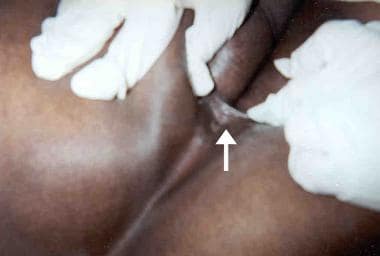
Anal fistulas and fissures. This patient complained of constipation. |
 | View Full Size Image | |
Media type: Photo
|
- Chung CC, Choi CL, Kwok SP, Leung KL, Lau WY, Li AK. Anal and perianal tuberculosis: a report of three cases in 10 years. J R Coll Surg Edinb. Jun 1997;42(3):189-90. [Medline].
- Farquharson M. Haemorrhoids, fissures and anal fistulae. Trop Doct. Oct 2002;32(4):196-201. [Medline].
- Garcia-Aguilar J, Belmonte C, Wong WD, Goldberg SM, Madoff RD. Anal fistula surgery. Factors associated with recurrence and incontinence. Dis Colon Rectum. Jul 1996;39(7):723-9. [Medline].
- Isbister WH, Prasad J. Fissure in ano. Aust N Z J Surg. Feb 1995;65(2):107-8. [Medline].
- Jonas and Scholefield. American Gastroenterology Association. 2004.
- Nordgren S, Fasth S, Hultén L. Anal fistulas in Crohn's disease: incidence and outcome of surgical treatment. Int J Colorectal Dis. Dec 1992;7(4):214-8. [Medline].
- North JH Jr, Weber TK, Rodriguez-Bigas MA, Meropol NJ, Petrelli NJ. The management of infectious and noninfectious anorectal complications in patients with leukemia. J Am Coll Surg. Oct 1996;183(4):322-8. [Medline].
- Oh C, Divino CM, Steinhagen RM. Anal fissure. 20-year experience. Dis Colon Rectum. Apr 1995;38(4):378-82. [Medline].
Anal Fistulas and Fissures excerpt Article Last Updated: Sep 27, 2007
|