Background
Scarlet fever (known as scarlatina in older literature references) is a syndrome characterized by exudative pharyngitis (see the image below), fever, and bright-red exanthem. It is caused by streptococcal pyrogenic exotoxins (SPEs) types A, B, and C produced by group A beta-hemolytic streptococci (GABHS) found in secretions and discharge from the nose, ears, throat, and skin. Scarlet fever may follow streptococcal wound infections or burns, as well as upper respiratory tract infections. Food-borne outbreaks have been reported. [1, 2] Reemergence of the condition is being recognized, perhaps because of newer virulence of the streptoccocal bacteria. [3, 4, 5, 6, 7, 8]
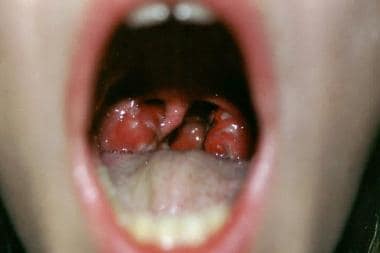 The exudative pharyngitis typical of scarlet fever. Although the tongue is somewhat out of focus, the whitish coating observed early in scarlet fever is visible.
See 15 Back-to-School Illnesses You Should Know, a Critical Images slideshow, to help identify conditions that may occur in young patients after they return to the classroom.
Ordinarily, scarlet fever evolves from a tonsillar/pharyngeal focus, although the rash develops in less than 10% of cases of “strep throat.” The site of bacterial replication tends to be inconspicuous compared to the possible dramatic effects of released toxins. Exotoxin-mediated streptococcal infections range from localized skin disorders to the widespread eruption of scarlet fever to the uncommon but highly lethal streptococcal toxic shock syndrome.

Pathophysiology
As the name “scarlet fever” implies, an erythematous eruption is associated with a febrile illness. The circulating toxin, produced by GABHS and often referred to as erythemogenic or erythrogenic toxin, causes the pathognomonic rash as a consequence of local production of inflammatory mediators and alteration of the cutaneous cytokine milieu. This results in a sparse inflammatory response and dilatation of blood vessels, leading to the characteristic scarlet color of the rash. [9]
Usually, the sites of GABHS replication in scarlet fever are the tonsils and pharynx. Clinically indistinguishable, scarlet fever may follow streptococcal infection of the skin and soft tissue, surgical wounds (ie, surgical scarlet fever), or the uterus (ie, puerperal scarlet fever).
Etiology
Scarlet fever is a streptococcal disease. Streptococci are gram-positive cocci that grow in chains. They are classified by their ability to produce a zone of hemolysis on blood agar and by differences in carbohydrate cell wall components (A-H and K-T). They may be alpha-hemolytic (partial hemolysis), beta-hemolytic (complete hemolysis), or gamma-hemolytic (no hemolysis).
Group A streptococci are normal inhabitants of the nasopharynx. Group A streptococci can cause pharyngitis, skin infections (including erysipelas pyoderma and cellulitis), pneumonia, bacteremia, and lymphadenitis.
Most streptococci excrete hemolyzing enzymes and toxins. The erythrogenic toxins produced by GABHS are the cause of the rash of scarlet fever. The erythema-producing toxin was discovered by Dick and Dick in 1924. Scarlet fever is usually associated with pharyngitis; however, in rare cases, it follows streptococcal infections at other sites.
Although infections may occur year-round, the incidence of pharyngeal disease is highest in school-aged children during winter and spring and in a setting of crowding and close contact. Person-to-person spread by means of respiratory droplets is the most common mode of transmission. It can rarely be spread through contaminated food, as seen in an outbreak in China. [2]
The organism is able to survive extremes of temperature and humidity, which allows spread by fomites. Geographic distribution of skin infections tends to favor warmer or tropical climates and occurs mainly in summer or early fall in temperate climates.
The incubation period for scarlet fever ranges from 12 hours to 7 days. Patients are contagious during the acute illness and during the subclinical phase.
Epidemiology
As many as 10% of the population contracts group A streptococcal pharyngitis. Of this group, as many as 10% then develop scarlet fever.
In the past century, the number of cases of scarlet fever has remained high, with marked decrease in case-mortality rates secondary to widespread use of antibiotics. Transmission usually occurs via airborne respiratory particles that can be spread from infected patients and asymptomatic carriers.
The infection rate increases in overcrowded situations (eg, schools, institutional settings) and it peaks during late fall, winter, and spring in temperate environments. Immunity, which is type specific, may be induced by a carrier state or overt infection. In adulthood, incidence decreases markedly as immunity develops to the most prevalent serotypes. Complications (eg, rheumatic fever) are more common in recent immigrants to the United States.
Scarlet fever predominantly occurs in children aged 5-15 years, although it can also occur in older children and adults. It is uncommon in children aged 3 years or younger. [10] By the time children are 10 years old, 80% have developed lifelong protective antibodies against streptococcal pyrogenic exotoxins, which prevent future disease manifestation. Scarlet fever is rare in children younger than 1 year because of the presence of maternal antiexotoxin antibodies and lack of prior sensitization.
Leslie et al suggest from a case-control study that antecedent streptococcal infection can increase the likelihood of children developing certain neuropsychiatric disorders, including Tourette syndrome, attention-deficit/hyperactivity disorder, and major depressive disorder. [11]
Males and females are affected equally. No racial or ethnic predilection is reported for group A streptococcal infection.
Prognosis
When the condition is identified in a timely fashion, the prognosis is excellent. Most patients recover fully after 4-5 days, with resolution of skin symptoms over several weeks. Attacks may recur.
In the preantibiotic era, infections due to GABHS were major causes of mortality and morbidity. Historically, scarlet fever resulted in death in 15-20% of those affected. However, scarlet fever is no longer associated with the deadly epidemics that made it so feared in the 1800s. Since the advent of antibiotic therapy, the mortality rate for scarlet fever has been less than 1%. However, school outbreaks still occur owing to significant close proximity of susceptible children in a limited and confined area, which can lasts for weeks.
Today, as a result not only of antibiotic therapy but also of enhanced immune status of the population and improved socioeconomic conditions, scarlet fever usually follows a benign course. Any undue morbidity and mortality are more likely to arise from suppurative complications (eg, peritonsillar abscess, sinusitis, bronchopneumonia, and meningitis) or problems associated with immune-mediated sequelae, rheumatic fever, or glomerulonephritis. Very rare complications, such as septic shock with multisystem organ failure, have been reported. [12]
Known complications, such as septicemia, vasculitis, hepatitis, or rheumatic fever, should be considered on a case-by-case basis as determined by the presence of clinical history and examination findings suggestive of those diseases. [13, 14] Localized soft tissue infections may suggest the presence of underlying osteomyelitis, but scarlet fever may occur from cellulitis alone. [15] When scarlet fever has been determined to be due to a soft tissue infection over or near bone, evaluation for bony involvement should be considered.
Patient Education
Patients must be instructed to complete the entire course of antibiotics, even if symptoms resolve. They should be advised to follow general good hygiene precautions, especially in households with other small children.
Patients should be warned that they will have generalized exfoliation over the next 2 weeks. In particular, they should be warned about signs of complications of streptococcal infection, such as persistent fever, increased throat or sinus pain, and generalized swelling.
For patient education resources, see the Children’s Health Center and the Ear, Nose, and Throat Conditions Center, as well as Strep Throat and Skin Rashes in Children.
-
The exudative pharyngitis typical of scarlet fever. Although the tongue is somewhat out of focus, the whitish coating observed early in scarlet fever is visible.