Practice Essentials
Varicella, commonly known in the United States as chickenpox, is caused by the varicella-zoster virus. The disease is generally regarded as a mild, self-limiting viral illness with occasional complications. Varicella is common and highly contagious and affects nearly all susceptible children before adolescence. (See the image below.) Although most varicella infection confers life-long immunity, varicella clinical reinfections among healthy children have been described. [1]
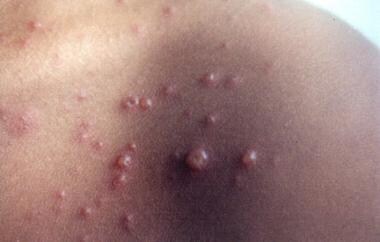 The pleomorphic rash characteristic of varicella. Papules, vesicles, and pustules are concurrently present.
Signs and symptoms
Presenting symptoms may include a history of low-grade fever, abdominal pain, a history of rash, intense pruritus, headache, malaise, anorexia, cough and coryza, and sore throat. Rash and fever are the typical findings during physical examination in pediatric patients with varicella. An ill appearance should raise concern for pulmonary or neurologic complications or serious bacterial superinfection.
See Presentation for more detail.
Diagnosis
Laboratory studies are usually unnecessary for diagnosis, because varicella is clinically obvious. However, some tests and procedures may be helpful in confirming the diagnosis or in identifying complications. Imaging studies are generally not required for varicella unless secondary complications are a concern (eg, chest radiography for varicella pneumonia).
See Workup for more detail.
Management
Adolescents, adults, and pregnant patients are at increased risk for severe disease and are often treated with antivirals. Other groups that require specific treatment are children who are immunocompromised, those who are otherwise at risk for severe disease, and those who already have severe disease. Other treatments include supportive measures, administration of varicella zoster immune globulin (VZIG), and management of secondary bacterial infection.
See Treatment and Medication for more detail.

Background
Before vaccination for varicella became widespread in the United States, this disease affected approximately 4 million children per year, caused as many as 100 deaths in children annually, and was responsible for an estimated $400 million in medical costs and lost wages each year. Since the varicella vaccine was introduced for children aged 12-18 months in the United States in 1995 and booster vaccine given at age 4-5 years, disease incidence has substantially decreased. (See Epidemiology.)
Chickenpox is usually a benign disease in children, and almost all children recover uneventfully. (See Prognosis.) However, varicella is not totally benign even today. A significant number of varicella cases are associated with complications, among the most serious of which are varicella pneumonia and encephalitis.
Go to Chickenpox for complete nonpediatric information on this topic.
Pathophysiology
The causative organism, varicella-zoster virus, is a member of the human herpesvirus subfamily Alphaherpesvirinae and, like all herpes viruses, is a DNA virus. The virus enters through the respiratory system (conjunctival or upper respiratory mucosa) and colonizes the upper respiratory tract. Viral replication takes place in regional lymph nodes over the next 2-4 days; 4-6 days later, a primary viremia spreads the virus to reticuloendothelial cells in the spleen, liver, and elsewhere.
After a week, a secondary viremia disseminates the virus to the viscera and skin, eliciting the typical skin lesions (see the images below). [2] This viremia also spreads the virus to respiratory sites and is responsible for the contagion of varicella before the appearance of the rash. Infection of the central nervous system (CNS) or liver also occurs at this time, as may encephalitis, hepatitis, or pneumonia.
The pleomorphic rash characteristic of varicella. Papules, vesicles, and pustules are concurrently present.
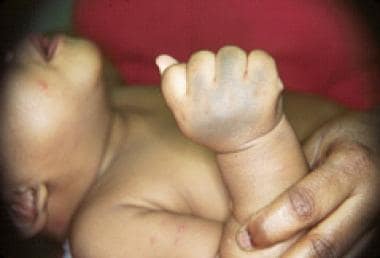 Papulovesicular lesions on arm in varying stages of healing in this infant with varicella. Photograph courtesy of Susan Feigelman, MD.
The usual incubation period is 10-21 days. The patient is contagious from 1-2 days before the appearance of rash until the lesions crust over, usually 5-6 days after the rash first appears.
Varicella is associated with humoral and cell-mediated immune responses. These responses induce long-lasting immunity. Repeat subclinical infection can occur in these persons, but second attacks of chickenpox are extremely rare in immunocompetent persons. Reexposure and subclinical infections may serve to boost the immunity acquired after an episode of chickenpox. This may change in the post vaccine era.
Etiology
Transmission
Varicella is caused by the varicella-zoster virus. The infectious particles are cell-free virus particles derived from skin lesions or the respiratory tract. Transmission occurs mainly through respiratory droplets that contain the virus, making the disease highly contagious even before the rash appears. Direct person-to-person contact with lesions also spreads the virus. Papules and vesicles, but not the crusts, have high populations of the virus. In addition, maternal varicella with viremia can transplacentally spread to the fetus. This leads to neonatal varicella.
Risk factors for severe varicella
Risk factors for severe varicella in neonates are as follows:
-
The first month of life: A neonate’s first month of life is a susceptible period for severe varicella, especially if the mother is seronegative.
-
Early delivery: Delivery before 28 weeks’ gestation also renders a baby susceptible because transplacental transfer of immunoglobulin G (IgG) antibodies occurs after this time.
Risk factors for severe varicella in adolescents and adults are as follows:
-
Steroid therapy: High doses (ie, doses equivalent to 1-2 mg/kg/d of prednisolone) for 2 weeks or more are definite risk factors for severe disease. Even short-term therapy at these doses immediately preceding or during the incubation period of varicella can cause severe or fatal varicella. [3]
-
Malignancy: All children with cancer have an increased risk for severe varicella. The risk is highest for children with leukemia. Almost 30% of patients who are immunocompromised and who have leukemia have visceral dissemination of varicella; 7% may die.
-
Immunocompromised state (eg, malignancy, antimalignancy drugs, human immunodeficiency virus [HIV], other congenital or acquired immunodeficient conditions): Defects of cellular but not humoral immunodeficiency are believed to render a person susceptible to severe varicella.
-
Pregnancy: Pregnant women have high risk of severe varicella, especially pneumonia.
Epidemiology
United States statistics
Before varicella vaccine use became widespread, 4 million cases of chickenpox were reported annually. National seroprevalence data for 1988-1994 indicated that 95.5% of adults aged 20-29 years, 98.9% of adults aged 30-39 years, and more than 99.6% of adults older than 40 years were immune to varicella. [4] The disease was responsible for 11,000 hospitalizations each year and approximately 50-100 deaths.
The adoption of universal vaccination against varicella in 1995 reduced the incidence of varicella, as well as the associated morbidity and mortality rates. [5, 6, 7, 8] By 2000, vaccination coverage among children 19-35 months in 3 communities in Texas, California, and Pennsylvania had reached 74-84%, and reported total varicella cases had declined 71-84%. Most of the decline occurred among children aged 12 months to 4 years; however, incidence declined in all age groups, including infants and adults. [9]
Currently, fewer than 10 deaths occur per year, most of them in unimmunized people. Although vaccination coverage has exceeded 80% over the past few years, outbreaks of breakthrough varicella still occur in schools and daycare centers. [10, 11, 12]
Children with varicella expose adult contacts in households, [13] schools, and daycare centers to the risk of severe, even fatal, disease. Household transmission rates are 80-90%. Second cases within the household are often more severe. School or daycare center contact is associated with lower but still significant transmission rates. Children who are susceptible rarely acquire the disease by contact with adults with zoster. Maximum transmission occurs during late winter and spring.
International statistics
Varicella affects nearly all children worldwide who do not have immunity. Annual incidence is estimated at 80-90 million cases. Most developing countries have low immunization rates because of the cost involved, and varicella disease is a risk for travelers to such countries.
A survey of 1473 cases in Japan demonstrated that 81.4% involved children younger than 6 years. [14] In Japan, the annual prevalence peaked between March and May, with subsequent lower prevalence between August and October.
The epidemiology of varicella differs between countries with temperate climates and those with tropical climates. In most countries with temperate climates, more than 90% of persons are infected by adolescence but in countries with tropical climates, a higher proportion of infections are acquired at older ages, which results in higher susceptibility among adults.
Age distribution for varicella
The maximum incidence of varicella in unvaccinated populations is in children aged 1-6 years. Persons older than 14 years account for 10% of varicella cases. In the United States, the peak age is now 9-11 years. [5]
In tropical climates, varicella is more common in older children. Most cases in Japan were in children younger than 6 years. Approximately 9.6% of cases involved children younger than 1 year, and almost one third of these were infants younger than 5 months.
Varicella does not have a racial predilection or a sex predilection.
Prognosis
Otherwise healthy children with varicella have excellent prognoses. In otherwise healthy children aged 1-14 years, the mortality rate is estimated at 2 deaths per 100,000 cases. The case-fatality rate in the general population is 6.7 cases per 100,000 population. Children with immunocompromised states, however, are at risk for severe disease and death. The mortality rate in children who are immunocompromised is much higher than that in otherwise healthy children. Among children with leukemia, the mortality rate of varicella is 7%.
One study suggested that nearly 1:50 varicella cases are associated with complications. Among the most serious complications are varicella pneumonia and encephalitis; both are associated with a high mortality rate. Before universal vaccination, most varicella-related deaths in the United States were from associated encephalitis, pneumonia, secondary bacterial infection, and Reye syndrome. In addition, significant concerns have been raised about the association of varicella with severe invasive group A streptococcal disease. [15]
The disease can be serious in neonates, depending on the timing of infection in the mother. Varicella during pregnancy can cause various adverse outcomes for mother and infant, depending on the stage of pregnancy. Neonatal varicella mortality rates can reach 30%.
Complications
Pneumonia
Perhaps the most serious complication of varicella is viral pneumonia, which primarily occurs in older children and adults. Respiratory symptoms usually appear 3-4 days after the rash. The pneumonia may be unresponsive to antiviral therapy and may lead to death.
Secondary bacterial infections
Varicella may predispose patients to secondary bacterial infections. Signs and symptoms of such infections can be indistinguishable from uncomplicated varicella during the first 3-4 days. Skin lesion infections are common and occur in 5-10% of children. These lesions provide a portal of entry for virulent organisms; rapidly spreading cellulitis, septicemia, and other serious infections may occur. Superficial infection with impetigo is suggestive of potential bacterial superinfection.
The most common infectious organisms are group A streptococci and Staphylococcus aureus. Varicella places the patient at high risk for acquiring invasive group A streptococcal disease. [16, 17, 18] In addition to toxic shock syndrome, group A streptococci may cause necrotizing fasciitis, bacteremia, osteomyelitis, pyomyositis, gangrene, subgaleal abscess, arthritis, and meningitis in patients with varicella.
Staphylococci reportedly cause cellulitis, impetiginous pox infections, staphylococcal scalded skin syndrome, toxic shock syndrome, pericarditis, and osteomyelitis in these patients.
Neurological complications
Acute postinfectious cerebellar ataxia is the most common neurological complication, with an incidence of 1 case per 4000 patients with varicella. Ataxia has sudden onset that usually occurs 2-3 weeks after the onset of varicella. Manifestations may range from mild unsteadiness to complete inability to stand and walk, with accompanying incoordination and dysarthria. Manifestations are maximal at onset; a waxing and waning course suggests another diagnosis. The sensorium is clear, even when the ataxia is profound.
The condition may persist for 2 months. The prognosis for patients with ataxia is good, but a few children may have residual ataxia, incoordination, or dysarthria.
Encephalitis occurs in 1.7 patients per 100,000 cases of varicella among otherwise healthy children aged 1-14 years. The disease manifests during acute varicella a few days after rash onset. Lethargy, drowsiness, and confusion are the usual presenting symptoms. Some children may have seizures, and encephalitis can rapidly progress to deep coma. This serious complication of varicella has a 5-20% mortality rate.
Reye syndrome was associated with varicella when aspirin use was common. Identification of this association now has made acetaminophen the preferred drug, and Reye syndrome has become rare.
Other neurological complications include aseptic meningitis, myelitis (including Guillain-Barré syndrome), polyradiculitis, and meningoencephalitis. A careful neurologic examination can identify associated meningoencephalitis.
Herpes zoster
A delayed complication of varicella, herpes zoster infection, occurs months to years after the primary infection in about 15% of patients. The complication is caused by virus that persists in the sensory ganglions.
Herpes zoster consists of a unilateral vesicular rash, limited to 1-3 dermatomes. The rash is often painful in older children and adults. Among the health benefits of routine varicella immunization in childhood may be a lifelong decreased risk for reactivation of the virus as shingles.
Other complications
About 5% of children with varicella develop otitis media, caused by the usual pathogens.
Hepatitis is a self-limited accompaniment of varicella. Severe hepatitis with clinical manifestations is infrequent in otherwise healthy children with varicella. Liver involvement is independent of the severity of skin and systemic manifestations. Identify right upper quadrant pain with or without associated jaundice.
Retinitis and optic neuritis have been reported as rare complications of varicella in children who are immunocompetent. [19]
Ischemic stroke associated with varicella zoster arteriopathy has been reported as a delayed complication of chickenpox in children. [20, 21]
Other reported complications include glomerulonephritis, [22] hemorrhagic varicella, thrombocytopenia, myocarditis, appendicitis, pancreatitis, Henoch-Schönlein purpura, orchitis, iritis, and keratitis. Extracutaneous complications increase proportionately to the age of the patient.
Patient Education
Families of children with chickenpox should be instructed to bathe the child regularly to reduce itching and prevent secondary infection. To prevent scratching, which can lead to secondary infection and scarring, the child’s fingernails should be kept short, mittens or socks may be worn on the hands at night, and medication for itching can be given as needed. Aspirin-containing medications should not be used.
Children with chickenpox should avoid nonimmune pregnant women, unimmunized young infants, and others with immunodeficiencies or who are taking prednisone long term. Children with chickenpox may not return to school or day care until all lesions are crusted over.
Parents should take children to the hospital if the following symptoms occur:
-
Unusual redness, swelling, or pain over an area of the rash
-
Refusal to drink fluids
-
Signs of dehydration, such as scanty and yellow-colored urine, increasing drowsiness, dry mouth and lips, excessive thirst, or lethargy
-
Confusion, irritability, drowsiness, or difficulty waking
-
Inability to walk or unusual weakness
-
Complaints of severe headache, stiff neck, and/or back pain
-
Frequent vomiting
-
Difficulty breathing, chest pain, wheezing, fast breathing, or severe cough
-
Fever persisting more than 4 days or fever returns after defervescence
-
A more sickly appearance than when last seen by the doctor
For patient education resources, see the Bacterial and Viral Infections Center, as well as Chickenpox and Skin Rashes in Children.
-
The pleomorphic rash characteristic of varicella. Papules, vesicles, and pustules are concurrently present.
-
Papulovesicular lesions on arm in varying stages of healing in this infant with varicella. Photograph courtesy of Susan Feigelman, MD.
Tables

What would you like to print?
- Overview
- Presentation
- DDx
- Workup
- Treatment
- Approach Considerations
- Supportive Therapy
- Antiviral Therapy
- Varicella-Zoster Immune Globulin Therapy
- Treatment of Neonatal Varicella
- Treatment of Secondary Bacterial Infections
- Varicella Vaccination
- Admission to Intensive Care Unit
- Transfer to Tertiary Care Facility
- Dietary Measures
- Restriction of Activity
- Consultations
- Show All
- Medication
- Questions & Answers
- Media Gallery
- References