Practice Essentials
A purist's definition of mastoiditis includes all inflammatory processes of the mastoid air cells of the temporal bone. As the mastoid is contiguous to and an extension of the middle ear cleft, virtually every child or adult with acute otitis media (AOM) or chronic middle ear inflammatory disease has mastoiditis. In most cases, the symptomatology of the middle ear predominates (eg, fever, pain, conductive hearing loss), and the disease within the mastoid is not considered a separate entity (see the image below). [1, 2] (See Etiology and Presentation.)
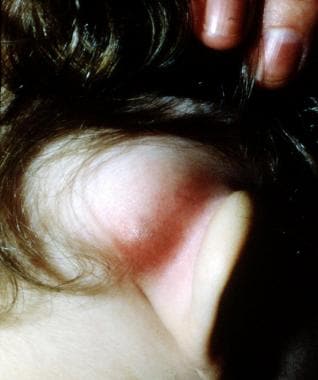 Mastoiditis with subperiosteal abscess. Note the loss of the skin crease and the pointed abscess.
Acute mastoiditis is associated with AOM. In some patients, the infection spreads beyond the mucosa of the middle ear cleft, and they develop osteitis within the mastoid air-cell system or periosteitis of the mastoid process, either directly by bone erosion through the cortex or indirectly via the emissary vein of the mastoid. These patients have acute surgical mastoiditis (ASM), an intratemporal complication of otitis media. (See Etiology.)
Chronic mastoiditis is most commonly associated with chronic suppurative otitis media and particularly with cholesteatoma formation. Cholesteatomas are benign aggregates of squamous epithelium that can grow and alter normal structure and function of surrounding soft tissue and bone. This destructive process is accelerated in the presence of active infection by the secretion of osteolytic enzymes by the epithelial tissue. (See Etiology.)
Progression of mastoiditis
Mastoiditis progresses in the following 5 stages and may be arrested at any point (see Presentation and Workup):
-
Hyperemia of the mucosal lining of the mastoid air cells
-
Transudation and exudation of fluid and/or pus within the cells
-
Necrosis of bone by loss of vascularity of the septa
-
Cell wall loss with coalescence into abscess cavities
-
Extension of the inflammatory process to contiguous areas
Patient education
Warn patients and their families of possible cosmetic deformity following mastoid surgery.
Signs and symptoms of mastoiditis
Frequent signs of acute mastoiditis include the following [3] :
-
Mastoid area erythema
-
Proptosis of the auricle
-
Fever
Tenderness and inflammation over the mastoid process are the most consistent signs of acute surgical mastoiditis (ASM).
Workup and management
Despite the use of antibiotics, acute mastoiditis still remains a threat for patients with acute otitis media (AOM), especially for children younger than age 5 years. Great care is required on the part of clinicians to make an early diagnosis in order to promote adequate treatment and to prevent complications. [3]
Material for culture and sensitivity should be obtained from the ear (via tympanocentesis or myringotomy), blood, any abscess, and mastoid tissue (if it becomes available). Obtain and evaluate spinal fluid if any suggestion exists of intracranial extension of the process.
Workup also includes the following:
-
Complete blood count (CBC)
-
Audiometry
-
Tympanocentesis/myringotomy
-
Computed tomography (CT) scanning - CT scanning of the temporal bone is the standard for evaluation of mastoiditis, with published sensitivities ranging from 87-100%
Surgical therapy confined to the ear includes myringotomy/tympanocentesis, tympanostomy tube placement, and mastoidectomy.
Antibiotics are the principal medications used in acute surgical mastoiditis (ASM). Culture results and the sensitivity of the organism ultimately govern selection of medications.

Etiology
As with most infectious processes, consider host and microbial factors when evaluating surgical mastoiditis. Host factors include mucosal immunology, temporal bone anatomy, and systemic immunity. Microbial factors include protective coating, antimicrobial resistance, and ability to penetrate local tissue or vessels (ie, invasive strains). As the clearance of the mastoid is dependent upon a patent antrum, resolution is unlikely unless this anatomical isthmus opens by control of mucosal swelling, which otherwise creates a reservoir for infection.
Host factors
Most children presenting with acute surgical mastoiditis (ASM) are younger than age 2 years and have little history of otitis media. This is an age at which the immune system is relatively immature, particularly with regard to its ability to respond to challenges from polysaccharide antigens.
Host anatomical factors may have a role. The mastoid develops from a narrow outpouching of the posterior epitympanum (ie, the aditus ad antrum). Pneumatization occurs shortly after birth, once the middle ear becomes aerated, and this process is complete by age 10 years. Mastoid air cells are created by invasion of epithelium-lined sacs between spicules of new bone and by degeneration and redifferentiation of existing bone marrow spaces.
Other areas of the temporal bone pneumatize similarly, including the petrous apex and the zygomatic root. The antrum, as with the mastoid air cells, is lined with respiratory epithelium that swells when infection is present. Blockage of the antrum by inflamed mucosa entraps infection within the air cells by inhibiting drainage and precluding reaeration from the middle-ear side.
Persistent acute infection within the mastoid cavity may lead to a rarifying osteitis, which destroys the bony trabeculae that form the mastoid cells (hence the term coalescent mastoiditis). Essentially, coalescent mastoiditis is an empyema of the temporal bone that, unless its progress is arrested, drains either through the natural antrum to give spontaneous resolution or creates further complication by draining unnaturally to the mastoid surface, petrous apex, or intracranial spaces. Other temporal bone structures or nearby structures, such as the facial nerve, labyrinth, and venous sinuses, may become involved.
A retrospective study by Adams et al indicated that children with autism spectrum disorder have an increased likelihood of developing middle ear infections and otitis-related complications, including a more than two-fold greater chance of developing mastoiditis. [4]
Microbial factors
Reported pathogens in mastoiditis include the following:
-
Streptococcus pneumoniae – Most frequently isolated pathogen in acute mastoiditis, prevalence of approximately 25%
-
Group A beta-hemolytic streptococci
-
Staphylococcus aureus
-
Streptococcus pyogenes
-
Moraxella catarrhalis
-
Haemophilus influenzae
-
Pseudomonas aeruginosa
-
Mycobacterium species
-
Aspergillus fumigatus and other fungi
-
Nocardia asteroides - Case report [5]
Because acute otitis media (AOM) is the antecedent disease, the most common etiologic agent causing surgical mastoiditis is Streptococcus pneumoniae, followed by Haemophilus influenzae and group A Streptococcus pyogenes (GAS). Each of these bacteria has invasive forms and is recovered most often from children presenting with ASM. More than half of the Streptococcus pneumoniae recovered are of serotype 19, followed by serotypes 23 and 3.
The literature and the authors' experience indicate that a high frequency of multidrug-resistant Streptococcus pneumoniae (MDRSP) is now associated with ASM, and this may alter selection of antimicrobials (40-50% penicillin resistant, approximately 25% ceftriaxone resistant). Treatment of AOM with antimicrobials in the previous month increases the frequency of MDRSP. [6]
Gram-negative organisms and Staphylococcus aureus are recovered more frequently from patients with chronic mastoiditis.
Half of children admitted with acute mastoiditis have no previous history of recurrent AOM. In those children, Streptococcus pneumoniae has been the leading pathogen, while Pseudomonas aeruginosa has been more prevalent in children with recurrent AOM.
Epidemiology
Incidence of surgical mastoiditis from acute otitis media is reported as 0.004% in the United States. [7] Some fear that untreated otitis media increases the risk of acute mastoiditis and is the cause of higher incidences in developing countries and very young children. [8, 9]
The Inuit population has a high predilection for middle-ear disease and, as a likely consequence, mastoiditis.
Rates of antibiotic treatment for otitis in the Netherlands, Norway, and Denmark were 31%, 67%, and 76%, respectively. The incidence of mastoiditis was approximately 4 cases per 100,000 children per year over 5 years.
Acute mastoiditis is a disease of the very young. Most patients present when younger than age 2 years, with a median age of 12 months. However, it can occur in persons of any age.
A retrospective review of pediatric patients in Colorado found that despite an initial drop in the incidence of acute mastoiditis in children under age 2 years following the introduction of heptavalent pneumococcal conjugate vaccine (PCV7), the incidence rose again to pre-PCV7 levels within a few years. The study, by Halgrimson et al, examined pediatric inpatient data from 1999-2008 for documented cases of acute mastoiditis or patients who had undergone mastoidectomy. [10]
The investigators found that the annual incidence of acute mastoiditis in children under age 2 years dropped from 11.0 per 100,000 population in 2001, a year after PCV7 was introduced, to 4.5 per 100,000 population in 2003. By 2008, however, the incidence had again risen, to 12.0 per 100,000 population. An increase in the prevalence of S pneumoniae isolates nonsusceptible to penicillin also occurred in Colorado, from 0% between 1999 and 2004 to 38% between 2005 and 2008. Halgrimson and colleagues suggested that the presence of non-PCV7 pneumococcal serotypes and a rise in pneumococcal antibiotic resistance may have caused the incidence of acute mastoiditis to increase. [10]
Another study, however, found that the introduction of pneumococcal conjugate vaccines may have led to a national reduction in pediatric mastoiditis rates. The study, by Marom et al, looked at insurance claims from a nationwide managed health care plan to analyze health care visits associated with otitis media in children aged 6 years or younger. The investigators found that between 2008 and 2011, mastoiditis rates decreased from 61 per 100,000 child-years to 37 per 100,000 child-years. [11]
Noting a reduction in US hospitalization rates for acute mastoiditis in children aged 0-2 years between 2009 and 2012, a study by Tawfik et al suggested that use of the 13-valent pneumococcal vaccine (PCV13) may have had a protective benefit against mastoiditis for youngsters in this age group. However, the study, which looked at annual incidences of hospitalization for pediatric acute mastoiditis after the introduction of PCV7 and PCV13, did not find an overall decline in hospitalization rates for acute mastoiditis between 2000 and 2012 in persons below age 21 years. [12]
Prognosis
Expect patients with acute surgical mastoiditis (ASM) to recover completely provided that the facial nerve, vestibule, and intracranial structures are not involved. Cosmetic deformity of the operated ear can usually be prevented with judicious placement of the incision and the development of flaps to pull the ears posteriorly when replaced.
Conductive hearing loss should resolve provided that the ossicular chain remains intact. Conduct testing after otorrhea has ended and the ear has healed.
Extension of the infectious process of mastoiditis can include the following:
-
Posterior extension to the sigmoid sinus (causing thrombosis)
-
Posterior extension to the occipital bone to create an osteomyelitis of calvaria or a Citelli abscess
-
Superior extension to the posterior cranial fossa, subdural space, and meninges
-
Anterior extension to the zygomatic root
-
Lateral extension to form a subperiosteal abscess
-
Inferior extension to form a Bezold abscess
-
Medial extension to the petrous apex
-
Intratemporal involvement of the facial nerve and/or labyrinth
A study by Shiner et al indicated that in pediatric patients with acute mastoiditis, treatment with mastoidectomy during the initial episode is an independent risk factor for ipsilateral recurrence. At 12 months, the hazard ratio for recurrence after first-episode mastoidectomy was 11.3, versus 3.3 for patients whose initial episode was not treated with this surgery. Within 6 years, these figures were 17.0 and 3.6, respectively. The investigators stated that the etiology behind mastoidectomy-related recurrence remains to be determined. [13]
Complications
Complications of mastoiditis include the following:
-
Hearing loss
-
Facial nerve palsy
-
Cranial nerve involvement
-
Osteomyelitis
-
Petrositis
-
Gradenigo syndrome - Otitis media, retro-orbital pain, and abducens palsy
-
Intracranial extension - Meningitis, cerebral abscess, epidural abscess, subdural empyema
-
Sigmoid sinus thrombosis
-
Abscess formation - Citelli abscess (extension to occipital bone, calvaria), subperiosteal abscess (abscess between the periosteum and mastoid bone, resulting in the typical appearance of a protruding ear; see the image below), and Bezold's abscess (abscess of soft tissues that track along the sternomastoid sheath; Bezold abscesses are very rare complications and are usually found only in adults with a well-pneumatized mastoid tip)
See the image below.
Mastoiditis with subperiosteal abscess. Note the loss of the skin crease and the pointed abscess.
Meningitis and facial nerve paralysis are possible in mastoiditis. Approximately 7% of patients may develop intracranial complications related to acute mastoiditis. These complications can include sigmoid sinus thrombosis, epidural abscess, and meningitis. Persistent otalgia or otorrhea with associated neurologic symptoms in a patient taking oral antibiotics are ominous signs that suggest a complication.
Otogenic meningitis is the most common intracranial complication of neglected otitis media. In the Western world, such complications seldom occur in children and adolescents and are extremely rare in adults. The current use of antibiotics and of more sophisticated surgery has greatly diminished the incidence of otogenic meningitis; however, this has resulted in physicians having less experience with diagnosis and treatment of this complication. Emergency surgical treatment is mandatory.
In a study done by Luntz et al of 223 consecutive cases of acute mastoiditis, 16 patients presented with complications, including cerebellar abscess, perisinus empyema, subdural abscess or empyema, extradural abscess, cavernous sinus thrombosis, lateral sinus thrombosis, bacterial meningitis, labyrinthitis, petrositis, and facial nerve palsy. [14]
A study by Garcia et al indicated that in children with acute mastoiditis, the risk of complications is greater in those under age 24 months who have a high leukocyte count or a high C-reactive protein (CRP) level. The investigators suggested that 7.21 mg/dL CRP is a good cutoff value for monitoring children for complications. [15]
Using the Kids’ Inpatient Database of the Healthcare Cost and Utilization Project (HCUP), Favre et al found that the rates of acute mastoiditis complications in patients aged 21 years or younger included the following: subperiosteal abscess (6.90%), intracranial thrombophlebitis/thrombosis (5.30%), intracranial abscess (3.90%), otitic hydrocephalus (1.20%), encephalitis (0.90%), subperiosteal abscess with intracranial complication (0.60%), petrositis (0.60%), and meningitis (0.30%). [16]
In a retrospective study of children admitted to the hospital with acute mastoiditis, Carmel et al found that patients who received preadmission antibiotic therapy had a higher complication rate than did those who were not treated prior to admission (52% vs 27%, respectively). [17]
-
Mastoiditis with subperiosteal abscess. Note the loss of the skin crease and the pointed abscess.
-
Cortical mastoidectomy in a densely sclerosed mastoid.
-
Preoperative preparation of the patient.
-
Draping the surgical area.
-
Injection of the area with 2% Xylocaine and 1:100,000 adrenaline to reduce bleeding.
-
Marking the incision site.
-
Placement of the incision, a few mm behind the postauricular sulcus.
-
Deepening the incision down to the bone.
-
Elevation of the periosteum to expose the mastoid cortex to the mastoid tip.
-
Mastoid drilling in progress with simultaneous saline irrigation.
-
Creation of the initial groove and the vertical line.
-
Exposure of the antrum and exenteration of the mastoid air cells.
-
Curetting the aditus to enlarge it.
-
Further exposure.
-
Healed postaural scar.
-
Extent of cortical mastoidectomy in a well-pneumatized mastoid.