Continually Updated Clinical Reference
 
 
  All Sources     eMedicine     Medscape     Drug Reference     MEDLINE
 
eMedicine - Fracture, Humerus : Article by

Quick Find
Authors & Editors
Introduction
Clinical
Differentials
Workup
Treatment
Medication
Follow-up
Miscellaneous
Acknowledgments
Multimedia
References

Related Articles
Dislocations, Shoulder

Fractures, Clavicle

Fractures, Elbow

Fractures, Scapular


Patient Education
Breaks, Fractures, and Dislocations Center

Broken Arm Overview

Broken Arm Causes

Broken Arm Symptoms

Broken Arm Treatment

Shoulder Dislocation Overview

Broken Elbow Overview


Author: Andrew A Aronson, MD, Assistant Professor of Emergency Medicine, Drexel University School of Medicine; Consulting Staff, Department of Emergency Medicine, Allegheny General Hospital

Andrew A Aronson is a member of the following medical societies: American College of Emergency Physicians, Massachusetts Medical Society, and Society for Academic Emergency Medicine

Coauthor(s): Adarsh K Srivastava, MD, Staff Physician, Department of Emergency Medicine/Internal Medicine, Allegheny General Hospital

Editors: Michelle Ervin, MD, Chair, Department of Emergency Medicine, Howard University Hospital; Francisco Talavera, PharmD, PhD, Senior Pharmacy Editor, eMedicine; Eric Legome, MD, Chair, Department of Emergency Medicine, St Vincent's Hospital, Manhattan; John D Halamka, MD, MS, Associate Professor of Medicine, Harvard Medical School, Beth Israel Deaconess Medical Center; Chief Information Officer, CareGroup Healthcare System and Harvard Medical School; Attending Physician, Division of Emergency Medicine, Beth Israel Deaconess Medical Center; Rick Kulkarni, MD, Medical Director, Assistant Professor of Surgery, Section of Emergency Medicine, Yale-New Haven Hospital

Author and Editor Disclosure

Synonyms and related keywords: humerus fracture, fractured humerus, broken arm, broken shoulder, shoulder fracture, arm fracture, forearm fracture


Background

Humerus fractures are commonly seen in the acute care setting and make up 5% of all fractures. In evaluating these injuries, being able to classify the fracture and if necessary, reduce, immobilize, and know when to seek orthopedic consultation is important.

Eighty percent of humerus fractures are nondisplaced or minimally displaced, and therefore, can be managed nonoperatively. Associated injuries are common in patients with osteoporosis. Distal humeral fractures are associated with ipsilateral proximal forearm fractures. Rarely, vascular or nerve injuries are associated with humerus fractures.
 
This article discusses fractures based on location: proximal and diaphyseal (midshaft).

For more information, see Medscape’s Fracture Resource Center and Osteoporosis Resource Center.

Pathophysiology

Humerus fractures are caused by direct trauma to the arm or shoulder or by axial loading transmitted through the elbow. Attachments from pectoralis major, deltoid, and rotator cuff muscles influence the degree of displacement of proximal humerus fractures.

Frequency

United States

Humerus fractures represent 4-5% of all fractures. Humeral diaphyseal fractures account for 1.2% of all fractures. 

Age

  • Proximal humeral fractures are more common in elderly persons, with the average age of 64.5 years. 
  • Humeral diaphyseal fractures occur in a slightly younger population, with the average age being 54.8 years. 
  • Fracture patterns are similar across all ages, though older people are more prone to fracture because of osteoporosis.


History

  • History of a benign fall in which the elbow is either struck directly or axially loaded in a fall onto an outstretched hand.
  • Motor vehicle and sport injuries account for most humeral injuries for younger males.
  • Pathologic fractures of the humerus may occur with minimal trauma. Suspect these in patients with the following history:
    • Cancer metastatic to bone
    • Paget disease
    • Bone cyst
    • Pain without trauma
    • Edema
    • Decreased range of motion (ROM)

Physical

  • Pain occurs with palpation or movement of shoulder or elbow.
  • Ecchymosis and edema are usually present.
  • Perform a careful neurovascular examination. Radial nerve injury following humerus shaft fractures is relatively common.
  • Proximal
    • Patients present with a painful shoulder and a very restricted range of motion.
    • Obvious deformity is suggestive of glenohumeral dislocation; swelling and ecchymosis are the common examination findings.
    • Nerve damage with a proximal humerus fracture is rare.
  • Diaphyseal
    • Patients present with a painful deformed arm that may be associated with a radial nerve palsy. Usually, the radial nerve palsy is reversible.
    • Crepitus may be observed.
    • Shortening of the arm suggests displacement.
  • Assessment of the radial nerve
    • The radial nerve’s primary motor function is to innervate the dorsal extrinsic muscles in the forearm. Motor testing should include extension of the wrist and metacarpophalangeal (MCP) joints as well as abduction and extension of the thumb. Proximal injury of the radial nerve causes wrist drop. 
    • On examination, the fingers are in flexion at the MCP joints and the thumb is adducted.
  • Rarely, the median or ulnar nerves are affected.                   
  • With all humerus fractures, ensure strong radial and ulnar pulses.

Causes

  • The most common cause of proximal humeral fractures is a fall from standing, followed by motor vehicle accident and a fall involving stairs. Additional mechanisms include violent muscle contractions from seizure activity, electrical shock, and athletic-related trauma. Proximal humeral fractures are most often closed.
  • Humeral diaphyseal fractures causes include a fall from standing, motor vehicle accident, a fall from height, and pathological.


Dislocations, Shoulder
Fractures, Clavicle
Fractures, Elbow
Fractures, Scapular

Other Problems to Be Considered

  • A humerus fracture in a child with an inconsistent injury mechanism should raise suspicion for abuse and trigger further investigation.
  • Fractures that occur spontaneously, without apparent injury, suggest a pathologic fracture.


Imaging Studies

  • For the distal and diaphyseal humeral fractures, anteroposterior and lateral views of the humerus, as well as transthoracic and axillary views of the shoulder, should be adequate to visualize a fracture.
  • CT scans are helpful if radiographs are unclear.
  • Proximal humerus fracture
    • The humeral head articulates with the scapular glenoid.
    • The proximal humerus has 4 parts: articulating surface (anatomical neck), greater tuberosity, lesser tuberosity, and humeral shaft. The surgical neck is just distal to both tuberosities.
    • All greater tuberosity fractures should, at some point, have an ultrasound examination or an MRI to check the integrity of the rotator cuff.
    • Blood is supplied to the humeral head from branches off the axillary artery. Blood travels distally to proximally. Fractures of the anatomical neck may affect blood supply and result in avascular necrosis of the humeral head. 
  • Neer classification system is the commonly used terminology to describe proximal humerus fractures. 
    • If any of the 4 segments is separated by more than 1 cm from its neighbor or is angulated more than 45°, the fracture is said to be displaced.
    • One-part fractures are nondisplaced fractures or fractures with minimal displacement.
    • Two-part fractures are fractures in which only a single segment is displaced in relation to the other three.
    • Three-part fractures occur when two segments are displaced in relation to the other two parts.
    • Four-part fractures exist when all the humeral segments are displaced.
    • Operative treatment decisions are based primarily on the number of segments involved and degree of displacement. Most fractures are displaced minimally and treated conservatively. Often, 3- and 4-part fractures require surgical management due to damage of the vasculature of the humeral head.
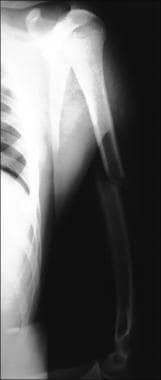
  • Diaphyseal fractures - Classified as simple, wedge, or complex (comminuted)


Prehospital Care

  • Immobilize the fracture.

Emergency Department Care

Minimize the patient’s movement and provide adequate analgesia to make the patient comfortable in the acute care setting.

  • Proximal humerus fracture
    • Most minimally displaced proximal humeral fractures can be managed nonoperatively.
    • Greater tuberosity fractures may have associated rotator cuff tears. The true incidence of rotator cuff tears is unknown. They are more common in older patients, high-energy injuries, and where there is significant displacement.
    • Sling and swathe application is the primary treatment.
    • Fractures of the anatomical neck should be referred to orthopedist due to the risk of avascular necrosis.
  • Humerus shaft (diaphyseal) fracture
    • Humerus shaft fracture should be stabilized using a coaptation splint.
    • Wrap splinting material snugly from axilla to nape of neck, creating a stirrup around the elbow.
    • Fracture reduction is usually not necessary because reduction is difficult to maintain.
    • Because of the shoulder's ability to compensate, 30-40° of angulation is acceptable. 

Consultations

  • Most isolated proximal and diaphyseal humeral fractures can be managed by an orthopedist in an outpatient setting. Even patients with fractures that may eventually require surgery generally may be discharged with early follow-up care if fracture is otherwise uncomplicated.
  • Open fractures represent a surgical emergency; obtain an immediate orthopedic consult.
  • Penetrating trauma requires particular neurovascular scrutiny.
  • Glenohumeral dislocation in conjunction with a proximal humerus fracture requires orthopedic evaluation.
  • Floating elbow (an ipsilateral humerus and forearm fracture) requires operative repair.


Drugs used to treat fractures are generally NSAIDs, analgesics, and anxiolytics.

Drug Category: Nonsteroidal anti-inflammatory agents (NSAIDs)

These agents are used most commonly for the relief of mild to moderately severe pain. Effects of NSAIDs in the treatment of pain tend to be patient specific, yet ibuprofen is usually DOC for initial therapy. Other options include flurbiprofen, ketoprofen, and naproxen.

Drug NameIbuprofen (Ibuprin, Advil, Motrin)
DescriptionUsually DOC for treatment of mild to moderately severe pain, if no contraindications. Inhibits inflammatory reactions and pain, probably by decreasing activity of enzyme cyclooxygenase, which inhibits prostaglandin synthesis.
Adult Dose200-400 mg PO q4-6h prn; not to exceed 3.2 g/d
Pediatric Dose<6 months: Not established
6 months to 12 years: 20-40 mg/kg/d PO divided tid/qid
>12 years: Administer as in adults
ContraindicationsDocumented hypersensitivity; peptic ulcer disease; recent GI bleeding or perforation; renal insufficiency; high risk of bleeding
InteractionsAspirin increases risk of inducing serious NSAID-related adverse effects; probenecid may increase concentrations and, possibly, toxicity; may decrease effects of hydralazine, captopril, and beta-blockers; may decrease diuretic effects of furosemide and thiazides; may increase PT in patients taking anticoagulants—monitor PT closely and instruct patients to watch for signs of bleeding; may increase risk of methotrexate toxicity; may increase phenytoin levels
PregnancyB - Fetal risk not confirmed in studies in humans but has been shown in some studies in animals
D - Fetal risk shown in humans; use only if benefits outweigh risk to fetus
PrecautionsCaution in congestive heart failure, hypertension, and decreased renal and hepatic function; caution in coagulation abnormalities or during anticoagulant therapy

Drug NameKetoprofen (Oruvail, Orudis, Actron)
DescriptionUsed for relief of mild to moderately severe pain and inflammation.
Administer small dosages initially to patients with small bodies, older persons, and those with renal or liver disease.
Doses higher than 75 mg do not increase therapeutic effects. Administer high doses with caution and closely observe patient for response.
Adult Dose25-50 mg PO q6-8h prn; not to exceed 300 mg/d
Pediatric Dose<3 months: Not established
3 months to 12 years: 0.1–1 mg/kg PO q6-8h
>12 years: Administer as in adults
ContraindicationsDocumented hypersensitivity
InteractionsAspirin increases risk of inducing serious NSAID-related adverse effects; probenecid may increase concentrations and, possibly, toxicity; may decrease effects of hydralazine, captopril, and beta-blockers; may decrease diuretic effects of furosemide and thiazides; may increase PT in patients taking anticoagulants—monitor PT closely and instruct patients to watch for signs of bleeding; may increase risk of methotrexate toxicity; may increase phenytoin levels
PregnancyB - Fetal risk not confirmed in studies in humans but has been shown in some studies in animals
D - Fetal risk shown in humans; use only if benefits outweigh risk to fetus
PrecautionsCaution in congestive heart failure, hypertension, and decreased renal and hepatic function; caution in coagulation abnormalities or during anticoagulant therapy

Drug NameNaproxen (Anaprox, Naprelan, Naprosyn)
DescriptionRelieves mild to moderately severe pain. Inhibits inflammatory reactions and pain by decreasing activity of enzyme cyclooxygenase, which decreases prostaglandin synthesis.
Adult Dose500 mg PO followed by 250 mg q6-8h; not to exceed 1.25 g/d
Pediatric Dose<2 years: Not established
>2 years: 2.5 mg/kg/dose PO; not to exceed 10 mg/kg/d
ContraindicationsDocumented hypersensitivity; peptic ulcer disease; recent GI bleeding or perforation; renal insufficiency
InteractionsAspirin increases risk of inducing serious NSAID-related adverse effects; probenecid may increase concentrations and, possibly, toxicity; may decrease effects of hydralazine, captopril, and beta-blockers; may decrease diuretic effects of furosemide and thiazides; may increase PT in patients taking anticoagulants—monitor PT closely and instruct patients to watch for signs of bleeding; may increase risk of methotrexate toxicity; may increase phenytoin levels
PregnancyB - Fetal risk not confirmed in studies in humans but has been shown in some studies in animals
D - Fetal risk shown in humans; use only if benefits outweigh risk to fetus
PrecautionsAcute renal insufficiency, interstitial nephritis, hyperkalemia, hyponatremia, and renal papillary necrosis may occur; patients with preexisting renal disease or compromised renal perfusion risk acute renal failure; leukopenia occurs rarely, is transient, and usually returns to normal during therapy; persistent leukopenia, granulocytopenia, or thrombocytopenia warrants further evaluation and may require discontinuation of drug

Drug NameFlurbiprofen (Ansaid)
DescriptionHas analgesic, antipyretic, and anti-inflammatory effects. May inhibit cyclooxygenase enzyme, inhibiting prostaglandin biosynthesis.
Adult Dose200-300 mg/d PO divided bid/qid
Pediatric DoseNot established
ContraindicationsDocumented hypersensitivity
InteractionsAspirin increases risk of inducing serious NSAID-related adverse effects; probenecid may increase concentrations and, possibly, toxicity; may decrease effects of hydralazine, captopril, and beta-blockers; may decrease diuretic effects of furosemide and thiazides; may increase PT in patients taking anticoagulants—monitor PT closely and instruct patients to watch for signs of bleeding; may increase risk of methotrexate toxicity; may increase phenytoin levels
PregnancyC - Fetal risk revealed in studies in animals but not established or not studied in humans; may use if benefits outweigh risk to fetus
D - Fetal risk shown in humans; use only if benefits outweigh risk to fetus
PrecautionsAcute renal insufficiency, interstitial nephritis, hyperkalemia, hyponatremia, and renal papillary necrosis may occur; patients with preexisting renal disease or compromised renal perfusion risk acute renal failure; leukopenia occurs rarely, is transient, and usually returns to normal during therapy; persistent leukopenia, granulocytopenia, or thrombocytopenia warrants further evaluation and may require discontinuation of drug

Drug Category: Analgesics

Pain control is essential to quality patient care. It ensures patient comfort, promotes pulmonary toilet, and aids physical therapy regimens. Many analgesics have sedating properties that benefit patients who have sustained fractures.

Drug NameAcetaminophen (Tylenol, Panadol, aspirin-free Anacin)
DescriptionDOC for treatment of pain in patients with documented hypersensitivity to aspirin or NSAIDs and in those with upper GI disease or taking oral anticoagulants.
Adult Dose325-650 mg PO q4-6h or 1000 mg tid/qid; not to exceed 4 g/d
Pediatric Dose<12 years: 10-15 mg/kg/dose PO q4-6h prn; not to exceed 2.6 g/d
>12 years: 325-650 mg q4h; not to exceed 5 doses/d
ContraindicationsDocumented hypersensitivity; known G-6-P deficiency
InteractionsRifampin can reduce analgesic effects; barbiturates, carbamazepine, hydantoins, and isoniazid may increase hepatotoxicity
PregnancyB - Fetal risk not confirmed in studies in humans but has been shown in some studies in animals
PrecautionsHepatotoxicity possible in chronic alcoholics following various dose levels; severe or recurrent pain or high or continued fever may indicate a serious illness; acetaminophen is contained in many OTC products and combined use with these products may result in cumulative acetaminophen doses exceeding recommended maximum dose

Drug NameAcetaminophen and codeine (Tylenol #3)
DescriptionDrug combination indicated for treatment of mild to moderately severe pain.
Adult Dose30-60 mg/dose based on codeine content PO q4-6h or 1-2 tab q4h; not to exceed 12 tab/d
Pediatric Dose0.5-1 mg/kg/dose based on codeine content PO q4-6h; 10-15 mg/kg/dose based on acetaminophen content; not to exceed 2.6 g/d of acetaminophen
ContraindicationsDocumented hypersensitivity
InteractionsCNS depressants or tricyclic antidepressants increase toxicity
PregnancyC - Fetal risk revealed in studies in animals but not established or not studied in humans; may use if benefits outweigh risk to fetus
PrecautionsCaution in patients dependent on opiates because this substitution may result in acute opiate-withdrawal symptoms; caution in severe renal or hepatic dysfunction

Drug NameHydrocodone bitartrate and acetaminophen (Vicodin ES)
DescriptionDrug combination indicated for relief of moderately severe to severe pain.
Adult Dose1-2 tab/cap PO q4-6h prn
Pediatric Dose<12 years: 10-15 mg/kg/dose acetaminophen PO q4-6h prn; not to exceed 2.6 g/d of acetaminophen
>12 years: 750 mg acetaminophen q4h; single dose not to exceed 10 mg of hydrocodone bitartrate; not to exceed 5 doses/d
ContraindicationsDocumented hypersensitivity; high-altitude cerebral edema; elevated intracranial pressure
InteractionsPhenothiazines may decrease analgesic effects; CNS depressants or tricyclic antidepressants may increase toxicity
PregnancyC - Fetal risk revealed in studies in animals but not established or not studied in humans; may use if benefits outweigh risk to fetus
PrecautionsTablets contain metabisulfite, which may cause hypersensitivity; caution in patients dependent on opiates because this substitution may result in acute opiate-withdrawal symptoms; caution in severe renal or hepatic dysfunction

Drug NameOxycodone and acetaminophen (Percocet)
DescriptionDrug combination indicated for relief of moderately severe to severe pain. DOC for aspirin-hypersensitive patients.
Adult Dose1-2 tab/cap PO q4-6h prn
Pediatric Dose0.05-0.15 mg/kg/dose oxycodone PO q4-6h prn; not to exceed 5 mg/dose of oxycodone
ContraindicationsDocumented hypersensitivity
InteractionsPhenothiazines may decrease analgesic effects; CNS depressants or tricyclic antidepressants increase toxicity
PregnancyC - Fetal risk revealed in studies in animals but not established or not studied in humans; may use if benefits outweigh risk to fetus
PrecautionsDuration of action may increase in elderly persons; be aware of total daily dose of acetaminophen patient is receiving; do not exceed 4000 mg/24 h of acetaminophen; higher doses may cause liver toxicity

Drug NameMorphine sulfate (Duramorph, Astramorph, MS Contin)
DescriptionDOC for narcotic analgesia because of its reliable and predictable effects, safety, and ease of reversibility with naloxone.
Morphine sulfate administered IV may be dosed in a number of ways and commonly is titrated until desired effect obtained.
Adult DoseStarting dose: 0.1 mg/kg IV/IM/SC
Maintenance dose: 5-20 mg/70 kg IV/IM/SC q4h
Relatively hypovolemic patients: Start with 2 mg IV/IM/SC and reassess hemodynamic effects of dose
Pediatric DoseNeonates: 0.05-0.2 mg/kg IV/IM/SC prn
Children: 0.1-0.2 mg/kg dose q2-4h prn
ContraindicationsDocumented hypersensitivity; hypotension; potentially compromised airway in which establishing rapid airway control would be difficult
InteractionsPhenothiazines may antagonize analgesic effects; tricyclic antidepressants, MAOIs, and other CNS depressants may potentiate adverse effects
PregnancyC - Fetal risk revealed in studies in animals but not established or not studied in humans; may use if benefits outweigh risk to fetus
PrecautionsAvoid in hypotension, respiratory depression, nausea, emesis, constipation, and urinary retention; caution in atrial flutter and other supraventricular tachycardias; has vagolytic action and may increase ventricular response rate

Drug Category: Anxiolytics

Patients with painful injuries usually experience significant anxiety. Anxiolytics allow a smaller analgesic dose to achieve same effect.

Drug NameLorazepam (Ativan)
DescriptionSedative hypnotic in benzodiazepine class with short onset of effect and relatively long half-life. By increasing action of GABA, a major inhibitory neurotransmitter, may depress all levels of CNS, including limbic and reticular formation.
Excellent for sedating patients for >24 h.
Monitor patient's BP after administering dose and adjust as necessary.
Adult DoseInitial dose: 2 mg total or 0.044 mg/kg IV, whichever is smaller
For greater lack of recall: 0.05 mg/kg IV; not to exceed 4 mg/dose
Pediatric Dose0.05-0.1 mg/kg IV slowly over 2-5 min; may repeat dose of 0.05 mg/kg IV slowly
ContraindicationsDocumented hypersensitivity; preexisting CNS depression; hypotension; narrow-angle glaucoma
InteractionsAlcohol, phenothiazines, barbiturates, and MAOIs increase toxicity
PregnancyD - Fetal risk shown in humans; use only if benefits outweigh risk to fetus
PrecautionsCaution in renal or hepatic impairment, myasthenia gravis, organic brain syndrome, or Parkinson disease


Further Inpatient Care

  • Open fractures
    • These require extensive irrigation.
    • Administer prophylactic antibiotics, such as cephalexin or gentamicin.

Further Outpatient Care

  • Proximal humerus fracture
    • Displaced 3- or 4-part fractures frequently require surgical fixation.
    • Open reduction and internal fixation is common in young patients.
    • Humeral arthroplasty in older patients is common.
    • For nonsurgical fractures, continue sling for comfort and institute early range of motion (ROM) exercises.
    • Schedule initial follow-up visit within 1 week.
  • Humerus shaft fracture
    • Most humerus shaft fractures are treated nonoperatively with an expected union rate of 90-100%, though surgical fixation, by either intramedullary nailing or plating, is necessary if the fracture is segmental or the vasculature is compromised.
    • Use coaptation splint until immediate postfracture pain has subsided, usually within 3-7 days. Then, place the patient in a functional brace.
    • An orthopedic surgeon best addresses decisions regarding alignment, rotation, and progression to union

In/Out Patient Meds

  • As with all fractures, provide adequate outpatient analgesia especially during the first few days. Narcotic analgesia may be appropriate.

Complications

  • Proximal humeral fracture
    • The most common complication is adhesive capsulitis. This can be prevented by the early initiation of a rehabilitation program.
    • Two-part fractures of the articular surface and 4-part fractures have a high incidence of avascular necrosis of the humeral head.
    • Repeated forceful attempts at reduction of a fracture dislocation may be associated with subsequent heterotropic bone formation.
  • Humeral shaft
    • The most common complication in humeral shaft fractures is radial nerve injury. The nerve deficit is usually a benign neurapraxia that resolves spontaneously, although recovery may take several months. 
    • Radial nerve injuries associated with penetrating trauma or open fractures are likely to be permanent and usually warrant operative exploration.

Prognosis

  • Proximal humeral fractures
    • Complete union is expected at 6-8 weeks.
    • Older patients often exhibit a functional decrease in shoulder ROM.
  • Diaphyseal fractures
    • These fractures have a high rate of union.
    • Residual angulation is well tolerated because of compensation by shoulder and elbow ROM.

Patient Education


Medical/Legal Pitfalls

  • Failure to assess and document radial nerve function in humerus shaft fracture
  • Failure to recognize a glenohumeral dislocation associated with a proximal humerus fracture. This may increase risk of avascular necrosis of humeral head.


The authors and editors of eMedicine gratefully acknowledge the contributions of previous authors, Daniel Corboy, MD, and D Daniel Rotenberg, MD, to the development and writing of this article.


Media file 1:  Diaphyseal humerus fracture.
Click to see larger pictureClick to see detailView Full Size Image
Media type:  Radiograph

Media file 2:  Neer classification.
Click to see larger pictureClick to see detailView Full Size Image
Media type:  Acrobat PDF


  • Byrd RG, Byrd RP Jr, Roy TM. Axillary artery injuries after proximal fracture of the humerus. Am J Emerg Med. Mar 1998;16(2):154-6. [Medline].
  • Keller A. The management of gunshot fractures of the humerus. Injury. Mar 1995;26(2):93-6. [Medline].
  • McKee MD, Jupiter JB. A contemporary approach to the management of complex fractures of the distal humerus and their sequelae. Hand Clin. Aug 1994;10(3):479-94. [Medline].
  • Minkowitz B, Busch MT. Supracondylar humerus fractures. Current trends and controversies. Orthop Clin North Am. Oct 1994;25(4):581-94. [Medline].
  • Niall DM, O'Mahony J, McElwain JP. Plating of humeral shaft fractures--has the pendulum swung back?. Injury. Jun 2004;35(6):580-6. [Medline].
  • Rosen P. Emergency Medicine. 2nd ed. Mosby-Year Book, Incorporated; 1988:735-758.
  • Szyszkowitz R, Seggl W, Schleifer P, et al. Proximal humeral fractures. Management techniques and expected results. Clin Orthop Relat Res. Jul 1993;13-25. [Medline].
  • Tintinalli J, Ruiz E, Krome R. Emergency Medicine. 4th ed. McGraw Hill Text; 1996:1242-1244.
  • Wilkins KE. Supracondylar fractures: what's new?. J Pediatr Orthop B. Apr 1997;6(2):110-6. [Medline].
  • Mckee MD. Fractures of the shaft of the humerus. In: Bucholz RW, Heckman JD, Brown CC, eds. Rockwood and Green's Fractures in Adults. Vol 1. 6th ed. Philadelphia, Pa: Lippincott Williams and Wilkins; 2006:1117-1159.
  • Warner JP, Costouros JG, Gerber C. Fractures of the proximal humerus. In: Bucholz RW, Heckman JD, Brown CC, eds. Rockwood and Green's Fractures in Adults. Vol 1. 6th ed. Philadelphia, Pa: Lippincott Williams and Wilkins; 2006:1161-1205.
  • Brown CC, McQueen MM, Tornetta III P. Orthopedic Surgery Essentials: Trauma. Philadelphia, Pa: Lippincott Williams and Wilkins; 2006:89-114.

Fracture, Humerus excerpt

Article Last Updated: Jul 16, 2008