You are in: eMedicine Specialties >
Emergency Medicine > TRAUMA AND ORTHOPEDICS
Dislocation, Interphalangeal
Article Last Updated: Feb 29, 2008
AUTHOR AND EDITOR INFORMATION
Section 1 of 11
Author: Grace M Young, MD, Associate Professor, Department of Pediatrics, University of Maryland Medical Center
Grace M Young is a member of the following medical societies: American Academy of Pediatrics and American College of Emergency Physicians
Editors: James E Keany, MD, FACEP, Medical Director, JetWest International Air Ambulance, Van Nuys, California; Consulting Staff, Department of Emergency Services, Mission Hospital Regional Medical Center, Mission Viejo, California; Francisco Talavera, PharmD, PhD, Senior Pharmacy Editor, eMedicine; Tom Scaletta, MD, Past-President, American Academy of Emergency Medicine; Chairperson, Department of Emergency Medicine, Edward Hospital; Assistant Professor of Emergency Medicine, Rush Medical College and Cook County Hospital; John D Halamka, MD, MS, Associate Professor of Medicine, Harvard Medical School, Beth Israel Deaconess Medical Center; Chief Information Officer, CareGroup Healthcare System and Harvard Medical School; Attending Physician, Division of Emergency Medicine, Beth Israel Deaconess Medical Center; Rick Kulkarni, MD, Medical Director, Assistant Professor of Surgery, Section of Emergency Medicine, Yale-New Haven Hospital
Author and Editor Disclosure
Synonyms and related keywords:
IP, finger, toe, proximal interphalangeal joint, PIP, distal interphalangeal joint, DIP, IP joint dislocations, interphalangeal joint dislocations, interphalangeal dislocations, toe dislocation, finger dislocation, dorsal PIP dislocation, volar IP dislocation, IP joint, PIP joint dislocations, DIP joint dislocations, thumb dislocation
Background
Interphalangeal (IP) joint dislocations of the fingers and toes are common. Typically associated with forced hyperextension or hyperflexion of the digit, they require immediate reduction. The IP joint is a hinge joint that allows only flexion and extension and consists of several ligamentous complexes. The volar plate provides stability against hyperextension injury and dorsal dislocation of the phalanx. It often ruptures during a dorsal dislocation and may be associated with an avulsion fracture at the base of the phalanx. The strong collateral ligament complex resists hyperextension and lateral dislocation injury. The extensor hood complex stabilizes against hyperflexion injury and volar displacement of the phalanx.
Pathophysiology
Forced hyperextension with axial compression causes a dorsal dislocation of the proximal IP (PIP) or distal IP (DIP) joint, in which the middle (or distal) phalanx is dislocated dorsal to the proximal (middle) phalanx. Forced hyperflexion results in a volar IP joint dislocation (eg, where the distal phalanx is dislocated volar to the middle phalanx). Patients whose digits have neurovascular compromise, an open joint dislocation, ligamentous or volar plate rupture, joint instability, or an associated fracture should have immediate orthopedic consultation. All finger dislocations should be reevaluated subsequently by an orthopedic or hand specialist to manage potential subtle ligamentous, cartilaginous, or bony injury. A lateral or volar PIP joint dislocation, although rare, requires an orthopedist for possible open reduction with internal fixation. A dislocation of the metacarpophalangeal (MCP) joint, although rare in adults, may be more common in children. MCP dislocation usually requires open reduction by a pediatric orthopedist.
Frequency
United States
Dorsal PIP dislocation is the most common IP dislocation. Volar IP joint dislocations are relatively uncommon. PIP joint dislocations occur more frequently than DIP joint dislocations.
History
- History usually reveals a traumatic athletic injury or entrapment of the finger between objects. Typically, the finger was jammed or bent backwards during basketball, football, or other sports activity. The patient often experiences diffuse pain, swelling, and tingling.
- Determine the following aspects of the patient's history:
- Which is the dominant hand of the patient and which hand is injured?
- What is the patient's occupation?
- Where did injury occur (eg, job, assault)?
- How much time has passed since the initial injury?
Physical
- An accurate and detailed examination often requires digital block anesthesia. The clinician should test and document each of the following:
- Gross deformity, diffuse edema, ecchymosis, and tenderness of the involved digit
- Possible anesthesia or paresthesia in the distal aspect of the involved digit
- Range of motion, function, and stability of involved joint
- Detailed neurovascular examination of entire involved hand
- Restriction in active flexion and extension, especially against resistance, suggests tendinous or ligamentous rupture or intraarticular osteochondral fragment.
- Test the integrity of the volar plate by passive hyperextension
- Test the collateral ligaments by exerting radial and ulnar stress.
- Skin laceration after a blunt hyperextension injury suggests volar plate rupture.
Causes
- Axial compression or lateral forces directed to the digit
- Forced hyperextension or hyperflexion of digit from traumatic athletic injury, entrapment of finger between objects, or a fall
- Predisposition to ligamentous injury possible in those with lax ligaments (eg, Down syndrome)
Dislocations, Hand
Fractures, Hand
Gamekeeper Thumb
Hand Injury, Soft Tissue
Imaging Studies
- Radiographs
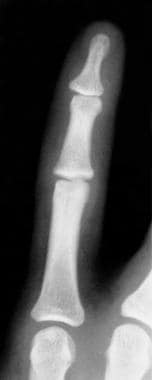
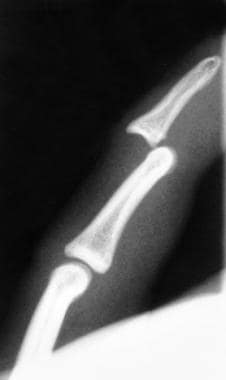
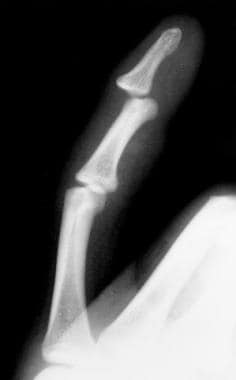
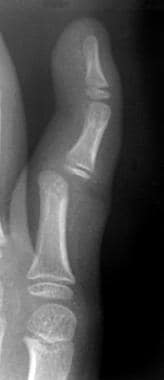
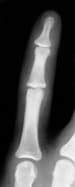
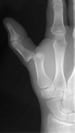
- Take anteroposterior, true lateral, and oblique radiographs of the affected digit. Obtain 3 views prior to and after reduction (see Images 1-4).
- Physeal, avulsion, or distal tuft fractures as well as osteochondral fragments are often subtle and seen only on 1 or 2 views.
- Obtain stress views to assess joint stability.
Procedures
- Administer digital block anesthesia 10-15 minutes before any reduction maneuver.
- Be sure to remove all rings.
Prehospital Care
- Splint, ice, and elevate the affected digit.
- Evaluate neurovascular status before and after transport to the ED.
Emergency Department Care
- Reduction and postreduction procedures (also see Joint Reduction, Finger Dislocation and Joint Reduction, Thumb Dislocation)
- With the patient's hand or foot securely braced, grasp dislocated phalanx with dry gauze loosely wrapped around the phalanx (gauze improves grip). Hyperextend joint slightly with gentle longitudinal traction for a dorsal dislocation or hyperflex for a volar dislocation. Gradually push dislocated phalanx into its normal anatomical position.
- Do not apply vigorous traction in a child, because that may interpose soft tissue or an osteochondral fragment into the distracted joint space and prevent reduction.
- After reduction, examine the affected joint for flexor-extensor tendon function, active range of motion, localized tenderness, and instability in the medial-lateral and dorsal-volar directions.
- Immobilize the joint with a foam-padded splint immediately after reduction to prevent redislocation or instability. Immobilize for 14-21 days for a PIP joint dislocation and 10-14 days for a DIP joint dislocation. Buddy taping for 3-6 weeks thereafter allows active range of motion and prevents hyperextension.
- For a dorsal PIP dislocation, apply the splint dorsally with the joint in 20-30 degrees of flexion.
- For a volar DIP dislocation, apply the splint only to the DIP joint on the volar aspect; the DIP should be in full extension. Allow the PIP joint full range of motion.
- In children, the cause of dislocation is more likely ligamentous laxity rather than rupture. Immobilization by buddy taping to an adjacent digit for 10-14 days is an acceptable alternative treatment.
- Obtain postreduction radiographs. Assess functional stability with stress views. This confirms correct joint alignment and congruity and identifies subtle fractures, especially chip or avulsion fractures.
- Assess neurovascular status following reduction.
Consultations
- Joint instability or neurovascular compromise after reduction requires immediate orthopedic or hand consultation.
- Because joint instability or dysfunction and subtle ligamentous, cartilaginous, or bony injury often are obscured by extensive edema and pain immediately after the injury, all finger joint dislocations should be referred for orthopedic or hand specialist evaluation within 2-3 weeks following reduction.
NSAIDs, analgesics, and anxiolytics are used to treat the pain associated with dislocations.
Drug Category: Nonsteroidal anti-inflammatory drugs (NSAIDs)
These agents are used most commonly for the relief of mild to moderately severe pain. Although the effects of NSAIDs in the treatment of pain tend to be patient specific, ibuprofen is the DOC for initial therapy. Other options include flurbiprofen, ketoprofen, and naproxen.
| Drug Name | Ibuprofen (Ibuprin, Advil, and Motrin) |
| Description | DOC for treatment of mild to moderately severe pain, if no contraindications. Inhibits inflammatory reactions and pain, probably by decreasing activity of enzyme cyclooxygenase, inhibiting prostaglandin synthesis. |
| Adult Dose | 400-800 mg/dose PO q6-8h |
| Pediatric Dose | 10 mg/kg/dose PO q8h; not to exceed adult dose |
| Contraindications | Documented hypersensitivity; peptic ulcer disease; recent GI bleeding or perforation; renal insufficiency; high risk of bleeding |
| Interactions | Aspirin increases risk of inducing serious NSAID-related adverse effects; probenecid may increase concentrations and, possibly, toxicity; may decrease effects of hydralazine, captopril, and beta-blockers; may decrease diuretic effects of furosemide and thiazides; may increase PT in patients taking anticoagulants (monitor PT carefully and instruct patients to watch for signs of bleeding); may increase risk of methotrexate toxicity; may increase phenytoin levels |
| Pregnancy | B - Fetal risk not confirmed in studies in humans but has been shown in some studies in animals D - Fetal risk shown in humans; use only if benefits outweigh risk to fetus
|
| Precautions | Caution in CHF, hypertension, and decreased renal or hepatic function; caution in anticoagulation abnormalities or during anticoagulant therapy (instruct patients to monitor for signs of bleeding) |
| Drug Name | Ketoprofen (Oruvail, Orudis, Actron) |
| Description | Used for relief of mild to moderately severe pain and inflammation. Administer small dosages initially to patients with small body size, the elderly, and those with renal or liver disease. Doses higher than 75 mg do not increase therapeutic effects. Administer high doses with caution and closely observe patient. |
| Adult Dose | 25-50 mg PO q6-8h prn; not to exceed 300 mg/d |
| Pediatric Dose | <3 months: Not established 3 months to 12 years: 0.1-1 mg/kg PO q6-8h >12 years: Administer as in adults |
| Contraindications | Documented hypersensitivity |
| Interactions | Aspirin increases risk of inducing serious NSAID-related adverse effects; probenecid may increase concentrations and, possibly, toxicity; may decrease effects of hydralazine, captopril, and beta-blockers; may decrease diuretic effects of furosemide and thiazides; may increase PT in patients taking anticoagulants (monitor PT carefully and instruct patients to watch for signs of bleeding); may increase risk of methotrexate toxicity; may increase phenytoin levels |
| Pregnancy | B - Fetal risk not confirmed in studies in humans but has been shown in some studies in animals D - Fetal risk shown in humans; use only if benefits outweigh risk to fetus
|
| Precautions | Caution in CHF, hypertension, and decreased renal or hepatic function; caution in anticoagulation abnormalities or during anticoagulant therapy (instruct patients to monitor for signs of bleeding) |
| Drug Name | Flurbiprofen (Ansaid) |
| Description | Has analgesic, antipyretic, and anti-inflammatory effects. May inhibit cyclooxygenase enzymes, inhibiting prostaglandin biosynthesis. |
| Adult Dose | 200-300 mg/d PO divided bid/qid |
| Pediatric Dose | Not established |
| Contraindications | Documented hypersensitivity |
| Interactions | Aspirin increases risk of inducing serious NSAID-related adverse effects; probenecid may increase concentrations and, possibly, toxicity; may decrease effects of hydralazine, captopril, and beta-blockers; may decrease diuretic effects of furosemide and thiazides; may increase PT in patients on anticoagulants (monitor PT carefully and instruct patients to watch for signs of bleeding); may increase risk of methotrexate toxicity; may increase phenytoin levels |
| Pregnancy | C - Fetal risk revealed in studies in animals but not established or not studied in humans; may use if benefits outweigh risk to fetus D - Fetal risk shown in humans; use only if benefits outweigh risk to fetus
|
| Precautions | Acute renal insufficiency, interstitial nephritis, hyperkalemia, hyponatremia, and renal papillary necrosis may occur; patients with preexisting renal disease or compromised renal perfusion risk acute renal failure; leukopenia occurs rarely, is transient, and usually returns to normal during therapy; persistent leukopenia, granulocytopenia, or thrombocytopenia warrants further evaluation and may require discontinuation of drug |
| Drug Name | Naproxen (Anaprox, Naprelan, Naprosyn) |
| Description | Used for relief of mild to moderately severe pain. Inhibits inflammatory reactions and pain by decreasing activity of enzyme cyclooxygenase, decreasing prostaglandin synthesis. |
| Adult Dose | 500 mg PO initial dose, followed by 250 mg q6-8h; not to exceed 1.25 g/d |
| Pediatric Dose | <2 years: Not established >2 years: 2.5 mg/kg/dose PO; not to exceed 10 mg/kg/d |
| Contraindications | Documented hypersensitivity; peptic ulcer disease; recent GI bleeding or perforation; renal insufficiency |
| Interactions | Aspirin increases risk of inducing serious NSAID-related adverse effects; probenecid may increase concentrations and, possibly, toxicity; may decrease effects of hydralazine, captopril, and beta-blockers; may decrease diuretic effects of furosemide and thiazides; may increase PT in patients taking anticoagulants (monitor PT carefully and instruct patients to watch for signs of bleeding); may increase risk of methotrexate toxicity; may increase phenytoin levels |
| Pregnancy | B - Fetal risk not confirmed in studies in humans but has been shown in some studies in animals D - Fetal risk shown in humans; use only if benefits outweigh risk to fetus
|
| Precautions | Acute renal insufficiency, interstitial nephritis, hyperkalemia, hyponatremia, and renal papillary necrosis may occur; patients with preexisting renal disease or compromised renal perfusion risk acute renal failure; leukopenia occurs rarely, is transient, and usually returns to normal during therapy; persistent leukopenia, granulocytopenia, or thrombocytopenia warrants further evaluation and may require discontinuation of drug |
Drug Category: Analgesics
Pain control is essential to quality patient care. It ensures patient comfort, promotes pulmonary toilet, and aids physical therapy regimens. Many analgesics have sedating properties that benefit patients with injuries.
| Drug Name | Acetaminophen (Tylenol, Panadol, Aspirin-free Anacin) |
| Description | DOC for treatment of pain in patients with documented hypersensitivity to aspirin and NSAIDs, those with upper GI disease, or those taking oral anticoagulants. |
| Adult Dose | 325-650 mg PO q4-6h or 1000 mg tid/qid; not to exceed 4 g/d |
| Pediatric Dose | <12 years: 10-15 mg/kg/dose PO q4-6h prn; not to exceed 2.6 g/d >12 years: 325-650 mg PO q4h; not to exceed 5 doses/d |
| Contraindications | Documented hypersensitivity |
| Interactions | Rifampin can reduce analgesic effects; barbiturates, carbamazepine, hydantoins, or isoniazid may increase hepatotoxicity |
| Pregnancy | B - Fetal risk not confirmed in studies in humans but has been shown in some studies in animals
|
| Precautions | Hepatotoxicity possible in chronic alcoholics following various dose levels; severe or recurrent pain or high or continued fever may indicate a serious illness; acetaminophen is contained in many OTC products and combined use with these products may result in cumulative acetaminophen doses exceeding recommended maximum dose |
| Drug Name | Oxycodone and acetaminophen (Percocet) |
| Description | Drug combination indicated for relief of moderately severe to severe pain. DOC for aspirin-hypersensitive patients. |
| Adult Dose | 1-2 tab or cap PO q4-6h prn |
| Pediatric Dose | 0.05-0.15 mg/kg/dose oxycodone PO q4-6h prn; not to exceed 5 mg/dose of oxycodone |
| Contraindications | Documented hypersensitivity |
| Interactions | Phenothiazines may decrease analgesic effects; CNS depressants or tricyclic antidepressants may increase toxicity |
| Pregnancy | C - Fetal risk revealed in studies in animals but not established or not studied in humans; may use if benefits outweigh risk to fetus
|
| Precautions | Duration of action may increase in elderly persons; be aware of total daily dose of acetaminophen patient is receiving; do not exceed 4,000 mg/24 h of acetaminophen; higher doses may cause liver toxicity |
| Drug Name | Oxycodone and aspirin (Percodan) |
| Description | Drug combination indicated for relief of moderately severe to severe pain. |
| Adult Dose | 1-2 tab or cap PO q4-6h prn |
| Pediatric Dose | 0.05-0.15 mg/kg/dose oxycodone PO q4-6h prn; not to exceed 5 mg/dose of oxycodone |
| Contraindications | Documented hypersensitivity; liver damage; hypoprothrombinemia; vitamin K deficiency; bleeding disorders; asthma; because of association of aspirin with Reye syndrome do not use in children (<16 y) who have flu |
| Interactions | Phenothiazines may decrease analgesic effects; CNS depressants or tricyclic antidepressants may increase toxicity; may potentiate anticoagulant effects of warfarin |
| Pregnancy | D - Fetal risk shown in humans; use only if benefits outweigh risk to fetus
|
| Precautions | Duration of action may increase in elderly patients; caution in renal or liver impairment, peptic ulcer disease, and erosive gastritis |
| Drug Name | Acetaminophen and codeine (Tylenol #3) |
| Description | Drug combination indicated for treatment of mild to moderately severe pain. |
| Adult Dose | 30-60 mg/dose based on codeine content PO q4-6h or 1-2 tab q4h; not to exceed 12 tab/d |
| Pediatric Dose | 0.5-1 mg/kg/dose based on codeine PO q4-6h; 10-15 mg/kg/dose based on acetaminophen content; not to exceed 2.6 g/d of acetaminophen |
| Contraindications | Documented hypersensitivity |
| Interactions | CNS depressants or tricyclic antidepressants may increase toxicity |
| Pregnancy | C - Fetal risk revealed in studies in animals but not established or not studied in humans; may use if benefits outweigh risk to fetus
|
| Precautions | Caution in patients dependent on opiates because this substitution may result in acute opiate-withdrawal symptoms; caution in severe renal or hepatic dysfunction |
| Drug Name | Hydrocodone bitartrate and acetaminophen (Vicodin ES) |
| Description | Drug combination indicated for relief of moderately severe to severe pain. |
| Adult Dose | 1-2 tab or cap PO q4-6h prn |
| Pediatric Dose | <12 years: 10-15 mg/kg/dose acetaminophen PO q4-6h prn; not to exceed 2.6 g/d of acetaminophen or 5 mg of hydrocodone bitartrate >12 years: 750 mg acetaminophen PO q4h; not to exceed 5 doses/d acetaminophen or 10 mg of hydrocodone bitartrate |
| Contraindications | Documented hypersensitivity; high-altitude cerebral edema; elevated intracranial pressure |
| Interactions | Phenothiazines may decrease analgesic effects; CNS depressants or tricyclic antidepressants may increase toxicity |
| Pregnancy | C - Fetal risk revealed in studies in animals but not established or not studied in humans; may use if benefits outweigh risk to fetus
|
| Precautions | Tablets contain metabisulfite, which may cause hypersensitivity; caution in patients dependent on opiates because this substitution may result in acute opiate-withdrawal symptoms; caution in severe renal or hepatic dysfunction |
Further Inpatient Care
- Admission may be warranted as dictated by a hand consultant or concurrent injuries.
Further Outpatient Care
- Apply ice and elevate the digit. Splint at all times.
- The patient should not participate in sports activities involving the hand.
- The patient should have a follow-up evaluation with an orthopedist or hand specialist.
In/Out Patient Meds
- NSAIDs may be taken as needed.
Transfer
- If an orthopedic or hand specialist is not immediately available for consultation, transfer patients whose reductions are unsuccessful or those who have an unstable joint, open joint injury, or associated epiphyseal or avulsion fracture.
Deterrence/Prevention
- Patients may use supportive taping during future sports activities.
Complications
- Complications are rare with early reduction, although persistent pain or swelling is common. Despite appropriate management with rest, ice, and elevation, pain and swelling may persist for 6-12 months.
- Inadequate immobilization after reduction may result in redislocation.
- Prolonged immobilization may result in muscle contracture.
- Volar plate injury may lead to recurrent dislocation with chronic laxity, hyperextensibility (swan-neck deformity on active extension), or flexion contracture (pseudoboutonnière deformity without DIP hyperextension).
- Late or delayed reduction commonly results in loss of joint motion, joint instability, and limitation of hand function.
Prognosis
- The prognosis is excellent with proper reduction and follow-up evaluation by orthopedic or hand specialist.
Patient Education
Medical/Legal Pitfalls
- Failure to perform successful reduction. Typical causes include intraarticular entrapment of the volar plate, extensor hood ligaments, or osteochondral fragment from an associated avulsion fracture. Buttonhole dislocation of the phalangeal neck through the joint capsule also may complicate reduction.
- Failure to diagnose an unstable joint, open joint injury, or associated epiphyseal or avulsion fracture
Special Concerns
- In a patient whose occupation requires manual dexterity, especially if the dominant hand is injured, carefully document range of joint motion and neurovascular status.
| Media file 1:
Anteroposterior view of distal interphalangeal (DIP) joint dislocation |
 | View Full Size Image | |
Media type: X-RAY
|
| Media file 2:
Lateral view of distal interphalangeal (DIP) joint dislocation |
 | View Full Size Image | |
Media type: X-RAY
|
| Media file 3:
Oblique view of distal interphalangeal (DIP) joint dislocation |
 | View Full Size Image | |
Media type: X-RAY
|
| Media file 4:
Oblique view of proximal interphalangeal (PIP) joint dislocation |

 | View Full Size Image | |
Media type: X-RAY
|
- Banerji S, Bullocks J, Cole P, Hollier L. Irreducible distal interphalangeal joint dislocation: a case report and literature review. Ann Plast Surg. Jun 2007;58(6):683-5. [Medline].
- Chinchalkar SJ, Gan BS. Management of proximal interphalangeal joint fractures and dislocations. J Hand Ther. Apr-Jun 2003;16(2):117-28. [Medline].
- Cornwall R. Finger metacarpal fractures and dislocations in children. Hand Clin. Feb 2006;22(1):1-10. [Medline].
- Deshmukh NV, Sonanis SV, Stothard J. Irreducible volar dislocations of the proximal interphalangeal joint. Emerg Med J. Mar 2005;22(3):221-3. [Medline].
- Freiberg A, Pollard BA, Macdonald MR, Duncan MJ. Management of proximal interphalangeal joint injuries. Hand Clin. Aug 2006;22(3):235-42. [Medline].
- Gilbert TJ, Cohen M. Imaging of acute injuries to the wrist and hand. Radiol Clin North Am. May 1997;35(3):701-25. [Medline].
- Kannan RY, Wilmshurst AD. Unstable proximal interphalangeal joint dislocations: another cause. Emerg Med J. Oct 2006;23(10):819. [Medline].
- Kozin SH. Fractures and dislocations along the pediatric thumb ray. Hand Clin. Feb 2006;22(1):19-29. [Medline].
- Morisawa Y, Ikegami H, Izumida R. Irreducible palmar dislocation of the distal interphalangeal joint. J Hand Surg [Br]. Jun 2006;31(3):296-7. [Medline].
- Nanno M, Sawaizumi T, Ito H. Irreducible palmar dislocation of the proximal interphalangeal joint of a finger evaluated by magnetic resonance imaging: a case report. Hand Surg. Dec 2004;9(2):253-6. [Medline].
- Otani K, Fukuda K, Hamanishi C. An unusual dorsal fracture-dislocation of the proximal interphalangeal joint. J Hand Surg Eur Vol. Apr 2007;32(2):193-4. [Medline].
- Papadonikolakis A, Li Z, Smith BP, Koman LA. Fractures of the phalanges and interphalangeal joints in children. Hand Clin. Feb 2006;22(1):11-8. [Medline].
- Van Ransbeeck H, De Smet L. Double dislocation of both interphalangeal joints in the finger. Case report and literature review. Acta Orthop Belg. Feb 2004;70(1):72-5. [Medline].
- Wang QC, Johnson BA. Fingertip injuries. Am Fam Physician. May 15 2001;63(10):1961-6. [Medline].
Dislocation, Interphalangeal excerpt Article Last Updated: Feb 29, 2008
|