Background
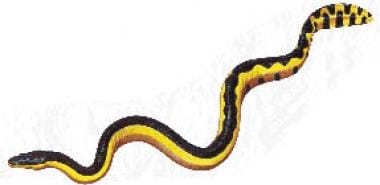
Sea snakes, venomous elapid snakes that inhabit marine environments, are the most abundant and widely dispersed group of poisonous reptiles in the world. [1] They comprise approximately 70 species, 50 of which are members of the family Hydrophiidae. Sea snakes are characterized by laterally compressed bodies and vertically flattened tails and nostrils with valve-like flaps, giving them an eel-like appearance. Their most characteristic feature is a paddle-like tail, which increases their swimming ability. [2] Unlike eels, however, sea snakes have scales but lack gills or fins. Although they spend much of their time underwater, they must surface regularly to breathe. [3] They are typically about 1 m in length, but some species may grow to 3 m. See the image below.
Sea snakes are found in warm coastal waters, predominantly in tropical and subtropical waters in the western Pacific and Indian Oceans. [4, 5] They are usually found in protected coastal waters and near river mouths. However, they are able to thrive in a variety of habitats, ranging from muddy or turbid water, to clear waters and coral reefs. Most species prefer shallow waters not far from land, around islands. The pelagic sea snake, Pelamis platurus, has a remarkably wide geographic range, reaching the western coasts of North America and South America from the Baja peninsula to Ecuador, along with the waters around Hawaii. Sea snakes are not found in the Atlantic Ocean, the Caribbean, or along the North American coast north of Baja.
Generally, sea snakes are not aggressive with gentle dispositions. They are not thought to bite humans unless provoked, and they typically do not actively pursue swimming prey. Sea snakes have been noted to become quite aggressive, when they are taken out of water, exhibiting erratic movements and striking anything near them that moves. [6]

Pathophysiology
Among this group are species with some of the most potent venoms of all snakes. The venom apparatus of sea snakes is fairly rudimentary, consisting of 2-4 short hollow maxillary fangs associated with a pair of venom-producing glands. The venom ducts open near the tips of the fangs. The fangs are dislodged easily from their sockets and may remain embedded in the skin of victims.
Nearly 80% of sea snake bites fail to produce significant envenomation, and bites may be inconspicuous, painless, and free of edema. Usually, little or no swelling is involved, and it is rare for any nearby lymph nodes to be affected. However, sea snake venom is extremely potent, and a complete envenomation by an adult sea snake may contain enough venom to kill 3 adult people.
The clinically relevant toxins in sea snake venom are neurotoxins and myotoxins. The primary neurotoxin causes peripheral paralysis by competitively binding to postsynaptic nicotinic acetylcholine receptors at the neuromuscular junction. Potent myotoxins account for the significant muscle necrosis, with consequent myoglobinemia and hyperkalemia that may occur following envenomation. Sea snake venom does not affect blood coagulation to a significant degree.
Sea snakes are closely related to Australian elapids; therefore, some paraspecificity exists between sea snake antivenom and Australian elapid antivenom.
Etiology
The following exposures may lead to sea snake envenomation:
-
Occupational exposure - Usually fishermen handling nets
-
Accidental exposure - Stepping on sea snakes in shallow water
-
Nonaccidental exposure - Intentionally handling sea snakes (eg, home aquariums)
Epidemiology
Frequency
United States
Hawaii is the only US state where sea snakes are found.
International
Sea snake envenomations occur throughout the serpents' geographic ranges, but accurate data about the incidence of envenomation are not available. Victims most commonly are fishermen bitten while handling nets or after stepping on a snake.
Race
No inherent racial predilection exists for sea snake bites; however, the best-represented races in areas with endemic sea snake populations are the most commonly bitten.
Sex
Males are bitten much more commonly than females, with a male-to-female ratio of approximately 4:1, because of the increased occupational exposure to sea snakes by male fishermen.
Age
Age is a factor in determining sea snake bites only insofar as it occurs with potential recreational or occupational exposure to the serpents.
Prognosis
Before the development of sea snake antivenom, the mortality rate associated with sea snake bites was approximately 10%, but approximately 50% for clinically significant envenomations. With timely administration of antivenom and aggressive supportive care, the mortality rate currently is much lower, although accurate numbers are not available.
Although sea snake venoms contain extremely potent toxins, as many as 80% of sea snake bites do not produce clinically significant envenomation. [7] Therefore, the overall prognosis for people bitten by sea snakes is good.
In fatal cases, death has been reported as early as 2.5 hours and as late as 24 days after envenomation.
Patient Education
In areas with endemic sea snake populations, public education about the identification and avoidance of sea snakes may be useful.
-
Technique for application of pressure immobilization in field management of sea snake bites. Figure 1, Apply a broad-pressure bandage over the bite site as soon as possible. Do not take off jeans because the movement of doing so assists venom to enter the bloodstream. Keep the bitten leg still. Figure 2, The bandage should be as tight as would be applied to a sprained ankle. Figure 3, Extend the bandage as high as possible.
-
Technique for application of pressure immobilization in field management of sea snake bites. Figure 4, Apply a splint to the leg. Figure 5, Bind the splint firmly to as much of the leg as possible. If the bandages and splint are applied correctly, they will be comfortable and may be left on for several hours. They should not be taken off until the patient has reached medical care. The doctor will decide when to remove the bandages. If venom has been injected, it will move into the bloodstream quickly once the bandages are removed. The doctor should leave the bandages and splint in position until he or she has assembled appropriate antivenom and drugs that may need to be used when the dressings and splint are removed. Figure 6, For bites on a hand or forearm, bind to the elbow with bandages, use a splint to the elbow, and use a sling.
-
Yellow-belly pelagic sea snake. Illustration by David Kirshner.