Continually Updated Clinical Reference
 
 
  All Sources     eMedicine     Medscape     Drug Reference     MEDLINE
 
eMedicine - Dental, Fractured Tooth : Article by

Quick Find
Authors & Editors
Introduction
Clinical
Differentials
Workup
Treatment
Medication
Follow-up
Miscellaneous
References

Related Articles
Dental, Avulsed Tooth

Dental, Displaced Tooth

Dental, Infections


Patient Education
Teeth and Mouth Center

Broken or Knocked-Out Teeth Overview

Broken or Knocked-Out Teeth Causes

Broken or Knocked-Out Teeth Symptoms

Broken or Knocked-Out Teeth Treatment

When to Visit the Dentist - Introduction


Author: Lynnus F Peng, MD, Assistant Clinical Professor, Department of Anesthesia, University of California at Irvine; Chairman of Anesthesia, Department of Surgery, St Jude Medical Center at Fullerton

Lynnus F Peng is a member of the following medical societies: Alpha Omega Alpha and American Society of Anesthesiologists

Coauthor(s): A Antoine Kazzi, MD, Chief of Service, Department of Emergency Medicine, Medical Director of the Emergency Unit, American University of Beirut; Willard Peng, BA, BS, MS, Doctor of Dental Surgery Candidate, Department of Oral Medicine, University of Southern California; Caleb Cheng, University of California at San Diego

Editors: Michael Glick, DMD, Professor and Acting Chair, Department of Diagnostic Sciences, New Jersey Dental School, University of Medicine and Dentistry of New Jersey; Francisco Talavera, PharmD, PhD, Senior Pharmacy Editor, eMedicine; Mark W Fourre, MD, Program Director, Department of Emergency Medicine, Maine Medical Center; Associate Clinical Professor, Department of Surgery, University of Vermont School of Medicine; John Halamka, MD, Chief Information Officer, CareGroup Healthcare System, Assistant Professor of Medicine, Department of Emergency Medicine, Beth Israel Deaconess Medical Center; Assistant Professor of Medicine, Harvard Medical School; Barry E Brenner, MD, PhD, FACEP, Program Director, Department of Emergency Medicine, University Hospitals, Case Medical Center

Author and Editor Disclosure

Synonyms and related keywords: tooth fracture, broken tooth, traumatized maxillary teeth, postnormal occlusion, overjet, short upper lip, incompetent lip, mouth breathing, maxillofacial injuries, maxillofacial fractures, Ellis classification, Ellis I fractures, Ellis II fractures, Ellis III fractures, chipped tooth, chipped teeth, root fractures, dentoalveolar fractures, malocclusion, dental displacement, maxillary fractures, mandibular fractures, Panorex, zinc oxide, calcium hydroxide paste, Dycal, bone wax, Ethicon, gutta-percha filling, partial pulpotomy, tetanus prophylaxis

Background

Dental fractures are commonly observed with other oral injuries. Early recognition and management can improve tooth survival and functionality. Approximately 82% of traumatized teeth are maxillary teeth. Fractures to the maxillary teeth are distributed among the central incisors (64%), lateral incisors (15%), and canines (3%).

Pathophysiology

The typical cause is severe force to the teeth sufficient to disrupt the enamel, dentin, or both of a tooth. In a study of 1610 children, predisposing factors included postnormal occlusion, an overjet exceeding 4 mm, a short upper lip, an incompetent lip, and mouth breathing.

Frequency

United States

More than 50% of physical trauma in child abuse occurs in the head and neck region.

International

In a study conducted in Sweden, approximately 7% of all physical injuries involved the oral cavity. In patients aged 0-19 years, 9% of injuries involved the oral cavity. During the Korean War, 3000 maxillofacial injuries occurred.

Mortality/Morbidity

Trauma to the teeth is not life threatening; however, associated maxillofacial injuries and fractures can compromise the airway. Morbidity to the teeth may be individualized to primary and permanent teeth. Fractures are more common in permanent teeth; primary teeth usually become displaced.

  • Primary teeth - Failure to continue eruption, color changes, infection, abscess, loss of space in the dental arch, ankylosis, injury to the permanent teeth, abnormal exfoliation
  • Permanent teeth - Color changes, infection, abscess, loss of space in the dental arch, ankylosis, resorption of root structure, abnormal root development

Sex

The male-to-female ratio is 2-3:1.

Age

The average age of injury is variable. In youths, falls and sporting activities account for most injuries. In later teenaged years, motor vehicle collisions (MVCs) account for most injuries.


History

  • Different physical and clinical findings present depending on where the tooth is fractured. Note the fracture's extent and the patient's age. The Ellis classification has been designed for evident fractures.
    • Ellis I fractures involve only the enamel; these injuries may show minor chipping with rough edges.
    • Ellis II fractures involve enamel and dentin; patients may complain of pain to touch and sensitivity to air. A pale yellow exposure of the dentinal processes, which communicates directly with the pulp, can occur. Patients younger than 12 years have immature teeth with much less dentin spanning the space between the pulp and enamel. The chance of infection and damage to the pulp in this age group is much greater because of larger pulp size and shorter dentin distance the infection has to traverse.
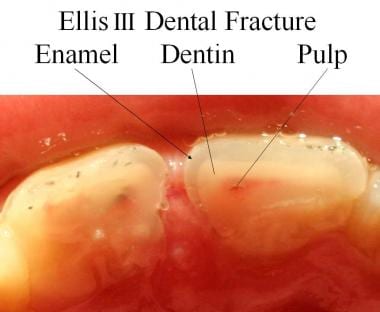
    • Ellis III fractures involve enamel, dentin, and pulp; patients complain of pain with manipulation, air, and temperature. Pinkish or reddish markings around surrounding dentin or blood in the center of the tooth from the exposed pulp may present.
  • Root fractures are clinically difficult to diagnose; patients may notice abnormal mobility and sensitivity to percussion of the tooth.
  • Dentoalveolar fractures may cause patients to complain of malocclusion and mobility with findings of a mobile group of teeth.

Physical

  • Inspection
    • Evaluate surrounding soft tissue area for laceration, discoloration, ecchymosis, and embedded foreign bodies (eg, chipped teeth).
    • Evaluate teeth for fractures, chips, and other deformities. Embedded tooth fragments may lead to chronic infection or fibrosis.
  • Palpation
    • Evaluate if the tooth is mobile or if an entire segment is mobile.
    • If possible, have the patient bite down to further localize suspect area.
  • Percussion and sensitivity
    • Percuss with tongue blade to evaluate sensitivity.
    • Assess sensitivity to air and hot and cold solutions.
    • Percussion is necessary when an impact trauma with no fractures or displacement is involved. In apparently undamaged teeth, the neurovascular bundle that enters through the apical canal may have been damaged. The resulting damage can lead to pulp degeneration. These teeth are often sensitive to percussion.

Causes

  • Unknown (17%)
  • Altercations (17%)
  • Contact sports (15.9%)
  • Motor vehicle collisions (10.8%)
  • Motorcycle accidents (10.4%)
  • Ice hockey (2.3%)


Dental, Avulsed Tooth
Dental, Displaced Tooth
Dental, Infections


Imaging Studies

  • Obtain 4 films (maxillary anterior and 3 periapical films from various angles) to evaluate a dental fracture or displacement.
    • In the ED, because such specialized films are often not available, use a limited facial series and a Panorex to evaluate maxillary and mandibular fractures, foreign bodies, and displacement.
    • A Panorex can be used to assess a mandibular fracture.


Emergency Department Care

Provide adequate pain management and tetanus vaccination, and ensure proper follow-up care.

  • Ellis I fracture: Smooth rough corners with a dental drill or an emery board.
    • Treatment of fractures contained solely within the enamel alone requires no urgent care. The tooth can be repaired cosmetically at the convenience of the patient
  • Ellis II fracture: Cover exposed dentin with a layer of zinc oxide or calcium hydroxide paste (Dycal).
    • Dycal requires the tooth to be absolutely dry for adherence. Cover the tooth with a small piece of dental or aluminum foil. Exposure to humidity increases the rate at which the Dycal will set.
    • In patients younger than 12 years, coverage is especially important to prevent infection.
  • Ellis III fracture: Cover exposed dentin with a layer of zinc oxide or calcium hydroxide. Bleeding and moisture with this type of fracture usually makes it more difficult for these materials to adhere to the tooth. Cover with dental foil and expediently refer the patient to a dentist.
  • Root and dentoalveolar fractures require splinting by a dentist for several weeks.
  • Bone wax (Ethicon), which is a combination of beeswax and isopropyl palmitate, is not recommended for open dental fractures because it can cause inflammatory reactions of the surrounding soft tissues (eg, pulp).

Consultations

  • Consult a dental or oral maxillofacial surgeon.
  • Depending on the extent of the fracture, the dentist may do perform a root canal with calcium hydroxide followed by a gutta-percha filling or a partial pulpotomy.


Drugs used to treat fractures generally are nonsteroidal anti-inflammatory drugs (NSAIDs), analgesics, anxiolytics, and proper antibiotics.

Drug Category: Antibiotics

Therapy must cover all likely pathogens in the context of the clinical setting.

Drug NamePenicillin VK (Veetids)
DescriptionInhibits biosynthesis of cell wall mucopeptide and is effective during active replication. Inadequate concentrations may produce only bacteriostatic effects.
Adult Dose250-500 mg PO q6h
Pediatric Dose50 mg/kg/d PO divided qid
ContraindicationsDocumented hypersensitivity
InteractionsProbenecid may increase effectiveness by decreasing clearance; tetracyclines are bacteriostatic, causing a decrease in the effectiveness of penicillins when administered concurrently
PregnancyB - Fetal risk not confirmed in studies in humans but has been shown in some studies in animals
PrecautionsCaution in renal impairment

Drug NameErythromycin (EES, E-Mycin, Ery-Tab)
DescriptionAn alternative for patients allergic to penicillin. Because of possible GI irritation, advise patients to take this medication with food or milk if GI upset is noted.
Adult Dose200-500 mg PO q6h
Pediatric Dose30-50 mg/kg/d PO divided qid
ContraindicationsDocumented hypersensitivity; hepatic impairment
InteractionsCoadministration may increase toxicity of theophylline, digoxin, carbamazepine, and cyclosporine; may potentiate anticoagulant effects of warfarin; coadministration with lovastatin and simvastatin increases risk of rhabdomyolysis
PregnancyB - Fetal risk not confirmed in studies in humans but has been shown in some studies in animals
PrecautionsCaution in liver disease; estolate formulation may cause cholestatic jaundice; GI adverse effects are common (give doses pc); discontinue use if nausea, vomiting, malaise, abdominal colic, or fever occur

Drug NameAmoxicillin (Amoxil, Polymox, Trimox)
DescriptionInterferes with the synthesis of cell wall mucopeptide during active replication, resulting in a bactericidal activity against susceptible bacteria.
Adult Dose250-500 mg PO q8h
Pediatric Dose20-50 mg/kg/d PO divided q8h
ContraindicationsDocumented hypersensitivity
InteractionsReduces efficacy of oral contraceptives
PregnancyB - Fetal risk not confirmed in studies in humans but has been shown in some studies in animals
PrecautionsAdjust dose in renal impairment

Drug Category: Analgesics

Pain control is essential to quality patient care. Analgesics ensure patient comfort, promote pulmonary toilet, and enable physical therapy regimens. Many analgesics have sedating properties that benefit patients in pain.

Drug NameFentanyl citrate (Duragesic, Sublimaze)
DescriptionA more potent narcotic analgesic with a much shorter half-life than morphine sulfate. DOC for conscious sedation analgesia.
With short duration (30-60 min) that is easy to titrate, an excellent choice for pain management and sedation. Easily and quickly reversed by naloxone.
After the initial dose, do not titrate subsequent doses more frequently than q3h or q6h thereafter.
Adult Dose0.5-1 mcg/kg/dose IV/IM q30-60min
Pediatric Dose<2 years: 2-3 mcg/kg/dose IV/IM q30-60min
2-12 years: 1-2 mcg/kg/dose IV/IM q60min
ContraindicationsDocumented hypersensitivity; hypotension or potentially compromised airway where establishing rapid airway control would be difficult
InteractionsPhenothiazines may antagonize analgesic effects of opiate agonists; tricyclic antidepressants may potentiate adverse effects of fentanyl when both drugs are used concurrently
PregnancyC - Fetal risk revealed in studies in animals but not established or not studied in humans; may use if benefits outweigh risk to fetus
PrecautionsCaution in hypotension, respiratory depression, constipation, nausea, emesis, and urinary retention; idiosyncratic reaction, known as chest wall rigidity syndrome, may require neuromuscular blockade in order to increase ventilation

Drug NameMeperidine (Demerol)
DescriptionNarcotic analgesic with multiple actions similar to those of morphine. May produce less constipation, smooth muscle spasm, and depression of the cough reflex than similar analgesic doses of morphine.
Adult Dose50-150 mg PO/IV/IM/SC q3-4h prn
Pediatric Dose1-1.8 mg/kg (0.5-0.8 mg/lb) PO/IV/IM/SC q3-4h prn; not to exceed adult dose
ContraindicationsDocumented hypersensitivity; MAOls; upper airway obstruction or significant respiratory depression; during labor when delivery of premature infant is anticipated
InteractionsMonitor for increased respiratory and CNS depression with coadministration of cimetidine; hydantoins may decrease effects of meperidine; avoid with protease inhibitors
PregnancyC - Fetal risk revealed in studies in animals but not established or not studied in humans; may use if benefits outweigh risk to fetus
PrecautionsCaution in patients with head injuries, since meperidine may increase respiratory depression and CSF pressure (use only if absolutely necessary); caution when using postoperatively and with history of pulmonary disease (suppresses cough reflex)
Substantially increased dose levels, due to tolerance, may aggravate or cause seizures even if no prior history of convulsive disorders; monitor closely for morphine-induced seizure activity with prior seizure history

Drug NameOxycodone and acetaminophen (Percocet)
DescriptionDrug combination indicated for relief of moderate to severe pain. DOC for patients who are hypersensitive to aspirin.
Adult Dose1-2 tab or cap PO q4-6h prn
Pediatric Dose0.05-0.15 mg/kg/dose oxycodone PO; not to exceed 5 mg/dose of oxycodone q4-6h prn
ContraindicationsDocumented hypersensitivity
InteractionsPhenothiazines may decrease analgesic effects of this medication; toxicity increases with coadministration of either CNS depressants or tricyclic antidepressants
PregnancyC - Fetal risk revealed in studies in animals but not established or not studied in humans; may use if benefits outweigh risk to fetus
PrecautionsDuration of action may increase in elderly persons; be aware of total daily dose of acetaminophen patient is receiving; do not exceed 4,000 mg/d of acetaminophen; higher doses may cause liver toxicity

Drug NameHydrocodone bitartrate and acetaminophen (Vicodin ES)
DescriptionDrug combination indicated for relief of moderate to severe pain.
Adult Dose1-2 tab or cap PO q4-6h prn
Pediatric Dose<12 years: 10-15 mg/kg/dose acetaminophen PO q4-6h prn; not to exceed 2.6 g/d of acetaminophen or 5 mg of hydrocodone bitartrate/dose
>12 years: 750 mg acetaminophen PO q4h; not to exceed 5 doses/d acetaminophen or 10 mg of hydrocodone bitartrate/dose
ContraindicationsDocumented hypersensitivity; elevated intracranial pressure
InteractionsCoadministration with phenothiazines may decrease analgesic effects; toxicity increases with CNS depressants or tricyclic antidepressants
PregnancyC - Fetal risk revealed in studies in animals but not established or not studied in humans; may use if benefits outweigh risk to fetus
PrecautionsTabs contain metabisulfite, which may cause hypersensitivity; caution in patients dependent on opiates because this substitution may result in acute opiate-withdrawal symptoms; caution in severe renal or hepatic dysfunction

Drug NameAcetaminophen (Tylenol, Panadol, Aspirin Free Anacin)
DescriptionDOC for the treatment of pain in patients with documented hypersensitivity to aspirin or NSAIDs, in those with upper GI disease, or in those who are taking oral anticoagulants.
Adult Dose325-650 mg PO q4-6h or 1000 mg tid/qid; not to exceed 4 g/d
Pediatric Dose<12 years: 10-15 mg/kg/dose PO q4-6h prn; not to exceed 2.6 g/d
>12 years: 325-650 mg PO q4h; not to exceed 5 doses/d
ContraindicationsDocumented hypersensitivity; G-6-PD deficiency
InteractionsRifampin can reduce analgesic effects of acetaminophen; coadministration with barbiturates, carbamazepine, hydantoins, and isoniazid may increase hepatotoxicity
PregnancyB - Fetal risk not confirmed in studies in humans but has been shown in some studies in animals
PrecautionsHepatotoxicity possible in chronic alcoholics following various dose levels; severe or recurrent pain or high or continued fever may indicate a serious illness; acetaminophen is contained in many OTC products, and combined use with these products may result in cumulative acetaminophen doses exceeding recommended maximum dose


Further Outpatient Care

  • Document arrangements to follow up with a dentist.
  • Ellis II and III fractures: Advise patients to avoid eating solid foods to prevent loss of the adhesive dressing and to follow up with a dentist within 24 hours.

Complications

  • Tooth loss
  • Cosmetic deformity
  • Infection

Patient Education


Medical/Legal Pitfalls

  • Failure to provide tetanus prophylaxis
  • Failure to rule out aspiration of tooth chips if unable to recover the tooth in the field
  • Failure to properly examine surrounding traumatized tissue for tooth chips
  • Failure to recognize domestic and/or child abuse
  • Failure to evaluate fully the temporomandibular joint, maxilla, mandible, and occlusion
  • Failure to evaluate associated head and neck injuries
  • Failure to recognize possible airway compromise
  • Failure to warn patient that any trauma to teeth can disrupt the neurovascular supply and lead to long-term pulp necrosis or root resorption


  • Bakland LK, Andreasen JO. Examination of the dentally traumatized patient. J Calif Dent Assoc. Feb 1996;24(2):35-7, 40-4. [Medline].
  • Cvek M, Mejare I, Andreasen JO. Conservative endodontic treatment of teeth fractured in the middle or apical part of the root. Dent Traumatol. Oct 2004;20(5):261-9. [Medline].
  • Devlin DH. A historical review of dental and facial skeletal trauma. J Calif Dent Assoc. Feb 1996;24(2):29-34. [Medline].
  • Gutmann JL, Gutmann MS. Cause, incidence, and prevention of trauma to teeth. Dent Clin North Am. Jan 1995;39(1):1-13. [Medline].
  • Harwood-Nuss A, Linden C, Luten R, eds. Dental injuries. In: The Clinical Practice of Emergency Medicine. 2nd ed. Philadelphia: Lippincott Williams & Wilkins; 1996:418-421.
  • Josell SD. Evaluation, diagnosis, and treatment of the traumatized patient. Dent Clin North Am. Jan 1995;39(1):15-24. [Medline].
  • Josell SD, Abrams RG. Traumatic injuries to the dentition and its supporting structures. Pediatr Clin North Am. Jun 1982;29(3):717-41. [Medline].
  • Krasner P, Rankow HJ. New philosophy for the treatment of avulsed teeth. Oral Surg Oral Med Oral Pathol Oral Radiol Endod. May 1995;79(5):616-23. [Medline].
  • Rosen P, Barkin R. Dental emergencies. In: Emergency Medicine Concepts and Clinical Practice. Vol 3. 3rd ed. St Louis: Mosby-Year Book; 1992: 2381-2398.
  • Trope M. Protocol for treating the avulsed tooth. J Calif Dent Assoc. Mar 1996;24(3):43-9. [Medline].

Dental, Fractured Tooth excerpt

Article Last Updated: Sep 27, 2007