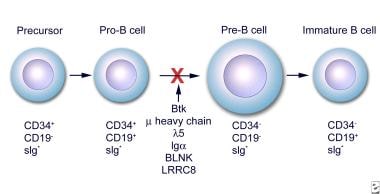
You are in: eMedicine Specialties > Dermatology > ALLERGY AND IMMUNOLOGY Bruton AgammaglobulinemiaArticle Last Updated: Sep 7, 2005AUTHOR AND EDITOR INFORMATIONAuthor: Isabel N Granja Jander, MD, Staff Physician, Department of Pediatrics, Schneider Children's Hospital, North Shore Long Island Jewish Healthcare System Isabel N Granja Jander is a member of the following medical societies: American Academy of Pediatrics Coauthor(s): Robert A Schwartz, MD, MPH, Professor and Head of Dermatology, Professor of Medicine, Professor of Pediatrics, Professor of Pathology, Professor of Preventive Medicine and Community Health, UMDNJ-New Jersey Medical School; Franklin Desposito, MD, Professor of Pediatrics and Clinical Director, Center for Human and Molecular Genetics, UMDNJ-New Jersey Medical School; Consulting Staff, Department of Pediatrics, UMDNJ-University Hospital Editors: Julie R Kenner, MD, PhD, Consultant, Clinical Research, Medical Affairs, VaxGen, Inc; Private Practice, Kenner Dermatology Center; David F Butler, MD, Professor of Dermatology, Texas A&M University College of Medicine; Director, Division of Dermatology, Scott and White Clinic; Director Dermatology Residency Training Program, Scott and White Clinic; Rosalie Elenitsas, MD, Associate Professor of Dermatology, University of Pennsylvania School of Medicine; Director, Penn Cutaneous Pathology Services, Department of Dermatology, University of Pennsylvania Health System; Catherine Quirk, MD, Clinical Assistant Professor, Department of Dermatology, Brown University; Dirk M Elston, MD, Director, Department of Dermatology, Geisinger Medical Center Author and Editor Disclosure Synonyms and related keywords: X-linked agammaglobulinemia, XLA, Bruton disease, Bruton's disease, Bruton tyrosine kinase, Bruton's tyrosine kinase, BTK, BTK gene, BTK gene, immunodeficiency disease INTRODUCTIONBackgroundX-linked agammaglobulinemia (XLA) is an inherited immunodeficiency disease caused by mutations in the gene coding for Bruton tyrosine kinase (BTK). The disease was first elucidated by Bruton in 1952, for whom the gene is named. BTK is critical to the maturation of pre–B cells to differentiating mature B cells. The BTK gene defect has been mapped to the long arm of the X chromosome at band Xq21.3 to Xq22, spanning 37.5kb with 19 exons forming 659 amino acids to complete the BTK cytosolic tyrosine kinase. A database of BTK mutations (BTKbase: Mutation registry for X-linked agammaglobulinemia) lists 544 mutation entries from 471 unrelated families showing 341 unique molecular events. No single mutation accounts for more than 3% of mutations in patients. In addition to mutations, a number of variants or polymorphisms have been found. PathophysiologyIn the absence of BTK, B lymphocytes do not differentiate or mature. Without mature B lymphocytes, antibody-producing plasma cells are also absent. As a consequence, the reticuloendothelial and lymphoid organs in which these cells proliferate, differentiate, and are stored are poorly developed. The spleen, the tonsils, the adenoids, the Peyer patches in the intestines, and the peripheral lymph nodes may all be reduced in size or absent in individuals with XLA. The protooncogene encoding for BTK has been cloned and its genomic organization determined, allowing an in-depth analysis of the role of BTK and other signaling molecules in B-cell differentiation. Mutations in each of the 5 domains of BTK can lead to disease. The single most common genetic event is a missense mutation. Most mutations lead to truncation of the BTK enzyme. These mutations affect critical residues in the cytoplasmic BTK protein and are highly variable and uniformly dispersed throughout the molecule. Nevertheless, the severity of disease cannot be predicted by the specific mutations. Approximately one third of point mutations affect CGG sites, which usually code for arginine residues. The putative structural implications of all of the missense mutations are provided in the database. BTK is necessary for the proliferation and the differentiation of B lymphocytes. Males with XLA have a total or almost total absence of B lymphocytes and plasma cells. XLA is an inherited disease that occurs in approximately 1 in 250,000 males. Female carriers have no clinical manifestations. Infections begin once transferred maternal immunoglobulin G (IgG) antibodies have been catabolized, typically at about 6 months of age. Diagnosis Early detection and diagnosis is essential to prevent early morbidity and mortality from systemic and pulmonary infections. The diagnosis is confirmed by abnormally low or absent numbers of mature B lymphocytes, as well as low or absent expression of the µ heavy chain on the surface of the lymphocyte. Conversely, T-lymphocyte levels are elevated. The definitive determinant of XLA is the complete absence of BTK ribonucleic acid (RNA) or protein. Specific molecular analysis is made by single-strand confirmation polymorphism (SSCP), direct DNA analysis, denaturing gradient gel electrophoresis, or reverse transcriptase–polymerase chain reaction to search for the BTK mutation. SSCP is also used for prenatal evaluation, which can be performed via chorionic villus sampling or amniocentesis when a mother is known to be a carrier. IgG levels less than 100 mg/dL support the diagnosis. Rarely, the diagnosis is made in adults in their second decade of life. This is thought to be due to a mutation in the protein, rather than a complete absence. FrequencyUnited StatesThe estimated frequency is approximately 1 case per 250,000 population. Two thirds of cases are familial, and one third of cases are believed to arise from new mutations. InternationalThe incidence of XLA around the world does not vary significantly. Mortality/MorbidityMost men with XLA live into their 40s. The prognosis is better if treatment is started early, ideally if intravenous immunoglobulin G (IVIG) is started before the individual is aged 5 years. Even with treatment, patients can expect to have chronic pulmonary infections, skin disease, inflammatory bowel disease (ulcerative colitis and Crohn disease), and central nervous system complications due to enteroviral infection. RaceMost studies involve Northern European patients. However, no racial predilection for XLA has been established. SexBruton agammaglobulinemia is an X-linked disease, with only male offspring being affected. Most cases are inherited, but, rarely, the disease manifests as a consequence of a spontaneous mutation. Mutations in the gene for the heavy mu gene (IGHM), the immunoglobulin-alpha gene, and the lambda-5 gene can cause agammaglobulinemia, with less than 1% CD19 expression on B cells. No female carriers present with the clinical manifestations of the BTK mutation. AgeMale infants become affected by XLA when maternal antibodies decline usually after age 4-6 months. If the mother has been identified as a carrier for the disease, chorionic villi sampling or amniocentesis can be performed to collect fetal lymphocytes in utero. At birth, cord blood samples can be tested for a decrease in CD19+ B cells and for an increase in mature T cells via fluorocytometric analysis. Children typically clinically manifest the disease at age 3-9 months with pneumonia, otitis media, cellulitis, meningitis, osteomyelitis, diarrhea, or sepsis. Rare cases of adults in their second decade have been diagnosed with a milder form XLA thought to be due to a mutation rather than an absence of the protein. CLINICALHistoryRecurrent infections begin in infancy and persist throughout adulthood. The most common presentation of XLA is increased susceptibility to encapsulated pyogenic bacteria, such as Streptococcus pneumoniae, Haemophilus influenzae, and Pseudomonas species. Skin infections in patients with XLA are mostly caused by group A streptococci and Staphylococcus aureus, and they can present as impetigo, cellulitis, abscesses, or furuncles. A form of eczema that resembles atopic dermatitis may be evident, along with an increased incidence of pyoderma gangrenosum, vitiligo, alopecia totalis, and Stevens-Johnson syndrome (from increased use of medications). Other infections that commonly present with XLA include enteroviral infections, sepsis, meningitis, and bacterial diarrhea (often caused by common organisms, such as Campylobacter jejuni and Giardia species). Individuals who are affected may have an increased incidence of autoimmune diseases leading to thrombocytopenia, neutropenia, hemolytic anemia, and rheumatoid arthritis. Persistent enteroviral infections may rarely lead to fatal encephalitis or a dermatomyositis-meningoencephalitis syndrome. In addition to the neurologic changes, clinical manifestations of this syndrome include edema, muscle wasting, and an erythematous rash over the extensor surfaces of the joints.
PhysicalMale infants with XLA may appear physically smaller than male infants without XLA because of delayed growth and development from recurrent infections. Rarely, XLA is associated with growth hormone deficiency, leading to significantly shorter stature in males with XLA than in males without XLA of the same age.
CausesThe BTK mutations underlying XLA interferes with the development and the function of B lymphocytes and their progeny. The major block occurs in the development of pro–B cells to pre–B cells and then to mature lymphocytes. Patients can have pre–B cells in the marrow, but they have few, if any, functional (mature) B cells in the peripheral blood and the lymphoid tissues. DIFFERENTIALSAcrodermatitis Enteropathica Ataxia-Telangiectasia Atopic Dermatitis Avitaminosis A Common Variable Immunodeficiency Severe Combined Immunodeficiency
|
| Drug Name | Immune globulin intravenous (Gamimune, Gammar-P, Sandoglobulin, Gammagard) |
|---|---|
| Description | Neutralizes circulating myelin antibodies through anti-idiotypic antibodies; down-regulates proinflammatory cytokines, including INF-gamma; blocks Fc receptors on macrophages; suppresses inducer T and B cells and augments suppressor T cells; blocks complement cascade; promotes remyelination; may increase CSF IgG (10%). Adjust dose and interval according to individual needs. Symptomatic adverse effects may be alleviated by premedicating with acetaminophen, diphenhydramine, or methylprednisolone (Solu-Medrol). |
| Adult Dose | 400-600 mg/kg/mo IV over 3-4 h |
| Pediatric Dose | Administer as in adults |
| Contraindications | Documented hypersensitivity; IgA deficiency |
| Interactions | Globulin preparation may interfere with immune response to live virus vaccines (MMR) and reduce efficacy (do not administer within 3 mo of vaccine); live polio virus vaccine should be avoided because of reports of vaccine-related paralytic poliomyelitis |
| Pregnancy | C - Fetal risk revealed in studies in animals but not established or not studied in humans; may use if benefits outweigh risk to fetus |
| Precautions | Check serum IgA before IVIG (use IgA-depleted product, eg, Gammagard S/D); infusions may increase serum viscosity and thromboembolic events; infusions may increase risk of migraine attacks, aseptic meningitis (10%), urticaria, pruritus, or petechiae (2-30 d postinfusion); increases risk of renal tubular necrosis in elderly patients and in patients with diabetes, volume depletion, and preexisting kidney disease; laboratory result changes associated with infusions include elevated antiviral or antibacterial antibody titers for 1 mo, 6-fold increase in ESR for 2-3 wk, and apparent hyponatremia |
These agents treat common sinopulmonary infections (eg, pneumonia, otitis media). Drugs, such as amoxicillin and amoxicillin/clavulanate, are typical agents used. Fluoroquinolone therapy is useful for respiratory staphylococcal infections and for patients with allergies to other medications. If the infection is caused by Mycoplasma organisms, the drug of choice is clarithromycin. Severe infections may require hospitalization and IV therapy with ceftriaxone or vancomycin.
| Drug Name | Amoxicillin (Amoxil, Trimox, Biomox) |
|---|---|
| Description | Interferes with synthesis of cell wall mucopeptides during active multiplication, resulting in bactericidal activity against susceptible bacteria. |
| Adult Dose | 250-500 mg PO q8h; not to exceed 3 g/d |
| Pediatric Dose | 20-50 mg/kg/d PO divided q8h; not to exceed 2 g/dose |
| Contraindications | Documented hypersensitivity |
| Interactions | Reduces efficacy of oral contraceptives |
| Pregnancy | B - Fetal risk not confirmed in studies in humans but has been shown in some studies in animals |
| Precautions | Adjust dose in renal impairment; may enhance likelihood of candidiasis |
| Drug Name | Ceftriaxone (Rocephin) |
|---|---|
| Description | Third-generation cephalosporin with broad-spectrum gram-negative activity; lower efficacy against gram-positive organisms; higher efficacy against resistant organisms. Arrests bacterial growth by binding to 1 or more penicillin-binding proteins. |
| Adult Dose | Uncomplicated infections: 250 mg IM once; not to exceed 4 g Severe infections: 1-2 g IV qd or divided bid; not to exceed 4 g/d |
| Pediatric Dose | >7 days: 25-50 mg/kg/d IV/IM; not to exceed 125 mg/d Infants and children: 50-75 mg/kg/d IV/IM divided q12h; not to exceed 2 g/d |
| Contraindications | Documented hypersensitivity |
| Interactions | Probenecid may increase levels; coadministration with ethacrynic acid, furosemide, and aminoglycosides may increase nephrotoxicity |
| Pregnancy | B - Fetal risk not confirmed in studies in humans but has been shown in some studies in animals |
| Precautions | Adjust dose in severe renal insufficiency (high doses may cause CNS toxicity); superinfections and promotion of nonsusceptible organisms may occur with prolonged use or repeated therapy; caution in breastfeeding |
| Drug Name | Vancomycin (Vancocin, Lyphocin, Vancoled) |
|---|---|
| Description | Potent antibiotic directed against gram-positive organisms and active against Enterococcus species. Useful in the treatment of septicemia and skin structure infections. Indicated for patients who cannot take or in whom no response has occurred with penicillins and cephalosporins or for those who have infections with resistant staphylococci. For abdominal penetrating injuries, it is combined with an agent active against enteric flora and/or anaerobes. To avoid toxicity, current recommendation is to assay trough levels after third dose, drawn 0.5 h prior to next dosing. Use CrCl to adjust dose in patients with renal impairment. Used in conjunction with gentamicin for prophylaxis in patients allergic to penicillin undergoing GI or GU tract procedures. |
| Adult Dose | 500 mg to 2 g/d IV divided tid/qid for 7-10 d |
| Pediatric Dose | 40 mg/kg/d IV divided tid/qid for 7-10 d |
| Contraindications | Documented hypersensitivity |
| Interactions | Erythema, histaminelike flushing, and anaphylactic reactions may occur when administered with anesthetic agents; taken concurrently with aminoglycosides, risk of nephrotoxicity may increase above that with aminoglycoside monotherapy; effects in neuromuscular blockade may be enhanced when coadministered with nondepolarizing muscle relaxants |
| Pregnancy | C - Fetal risk revealed in studies in animals but not established or not studied in humans; may use if benefits outweigh risk to fetus |
| Precautions | Caution in renal failure and neutropenia; red man syndrome is caused by too rapid IV infusion (dose administered over a few min) but rarely happens when dose is administered IV over 2 h or PO or IP; red man syndrome is not an allergic reaction |
| Drug Name | Clarithromycin (Biaxin) |
|---|---|
| Description | Inhibits bacterial growth, possibly by blocking dissociation of peptidyl tRNA from ribosomes, causing RNA-dependent protein synthesis to arrest. |
| Adult Dose | 250-500 mg PO q12h for 7-14 d |
| Pediatric Dose | 15 mg/kg PO divided bid |
| Contraindications | Documented hypersensitivity; coadministration of pimozide |
| Interactions | Toxicity increases with coadministration of fluconazole and pimozide; effects decrease and GI tract adverse effects may increase with coadministration of rifabutin or rifampin; may increase toxicity of anticoagulants, cyclosporine, tacrolimus, digoxin, carbamazepine, ergot alkaloids, triazolam, and HMG-CoA reductase inhibitors; plasma levels of certain benzodiazepines may increase, prolonging CNS depression; arrhythmias and increases in QTc intervals occur with disopyramide; coadministration with omeprazole may increase plasma levels of both agents |
| Pregnancy | C - Fetal risk revealed in studies in animals but not established or not studied in humans; may use if benefits outweigh risk to fetus |
| Precautions | Coadministration with ranitidine or bismuth citrate is not recommended with CrCl <25 mL/min; administer half dose or increase dosing interval if CrCl <30 mL/min; diarrhea may be a sign of pseudomembranous colitis; superinfections may occur with prolonged or repeated antibiotic therapy |
Bronchodilators are administered via an inhaler to reduce bronchoconstriction and inflammatory response in the lungs. Inhaled beta2-agonists, with or without steroid inhalation therapy, are the standard of care for pulmonary maintenance in XLA.
| Drug Name | Albuterol (Proventil, Ventolin) |
|---|---|
| Description | Beta-agonist for bronchospasm refractory to epinephrine. Relaxes bronchial smooth muscle by action on beta2-receptors with little effect on cardiac muscle contractility. |
| Adult Dose | 2-4 mg/dose PO tid/qid; not to exceed 32 mg/d 1-2 puffs via MDI q4-6h; not to exceed 12 inhalations per day 2.5-5 mg via nebulizer q4-6h in 2-5 mL sterile NS or water; to make solution, dilute 0.5 mL (2.5 mg) of 0.5% inhalation solution in 1-2.5 mL of NS |
| Pediatric Dose | Oral 2-5 years: 0.1-0.2 mg/kg/dose PO divided tid; not to exceed 12 mg/d 5-12 years: 2 mg/dose PO divided tid or qid; not to exceed 24 mg/d >12 years: Administer as in adults MDI <12 years: 1-2 inhalations qid with tube spacer >12 years: Administer as in adults Nebulizer <5 years: 1.25-2.5 mg in 1-2.5 mL q4-6h; to make solution, dilute 0.25-0.5 mL (1.25-2.5 mg) of 0.5% inhalation solution in 1-2.5 mL NS >5 years: Administer as in adults |
| Contraindications | Documented hypersensitivity |
| Interactions | Beta-adrenergic blockers antagonize effects; inhaled ipratropium may increase duration of bronchodilatation; cardiovascular effects may increase with MAOIs, inhaled anesthetics, tricyclic antidepressants, and sympathomimetic agents |
| Pregnancy | C - Fetal risk revealed in studies in animals but not established or not studied in humans; may use if benefits outweigh risk to fetus |
| Precautions | Caution in hyperthyroidism, diabetes mellitus, and cardiovascular disorders |
| Drug Name | Salmeterol (Serevent) |
|---|---|
| Description | By relaxing the smooth muscles of the bronchioles in conditions associated with bronchitis, emphysema, asthma, or bronchiectasis, can relieve bronchospasms. Effect may also facilitate expectoration. Adverse effects are more likely to occur when administered at higher or more frequent doses than recommended. |
| Adult Dose | 2 inhalations (42 mcg) bid |
| Pediatric Dose | <4 years: Not established 4-11 years: 1 inhalation (50 mcg) bid at least 12h apart >12 years: Administer as in adults |
| Contraindications | Documented hypersensitivity; angina, tachycardia, and cardiac arrhythmias associated with tachycardia |
| Interactions | Concomitant use of beta-blockers may decrease bronchodilating and vasodilating effects of beta-agonists; concurrent administration with methyldopa may increase pressor response; coadministration with oxytocic drugs may result in severe hypotension; ECG changes and hypokalemia resulting from diuretics may worsen when coadministered |
| Pregnancy | C - Fetal risk revealed in studies in animals but not established or not studied in humans; may use if benefits outweigh risk to fetus |
| Precautions | Not indicated to treat acute asthmatic symptoms |
These agents have anti-inflammatory properties and cause profound and varied metabolic effects. They modify the body's immune response to diverse stimuli.
| Drug Name | Beclomethasone (Beclovent, Vanceril) |
|---|---|
| Description | Inhibits bronchoconstriction mechanisms, produces direct smooth muscle relaxation, and may decrease number and activity of inflammatory cells, in turn, decreasing airway hyperresponsiveness. |
| Adult Dose | 2 inhalations (84 mcg) tid/qid Alternatively, 4 inhalations (168 mcg) bid Severe asthma: 12-16 inhalations (504-672 mcg) per day; adjust dose downward to response; not to exceed 20 inhalations (840 mcg) per day |
| Pediatric Dose | <6 years: Not established 6-12 years: 1-2 inhalations (42-84 mcg) tid/qid to response Alternatively, 4 inhalations (168 mcg) bid; not to exceed 10 inhalations (420 mcg) per day |
| Contraindications | Documented hypersensitivity; bronchospasm, status asthmaticus, and other types of acute episodes of asthma |
| Interactions | Coadministration with ketoconazole may increase plasma levels but does not appear to be clinically significant |
| Pregnancy | C - Fetal risk revealed in studies in animals but not established or not studied in humans; may use if benefits outweigh risk to fetus |
| Precautions | Coughing, upper respiratory tract infection, and bronchitis may occur |
| Drug Name | Fluticasone (Flovent) |
|---|---|
| Description | Inhibits bronchoconstriction mechanisms, produces direct smooth muscle relaxation, and may decrease number and activity of inflammatory cells, in turn, decreasing airway hyperresponsiveness. |
| Adult Dose | 2 sprays (50 mcg/spray) per nostril qd; may reduce to 1 spray per nostril for maintenance; not to exceed 4 sprays (200 mcg) per day |
| Pediatric Dose | 1 spray (50 mcg/spray) per nostril qd; may use up to 2 sprays (100 mcg) per nostril; not to exceed 4 sprays (200 mcg) per day |
| Contraindications | Documented hypersensitivity; bronchospasm, status asthmaticus, and other types of acute episodes of asthma |
| Interactions | Coadministration with ketoconazole may increase plasma levels but does not appear to be clinically significant |
| Pregnancy | C - Fetal risk revealed in studies in animals but not established or not studied in humans; may use if benefits outweigh risk to fetus |
| Precautions | Coughing, upper respiratory tract infection, and bronchitis may occur |
Bruton Agammaglobulinemia excerpt
Article Last Updated: Sep 7, 2005