Background
Vibrio vulnificus is a gram-negative bacillus that only affects humans and other primates. It is in the same family as bacteria that cause cholera. The first documented case of disease caused by the organism was in 1979.
V vulnificus is usually found in warm, shallow, coastal salt water in temperate climates throughout most of the world. It can be found in the Gulf of Mexico, along most of the East Coast of the United States, and along all of the West Coast of the United States. V vulnificus can be found in water; sediment; plankton; and shellfish, such as oysters, clams, and crabs. This organism can survive in seawater and can produce wound infections, a potentially serious problem among Asian tsunami survivors, [1] and potentially fatal necrotizing fasciitis in them and in individuals with liver cirrhosis. [2] This halophilic bacterium can also cause serious gastroenteritis after eating raw seafood. [3] Genome sequencing has been performed. [4]
See image below, as well as the article Vibrio Infections.
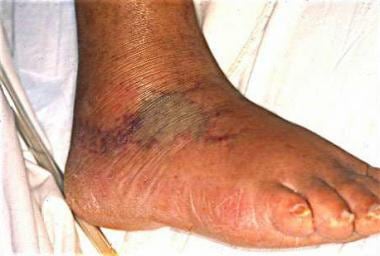 Vibrio infections. Early bullous lesions appear over the dorsum of the foot of a patient with cirrhosis.

Pathophysiology
V vulnificus infects the body in 2 ways, either by exposure to contaminated seafood, such as raw oysters, or through an open wound exposed to contaminated seawater. Among healthy individuals, within 16 hours of ingestion, they experience vomiting, diarrhea, and abdominal pain. Many patients develop distinctive bullous skin lesions. In patients who are immunocompromised, particularly those with chronic liver disease (especially cirrhosis), immunosuppression, end-stage renal disease, and hematopoietic disorders, V vulnificus can cause life-threatening septic shock and blistering skin lesions. Those who are immunocompromised are at a much greater risk for contracting V vulnificus and dying from overwhelming sepsis.
Because the incidence of disease is relatively low, not all strains of V vulnificus may be equally virulent. Recent data are consistent with the existence of 2 genotypes of V vulnificus, with the C-type being a strong indicator of potential virulence. [5] The biotype 3 group of the human pathogen V vulnificus may have emerged in Israel due to genome hybridization of 2 bacterial populations. This new clonal subgroup emphasizes that the fish aquaculture environment, and possibly manmade ecological niches as a whole, may be a source of new pathogenic strains. [6]
Etiology
See Pathophysiology.
It is seen in a variety of seafood. V vulnificus can grow rapidly in shellfish owing to the ambient air conditions occurring with intertidal exposure. [7] A study of Vibrio species isolated from retail shrimp in Hanoi found 201 of 202 samples were positive, with most having Vibrio parahaemolyticus (96.5%) and V vulnificus documented much less often, specifically in only 1.5%. [8] Sanitary working conditions and well-cooked shrimp should be encouraged.
Epidemiology
United States
V vulnificus infections are rare but underreported. Most cases are found in the Gulf Coast states, and they are most common during warm weather months. V vulnificus has been difficult to culture from North Carolina oyster samples since 2007. It may be that oysters were colonized with a more salt-tolerant bacterium during the drought, displacing V vulnificus, and may be preventing recolonization. [9] Evaluation of the graveyard skeletons of two American Civil War soldiers revealed they may have died as a result of V vulnificus septicemia. [10]
International
The frequency of V vulnificus infection, which is rare in Japan, was evaluated in 2008. Its prevalence varied in different districts. [11] A 2017 study from India found that 10 (38.5%) of 26 clam (Meretrix meretrix) samples obtained from the markets in the attractive tourist destination of Mangalore harbored V vulnificus. [12] Marine aquaculture has rendered V vulnificus infections relatively common all over the world. [13]
Race
All races are affected equally.
Sex
Males and females are affected equally.
Age
All ages are affected equally.
Prognosis
Vibrio vulnificus infection is an acute illness that is quickly resolved with antibiotics and does not have any long-term consequences. The prognosis is often excellent with proper treatment. However, it produces more than 95% of seafood-related deaths in the United States and has the highest fatality rate of any food-borne pathogen. [14]
Most V vulnificus infections are acute but have no long-term consequences; however, in patients who develop septic shock from infection with V vulnificus, the mortality rate is 50%. A 2017 case report describes a man becoming infected with V vulnificus after swimming in the Gulf of Mexico 5 days after the completion of a leg tattoo. [15] The patient died from septic shock; his chronic liver disease was cited as a possible contributing factor.
In rare instances, skin infection can result in necrotizing fasciitis. V vulnificus necrotizing skin and soft-tissue infections may result in multiple organ failure and death. A prediction model to estimate the case-fatality rate has been proposed. [16]
Retrospective analysis of 30 patients with necrotizing fasciitis and sepsis caused by Vibrio species and initially treated with surgical debridement or immediate limb amputation showed 11 (37%) died within several days of admission. [17] A higher mortality rate was noted with the Vibrio cholerae non-O1 group (57%) compared with the V vulnificus group (30%). Other bad prognostic signs included a systolic blood pressure of less than or equal to 90 mm Hg, decreased platelet counts, and leukopenia. The combination of hepatic dysfunction and diabetes mellitus was also associated with a poor outcome.
Predictive factors for mortality in primary septicemia or wound infections caused by V vulnificus have been accessed using a variety of parameters. Multivariate analysis has revealed that the presence of hemorrhagic bullae/necrotizing fasciitis, primary septicemia, a greater severity of illness, absence of leukocytosis, and hypoalbuminemia were the significant risk factors for mortality in V vulnificus skin and soft tissue infections. [18]
The presence of hemorrhagic bullous skin lesions, necrotizing fasciitis, primary septicemia, a greater severity-of-illness, absence of leukocytosis, and hypoalbuminemia were found to be the significant risk factors for mortality in patients with V vulnificus infection. [18]
Patient Education
Counsel patients who are immunocompromised to prevent exposure to V vulnificus. The high mortality associated with this septicemia suggests susceptible individuals should be forewarned by signs displayed in restaurants; physicians should educate patients with chronic liver disease about the risk of raw oyster consumption. Additionally, harvesting methods that reduce contamination by V vulnificus should be used. [19]
-
Vibrio infections. Early bullous lesions appear over the dorsum of the foot of a patient with cirrhosis.