Overview
Frostbite is a cold-related injury characterized by the freezing of tissue. Most cases of frostbite occur outdoors in various occupations and activities such as mountaineering, military training, and cold weather sports and in situations such as homelessness and unexpected exposure due to becoming lost or injured. [1, 2, 3] Indoor-related frostbite injuries are most often due to exposure to compressed gas such as carbon dioxide in fire extinguishers and in the form of dry ice. [4, 5] High-altitude pursuits such as mountaineering pose significant risk for frostbite owing to the combination of extremely cold temperatures and strong winds with the physiologic challenges of hypoxia and dehydration. [6]
Other risk factors for developing frostbite include chronic medical conditions (eg, diabetes, cardiovascular disease, peripheral vascular disease, Raynaud phenomenon), African American race, vibration-induced white finger (VIWF), previous history of frostbite, and use of certain medications (eg, beta-blockers, sedatives). [7, 8]
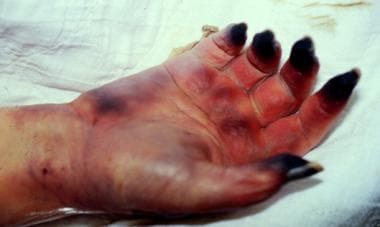
Examples of frostbite are shown below.
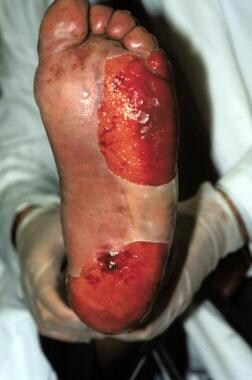 Frostbite of the foot. Photo courtesy of Kevin P. Kilgore, MD, Department of Emergency Medicine, Regions Hospital.
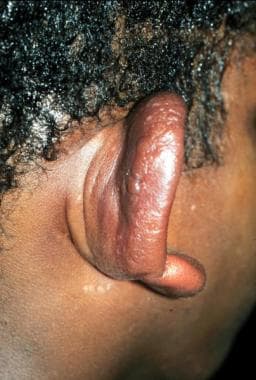 Frostbite of the ear. Photo courtesy of Kevin P. Kilgore, MD, Department of Emergency Medicine, Regions Hospital.
Go to Frostbite for complete information on this topic.

Prehospital Care
Address life-threatening conditions, such as injury from major trauma and hypothermia, first. If able, move the patient to a warm, dry area and remove all wet clothing and jewelry and replace with dry, soft clothing and/or blankets/sleeping bags to minimize further heat loss. Avoid further trauma that might exacerbate the injury, such as rubbing the area.
While the use of supplemental oxygen in the treatment is frostbite is debated, it should be administered if indicated for the management of hypoxia, high-altitude cerebral edema (HACE) or high-altitude pulmonary edema (HAPE) at high altitude. [9]
Appropriate analgesia, including NSAIDs and opioids, should be administered. [10]
A risk assessment should be done concerning the possibility of reexposure. If there is a danger of refreezing of the affected area, once warmed, do not attempt rewarming. This management point cannot be emphasized enough. For example it is better to walk with frozen feet to shelter than to attempt rewarming at the scene. If refreezing is not a concern, and definitive care is greater than 2 hours away, rapid rewarming should be initiated as soon as possible. Heat packs, heaters, and fire should not be used as they pose a significant risk for thermal injury. The recommended method is by submersion of affected skin in warm water. Water should be heated to 37-39°C (98.6-102.2°F). This can be estimated by having the rescuer/caregiver place his or her uninjured hand in the water for 30 seconds comfortably. Allowing the water to swirl around the extremity assists in maintaining the proper temperature at the point of contact. The water temperature should be monitored often (as above) and warmed as needed. Rewarming of the affected area is achieved when the tissue is soft and pliable and has taken on a reddish-purple color. [10, 11]
After rewarming, aloe vera ointment, if available, should be applied liberally before clean, nonadherent dressings (eg, paraffin gauze) are applied.
Blisters should not be debrided in the field.
The affected body part is likely to be an extremity, so wrap it in a bulky dressing or blanket for mechanical protection during transport. In addition, oral hydration and administration of ibuprofen may improve the outcome, if feasible. Avoid alcohol or sedatives, which can enhance heat loss and impair shivering.
Emergency Department Care
Address life-threatening conditions first. Fluid resuscitation, especially in persons with frostbite occurring at altitude, enhances blood flow and tissue perfusion. Rapidly rewarm the affected body part, avoiding further trauma.
An appropriate warming technique is the use of a whirlpool bath or tub of water at 37-39°C (98.6-102.2°F). Mild antibacterial soap may be added. Avoid warmer temperatures or dry heat because of the risk of thermal injury. [10, 11] If a tub is not available, use warm, wet packs at the same temperature. Avoid massaging the affected area, as this can cause further injury. Thawing usually takes 20-40 minutes and is complete when the distal tip of the affected area flushes and tissue is soft and pliable and has taken on a reddish-purple color. Once thawed, keep the body part on sterile sheets, elevated, and splinted when possible. A cradle may be used over an injured lower extremity to avoid pressure or trauma.
Administer analgesics, such as morphine sulfate, as needed for pain. Ibuprofen should also be administered.
The approach to blisters is debated. It is reasonable to debride clear blisters to prevent thromboxane-mediated tissue injury and to leave hemorrhagic blisters intact to reduce the risk of infection. [12] Apply topical aloe vera gel every 6 hours with dressing changes and use non adherent dressings until expert wound advice is obtained.
There is no role for antibiotic therapy in acute frostbite. In the rare situation of an open fracture associated with an area of frostbite, then appropriate antibiotic therapy is warranted.
Tetanus prophylaxis should be administered if the patient's vaccination status is not current or unknown.
In patients with an associated dislocation, perform reduction as soon as thawing is complete. Manage fractures conservatively until post-thaw edema has resolved.
Angiography or technetium Tc 99 bone scanning can be used to determine tissue viability and may help surgical consultants in determining the need for tissue debridement or amputation. [10]
Vasodilators
Vasodilators have shown in multiple studies to reduce amputation rates. [13, 14] The FDA approved IV administration of iloprost (Aurlumyn) in February 2024 for severe frostbite to reduce the risk of digit amputation.
Approval of iloprost was based on data from a published open-label, randomized controlled trial that enrolled 47 adults with severe frostbite into 1 of 3 treatment groups. Group 1 received iloprost IV for 6 hours daily for up to 8 days. The 2 other groups received other off-label medications for frostbite, given with iloprost IV (Group 2) or without iloprost (Group 3). On day 7, the bone scan finding predictive of needing amputation was observed in 0% (0 of 16) patients receiving iloprost alone (Group 1) compared with 19% (3 of 16) patients in Group 2 and 60% (9 of 15) patients in Group 3. [15, 16]
A retrospective study of patients who received iloprost IV (n = 26) in an urban emergency department for frostbite compared with those receiving usual care (n = 64) showed significantly lower digital amputation in the iloprost group for grade 3 frostbite (18% vs 44%, P< .001) and for grade 4 frostbite (46% vs 95%, P< .001). [17]
Thrombolytic and anticoagulant therapies
Thrombolytic therapy with tissue plasminogen activator (tPA) should be considered for deep (anticipated tissue loss) frostbite within 24 hours of thawing if significant morbidity is expected. When administered within 24 hours of thawing, it has been shown to decrease amputation rates. This is not without significant risk and should only be undertaken at, or under the guidance of, a center familiar with treating frostbite with tPA. [18, 19]
Heparin or low-molecular-weight heparin can be used as an adjunctive therapy with tPA, but it is not recommended as a monotherapy. [10] It is indicated to reduce thromboembolic disease due to the immobility resulting from treatment.
Surgical Consultation
The only indication for early surgical intervention is debridement of blisters or necrotic tissue and fasciotomy in the case of compartment syndrome. Early surgical consultation for amputation is rarely needed. It often takes 1-3 months for frostbitten tissue to be declared viable. The affected area generally heals or mummifies without surgery. Once time has dictated what tissue is viable, then surgery can be planned. This approach permits maintenance of digital length and preservation of function by avoiding surgery, which could convert tissue with borderline perfusion towards necrosis. Therefore, unless guided by scintigraphy, delay amputation as long as possible. [20]
Lower extremity involvement, infection, and delay in seeking medical attention are associated with an increased risk of operative therapy.
Surgical consultation is appropriate for guiding long-term management, including debridement for infections not responding to conservative management or for skin grafting. As frostbite often occurs in extremities, a surgical consult for involved fingers should occur early as functional considerations are important.
Transfer
Transfer the patient to another facility if treating personnel are unfamiliar with the management of frostbite and its sequelae and/or if the area involved is functionally important (eg, nose, fingers).
In some settings, burn units have particular expertise in managing severe frostbite injuries. In one report, 29% of homeless patients admitted to a burn unit were admitted for frostbite. [21] Therefore, transfer to a facility with a burn unit should be considered.
Guidelines
Guidelines on the prevention and treatment of frostbite were released in July 2019 by the Wilderness Medical Society. [22]
Prevention
Preventive measures include maintaining peripheral perfusion, exercise, and protection from cold.
The following measures can be used to ensure local tissue perfusion:
-
Maintain adequate hydration and core body temperature
-
Minimize the effects of known factors (eg, medications, diseases, other substances, including drug or alcohol usage) that may decrease perfusion
-
Insulate from the cold with the use of skin and scalp coverage
-
Minimize blood flow restriction (eg, avoidance of immobility and constrictive footwear or clothing)
-
Maintain adequate nutrition
-
Use supplemental oxygen in severely hypoxic conditions (eg, >7500 m)
Exercise can be used to maintain peripheral perfusion by elevating core and peripheral temperatures and enhancing cold-induced peripheral vasodilation. An important caveat is that it can induce exhaustion, which may lead to profound systemic heat loss.
The following measures can be used to ensure protection from the cold:
-
Avoid environmental conditions that predispose to frostbite (ie, less than -15°C [5°F])
-
Protect skin from wind, cold, and moisture
-
Avoid perspiration (sweating) or wet extremities
-
Increase skin protection and insulation with layering of clothing and using mittens rather than gloves, including the use of electric or chemical hand/foot warmers
-
Avoid behaviors or situations (eg, drug/alcohol use, hypoxemia) that deter recognition of changing environmental conditions
-
Perform regular awareness checks (self, group) for impending frostbite signs and symptoms and recognizing superficial frostbite prior to it becoming more serious
-
Minimize the duration of exposure to cold temperatures
Field and initial hospital treatment
The following is a summary of field treatment (>2 hours from definitive care):
-
Treat hypothermia or serious trauma
-
Remove extraneous material (eg, jewelry) from affected body part
-
Rapidly rewarm affected body part in water (maintain 37-39°C [98.6-102.2°F]) until the area is soft (pliable) to the touch; passive rewarm if rapid rewarming not available
-
Administer ibuprofen at 12 mg/kg/day divided twice daily, if available
-
Administer pain medication (eg, opiates) as needed, if available
-
Institute air drying (ie, do not rub at any point)
-
Protect from refreezing and direct trauma
-
Apply aloe vera gel or cream, if available
-
Use dry, bulky dressings
-
Elevate affected body part, if possible
-
Ensure systemic hydration
-
Avoid ambulation on thawed lower extremity, except if only distal toes affected
The following is a summary of initial hospital management:
-
Treat hypothermia or serious trauma
-
Rapidly rewarm affected body part in water (maintain 37-39°C [98.6-102.2°F]) until the area is soft (pliable) to the touch
-
Administer ibuprofen at 12 mg/kg/day divided twice daily
-
Administer pain medication (eg, opiates) as needed
-
Administer tetanus prophylaxis
-
Institute air drying (ie, do not rub at any point)
-
Debride with selective drainage by needle aspiration of clear blisters, leaving hemorrhagic blisters intact
-
Apply aloe vera cream or gel every 6 hours with dressing changes
-
Use dry, bulky dressings
-
Elevate affected body part, if possible
-
Ensure systemic hydration
-
Thrombolytic therapy: This should be considered for deep frostbite at distal interphalangeal joints or proximal if fewer than 24 hours have elapsed since thawing. Angiography should be used for prethrombolytic intervention and for monitoring progress. If angiography is not available, consider using intravenous thrombolysis.
-
Iloprost therapy: This should be considered for deep frostbite on or proximal to the proximal interphalangeal joint within 48 hour of the injury; this is particularly pertinent if angiography is not available or if there are contraindications to thrombolysis.
-
Clinical examination (plus angiography or technetium TC-99 bone scan if necessary): This is performed to help determine surgical margins. An experienced surgeon should perform an evaluation for possible intervention.
-
Frostbite of the foot. Photo courtesy of Kevin P. Kilgore, MD, Department of Emergency Medicine, Regions Hospital.
-
Frostbite of the ear. Photo courtesy of Kevin P. Kilgore, MD, Department of Emergency Medicine, Regions Hospital.
-
Frostbite of the hand.