Lowenthal MN, Tombak A, Lowenthal A. Secondary hypertrophic osteoarthropathy (HOA) mimicking primary HOA (pachydermoperiostitis or Touraine-Solente-Golé) syndrome. Isr Med Assoc J. 2004 Jan. 6(1):64. [QxMD MEDLINE Link].
Sonoda A, Wada Y, Togo K, Mizukami K, Fuyuno Y, Umeno J, et al. Characteristic Facial Appearance Was the Key to Diagnosing Chronic Enteropathy Associated with SLCO2A1-associated Primary Hypertrophic Osteoarthropathy. Intern Med. 2020 Feb 15. 59 (4):491-494. [QxMD MEDLINE Link].
Sandoval AR, Robles BJ, Llanos JC, Porres S, Dardón JD, Harrison RM. Cutis verticis gyrata as a clinical manifestation of Touraine-Solente-Gole' syndrome (pachydermoperiostosis). BMJ Case Rep. 2013 Jul 12. 2013:[QxMD MEDLINE Link].
Alves AP, Holanda Filha JG, et al. [Eyelid ptosis associated with pachydermoperiostosis: case report.]. Arq Bras Oftalmol. 2005 May-Jun. 68(3):401-4. [QxMD MEDLINE Link].
Arinci A, Tümerdem B, Karan MA, et al. Ptosis caused by pachydermoperiostosis. Ann Plast Surg. 2002 Sep. 49(3):322-5. [QxMD MEDLINE Link].
Touraine A, Solente G, Gole L. Un syndrome osteodermopathique: la pachydermie plicaturee avec pachyperiostose ds extremites. Presse Med. 1935. 43:1820-4.
Uppal S, Diggle CP, Carr IM, et al. Mutations in 15-hydroxyprostaglandin dehydrogenase cause primary hypertrophic osteoarthropathy. Nat Genet. 2008 Jun. 40(6):789-93. [QxMD MEDLINE Link].
Nakazawa S, Niizeki H, Matsuda M, Nakabayashi K, Seki A, Mori T, et al. Involvement of prostaglandin E2 in the first Japanese case of pachydermoperiostosis with HPGD mutation and recalcitrant leg ulcer. J Dermatol Sci. 2015 May. 78(2):153-5. [QxMD MEDLINE Link].
Zhang Z, He JW, Fu WZ, Zhang CQ, Zhang ZL. Mutations in the SLCO2A1 gene and primary hypertrophic osteoarthropathy: a clinical and biochemical characterization. J Clin Endocrinol Metab. 2013 May. 98(5):E923-33. [QxMD MEDLINE Link].
Ayoub N, Al-Khenaizan S, Sonbol H, Albreakan R, AlSufyani M, AlBalwi M. A novel homozygous mutation in the SLCO2 A1 gene is associated with severe primary hypertrophic osteoarthropathy phenotype in a Saudi patient. Int J Dermatol. 2015 Jan 20. [QxMD MEDLINE Link].
Lee S, Park SY, Kwon HJ, Lee CH, Kim OH, Rhee Y. Identification of the Mutations in the Prostaglandin Transporter Gene, SLCO2A1 and Clinical Characterization in Korean Patients with Pachydermoperiostosis. J Korean Med Sci. 2016 May. 31 (5):735-42. [QxMD MEDLINE Link].
Ishizuka T, Fujioka K, Mori I, Takeda T, Fuwa M, Ikeda T, et al. Primary hypertrophic osteoarthropathy with severe arthralgia identified by gene mutation of SLCO2A1. Mod Rheumatol Case Rep. 2021 Jan 18. 1-7. [QxMD MEDLINE Link].
Saadeh D, Kurban M, Ghosn S, Btadini W, Nemer G, Arayssi T, et al. Pachydermoperiostosis genetic screening in Lebanese families uncovers a novel SLCO2A1mutation. J Eur Acad Dermatol Venereol. 2014 Jul 25. [QxMD MEDLINE Link].
Kim HJ, Koo KY, Shin DY, Kim DY, Lee JS, Lee MG. Complete form of pachydermoperiostosis with SLCO2A1 gene mutation in a Korean family. J Dermatol. 2015 Mar 21. [QxMD MEDLINE Link].
Wang L, Yu J, Li Y, Liu X, Zhang Z. [Genetic diagnosis for a Chinese Han family with primary hypertrophic osteoarthropathy]. Zhonghua Yi Xue Yi Chuan Xue Za Zhi. 2015 Apr. 32(2):213-7. [QxMD MEDLINE Link].
Niizeki H, Shiohama A, Sasaki T, Seki A, Kabashima K, Otsuka A, et al. The complete type of pachydermoperiostosis: a novel nonsense mutation p.E141* of the SLCO2A1 gene. J Dermatol Sci. 2014 Sep. 75(3):193-5. [QxMD MEDLINE Link].
Erken E, Köroglu C, Yildiz F, Ozer HT, Gülek B, Tolun A. A novel recessive 15-hydroxyprostaglandin dehydrogenase mutation in a family with primary hypertrophic osteoarthropathy. Mod Rheumatol. 2014 Feb 18. [QxMD MEDLINE Link].
Rendina D, De Filippo G, Viceconti R, et al. Interleukin (IL)-6 and receptor activator of nuclear factor (NF)-kappaB ligand (RANKL) are increased in the serum of a patient with primary pachydermoperiostosis. Scand J Rheumatol. 2008 May-Jun. 37(3):225-9. [QxMD MEDLINE Link].
Ikeda F, Okada H, Mizuno M, et al. Pachydermoperiostosis associated with juvenile polyps of the stomach and gastric adenocarcinoma. J Gastroenterol. 2004. 39(4):370-4. [QxMD MEDLINE Link].
Chen X, Yang C, Zhang L, Hu Q. Rare gastric manifestations in primary pachydermoperiostosis. Rheumatology (Oxford). 2021 Feb 8. [QxMD MEDLINE Link].
Lakshmi TS, Rao PN, Nagaria M. Primary pachydermoperiostosis associated with Menetrier's disease. Indian J Dermatol Venereol Leprol. 2001 Sep-Oct. 67(5):256-8. [QxMD MEDLINE Link].
Sethuraman G, Malhotra AK, Khaitan BK, et al. Familial pachydermoperiostosis in association with protein-losing enteropathy. Clin Exp Dermatol. 2006 Jul. 31(4):531-4. [QxMD MEDLINE Link].
Bachmeyer C, Blum L, Cadranel JF, et al. Myelofibrosis in a patient with pachydermoperiostosis. Clin Exp Dermatol. 2005 Nov. 30(6):646-8. [QxMD MEDLINE Link].
Kumar U, Bhatt SP, Misra A. Unusual associations of pachydermoperiostosis: A case report. Indian J Med Sci. 2008 Feb. 62(2):65-8. [QxMD MEDLINE Link].
Saghafi M, Azarian A, Nohesara N. Primary hypertrophic osteoarthropathy with myelofibrosis. Rheumatol Int. 2008 Apr. 28(6):597-600. [QxMD MEDLINE Link].
Ninomiya S, Hara T, Tsurumi H, Kanemura N, Kasahara S, Ogawa Y, et al. Myelofibrosis successfully treated with prednisolone in a patient with pachydermoperiostosis. Intern Med. 2011. 50(19):2207-11. [QxMD MEDLINE Link].
Poormoghim H, Hosseynian A, Javadi A. Primary hypertrophic osteoarthropathy. Rheumatol Int. 2010 Dec 2. [QxMD MEDLINE Link].
Ukinc K, Ersoz HO, Erem C, et al. Pachydermoperiostosis with gynecomastia and osteoporosis: a rare case with a rare presentation. Int J Clin Pract. 2007 Nov. 61(11):1939-40. [QxMD MEDLINE Link].
Fietta P, Manganelli P. Pachydermoperiostosis and psoriatic onychopathy: an unusual association. J Eur Acad Dermatol Venereol. 2003 Jan. 17(1):73-6. [QxMD MEDLINE Link].
Akdeniz BG, Seckin T. Periodontal and alveolar bone abnormalities associated with pachydermoperiostosis. Periodontal Clin Investig. 2001. 23(1):5-10. [QxMD MEDLINE Link].
Levin SE, Harrisberg JR, Govendrageloo K. Familial primary hypertrophic osteoarthropathy in association with congenital cardiac disease. Cardiol Young. 2002 May. 12(3):304-7. [QxMD MEDLINE Link].
Sinha GP, Curtis P, Haigh D, et al. Pachydermoperiostosis in childhood. Br J Rheumatol. 1997 Nov. 36(11):1224-7. [QxMD MEDLINE Link].
Nakajima M, Hirano T, Itoh K, et al. Atherothrombotic brain infarction in a patient with pachydermoperiostosis. Mod Rheumatol. 2008. 18(3):281-4. [QxMD MEDLINE Link].
Diamond S, Momeni M. Primary hypertrophic osteoarthropathy in a patient with rheumatoid arthritis. J Clin Rheumatol. 2007 Aug. 13(4):242-3. [QxMD MEDLINE Link].
Shinjo SK, Borba EF, Gonçalves CR, et al. Ankylosing spondylitis in a patient with primary hypertrophic osteoarthropathy. J Clin Rheumatol. 2007 Jun. 13(3):175. [QxMD MEDLINE Link].
Ozdemir M, Yildirim S, Mevlitoglu I. En coup de sabre accompanied by pachydermoperiostosis: a case report. Clin Exp Rheumatol. 2007 Mar-Apr. 25(2):315-7. [QxMD MEDLINE Link].
Martinez-Lavin M, Vargas A, Rivera-Vinas M. Hypertrophic osteoarthropathy: a palindrome with a pathogenic connotation. Curr Opin Rheumatol. 2008 Jan. 20(1):88-91. [QxMD MEDLINE Link].
Qian X, Qin J. Hypertrophic pulmonary osteoarthropathy with primary lung cancer. Oncol Lett. 2014 Jun. 7(6):2079-2082. [QxMD MEDLINE Link]. [Full Text].
Marques P, Stelmachowska-Banas M, Collier D, Wernig F, Korbonits M. Pachydermoperiostosis mimicking the acral abnormalities of acromegaly. Endocrine. 2020 Feb. 67 (2):499-500. [QxMD MEDLINE Link].
Reginato AJ, Schiapachasse V, Guerrero R. Familial idiopathic hypertrophic osteoarthropathy and cranial suture defects in children. Skeletal Radiol. 1982. 8(2):105-9. [QxMD MEDLINE Link].
Seggewiss R, Hess T, Fiehn C. A family with a variant form of primary hypertrophic osteoarthropathy restricted to the lower extremities. Joint Bone Spine. 2003 Jun. 70(3):230-3. [QxMD MEDLINE Link].
Adams B, Amin T, Leone V, Wood M, Kraft JK. Primary hypertrophic osteoarthropathy: ultrasound and MRI findings. Pediatr Radiol. 2016 May. 46 (5):727-30. [QxMD MEDLINE Link].
Hedayati H, Barmada R, Skosey JL. Acrolysis in pachydermoperiostosis. Primary or idiopathic hypertrophic osteoarthropathy. Arch Intern Med. 1980 Aug. 140(8):1087-8. [QxMD MEDLINE Link].
Herbert DA, Fessel WJ. Idiopathic hypertrophic osteoarthropathy (pachydermoperiostosis). West J Med. 1981 Apr. 134(4):354-7. [QxMD MEDLINE Link].
Jajic Z, Jajic I, Nemcic T. Primary hypertrophic osteoarthropathy: clinical, radiologic, and scintigraphic characteristics. Arch Med Res. 2001 Mar-Apr. 32(2):136-42. [QxMD MEDLINE Link].
Fam AG, Chin-Sang H, Ramsay CA. Pachydermoperiostosis: scintigraphic, thermographic, plethysmographic, and capillaroscopic observations. Ann Rheum Dis. 1983 Feb. 42(1):98-102. [QxMD MEDLINE Link].
Santhosh S, Bhattacharya A, Bhadada S, Kaur R, Singh M, Mittal BR. Three-phase skeletal scintigraphy in pachydermoperiostosis. Clin Nucl Med. 2011 Dec. 36(12):e199-201. [QxMD MEDLINE Link].
Shakya P, Pokhrel KN, Mlunde LB, Tan S, Ota E, Niizeki H. Effectiveness of non-steroidal anti-inflammatory drugs among patients with primary hypertrophic osteoarthropathy: A systematic review. J Dermatol Sci. 2018 Apr. 90 (1):21-26. [QxMD MEDLINE Link].
Sun F, Guo L, Ye S. Primary Hypertrophic Osteoarthropathy With SLCO2A1 Mutation in a Chinese Patient Successfully Treated With Etoricoxib. J Clin Rheumatol. 2018 Apr. 24 (3):164-167. [QxMD MEDLINE Link].
Vaidya B, Baral R, Baral H, Nakarmi S. Inflammatory variant of pachydermoperiostosis responding to methotrexate: a report of two cases. Oxf Med Case Reports. 2019 Apr. 2019 (4):omy128. [QxMD MEDLINE Link].
Wen X, Li Y, Hamblin MR, Jiang X. Facial Manifestations of Pachydermoperiostosis Treated with Botulinum Toxin Type-A: Report of 3 Cases. Acta Derm Venereol. 2017 Feb 22. [QxMD MEDLINE Link].
Bhansali A, Singh R, Sriraam M, et al. Pachydermoperiostitis and bisphosphonates. J Assoc Physicians India. 2006 Apr. 54:340. [QxMD MEDLINE Link].
Guyot-Drouot MH, Solau-Gervais E, Cortet B, et a;. Rheumatologic manifestations of pachydermoperiostosis and preliminary experience with bisphosphonates. J Rheumatol. 2000 Oct. 27(10):2418-23. [QxMD MEDLINE Link].
Maeda H, Kumagai K, Konishi F, et al. Successful treatment of arthralgia with tamoxifen citrate in a patient with pachydermoperiostosis. Rheumatology (Oxford). 2000 Oct. 39(10):1158-9. [QxMD MEDLINE Link].
Okten A, Mungan I, Kalyoncu M, et al. Two cases with pachydermoperiostosis and discussion of tamoxifen citrate treatment for arthralgia. Clin Rheumatol. 2007 Jan. 26(1):8-11. [QxMD MEDLINE Link].
Jojima H, Kinoshita K, Naito M. A case of pachydermoperiostosis treated by oral administration of a bisphosphonate and arthroscopic synovectomy. Mod Rheumatol. 2007. 17(4):330-2. [QxMD MEDLINE Link].
Li SS, He JW, Fu WZ, Liu YJ, Hu YQ, Zhang ZL. Clinical, Biochemical, and Genetic Features of 41 Han Chinese Families With Primary Hypertrophic Osteoarthropathy, and Their Therapeutic Response to Etoricoxib: Results From a Six-Month Prospective Clinical Intervention. J Bone Miner Res. 2017 Apr 20. [QxMD MEDLINE Link].
George L, Sachithanandam K, Gupta A, et al. Frontal rhytidectomy as surgical treatment for pachydermoperiostosis: a case report. J Dermatolog Treat. 2008. 19(1):61-3. [QxMD MEDLINE Link].
Monteiro E, Carvalho P, Silva A, et al. Frontal rhytidectomy: a new approach to improve deep wrinkles in a case of pachydermoperiostosis. Plast Reconstr Surg. 2003 Sep 15. 112(4):1189-91. [QxMD MEDLINE Link].
Seyhan T, Ozerdem OR, Aliagaoglu C. Severe complete pachydermoperiostosis (Touraine-Solente-Golé syndrome). Dermatol Surg. 2005 Nov. 31(11 Pt 1):1465-7. [QxMD MEDLINE Link].
Bruner S, Frerichs O, Raute-Kreinsen U, et al. [Correction of finger clubbing in primary hypertrophic osteoarthropathy (Touraine-Solente-Gole syndrome)]. Handchir Mikrochir Plast Chir. 2007 Apr. 39(2):135-8. [QxMD MEDLINE Link].
Warwas S, Specker C, Jäger M, Landgraeber S. Arthroscopic synovectomy and radiosynoviorthesis: a treatment option for recurrent arthritis symptoms in patients with pachydermoperiostosis. Reumatismo. 2013 May 27. 65(2):82-5. [QxMD MEDLINE Link].

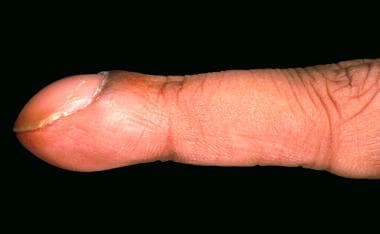
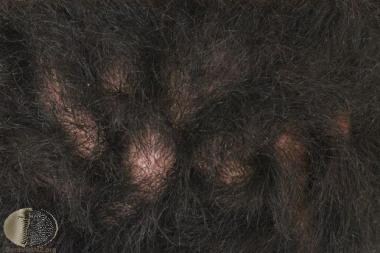 Cutis verticis gyrata. Courtesy of DermNet New Zealand (http://www.dermnetnz.org/assets/Uploads/dermal-infiltrative/cvg2.jpg).



