You are in: eMedicine Specialties > Dermatology > DISEASES OF THE ORAL MUCOSA Cheilitis Granulomatosa (Miescher-Melkersson-Rosenthal Syndrome)Article Last Updated: Sep 7, 2006AUTHOR AND EDITOR INFORMATIONAuthor: Crispian Scully, MD, PhD, CBE, MDS, Professor, Dean, Director of Studies and Research, and Eastman Dental Institute for Oral Health Care Sciences, International Centers for Excellence in Dentistry, University of London, UK Editors: David P Fivenson, MD, Director, Wound Care Service, Department of Dermatology, Henry Ford Health System; Richard P Vinson, MD, Assistant Clinical Professor, Department of Dermatology, Texas Tech University School of Medicine; Consulting Staff, Mountain View Dermatology, PA; Warren R Heymann, MD, Head, Division of Dermatology, Professor, Department of Internal Medicine, University of Medicine and Dentistry of New Jersey; Joel M Gelfand, MD, MSCE, Medical Director, Clinical Studies Unit, Assistant Professor, Department of Dermatology, Associate Scholar, Center for Clinical Epidemiology and Biostatistics, University of Pennsylvania; Dirk M Elston, MD, Director, Department of Dermatology, Geisinger Medical Center Author and Editor Disclosure Synonyms and related keywords: granulomatous cheilitis, orofacial granulomatosis, Miescher cheilitis, Melkersson-Rosenthal syndrome, Rossolimo-Melkersson-Rosenthal syndrome, swelling of the lip, Crohn disease, Crohn's disease INTRODUCTIONBackgroundGranulomatous cheilitis is a chronic swelling of the lip due to granulomatous inflammation. Miescher cheilitis is the term used when the granulomatous changes are confined to the lip. Miescher cheilitis is generally regarded as a monosymptomatic form of the Melkersson-Rosenthal syndrome, although the possibility remains that these may be 2 separate diseases. Melkersson-Rosenthal syndrome is the term used when cheilitis occurs with facial palsy and plicated tongue. Melkersson-Rosenthal syndrome is occasionally a manifestation of Crohn disease or orofacial granulomatosis. PathophysiologyIn granulomatous cheilitis, normal lip architecture is eventually altered by the presence of lymphoedema and noncaseating granulomas in the lamina propria. FrequencyInternationalThe frequency is unknown; the condition is rare. Mortality/MorbidityMorbidity depends on whether underlying organic disease, such as Crohn disease or sarcoidosis, is present. RaceNo racial predilection is recognized. SexNo sexual predilection is known. AgeOnset usually occurs in young adult life. CLINICALHistoryCheilitis granulomatosa is episodic with nontender swelling and enlargement of one or both lips. Occasionally, similar swellings involve other areas, including the periocular region.
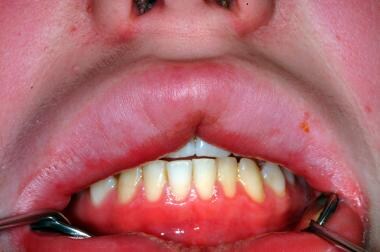
PhysicalThe earliest manifestation is sudden diffuse or occasionally nodular swellings of the lip or the face involving (in decreasing order of frequency) the upper lip, the lower lip, and one or both cheeks. The forehead, the eyelids, or one side of the scalp may be involved (less common). The upper lip is involved slightly more often than the lower lip, and it may feel soft, firm, or nodular on palpation.
CausesThe cause is unknown. A genetic predisposition may exist in Melkersson-Rosenthal syndrome; siblings have been affected, and a plicated tongue may be present in otherwise unaffected relatives. Crohn disease, sarcoidosis, and orofacial granulomatosis may present in a similar clinical fashion, and with identical histologic findings. Dietary or other antigens are the most common identified cause of orofacial granulomatosis. Contact antigens are sometimes implicated. DIFFERENTIALSAngioedema, Acquired Angioedema, Hereditary Cheilitis Granulomatosa (Miescher-Melkersson-Rosenthal Syndrome) Leprosy Sarcoidosis
| ||||||||||||||||||||||||||||||||||||||||||||||||||||||||||||||||||||||||||||||||||||||||||||||||||||||||||||||
| Drug Name | Clofazimine (Lamprene) |
|---|---|
| Description | Inhibits mycobacterial growth, binds preferentially to mycobacterial DNA. Has antimicrobial properties, but mechanism of action is unknown. |
| Adult Dose | 100 mg PO bid for 10 d, then twice weekly for 4 mo |
| Pediatric Dose | 1 mg/kg/d PO qd |
| Contraindications | Documented hypersensitivity; breastfeeding; hepatic disease; renal disease |
| Interactions | Dapsone may inhibit anti-inflammatory activity |
| Pregnancy | C - Safety for use during pregnancy has not been established. |
| Precautions | Severe abdominal symptoms may require exploratory laparotomies; caution in patients with GI problems (eg, abdominal pain, diarrhea); skin discoloration due to drug may result in depression or suicide; apply oil to skin for dryness and ichthyosis; stains soft contact lenses |
| Drug Name | Dapsone (Avlosulfon) |
|---|---|
| Description | Bactericidal and bacteriostatic against mycobacteria. Mechanism of action is similar to that of sulfonamides where competitive antagonists of PABA prevent formation of folic acid, inhibiting bacterial growth. |
| Adult Dose | 50-300 mg PO qd (average dose, 100 mg qd) |
| Pediatric Dose | Not established |
| Contraindications | Absolute: Documented hypersensitivity Relative: G-6-PD deficiency (especially in African Americans, Middle Easterners, and Asians), significant cardiopulmonary disease, significant hematologic disease, sulfa allergy (cautious use in patients with sulfa allergy may be attempted; cross-reactivity is relatively rare and mild) |
| Interactions | May inhibit anti-inflammatory effects of clofazimine; hematologic reactions may increase with folic acid antagonists, eg, pyrimethamine (monitor for agranulocytosis during second and third mo of therapy); probenecid increases toxicity; trimethoprim with dapsone may increase toxicity of both drugs; because of increased renal clearance, levels may significantly decrease when administered concurrently with rifampin |
| Pregnancy | C - Safety for use during pregnancy has not been established. |
| Precautions | Perform weekly blood counts (first mo), then perform WBC counts monthly (6 mo), and then semiannually; discontinue if significant reduction in platelets, leukocytes, or hematopoiesis occurs; caution in methemoglobin reductase deficiency, G-6-PD deficiency, or hemoglobin M because of high risk for hemolysis and Heinz body formation; caution in patients exposed to other agents or conditions (eg, infection, diabetic ketosis) capable of producing hemolysis; peripheral neuropathy can occur (rare); phototoxicity may occur when exposed to UV light |
These agents decrease inflammatory responses and systemically interfere with events leading to inflammation.
| Drug Name | Sulfapyridine (Dagenan) |
|---|---|
| Description | Competitive antagonist of PABA. Mechanism of action in linear IgA dermatosis is unknown. |
| Adult Dose | Initial dose is 500 mg PO bid; increase by 1 g q1-2wk until disease is controlled; control may require 1-4 g/d |
| Pediatric Dose | 35 mg/kg PO bid; not to exceed 100 mg/kg/d |
| Contraindications | Documented hypersensitivity; slow acetylators may require smaller doses or more gradual initial dosage adjustment |
| Interactions | Bioavailability of digoxin is reduced (interval of 2-3 h between administrations is recommended) |
| Pregnancy | B - Usually safe but benefits must outweigh the risks. |
| Precautions | Idiosyncratic reactions, such as hypersensitivity pneumonitis, a lupuslike syndrome, pancreatitis, and toxic hepatitis, may occur; agranulocytosis rarely occurs; both immune hemolytic anemia and nonimmune hemolytic anemia develop (the latter is more common in patients with G-6-PD deficiency); folate deficiency may occur secondary to impaired absorption; nephrolithiasis may occur as with other sulfa drugs; toxic epidermal necrolysis has been reported with medications containing sulfa groups; check complete blood count and liver function tests monthly for 5 mo then q6wk thereafter |
| Drug Name | Sulfasalazine (Azulfidine) |
|---|---|
| Description | Decreases inflammatory response and systemically inhibits prostaglandin synthesis. |
| Adult Dose | 500 mg PO qd |
| Pediatric Dose | Not established |
| Contraindications | Documented hypersensitivity; sulfa drugs or any component; those diagnosed with GI or GU obstruction |
| Interactions | Decreases effects of iron, digoxin, and folic acid; conversely, increases effect of oral anticoagulants, oral hypoglycemic agents, and methotrexate |
| Pregnancy | B - Usually safe but benefits must outweigh the risks. |
| Precautions | Caution in patients with renal or hepatic impairment, blood dyscrasias, or urinary obstruction |
These agents have anti-inflammatory properties and cause profound and varied metabolic effects. In addition, these agents modify the body's immune response to diverse stimuli.
| Drug Name | Triamcinolone (Aristocort) |
|---|---|
| Description | For inflammatory dermatosis responsive to steroids. Decreases inflammation by suppressing migration of polymorphonuclear leukocytes and reversing capillary permeability. |
| Adult Dose | 2.5-40 mg (10 mg/mL or 40 mg/mL formulations; intralesional); repeat prn but not to exceed q4-6wk |
| Pediatric Dose | 2.5-15 mg (10 mg/mL or 40 mg/mL solutions; intralesional); repeat prn but not to exceed q4-6wk |
| Contraindications | Documented hypersensitivity; fungal, viral, and bacterial skin infections |
| Interactions | None reported |
| Pregnancy | C - Safety for use during pregnancy has not been established. |
| Precautions | Do not use in decreased skin circulation; prolonged or frequent use may result in Cushing syndrome, reversible HPA-axis suppression, hyperglycemia, and glycosuria |
These agents inhibit key factors that mediate immune reactions, which, in turn, decrease inflammatory responses.
| Drug Name | Azathioprine (Imuran) |
|---|---|
| Description | Antagonizes purine metabolism and inhibits synthesis of DNA, RNA, and proteins. May decrease proliferation of immune cells, which results in lower autoimmune activity. |
| Adult Dose | 1 mg/kg qd/bid (empiric) or by TPMT level; increase by 0.5 mg/kg q4wk until response, not to exceed 2.5 mg/kg/d TPMT testing not entirely reliable; involves testing activity of TPMT activity in RBCs, which correlates with systemic TPMT activity; functional enzyme test has been shown to have variability between test sites, and kits may contain varying amounts of enzyme inhibitor; starting at low doses, monitoring for pancytopenia, then increasing the dose is an alternative; if clinical response is not good, patient may be a homozygote for high activity and may need increased dose; Wolverton does not recommend using this assay (Wolverton, Comprehensive Dermatologic Drug Therapy); some references recommend checking before treatment in all patients TPMT <5 U: No treatment with azathioprine TPMT 5-13.7 U: Not to exceed 0.5 mg/kg TPMT 13.7-19 U: Not to exceed 1.5 mg/kg TPMT >19 U: Not to exceed 2.5 mg/kg |
| Pediatric Dose | Safety and efficacy not established |
| Contraindications | Absolute: Documented hypersensitivity, pregnancy or attempting pregnancy, clinically significant active infection Relative: Concurrent use of allopurinol; prior treatment with alkylating agents (eg, cyclophosphamide, chlorambucil, melphalan, others [high risk of neoplasia]) |
| Interactions | Allopurinol increases risk of pancytopenia; captopril/ACE inhibitors may increase risk of anemia and leukopenia; warfarin dose may need to be increased; pancuronium dose may need to be increased for adequate paralysis; live virus vaccines and cotrimoxazole increase risk of hematologic toxicity; rifampicin may cause transplants to possibly be rejected; clozapine may increase risk of agranulocytosis |
| Pregnancy | D - Unsafe in pregnancy |
| Precautions | Increased risk of neoplasia; caution in liver disease and renal impairment; hematologic toxicities may occur; rarely, patients may develop fever without associated infections; measure thiopurine methyltransferase level prior to treatment; periodically monitor CBC count and liver function |
| Media file 1: Labial swelling and angular cheilitis. | |
![]() | View Full Size Image | Media type: Photo |
Cheilitis Granulomatosa (Miescher-Melkersson-Rosenthal Syndrome) excerpt
Article Last Updated: Sep 7, 2006