Practice Essentials
Angina bullosa hemorrhagica (ABH) is the term used to describe acute, benign, and generally subepithelial oral mucosal blisters filled with blood that are not attributable to a systemic disorder or hemostatic defect. [1, 2, 3, 4]
This condition was first described in 1933 as traumatic oral hemophlyctenosis. Badham first used the currently accepted term angina bullosa hemorrhagica in 1967.
The lesions may be confused with other more serious disorders (eg, mucous membrane pemphigoid, epidermolysis bullosa, linear IgA, dermatitis herpetiformis); however, the isolated nature, rapid healing, and rare recurrence of angina bullosa hemorrhagica blisters generally are sufficient findings to rule out the previously mentioned conditions.
The lesions of angina bullosa hemorrhagica may be indistinguishable from blood blisters related to thrombocytopenia; however, blood tests and the absence of areas of ecchymosis, epistaxis, or gingival bleeding are helpful signs to rule it out.
Some authors suggest mild trauma as the causative agent in angina bullosa hemorrhagica to break the epithelial–connective-tissue junction, causing bleeding of superficial capillaries and resulting in the formation of a subepithelial hemorrhagic bullae.
Also see the Medscape articles Bullous Pemphigoid, Epidermolysis Bullosa, Linear IgA Dermatosis, and Dermatitis Herpetiformis.
Prognosis
The prognosis for angina bullosa hemorrhagica (ABH) is good. Recurrences have been reported to occur once or twice a year in 30% of the affected population at the same or different site, with no specific precipitating factor (eg, trauma) or seasonal predilection. [5, 6]
ABH is a benign condition; however, some authors have reported acute upper airway obstruction associated with rapidly enlarging bulla of the posterior pharynx and epiglottic region. [7] Rarely, tracheal intubation and surgical tracheostomy are required in such patients.
Signs and symptoms
Also see Physical Examination and Diagnostic Considerations.
Angina bullosa hemorrhagica (ABH) is characterized by its sudden onset during or just after eating. [8] The lesions may be preceded by stinging pain or a burning sensation, but they are essentially asymptomatic. [9] A large bullae in the palatal region has been reported to give rise to a feeling of suffocation. [10] Occasionally, patients may present with hoarseness or blood-tinged sialorrhea. [9]
The blisters may last from a few minutes to 24-48 hours and then spontaneously rupture, typically during meals, releasing blood into the mouth. It usually leaves an erosion covered by epithelial slough that heals without scarring, discomfort, or pain within a week’s time. [11] The lesions may appear intermittently or at regular intervals. The cases reported had a duration ranging from 4 months [5] to 25 years. [6]
Patients do not report a tendency to bleed at other sites.
Family history generally is noncontributory to angina bullosa hemorrhagica. Grinspan et al [12] reported that 44% of his patients in a series of 24 cases published in 1999 had from type 2 diabetes, hyperglycemia, or family history of diabetes. No conclusive evidence of a cause-and-effect relationship exists between the presence of angina bullosa hemorrhagica and glucose metabolism.
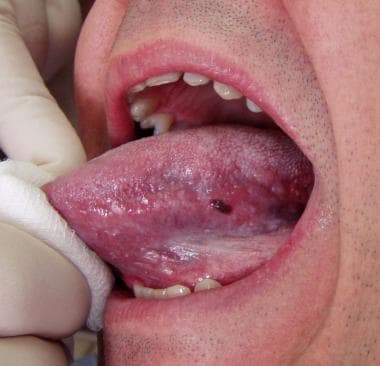 A 42-year-old man with the sudden appearance of angina bullosa hemorrhagica. The patient experienced pain a few minutes before the bulla appeared. He had a history of 3 similar previous episodes at the same site. Because the lesions only stay intact for a short duration, the patient took the picture using his own cellular phone. Image shows 24 hours after the initial presentation of angina bullosa hemorrhagica.
Complications
There is a remote risk of asphyxia with palatal or pharyngeal lesions. [9]
Diagnostics
In angina bullosa hemorrhagica (ABH), platelet counts and coagulation tests are within normal limits.
Performing a biopsy of an intact bulla is difficult because of the short duration of the lesion. Otherwise, a biopsy of a ruptured bulla exhibits a nonspecific ulceration.
Also see Histologic Findings.
Treatment
ABH is a self-limiting condition hence no specific therapy is recommended other than observation. However, administration of corticosteroids may be indicated in emergency cases of rapidly expanding lesions at risk for asphyxiation.
Antiseptic washes containing 0.02% chlorhexidine gluconate and topical analgesics are non-mandatory and may be prescribed on an as-needed basis for the ulcer. [13]
Awareness and correct history taking of this rare condition is important to prevent unnecessary diagnostic measures and added mental stress to patients, especially when given the initial working impression of other differentials with poorer prognosis.
Coagulation tests and platelet count may be indicated to rule out a blood dyscrasia.
Complications
Any large, intact blood blister should be incised to prevent further enlargement that could cause airway obstruction.
The residual erosion or ulcer from ruptured blistered heal without scarring usually within 1 week's time. There has been a reported case of recurrent episodes of ABH, [13, 14] and rarely, large ABH have caused airway obstruction [7] and feeling of being "choked." [15]
Prevention
Avoidance of mechanical stimuli (eg, metal crown, dental prosthesis) may prevent trauma. The intake of ascorbic acid/citrus flavonoids (200 mg 1 tab bid) may be helpful in decreasing/preventing recurrence. [12] As an adverse event of inhaled corticosteroid therapy, rinsing the mouth with water after inhalation may be preventive. [16] In patients with systemic diseases, antibiotics and/or nonsteroidal anti-inflammatory drugs have been used to prevent secondary infection. [17]
In patients with prior history of ABH, avoidance of coarse/hard food is prudently advised.
Consultation with a medical professional is still recommended should ABH or similar-looking blisters recur/occur in the oral mucosa to establish the diagnosis and rule out other differentials with poorer prognosis.

Pathophysiology
A genetic predisposition of loose adhesion between the epithelium and corium of the mucosa or a weak anchorage of the mucosal vessels may result in subepithelial hemorrhage. [9]
Angina bullosa hemorrhagica (ABH) may also represent an acute or chronic injury to soft tissue. It is an example of an oral mucosal traumatic lesion. [11, 18] Angina bullosa hemorrhagica most commonly occurs in the soft palate where the covering squamous epithelium of the nonkeratinized type is thin and friable. [8] The break in the epithelial-connective–tissue junction causes bleeding of the superficial capillaries, resulting in the formation of the subepithelial hemorrhagic bullae. [8]
Angina bullosa hemorrhagica may also be a rare and underestimated adverse effect of inhalational corticosteroid therapy. The resulting collagen synthesis modifications lead to mucosal atrophy and a decrease in submucosal elastic fibers, especially in the elderly population over the long term (>5 y). Long-term use of such inhalers may induce capillary breakdown. [8, 16] Similarly, vascular fragility has also been implicated, in view of the association of angina bullosa hemorrhagica with diabetes mellitus. [9]
Etiology
The described cases of angina bullosa hemorrhagica (ABH) had spontaneous onset or were related to minor trauma of ingestion of hot drinks [19] ; hard, rough, and crispy foods [20, 8] ; restorative dentistry [21] ; or periodontal therapy. [22] Foods are responsible for the majority of ABH cases. [23]
Other potential causes of angina bullosa hemorrhagica mentioned in the literature are dental injections of anesthetics [20, 24] ; steroid inhalers [25, 24] ; endoscopy [19, 26] ; trauma from the sharp edges of adjacent teeth, metal crowns, and prosthetic use [9, 27] ; increased progesterone levels during the menstrual cycle [28] ; tobacco consumption [27] ; anticoagulant intake [17] ; and coughing, sneezing, and shouting. [7, 8]
A report of 16 cases affecting the soft palate described hypertension as the most frequent underlying systemic condition (6 of 16 subjects); however, its relationship remains speculative, as hypertension is common in adults. [8] Other reported associated systemic factors were diabetes mellitus, chronic kidney injury on hemodialysis, asthma, rheumatoid arthritis, gastrointestinal disturbances, hyperuricemia, and systemic lupus erythematosus. [7, 17, 22, 9, 6, 29]
In general, angina bullosa hemorrhagica is not attributable to blood dyscrasia, vesiculobullous disorders, or systemic diseases. A causative factor is not identified in approximately 47% of patients with angina bullosa hemorrhagica. [7]
Epidemiology
Angina bullosa hemorrhagica (ABH) predominantly affects middle-aged or elderly people. The median age at presentation is 54 years, with 60% of the patients in the range of 45-70 years. Lesions have not been documented in children younger than 10 years.
In a 14-year multi-institutional retrospective study from Brazil where 23 ABH cases from 2006 to 2020 were reviewed, the prevalence of ABH was found to be 0.18%. The same study showed a slight prevalence in males. [13]
-
A 42-year-old man with the sudden appearance of angina bullosa hemorrhagica. The patient experienced pain a few minutes before the bulla appeared. He had a history of 3 similar previous episodes at the same site. Because the lesions only stay intact for a short duration, the patient took the picture using his own cellular phone.
-
A 42-year-old man with the sudden appearance of angina bullosa hemorrhagica. The patient experienced pain a few minutes before the bulla appeared. He had a history of 3 similar previous episodes at the same site. Because the lesions only stay intact for a short duration, the patient took the picture using his own cellular phone. Image shows 24 hours after the initial presentation of angina bullosa hemorrhagica.
Tables
| Main criteria |
| (I) Clinically noticeable hemorrhagic bulla or erosion with a history of bleeding of the oral mucosa |
| (II) Exclusively oral or oropharyngeal localization |
| Additional criteria |
| (III) Palatal localization |
| (IV) Triggering event or promoting factor (food intake) |
| (V) Recurrent lesions |
| (VI) Favorable evolution without leaving a scar in a few days |
| (VII) Painless lesion, tingling, or burning sensation |
| (VIII) Normal platelet count and coagulation profile |
| (IX) Negative direct immunofluorescence |