Practice Essentials
Epulis fissuratum is a mucosal hyperplasia that results from chronic low-grade trauma induced by a denture flange. [1] (See the image below.) Epulis fissuratum is analogous to acanthoma fissuratum of skin.
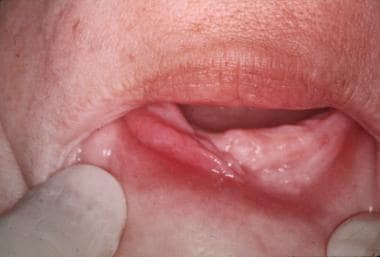 An epulis fissuratum in the anterior part of the mandible shows a central groove where the denture flange rests. Note the inflammatory erythema. The surface of the lesion is usually smooth as shown in the image.

Pathophysiology
Epulis fissuratum arises in association with denture flanges. Consequently, epulis fissuratum is usually observed in the maxillary or mandibular vestibule.
The cause of epulis fissuratum is chronic low-grade irritation from an ill-fitting denture. Frequently, this is the consequence of resorption of the alveolar ridge so that the denture moves further into the vestibular mucosa, creating an inflammatory fibrous hyperplasia that proliferates over the flange. [2]
Epidemiology
A study on the prevalence of oral lesions among 210 denture wearers found that oral lesions were found in 20.5% of the cases and that denture-induced fibrous hyperplasia was the most common type of lesion detected (41.9%). [3]
Sex- and age-related demographics
Most studies indicate a clear predilection for epulis fissuratum in females. [4] Possible atrophic epithelial changes secondary to menopause may influence an increased reaction to trauma in older females.
Epulis fissuratum occurs in greatest numbers in the fifth, sixth, and seventh decades, but it can be observed at almost any age. Epulis fissuratum has been described in children. The fact that the lesions are related to denture wear and chronicity of an irritative process explains the higher incidence in older individuals.
Prognosis
With correction of the poorly fitting denture, the prognosis for epulis fissuratum is excellent.
Morbidity/mortality
Significant morbidity does not occur with epulis fissuratum.
Patient Education
Instruct the patient that regular dental care is necessary and that the oral tissues are changing constantly. This means that dentures are not permanent and need adjustments over time.
-
An epulis fissuratum in the anterior part of the mandible shows a central groove where the denture flange rests. Note the inflammatory erythema. The surface of the lesion is usually smooth as shown in the image.
-
The mass in the posterior part of the maxillary vestibule is associated with a full denture; however, in this patient, the mass represented a squamous cell carcinoma. The surface is more granular in appearance, although this is not always the case.
-
A view of a whole mount of a tissue section taken from an epulis fissuratum shows that it is essentially a fibrous hyperplasia. The central groove can be observed, and, in this patient, papillary hyperplasia is present in some areas.