Background
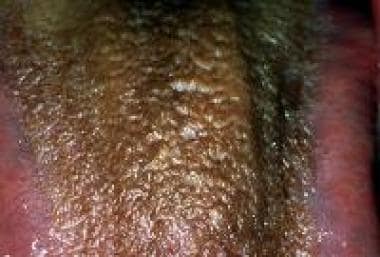
Hairy tongue (lingua villosa) is a commonly observed condition of defective desquamation of the filiform papillae that results from a variety of precipitating factors. [1] The condition is most frequently referred to as black hairy tongue (lingua villosa nigra); however, hairy tongue may also appear brown, white, green, pink, or any of a variety of hues depending on the specific etiology and secondary factors (eg, use of colored mouthwashes, breath mints, candies). [2, 3] See the images below:
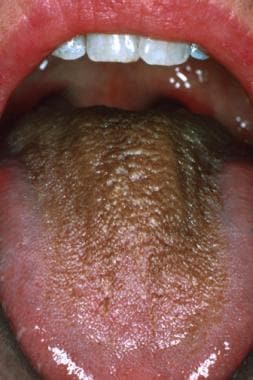 Brown hairy tongue in a middle-aged woman who drinks coffee. Note how the condition is limited to the mid-dorsal part of the tongue, becoming more prominent toward the posterior part.
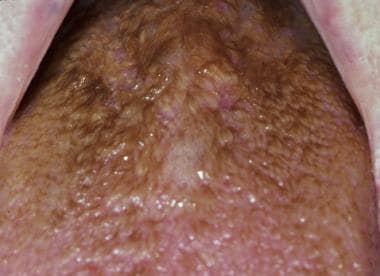 This patient is a middle-aged woman who drank coffee and smoked cigarettes for many years. Her chief complaint was a tickling sensation in the oral pharynx during swallowing. The slight greenish cast to her tongue was due to the use of a mouthwash immediately prior to her appointment.

Pathophysiology
Precipitating factors for hairy tongue include poor oral hygiene, the use of medications such as broad-spectrum antibiotics (particularly tetracyclines), and therapeutic radiation of the head and the neck. [4] All cases of hairy tongue are characterized by a hypertrophy and elongation of filiform papillae, with a lack of normal desquamation. Normal filiform papillae are approximately 1 mm in length, whereas filiform papillae in hairy tongue have been measured at more than 15 mm in length.
Etiology
The basic defect in hairy tongue is a hypertrophy of filiform papillae on the dorsal surface of the tongue, usually due to a lack of mechanical stimulation and debridement. This condition often occurs in individuals with poor oral hygiene (eg, lack of tooth brushing, eating a soft diet with no roughage that would otherwise mechanically debride the dorsal surface of the tongue).
Contributory factors for hairy tongue are numerous and include tobacco use and coffee or tea drinking. These factors account for the various colors associated with the condition. [5, 6, 7] Medications, such as lorazepam, [8, 9] lithium, [10] and linezolid, have been implicated. [11, 12, 13] Other medications that have been reported to induce black hairy tongue include doxycycline, penicillin lozenges, mepazine, oral tetracycline, olanzapine, and oral erythromycin. [14]
Epidemiology
Frequency
The prevalence of hairy tongue varies widely, from 8.3% in children and young adults to 57% in persons who are addicted to drugs and incarcerated. Hairy tongue has been reported with greater frequency in males, those who use tobacco, those who heavily drink coffee and tea, patients infected with HIV, and those who are HIV negative and use intravenous drugs. [15, 16, 17, 18, 19] There may also be geographical disparity depending on the relative contribution of identified etiologic factors. [20]
Race
No racial predilection is associated with hairy tongue.
Sex
Although hairy tongue is reported more often in males, it is not uncommon in females, especially those who drink coffee or tea and/or those who use tobacco.
Age
The incidence and the prevalence of hairy tongue increases with age, [21] possibly because a higher percentage of the population engage in activities (eg, using tobacco, drinking coffee or tea) that predispose to the condition.
Prognosis
The prognosis for hairy tongue is excellent. If the precipitating factors cannot be adequately controlled or compensated for, patients may have to make tongue brushing or scraping part of their daily oral hygiene regimen.
Hairy tongue is rarely symptomatic, although overgrowth of Candida albicans may result in glossopyrosis (burning tongue). Patients frequently complain of a tickling sensation in the soft palate and the oral pharynx during swallowing. In more severe cases, patients may actually complain of a gagging sensation. Retention of oral debris between the elongated papillae may result in halitosis.
Patient Education
Education regarding proper oral hygiene procedures is more easily provided to the patient as part of a routine dental appointment; however, encouragement in this regard is appropriate from any healthcare provider.
-
Brown hairy tongue in a middle-aged woman who drinks coffee. Note how the condition is limited to the mid-dorsal part of the tongue, becoming more prominent toward the posterior part.
-
Brown hairy tongue in a middle-aged man who smokes cigarettes. The condition is limited to the posterior two thirds of the dorsal surface of the tongue.
-
Close-up view of brown hairy tongue in a middle-aged man who smokes cigarettes. The condition is limited to the posterior two thirds of the dorsal surface of the tongue.
-
This patient is a middle-aged woman who drank coffee and smoked cigarettes for many years. Her chief complaint was a tickling sensation in the oral pharynx during swallowing. The slight greenish cast to her tongue was due to the use of a mouthwash immediately prior to her appointment.
-
This male geriatric patient had smoked a pipe for many years. He was unaware of the presence of his hairy tongue until it was brought to his attention during a routine dental examination.
-
Male geriatric patient had smoked a pipe for many years. He was unaware of the presence of his hairy tongue until it was brought to his attention during a routine dental examination. Photo 1 month following his initial examination. While he has not decreased his pipe smoking, he has gently brushed the dorsal surface of his tongue when he brushes his teeth during the intervening 4 weeks. The hairy tongue has completely resolved.
-
Middle-aged woman with a hairy tongue that is brown.