Continually Updated Clinical Reference
 
 
  All Sources     eMedicine     Medscape     Drug Reference     MEDLINE
 
eMedicine - Acneiform Eruptions : Article by

Quick Find
Authors & Editors
Introduction
Clinical
Differentials
Workup
Treatment
Follow-up
References

Related Articles
Acne Vulgaris

Contact Dermatitis, Allergic

Disseminate and Recurrent Infundibular Folliculitis

Drug Eruptions

Eosinophilic Pustular Folliculitis

Eruptive Vellus Hair Cysts

Favre-Racouchot Syndrome (Nodular Elastosis with Cysts and Comedones)

Fibrous Papule of the Face

Folliculitis

Milia

Perioral Dermatitis

Pseudofolliculitis of the Beard

Pseudomonas Folliculitis

Rosacea

Seabather's Eruption

Sporotrichosis

Syphilis

Syringoma

Trichilemmoma

Trichoepithelioma

Tuberous Sclerosis


Patient Education
Skin, Hair, and Nails Center

Teen Health Center

Sexually Transmitted Diseases Center

Acne Overview

Acne Causes

Acne Treatment

Syphilis Overview


Author: Julianne H Kuflik, MD, Staff Physician, Department of Dermatology, UMDNJ-New Jersey Medical School

Julianne H Kuflik is a member of the following medical societies: American Academy of Dermatology

Coauthor(s): Robert A Schwartz, MD, MPH, Professor and Head of Dermatology, Professor of Medicine, Professor of Pediatrics, Professor of Pathology, Professor of Preventive Medicine and Community Health, UMDNJ-New Jersey Medical School

Editors: Robin Travers, MD, Professor, Department of Dermatology, Boston University School of Medicine; David F Butler, MD, Professor of Dermatology, Texas A&M University College of Medicine; Director, Division of Dermatology, Scott and White Clinic; Director Dermatology Residency Training Program, Scott and White Clinic; Jeffrey Meffert, MD, Assistant Clinical Professor of Dermatology, Medicine, University of Texas Health Science Center-San Antonio; Glen H Crawford, MD, Assistant Clinical Professor, Department of Dermatology, University of Pennsylvania School of Medicine; Chief, Division of Dermatology, The Pennsylvania Hospital; Dirk M Elston, MD, Director, Department of Dermatology, Geisinger Medical Center

Author and Editor Disclosure

Synonyms and related keywords: nevus comedonicus, eruptive hair cysts, tuberous sclerosis, amineptine acne, steroid acne, chloracne, acneiform drug eruptions, gram-negative folliculitis, eosinophilic pustular folliculitis, Pityrosporum, folliculitis, coccidioidomycosis, secondary syphilis, sporotrichosis, rosacea, perioral dermatitis, acnelike disorders

Background

Acneiform eruptions may consist of comedones, papulopustules, cysts, or nodules that resemble acne vulgaris. Occasionally, this may lead to their initial misdiagnoses. Acnelike disorders occur from a wide variety of diseases, including infections, growth anomalies, and drug reactions. Those entities included in this discussion are nevus comedonicus, eruptive hair cysts, tuberous sclerosis, amineptine acne, steroid acne, chloracne, acneiform drug eruptions, gram-negative folliculitis, eosinophilic pustular folliculitis, Pityrosporum folliculitis, coccidioidomycosis, secondary syphilis, sporotrichosis, rosacea, and perioral dermatitis.


History

Patients with acneiform diseases present with acnelike lesions such as papulonodules, pustules, comedones, and cysts. The physical locations, which commonly include the face, trunk, and extremities, usually vary between the diseases. For example, steroid acne and the various folliculitis disorders usually manifest more prominently on the trunk and extremities, whereas perioral dermatitis and rosacea locate to the face. The evolution of the lesions may provide additional clues to the etiology. The infectious disorders can form ulcerated and crusted nodules. Systemic signs and symptoms may also narrow the differential diagnosis; for example, certain drug eruptions are associated with febrile illness and peripheral blood leukocytosis. Occupational and medication exposures, including over-the-counter and herbal remedies, should be recorded.

Physical


  • Nevus comedonicus (NC) is an infrequent developmental anomaly manifesting as aggregated open comedones. It consists of dilated follicular or eccrine orifices plugged with keratin. Also known as comedone nevus and nevus acneiformis unilateralis, it may be solitary, congenital, or occur later in life as a result of occupational exposure. The differential diagnosis of NC includes familial dyskeratotic comedones and linear comedone formations usually linked with acne vulgaris or chronically sun-damaged skin (Favre-Racouchot disease). Infrequently, multiple comedones in other unusual contexts may raise NC as a possible consideration. Treatment of NC is generally surgical, through excision or carbon dioxide laser ablation of the involved skin. Medical therapy with topical retinoids may be of some benefit. For more information, see Nevus Comedonicus.

  • The eruptive vellus hair cysts manifest as flesh-colored papules found usually on the face, chest, neck, thighs, groin, buttocks, and axillae. They represent an anomaly of the vellus hair follicles and may be hereditary. Histopathology reveals a mid dermal epithelial cyst containing vellus hairs and keratinous material. These cysts may undergo spontaneous regression, form a connection to the epidermis, or undergo degradation with a resultant foreign body granulomatous formation. Treatment is often difficult. Incision and drainage of individual lesions carries the risk of subsequent scarring, and modalities such as carbon dioxide laser ablation are difficult to use over large surface areas. Topical retinoids and 12% lactic acid preparations have proven useful in some instances. For more information, see Eruptive Vellus Hair Cysts.

  • Steroid acne is observed as monomorphous papulopustules located predominantly on the trunk and extremities, with less involvement of the face. Characteristically, it appears after the administration of topical or systemic corticosteroids, including intravenous and inhaled therapy. The eruption usually resolves after discontinuation of the steroid and, in addition, may respond to the usual treatments of acne vulgaris. For more information, see Acne Vulgaris.

  • Exposure to halogenated aromatic hydrocarbon compounds, such as chlorinated dioxins and dibenzofuranes, by inhalation, ingestion, or direct contact of contaminated compounds or foods induces a cutaneous eruption of polymorphous comedones and cysts referred to as chloracne. Other associated skin findings may include xerosis and pigmentary changes. Internal changes involving the ophthalmic, nervous, and hepatic systems may also occur, and some chloracnegens can be oncogenic. Treatment is difficult because chloracne may persist for years, even without further exposure. Chemicals that contain iodides, bromides, and other halogens can also induce an acneiform eruption similar to that of steroid acne; however, the iodide-induced eruption may be more extreme.

  • Antibiotics may induce an acute generalized pustular eruption. Penicillins and macrolides are the greatest offenders. Patients usually are febrile with leukocytosis, and the eruption does not usually involve comedones. Other implicated antibiotics include co-trimoxazole, doxycycline, ofloxacin, and chloramphenicol. Other types of medications can also produce an acnelike eruption, including corticotropin, nystatin, isoniazid, itraconazole, hydroxychloroquine, naproxen, mercury, amineptine, the antipsychotics olanzapine and lithium, and chemotherapy drugs. For more information, see Drug Eruptions.

  • Various infections may also display an acneiform pattern. Gram-negative folliculitis, a persistent papulopustular eruption, may be a complication in patients on prolonged antibiotic treatment for acne vulgaris or rosacea. It is more common in male patients. Culture of the papulopustules grows gram-negative bacilli and gram-negative rods, including Escherichia coli and Klebsiella, Enterobacter, and Proteus species. Treatment consists of the appropriate antibiotic coverage for the causative organism. Isotretinoin may sometimes be an effective alternative or adjunctive treatment. For more information, see Gram-Negative Folliculitis, Acne Vulgaris, and/or Rosacea.

  • Pityrosporum folliculitis is another infectious folliculitis that is presumably caused by a host reaction to the yeast Malassezia furfur, previously named Pityrosporum ovale, a normal human skin commensal. It appears primarily on the trunk and upper extremities of late adolescents and young adults. Unlike acne vulgaris, it is pruritic, does not contain comedones, and responds to appropriate antifungal therapy rather than antibiotics. The yeast and hyphae can be observed in biopsy specimens in the widened follicular ostia along with keratinous material, and occasionally, rupture of the follicular wall may occur. Treatment typically involves topical or systemic antifungal therapy. For more information, see Pityrosporum Folliculitis.

  • Eosinophilic pustular folliculitis (EPF) is another disease of unknown etiology that usually manifests as a recurrent pruritic papulopustular eruption on the face, trunk, and extremities. Histopathology reveals a predominantly perifollicular infiltration of eosinophils with some mononuclear cells and subcorneal pustules composed of eosinophils. EPF has been described in infants and in immunocompromised patients with HIV, and the classic immunocompetent type is known as Ofuji disease (first described by Ofuji in the adult Japanese population). Patients may also demonstrate blood eosinophilia and leukocytosis. Treatment modalities and results vary greatly. Options include topical and systemic corticosteroids, oral antibiotics, indomethacin, dapsone, isotretinoin, and pulsed ultraviolet phototherapy (PUVA). For more information, see Eosinophilic Pustular Folliculitis.

  • Other infectious diseases may also induce an acnelike pattern.

    • In secondary syphilis, papulopustules and nodules, some crusted, may occur on the face, trunk, and extremities. The causative agent, the spirochete Treponema pallidum, may be easily observed in biopsy specimens with the Warthin-Starry stain. In addition, serologic tests and the presence of spirochetes on darkfield microscopy may reveal the diagnosis. For more information, see Syphilis

    • Mycotic infections may also manifest cutaneously with papules and nodules that may ulcerate and crust.

    • Sporothrix schenckii, the responsible agent of sporotrichosis, commonly induces a lymphocutaneous reaction, but it can also produce a persistent fixed localized cutaneous papulonodular eruption that may involve the face. The organism can be demonstrated histologically, by peripheral blood smear, and by fungal culture. For more information, see Sporotrichosis

    • Cutaneous coccidioidomycosis usually caused by inhalation and dissemination of Coccidioides immitis, may rarely occur by primary inoculation and appear as papulopustules, nodules, or plaques that can eventually ulcerate and crust. For more information, see Coccidiomycosis.

  • Rosacea appears similarly to acne vulgaris with papulopustules on the face, but in addition, patients may also have facial flushing and telangiectases. For more information, see Rosacea.

    • Rosacea is more common in the white population and in women in the third and fourth decades of life. Men, however, are more commonly affected by sebaceous and connective tissue hyperplasia of the nose (rhinophyma), a complication of chronic rosacea. Associated eye findings are variable but include blepharitis, conjunctivitis, iritis, iridocyclitis, hypopyon iritis, and even keratitis.

    • Although the definitive etiology is unknown, weather extremes, hot or spicy foods, alcohol, and Demodex folliculorum mites can trigger and exacerbate this condition. Acne rosacea has also been associated with the ingestion of a high-dose vitamin B supplement.

    • Although biopsies are not usually performed, histopathology may reveal lymphohistiocytic perivascular and perifollicular inflammation, ectatic vascular channels, elastosis, and hypertrophy of the connective tissue and sebaceous follicles. Treatment primarily includes sunscreens and topical antibiotics such as metronidazole, retinoids, and oral tetracyclines.

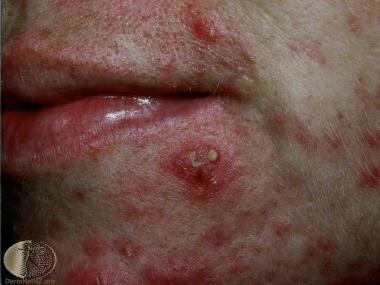
  • Perioral dermatitis, also a disorder of unknown etiology, is mainly observed in the young, white, female population as papulopustules with erythematous bases. The eruption is predominantly perioral in location, characteristically sparing the vermilion border of the lip, but it may also include the perinasal and periorbital areas. Biopsies are rarely performed but would show some changes similar to rosacea. The etiology is unknown, as in rosacea, and suggested causative agents include Demodex, topical or inhaled corticosteroids, moisturizers, fluorinated compounds, and contact irritants or allergens. Therapy typical includes cessation of halogenated topical steroids and initiation of topical antibiotic therapies such as metronidazole. Proper use of a spacer or inhalation device may help when the dermatitis occurs with inhaled steroids. For more information, see Perioral Dermatitis.


Acne Vulgaris
Contact Dermatitis, Allergic
Disseminate and Recurrent Infundibular Folliculitis
Drug Eruptions
Eosinophilic Pustular Folliculitis
Eruptive Vellus Hair Cysts
Favre-Racouchot Syndrome (Nodular Elastosis with Cysts and Comedones)
Fibrous Papule of the Face
Folliculitis
Milia
Perioral Dermatitis
Pseudofolliculitis of the Beard
Pseudomonas Folliculitis
Rosacea
Seabather's Eruption
Sporotrichosis
Syphilis
Syringoma
Trichilemmoma
Trichoepithelioma
Tuberous Sclerosis


Lab Studies

  • The workup of acneiform eruptions varies greatly, reflecting the wide variety of diseases. This can include skin biopsies, cultures and sensitivities, serologic tests, and empiric trials of drug withdrawal (see Physical).


Medical Care

Treatment varies with the particular disease suspected and consists of a wide range of methods, including excision, laser ablation, topical/oral antibiotics, topical/oral retinoids, and drug withdrawal. Please review individual topics in Physical for greater detail.


Patient Education


  • Adams BB, Chetty VB, Mutasim DF. Periorbital comedones and their relationship to pitch tar: a cross-sectional analysis and a review of the literature. J Am Acad Dermatol. Apr 2000;42(4):624-7. [Medline].
  • Adams BB, Mutasim DF. Pustular eruption induced by olanzapine, a novel antipsychotic agent. J Am Acad Dermatol. Nov 1999;41(5 Pt 2):851-3. [Medline].
  • Bogdanowski T, Rubisz-Brzezinska J. [Giant nevus comedonicus]. Przegl Dermatol. Jul-Aug 1988;75(4):305-7. [Medline].
  • Borton LK, Schwartz RA. Pityrosporum folliculitis: a common acneiform condition of middle age. Ariz Med. Aug 1981;38(8):598-601. [Medline].
  • Choi MJ, Kim JW, Koh BK. Solitary premature sebaceous hyperplasia associated with acneiform eruption. Acta Derm Venereol. 2004;84(6):483-4. [Medline].
  • del Río E. Peculiar distribution of comedones: a report of three cases. Dermatology. 1997;195(2):162-3. [Medline].
  • Demitsu T, Kosuge A, Yamada T, Usui K, Katayama H, Yaoita H. Acute generalized exanthematous pustulosis induced by dexamethasone injection. Dermatology. 1996;193(1):56-8. [Medline].
  • Farella V, Sberna F, Knöpfel B, Urso C, Difonzo EM. Acne-like eruption caused by amineptine. Int J Dermatol. Dec 1996;35(12):892-3. [Medline].
  • Forstinger C, Kittler H, Binder M. Treatment of rosacea-like demodicidosis with oral ivermectin and topical permethrin cream. J Am Acad Dermatol. Nov 1999;41(5 Pt 1):775-7. [Medline].
  • Fung MA, Berger TG. A prospective study of acute-onset steroid acne associated with administration of intravenous corticosteroids. Dermatology. 2000;200(1):43-4. [Medline].
  • Grimalt R, Mascaró-Galy JM, Ferrando J, Lecha M. Guess what? Macronodular iatrogenic acne due to amineptine. Eur J Dermatol. Sep 1999;9(6):491-2. [Medline].
  • Harden D, Keeling JH. Papular and nodular lesions of the scalp, face, and neck. Secondary syphilis. Arch Dermatol. Aug 1997;133(8):1027, 1030. [Medline].
  • Held JL, Andrew JE, Toback AC. Eruptive vellus hair cysts. Cutis. Sep 1987;40(3):259-60. [Medline].
  • Hurwitz RM. Steroid acne. J Am Acad Dermatol. Dec 1989;21(6):1179-81. [Medline].
  • Józwiak S, Schwartz RA, Janniger CK, Michalowicz R, Chmielik J. Skin lesions in children with tuberous sclerosis complex: their prevalence, natural course, and diagnostic significance. Int J Dermatol. Dec 1998;37(12):911-7. [Medline].
  • Kanzaki T. Acneiform eruption induced by lithium carbonate. J Dermatol. Aug 1991;18(8):481-3. [Medline].
  • Kogan BG, Stepanenko VI, Gorgol VT. Substantiation of a rational system of examination algorithms and standards of comprehensive treatment of patients with rosacea, demodecosis and perioral dermatitis. Ukrainian J Dermatol Venereol. 2003;2(9):17-27.
  • Kusuhara M, Hachisuka H, Sasai Y. Statistical survey of 150 cases with sporotrichosis. Mycopathologia. May 1988;102(2):129-33. [Medline].
  • Lambert WC, Bagley MP, Khan Y, Schwartz RA. Pustular acneiform secondary syphilis. Cutis. Jan 1986;37(1):69-70. [Medline].
  • Lee S, Park SG, Lee MG. Chloracne with acantholytic dyskeratosis associated with herbicides: A new histological variant?. J Am Acad Dermatol. Apr 2004;50(4):E8. [Medline].
  • Lefkowitz A, Schwartz RA, Lambert WC. Nevus comedonicus. Dermatology. 1999;199(3):204-7. [Medline].
  • Marks R, Black MM. Perioral dermatitis. A histopathologic study of 26 cases. Br J Dermatol. Mar 1971;84(3):242-7. [Medline].
  • Moloney FJ, Egan CA. Case 3. Acne agminata (lupus miliaris disseminatus faciei). Clin Exp Dermatol. Nov 2003;28(6):685-6. [Medline].
  • Monk B, Cunliffe WJ, Layton AM, Rhodes DJ. Acne induced by inhaled corticosteroids. Clin Exp Dermatol. Mar 1993;18(2):148-50. [Medline].
  • Mori R, Matsushima S, Honda T, Horiguchi Y, Imamura S. Chronic superficial pyoderma of the face: an unusual male case of rosacea fulminans. J Dermatol. Mar 2005;32(3):189-92. [Medline].
  • Neubert U, Jansen T, Plewig G. Bacteriologic and immunologic aspects of gram-negative folliculitis: a study of 46 patients. Int J Dermatol. Apr 1999;38(4):270-4. [Medline].
  • Prose NS, Milburn PB, Papayanopulos DM. Facial sporotrichosis in children. Pediatr Dermatol. Sep 1986;3(4):311-4. [Medline].
  • Rattana-Apiromyakij N, Kullavanijaya P. Eosinophilic pustular folliculitis: report of seven cases in Thailand. J Dermatol. Mar 2000;27(3):195-203. [Medline].
  • Rosenberger A, Tebbe B, Treudler R, Orfanos CE. [Acute generalized exanthematous pustulosis, induced by nystatin]. Hautarzt. Jun 1998;49(6):492-5. [Medline].
  • Roujeau JC, Bioulac-Sage P, Bourseau C, Guillaume JC, Bernard P, Lok C, et al. Acute generalized exanthematous pustulosis. Analysis of 63 cases. Arch Dermatol. Sep 1991;127(9):1333-8. [Medline].
  • Schwartz RA, Lamberts RJ. Isolated nodular cutaneous coccidioidomycosis. The initial manifestation of disseminated disease. J Am Acad Dermatol. Jan 1981;4(1):38-46. [Medline].
  • Sherertz EF. Acneiform eruption due to "megadose" vitamins B6 and B12. Cutis. Aug 1991;48(2):119-20. [Medline].
  • Song MG, Park KB, Lee ES. Resurfacing of facial angiofibromas in tuberous sclerosis patients using CO2 laser with flashscanner. Dermatol Surg. Dec 1999;25(12):970-3. [Medline].
  • Tindall JP. Chloracne and chloracnegens. J Am Acad Dermatol. Oct 1985;13(4):539-58. [Medline].
  • Vexiau P, Gourmel B, Castot A, Husson C, Rybojad M, Julien R, et al. Severe acne due to chronic amineptine overdose. Arch Dermatol Res. 1990;282(2):103-7. [Medline].
  • Warthan MM, Jumper CA, Smith JL. Acneiform eruption induced by Iressa (gefitinib) tablets used to treat non-small cell lung cancer. J Drugs Dermatol. Sep-Oct 2004;3(5):569-70. [Medline].

Acneiform Eruptions excerpt

Article Last Updated: Jan 23, 2007